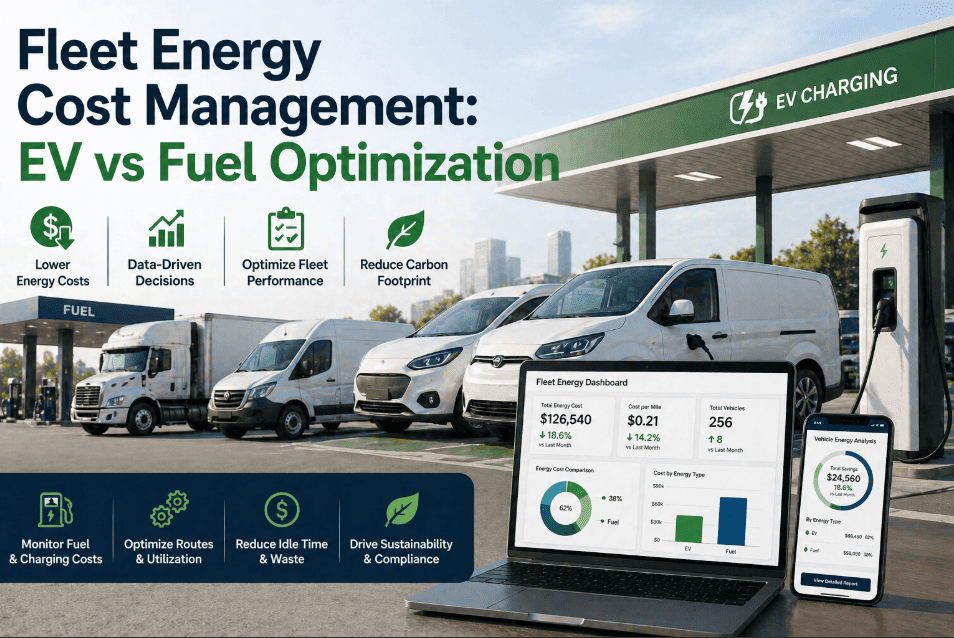
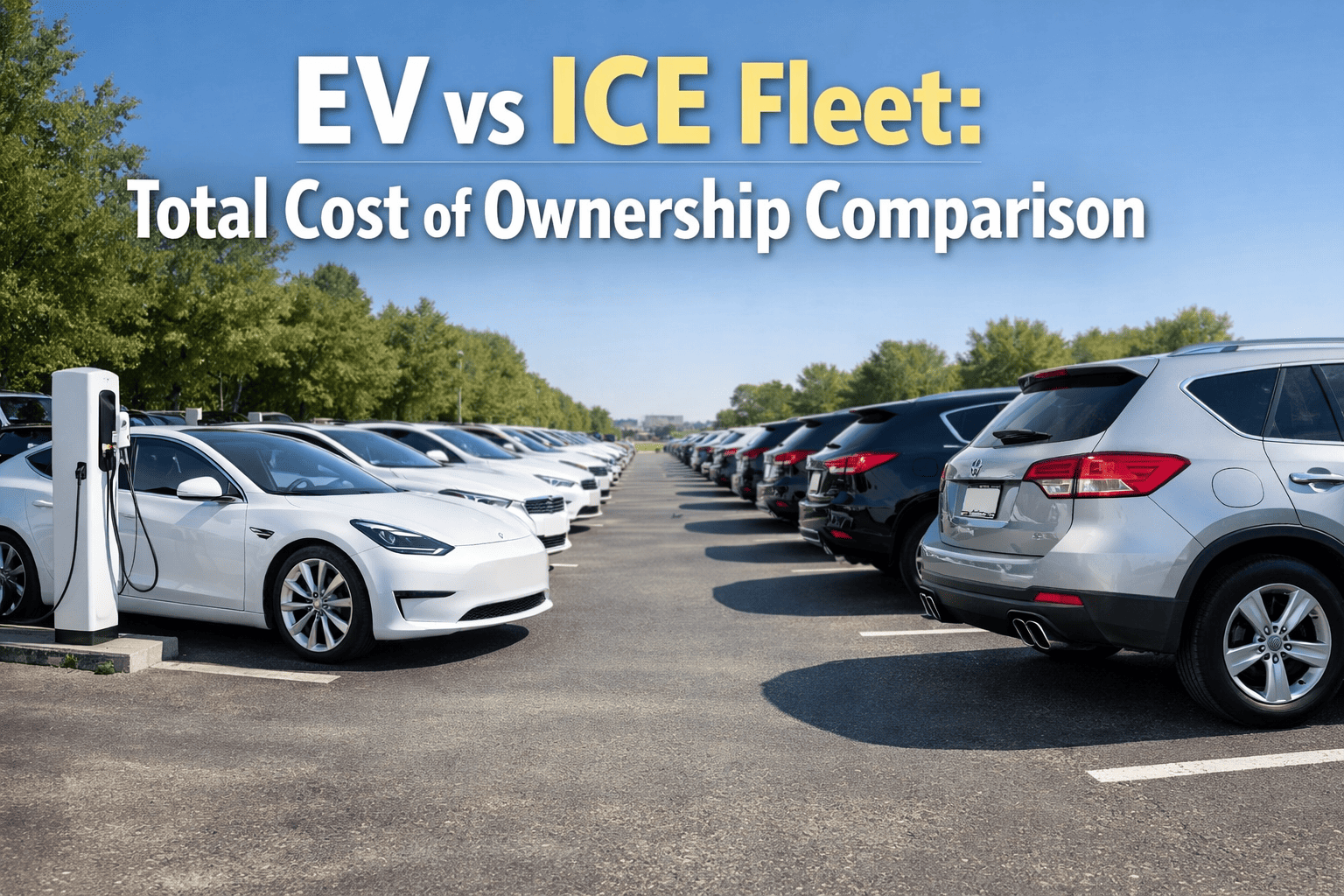
The cost of moving a vehicle one mile used to be a single line item: fuel. Today, fleet operators face a multi-energy reality where diesel sits at $0.15–$0.25 per mile, EV electricity at $0.03–$0.06 per mile depot-charged, public DC fast charging spikes back to $0.09–$0.15 per mile, and demand charges from utility companies can quintuple effective per-mile EV costs without managed scheduling. The fleet that simply replaces diesel trucks with EVs and plugs them in randomly captures only a fraction of the available savings. The fleet that runs an integrated energy management strategy — depot scheduling, off-peak time-of-use rates, public charging cost ceilings, and live cost-per-mile tracking — captures all of it. OxMaint AI brings every energy source into one cost framework so you optimize total energy spend, not individual fuel types in isolation.
Fleet Energy Cost Management · 2026
Stop Optimizing Fuel. Start Optimizing Energy.
Diesel, gasoline, depot charging, public DC fast, off-peak, peak demand — every fleet now juggles multiple energy types with wildly different per-mile costs. OxMaint AI tracks all of them in one platform and routes every vehicle to the cheapest available energy source for each trip.
Cost Per Mile: Energy Source Reality Check
Five Cost Factors Most Fleets Ignore — and OxMaint Tracks Automatically
Energy cost optimization isn't a single decision. It's five overlapping factors that have to be analyzed simultaneously per vehicle, per trip, per day. OxMaint AI does this continuously, in the background, on every vehicle in your fleet.
01
Time-of-Use Electricity Rates
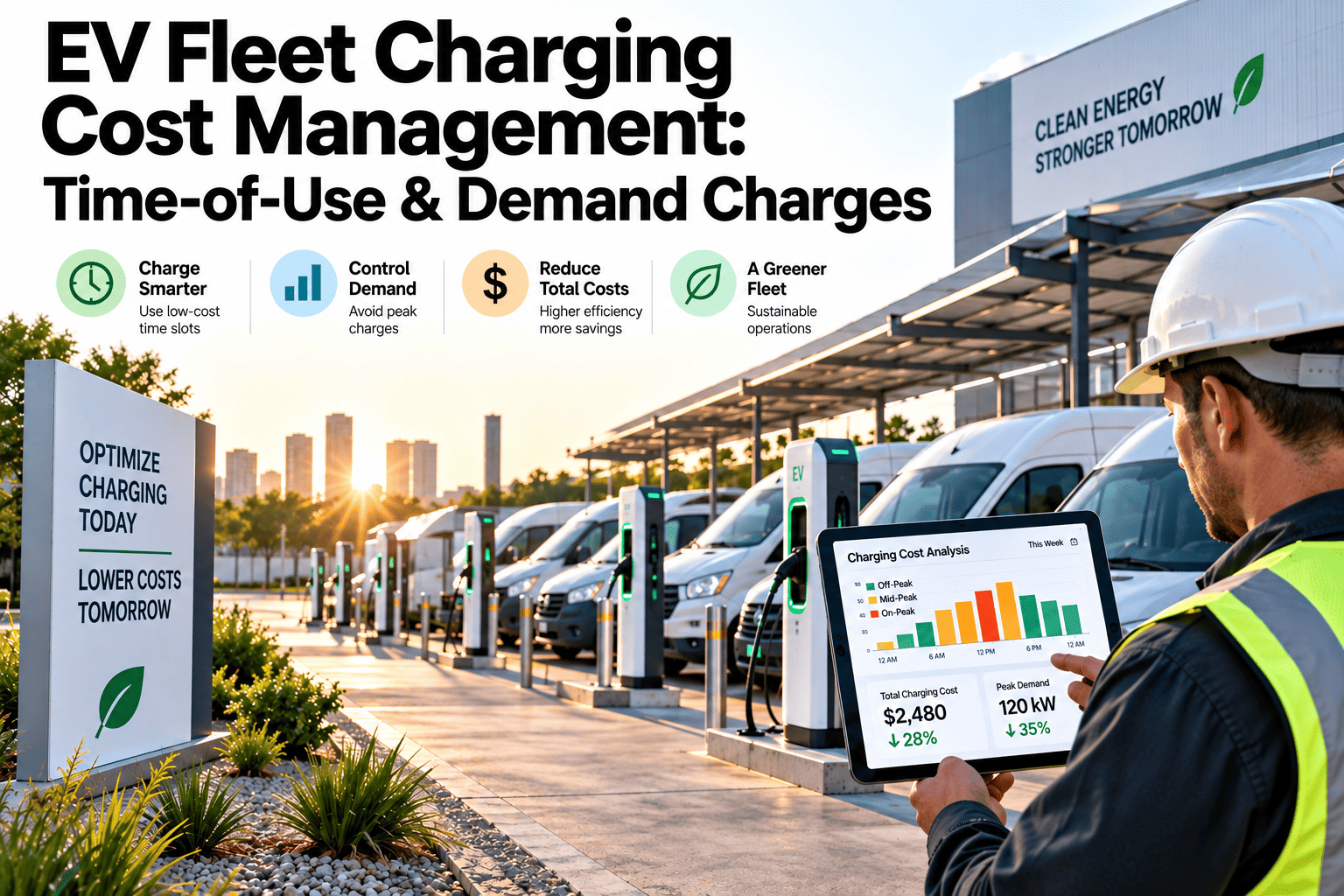
Off-peak charging (typically 11pm–6am) costs 50% less than peak rates in most markets. Without managed charging, EVs draw power whenever plugged in — often during the most expensive utility window.
Impact: Up to 30% energy cost reduction from charging schedule alone.
02
Demand Charges on EV Depots
Commercial utilities bill not just for kWh consumed but for peak demand drawn (kW). Five EVs DC fast charging simultaneously can spike demand charges that exceed energy charges — a hidden cost most fleets discover only after the first quarter's bill.
Impact: Demand charges can represent 30–50% of monthly EV depot bill if unmanaged.
03
Public Charging Network Pricing
DC fast charging away from depot ranges from $0.35–$0.55/kWh — 2 to 3× the cost of depot charging. A vehicle that ends up on public networks for 20% of its mileage can erase most of the EV cost advantage versus diesel.
Impact: 2–3× higher per-mile cost on public charging vs depot.
04
Climate & Range Penalty
Cold weather can reduce EV range by 20–30%. Heat demands battery cooling. Both shift effective cost-per-mile higher and can force unplanned public charging stops if vehicles aren't dispatched with weather-adjusted range buffers.
Impact: Effective cost can rise 15–25% in extreme conditions.
05
Diesel Price Volatility
Diesel prices have varied 30–40% within single calendar years. A fleet running 60% EV / 40% diesel without dynamic dispatch ends up running diesel routes when fuel is expensive and EV routes when electricity is cheap — randomly. OxMaint AI rebalances dispatch to match the cheaper energy source against route requirements.
Impact: 5–12% additional savings from intelligent powertrain dispatch.
Multi-Energy Fleet Management
One Platform. Every Energy Source. Lowest Total Cost.
OxMaint AI compares depot charging, public DC fast, diesel, and gasoline costs in real time — then dispatches each vehicle to its optimal energy strategy automatically.
Energy Source Decision Matrix: When Each Option Wins
No single energy source is right for every route. The matrix below shows when each option delivers the lowest total cost — and why fleet operators need software that decides per trip, not per fleet.
| Route Profile | Best Energy Source | Cost Per Mile | Why |
|---|
| Return-to-base, <200 mi/day | EV depot charging | $0.03–$0.06 | Predictable charging window, off-peak rates available |
| Last-mile delivery, urban | EV depot charging | $0.03–$0.06 | Stop-and-go optimal for regen braking, low daily mileage |
| Regional, 200–400 mi/day | EV with public DC fast | $0.07–$0.10 | Mostly depot, occasional public top-up; still beats diesel |
| Long-haul, 500+ mi/day | Diesel (until charging matures) | $0.18–$0.25 | Range limits and charging time still favor diesel for now |
| Cold climate, >200 mi/day | Diesel or hybrid | $0.15–$0.25 | EV range penalty erases cost advantage |
| Stop-and-go refuse/transit | EV depot charging | $0.03–$0.06 | Regen braking captures massive energy back; lowest TCO use case |
How OxMaint AI Optimizes Energy Cost in Practice
Live Cost Feed
Diesel prices, utility rates, public charging network pricing — all ingested per location.
→
Per-Trip Analysis
For each route: distance, terrain, weather, vehicle availability, charging windows. All factored together.
→
Optimal Dispatch
Vehicle with lowest cost-per-mile for this route gets the assignment. Charging schedule built around it.
→
Continuous Tracking
Actual cost-per-mile recorded against forecast. Models retrain on real data weekly.
Frequently Asked Questions
How much can a mixed fleet realistically save with energy optimization?+
Documented results vary by fleet composition and current maintenance maturity. A fleet that adds managed off-peak charging alone typically captures 25–30% of available EV charging savings. Adding demand charge management and public charging cost ceilings adds another 10–15%. Full energy-aware dispatch — choosing EV vs diesel per route based on live prices — adds 5–12% on top. Combined, fleets running OxMaint's full energy management see 35–50% reduction in total energy spend versus unmanaged operation.
Does OxMaint integrate with utility time-of-use programs?+
Yes — OxMaint pulls utility rate schedules per depot location and aligns charging windows accordingly. For utilities with formal demand-response or EV-specific tariffs, the platform configures schedules to match. When TOU rates change (most utilities update them seasonally), the system adjusts charging schedules automatically without requiring manual reconfiguration.
How does OxMaint handle demand charges?+
OxMaint's depot scheduling staggers vehicle charging to keep peak power draw below configured thresholds. If five vehicles all need to be charged overnight, the system charges three on Level 2 and rotates the fast chargers — keeping peak kW below the demand charge tier. This often saves more money than the energy charge optimization itself for fleets with multiple DC fast chargers.
Can OxMaint compare diesel and EV cost-per-mile in real time?+
Yes — OxMaint maintains live diesel prices per fleet location (via fuel card integration or manual entry) and live electricity rates per depot. Per-mile cost is calculated using current prices, vehicle efficiency from telematics, and route-specific factors (terrain, climate, payload). When a route can be served by either powertrain, the system flags which is cheaper for that specific trip and recommends dispatch accordingly.
OxMaint AI · Fleet Energy Optimization
Every Mile. Every Energy Source. Lowest Total Cost.
Single-energy fleet management is gone. Modern fleets run diesel, gasoline, depot charging, public DC fast, and off-peak rates simultaneously — and the difference between optimized and unoptimized energy spend is six figures per year on mid-sized fleets. OxMaint AI captures it.