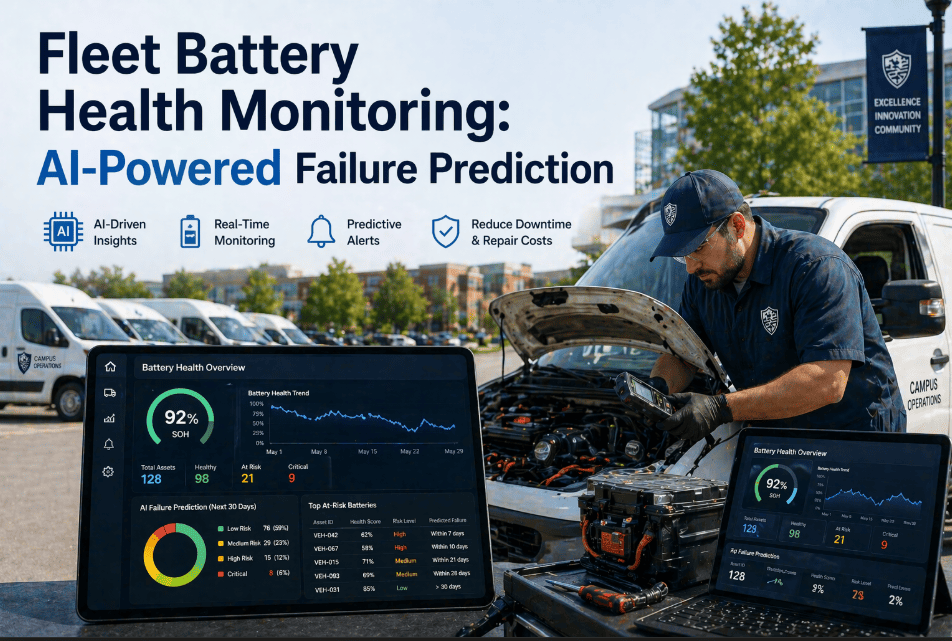
In March 2026, a national cold-chain logistics operator grounded 11 vehicles in a single week — not because of driver neglect or parts shortages, but because their maintenance management system had no mechanism to correlate what was happening inside each vehicle with what the maintenance schedule said should happen next. A refrigeration unit on vehicle 47 had been running 14°F warmer than its historical average for three weeks. A compressor bearing on vehicle 62 had been generating increasing vibration frequency for 19 days. Neither signal triggered a maintenance action because neither signal existed anywhere in their maintenance records — only in the raw telematics data that nobody was processing. AI-powered maintenance management closes this gap permanently. It continuously reads vehicle health signals, compares each vehicle's current condition against its own behavioral baseline, flags developing failures when they are still 2–8 weeks from breakdown, and converts those flags into work orders that are already scheduled, staffed, and parts-checked before the vehicle experiences any symptom. The result is not just fewer breakdowns — it is a maintenance operation that is structurally incapable of being surprised by the failures it could have prevented. Sign up for OxMaint and deploy AI-powered maintenance management across your fleet today.
Fleet Maintenance · Guide · 2026
AI-Powered Maintenance Management: Predictive Insights for Fleet Health
AI maintenance management converts the telematics data your fleet already generates into a continuous fleet health assessment — flagging developing failures weeks before breakdown, generating maintenance actions automatically, and building a vehicle condition record that improves CapEx forecasting, warranty claims, and regulatory compliance simultaneously.
4.8×
Higher cost for emergency repairs vs. the same repairs performed as planned maintenance events
45%
Reduction in unplanned downtime achievable with AI-powered predictive maintenance management programs
2–8 wks
Advance warning window AI maintenance management provides before component failure — converting emergencies to planned events
$233B
Annual maintenance cost savings estimated for Fortune 500 companies with full condition monitoring and predictive maintenance adoption
The 4-Layer Fleet Health Monitoring Architecture
AI-powered maintenance management does not operate as a single system — it is a four-layer intelligence architecture, each layer processing different data and producing different types of fleet health insight. Understanding how these layers work together explains why AI maintenance management delivers results that no combination of human monitoring and time-based schedules can replicate.
Layer 1
Real-Time Condition Data Collection
Telematics, OBD-II diagnostics, IoT sensors, and SCADA integrations continuously stream vehicle condition data into the platform — engine temperature, vibration, oil pressure, battery health, brake performance, and fuel efficiency. Data processed every 60–90 seconds per vehicle. This is the sensor layer — it creates the raw material that all AI analysis requires.
Output: continuous per-vehicle data streams
Layer 2
Baseline Deviation Analysis
ML models compare each vehicle's current readings against its own historical baseline at equivalent load and route conditions — not against a fleet average. A temperature reading 9°F above baseline on vehicle 47 is evaluated as an anomaly for that specific vehicle. This vehicle-specific comparison reduces false positives by 60–70% vs. threshold-based alerting systems that treat all vehicles identically.
Output: per-vehicle anomaly scores and deviation flags
Layer 3
Failure Pattern Recognition
Cross-vehicle ML models identify failure patterns across vehicle models, duty cycles, routes, and operators — recognizing when a combination of signals matches a known failure precursor pattern. When the same pattern appears on multiple vehicles of the same model, the system generates a fleet-wide preventive alert — catching the failure across all similar vehicles before any of them reach breakdown.
Output: fleet-wide pattern alerts and failure probability scores
Layer 4
Automated Maintenance Action
When Layer 3 generates a maintenance flag, Layer 4 closes the execution loop automatically: CMMS creates a prioritized work order, assigns the technician, checks parts inventory, schedules the repair in the next available maintenance window, and updates the vehicle's condition score. No dispatcher. No manual alert triage. No work order created 3 days after the alert was first visible.
Output: executed maintenance workflow with full audit trail
8 Fleet Health Indicators AI Monitors That Manual Programs Miss
These are the specific vehicle health signals that AI maintenance management reads continuously — and that time-based PM schedules, paper inspection logs, and manual work order systems are structurally incapable of tracking per vehicle at fleet scale.
Engine Thermal Profile Trending
Per-vehicle engine temperature tracked against load-normalized historical baseline. A vehicle consistently running 8–12°F above its own thermal profile at equivalent load — not above a generic threshold — is showing early cooling system degradation, combustion inefficiency, or oil viscosity shift. Detection window: 3–5 weeks before fault code generation.
Lead time: 3–5 weeks before failure
Drivetrain Vibration Spectrum
Accelerometer data analyzed for frequency signature changes indicating bearing wear, driveshaft imbalance, and gear mesh degradation. The frequency pattern of a failing bearing changes measurably 4–6 weeks before audible symptoms develop — and weeks before any driver-reported concern or visual inspection could identify the problem.
Lead time: 4–6 weeks before failure
Fuel Efficiency Degradation Index
Route-normalized fuel efficiency tracked per vehicle — isolating mechanical efficiency decline from driver behavior and route variation using ML regression. A 4–6% vehicle-attributable efficiency decline on consistent route profiles indicates injector fouling, valve wear, or turbocharger degradation. The efficiency signal appears 2–4 weeks before maintenance becomes urgent.
Lead time: 2–4 weeks before failure
Brake Performance Ratio
Brake application force compared to deceleration rate per stop, per vehicle — tracking efficiency decline before driver-reported concerns or visual inspection reveals pad thickness. Brake performance decline is the most preventable cause of DOT inspection failures and roadside violations. Detection 2–4 weeks ahead converts a compliance risk to a planned maintenance event.
Lead time: 2–4 weeks before compliance failure
DTC Frequency Escalation
Diagnostic Trouble Code generation rate tracked over time — not just current active codes, but the frequency trend of soft and pending codes. A component generating DTC events at increasing frequency is progressing toward hard failure regardless of current cleared status. Rate-of-change analysis catches the failure trajectory that snapshot fault-code monitoring misses entirely.
Lead time: 1–3 weeks before hard failure
Oil Consumption Rate Acceleration
Per-vehicle oil consumption tracked in quarts-per-mile between service events — flagging rate acceleration from established baseline. Consumption doubling from 0.4 to 0.8+ quarts per 1,000 miles indicates ring seal or valve guide degradation at the early-intervention stage ($400–$800) rather than the engine-damage stage ($5,000–$15,000). Tracking requires only technician log input at service events.
Lead time: 4–8 weeks before engine damage
Battery and Electrical Health
Cranking voltage, alternator output, and battery internal resistance tracked per vehicle — flagging degradation before cold-weather failure events. A battery showing 15–20% internal resistance increase over 30 days will fail within 60–90 days under cold-weather demand. Prediction and proactive replacement cost $150–$200 vs. roadside call-out and emergency battery replacement at $600–$900.
Lead time: 60–90 days before cold-weather failure
EV Battery State of Health
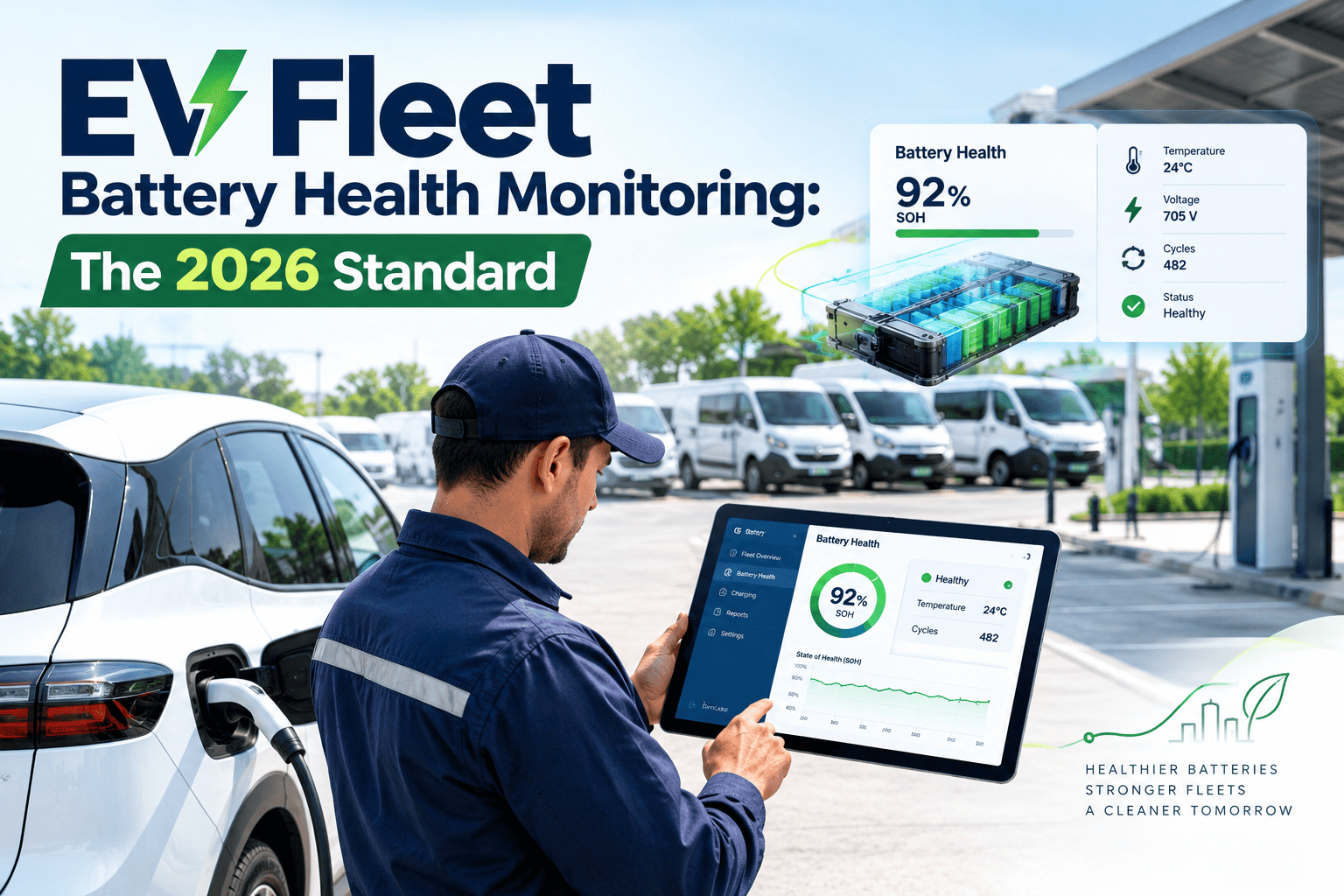
For electric fleet vehicles: battery pack state of health (SoH) tracked from charging cycle efficiency, cell temperature gradient, and capacity fade rate. A battery pack losing SoH at 1.2× the expected degradation rate indicates cell-level thermal management issues or charging pattern damage — detectable months before range degradation becomes operationally disruptive or warranty claim timelines expire.
Lead time: months before operational range impact
6 Maintenance Management Failures AI Eliminates Permanently
These are the structural failures of manual and time-based maintenance management — persistent across fleet types, sizes, and industries because they are baked into the management model itself, not into individual process failures that better training can fix.
01
The Invisible Failure Window
Between scheduled service visits, no vehicle condition data enters the maintenance record. A component can progress from early degradation to imminent failure entirely within this invisible window — and will, 23% of the time. AI monitoring closes this window permanently by reading condition data continuously, not at scheduled visit intervals.
02
Alert Fatigue at Scale
Threshold-based alerting systems that fire on absolute values rather than per-vehicle baseline deviation generate excessive false positives. Maintenance managers who receive 40–60 alerts per day quickly begin discounting them — including the real ones. AI's vehicle-specific baseline comparison reduces false positive rates by 60–70%, making alerts actionable rather than noise.
03
Tribal Knowledge Dependency
Senior technicians carry fleet health knowledge — which vehicles run hot, which transmissions shift rough before failing, which routes cause accelerated wear — in their heads. When they leave, the knowledge leaves. AI captures this pattern intelligence from data, codifies it in ML models, and makes it available to every technician across every location permanently.
04
Repeat Failures on the Same Platform
Without fleet-wide ML pattern recognition, the fourth failure of the same component on the same vehicle model looks like coincidence. AI identifies the pattern at failure two, generates a fleet-wide preventive alert at the right mileage threshold for all vehicles of that model, and prevents failures three through twenty. Pattern prevention is consistently the highest single ROI event in AI maintenance deployments.
05
CapEx Decisions Without Condition Data
Fleet replacement decisions made from mileage thresholds retire vehicles too early when condition is excellent and keep vehicles too long when multiple systems are degrading simultaneously. AI condition scoring per component — the cumulative health record built from every maintenance event and sensor reading — converts replacement decisions from mileage-guesses to engineering-data analysis.
06
Documentation That Fails at Audit
Warranty claims denied for insufficient maintenance documentation. DOT violations for incomplete inspection records. Insurance claims challenged for absence of systematic maintenance records. Paper-based systems generate these outcomes regularly because documentation requires a separate manual effort. AI-powered CMMS generates complete, timestamped, technician-attributed documentation as a byproduct of daily operations.
How OxMaint's AI Maintenance Management Delivers Fleet Health Intelligence
OxMaint connects telematics data, vehicle condition signals, maintenance history, and parts availability into a unified AI maintenance management platform — and automates the complete response cycle from health signal to executed maintenance action.
Hardware-Agnostic Telematics Integration
OxMaint connects to any telematics provider through open APIs — Samsara, Geotab, Verizon Connect, Motive, or OEM systems — with no proprietary hardware requirement. Vehicle health data begins flowing into OxMaint's AI models immediately. Per-vehicle baseline profiles build over the first 60–90 days, reaching 85–90% prediction accuracy as fleet-specific behavioral patterns accumulate in the models.
Per-Vehicle Condition Scoring
Every vehicle in OxMaint has a live condition score — updated continuously from telematics, updated with each work order completion, and updated with each inspection event. The score aggregates health signals across all monitored systems into a single fleet-health-at-a-glance metric visible on the maintenance dashboard. Dispatchers see condition scores alongside availability — routing high-priority loads to high-health vehicles automatically.
Automated Work Order Generation
AI health flags generate prioritized work orders in OxMaint automatically — vehicle ID, flagged system, confidence score, estimated time to failure, and recommended action included in the work order at creation. Parts inventory is checked, the technician is assigned, and the repair is scheduled in the next maintenance window. 70% of AI maintenance projects fail because this automation loop is not built. OxMaint builds it from the foundation.
Preventive + Predictive in a Unified Schedule
OxMaint runs time-based PM schedules and AI condition monitoring simultaneously in the same platform — with the condition monitoring layer adding maintenance actions when health signals indicate need, and suppressing PM actions when condition data shows the component is still healthy. The result is a maintenance schedule that is both systematically complete and dynamically responsive to actual vehicle condition.
Fleet-Wide Pattern Intelligence
OxMaint's cross-vehicle ML identifies failure patterns across vehicle models and duty cycles — generating fleet-wide preventive alerts when the same degradation signature appears on multiple similar vehicles. This intelligence compounds with every additional mile of fleet data processed: the more vehicles OxMaint monitors and the longer it monitors them, the earlier it detects emerging failure patterns.
Condition-Based CapEx Forecasting
AI condition scores — the accumulated health record per vehicle built from every sensor reading and maintenance event — feed OxMaint's rolling 5–10 year CapEx models. Fleet managers see replacement priority ranked by actual component health, not odometer readings. The vehicle with failing systems at 90,000 miles ranks above the vehicle in excellent condition at 130,000 miles — because condition data tells the truth that mileage alone cannot.
Build a Maintenance Management System That Cannot Be Surprised by Preventable Failures
OxMaint's AI maintenance management connects your fleet telematics to a 4-layer health monitoring architecture — continuous condition data, vehicle-specific baseline analysis, fleet-wide pattern recognition, and automated maintenance execution. Free to start. No hardware required. Results in 60–90 days.
Time-Based Maintenance Management vs. AI-Powered Fleet Health Management
60%
Fewer emergency repairs in fleets with AI maintenance management vs. time-based PM
Each prevented emergency repair saves 4.8× the planned repair cost — documented across fleet deployments in logistics, construction, and field service
93–97%
Fleet uptime achievable with AI health monitoring vs. 82–88% for time-based PM
Each percentage point of uptime represents operational revenue from vehicles on the road rather than in the shop — compounding at fleet scale
$1.8M
Annual savings documented — 250-vehicle fleet with AI predictive maintenance
30% maintenance cost reduction + 45% downtime decrease from connecting telematics to OxMaint's AI maintenance layer
11 mo
Average ROI payback period — down from 18 months in 2022 as platforms mature
Cloud deployment, faster implementation, and improved AI accuracy have compressed payback timelines by 39% since 2022
Frequently Asked Questions
What specifically does "AI-powered maintenance management" add to a standard CMMS platform?
A standard CMMS is a records and scheduling system — it stores work orders, PM schedules, parts inventory, and maintenance history, and it notifies when scheduled maintenance is due. This is valuable, but it is a reactive and time-triggered system that has no visibility into what is actually happening inside each vehicle between scheduled visits. AI-powered maintenance management adds four capabilities that a standard CMMS cannot provide: continuous condition monitoring (reading telematics and sensor data in real time rather than at scheduled intervals), vehicle-specific baseline deviation analysis (comparing each vehicle to its own historical behavior rather than generic thresholds), fleet-wide failure pattern recognition (identifying cross-vehicle failure precursor patterns before they generate individual breakdowns), and automated maintenance generation (converting AI health flags directly into work orders without dispatcher or analyst intervention). The practical result is that AI maintenance management is aware of developing failures 2–8 weeks before they generate any symptom or fault code — and converts that advance awareness into planned maintenance actions at planned repair cost rather than emergency events at 4.8× planned cost. OxMaint integrates both the standard CMMS layer and the AI intelligence layer in one platform — so the PM scheduling, work order management, and parts inventory exist in the same system as the AI health monitoring.
Sign up free to see the combined platform in operation.
How does OxMaint's AI distinguish between a genuine developing failure and sensor noise — and how does it avoid false positive alert fatigue?
False positive alert fatigue is the most common reason AI maintenance projects fail to scale beyond pilot programs — and OxMaint's AI architecture addresses it through vehicle-specific baseline comparison rather than fleet-wide thresholds. Most threshold-based systems fire an alert whenever a sensor reading crosses an absolute value — which generates excessive alerts because every vehicle operates differently. OxMaint's ML models instead evaluate each reading against that specific vehicle's historical behavior at equivalent load and route conditions. A temperature reading that would trigger a threshold alert on a vehicle running cool actually represents normal operating temperature for a high-duty-cycle truck that always runs warm. The result is a 60–70% reduction in false positive alert rate vs. threshold-based systems. Additionally, OxMaint's AI requires pattern persistence before generating a maintenance work order — a single anomalous reading triggers a monitoring flag, but a consistent trend over 3–7 days triggers the work order. This persistence requirement further reduces false positives while still providing the 2–8 week advance warning that makes the system valuable. Fleet managers and technicians receive alerts that are consistently actionable — which builds trust in the AI system rather than the alarm fatigue that causes teams to disable alerts.
Book a demo to see the alert accuracy performance data for fleets similar to yours.
How does AI maintenance management preserve fleet health knowledge when experienced technicians retire or leave?
Tribal knowledge loss is one of the most expensive and least tracked maintenance management risks in commercial fleet operations. Senior technicians carry years of fleet-specific knowledge — which vehicle models develop cooling issues on mountain routes, which transmissions show rough shifting 8,000 miles before failure, which electrical systems are sensitive to humidity — and this knowledge disappears when they retire or leave. OxMaint's AI captures and codifies this knowledge automatically from data, without requiring technicians to document it explicitly. Every maintenance event, every sensor reading, and every work order outcome becomes training data for the fleet-specific ML models. When a senior technician's tacit knowledge about a vehicle model's failure pattern is validated by 50 consistent maintenance events over 2 years, that knowledge is permanently encoded in the ML model — available to every technician, at every location, on every shift, indefinitely. New technicians operating in OxMaint receive the same quality of predictive insight as a 15-year veteran looking at the same vehicle — because the AI carries the institutional memory that no individual can retain or transfer. For fleets facing the 80,000+ driver shortage and accelerating technician retirement challenges of 2026, this knowledge codification capability has strategic importance beyond maintenance cost reduction.
Sign up free to start building your fleet's institutional maintenance intelligence.
How does OxMaint connect AI maintenance management to CapEx planning and fleet replacement decisions?
The connection between AI maintenance management and CapEx planning is the per-vehicle condition score — the cumulative health record that OxMaint builds from every sensor reading, maintenance event, and work order outcome across the vehicle's service life in the platform. This condition score tells a fundamentally different story than the odometer reading: a 110,000-mile vehicle with consistently healthy condition scores and a single major repair event has a very different remaining useful life than a 90,000-mile vehicle showing simultaneous degradation in cooling, drivetrain, and electrical systems across 18 months of AI monitoring. OxMaint's CapEx forecasting models use condition scores to rank replacement priority across the fleet — surfacing the vehicles approaching economic end-of-life based on actual component health, not mileage thresholds. The models also project the timing and expected cost of upcoming major maintenance events for each vehicle — allowing fleet managers to sequence replacements around maintenance cost trajectories rather than reacting to failure events. For portfolio managers and investors who need to evaluate fleet condition across multiple sites or subsidiaries, OxMaint generates portfolio-level condition reports that aggregate per-vehicle health data into the asset condition summary that supports CapEx investment justification.
Book a demo to see OxMaint's CapEx forecasting configured for your fleet's age and condition profile.
Your Fleet's Health Data Already Exists. OxMaint's AI Reads It, Acts On It, and Records It.
OxMaint's 4-layer AI maintenance management architecture — continuous condition monitoring, vehicle-specific baseline analysis, fleet-wide pattern intelligence, and automated maintenance execution — converts the telematics data your fleet already generates into a structurally preventive maintenance operation. Free to start. No hardware required. First prevented failure pays for the system. Join 1,000+ organizations running AI-powered fleet health management with OxMaint.