Fleet management is undergoing its most significant transformation in decades. Artificial intelligence and machine learning are no longer futuristic concepts being tested in pilot programs — they are operational infrastructure reshaping how fleets make decisions every single day. In Penske's 2025 Transportation Leaders Survey, 70% of respondents reported already adopting at least some AI solutions, up from 53% just one year earlier. Even more telling, 93% agreed that AI will improve organizational resiliency and agility for future growth. The shift is clear: AI in fleet operations has moved from experimental dashboards to real-time decisioning systems that predict failures, optimize routes, coach drivers, and automate the repetitive cognitive work that burns out your best people. The fleets that treated 2024 and 2025 as experimentation years now have 18 to 24 months of operational data proving what works — and the results are staggering: up to 89% reduction in accidents, 40% cuts in maintenance costs, and decision speeds compressed from hours to seconds. If your fleet has not yet harnessed AI-powered decision-making, sign up for OxMaint and discover what intelligent fleet management looks like in practice.
The AI Adoption Accelerator
The acceleration is not just about adoption numbers — it is about what AI enables. In 2026, artificial intelligence in fleet management is moving beyond reporting what happened last week to recommending what to do next. AI-driven exception management flags the specific vehicles, routes, or drivers that need attention instead of drowning managers in alerts. Predictive analytics delivers earlier signals of breakdown risk, high-risk driving patterns, or unusual fuel consumption. And generative AI copilots now allow fleet managers to ask natural-language questions like "Why did overtime spike last Tuesday?" and receive instant, data-backed answers. The fleets that invest in this capability now will compound their advantages every quarter.
How Machine Learning Actually Works in Fleet Operations
Machine learning is not magic — it is pattern recognition at a scale and speed that human analysts cannot match. Understanding how ML works in a fleet context demystifies the technology and reveals where the real value lies. Here is the process, from raw data to intelligent action.
Every fleet vehicle is a data generator. Telematics devices, GPS trackers, onboard diagnostics, fuel cards, and IoT sensors continuously stream information — engine temperature, tire pressure, fuel burn rates, braking patterns, idle time, location, speed, and hundreds of additional CAN bus data points. Machine learning begins by ingesting this raw data from across every vehicle and every trip in your fleet. The more data points collected, the more accurate predictions become.
ML algorithms analyze historical and real-time data to identify patterns invisible to human observation. A slow rise in exhaust temperature combined with declining fuel efficiency across similar routes can indicate injector or turbo stress weeks before a diagnostic alarm sounds. Patterns emerge not from a single data point but from the relationship between hundreds of variables interacting over time — something only machine learning can process at fleet scale.
Once patterns are detected, ML builds predictive models that forecast future outcomes: which component will fail, when it will fail, and how confident the prediction is. In 2026, these models have advanced from generic anomaly detection to specific component-level predictions — moving fleet managers from "something might be wrong" to "replace the alternator by Thursday." The models continuously refine themselves as new data flows in, improving accuracy over time.
The most advanced AI fleet systems do not just alert — they act. When a predictive model identifies a high-confidence failure risk, the system can automatically generate a work order, pre-order the necessary part, schedule the technician, and notify the operations team of the upcoming planned downtime window. This closed-loop workflow compresses the gap between detection and action from days to minutes. Book a demo to see how OxMaint turns ML predictions into automated maintenance workflows.
Five Domains Where AI Transforms Fleet Decisions
AI and machine learning do not improve fleet operations in one dimension — they reshape decision-making across every major operational domain simultaneously. Here are the five areas where the impact is most measurable and most immediate.
Predictive Maintenance
AI-powered predictive maintenance detects mechanical issues before they escalate into costly failures. Systems analyze sensor data to identify degradation patterns weeks before fault codes appear. Fleets using AI maintenance report 52% direct reductions in vehicle downtime and maintenance budget cuts of 25% to 40%. This is the single highest-ROI application of AI in fleet operations today — and the one with the most proven track record.
Dynamic Route Optimization
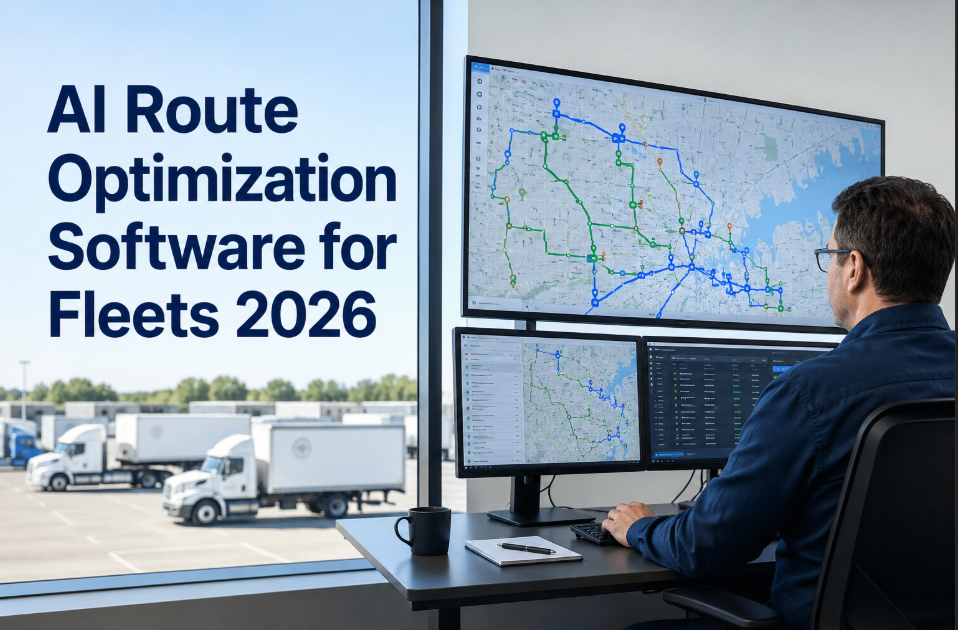
ML-powered routing goes far beyond shortest-distance calculations. Algorithms process real-time traffic, weather conditions, historical congestion patterns, delivery windows, and vehicle load capacity to determine the most fuel-efficient and time-efficient path for every trip. If a highway shuts down unexpectedly, AI systems automatically reroute vehicles to the safest alternative. Smarter routing reduces fuel consumption by 10% to 15% while improving on-time delivery performance.
Driver Safety and Behavior
AI-powered video telematics and behavior analytics detect risky driving patterns with remarkable precision — 98.5% accuracy in close-following detection and 99% accuracy in cellphone usage detection. These systems provide real-time coaching to drivers, enabling immediate behavioral correction rather than after-the-fact discipline. Fleets using AI safety tools report up to 89% reduction in accidents, with corresponding drops in insurance premiums, liability exposure, and workers' compensation claims. Sign up for OxMaint to start building a data-driven safety culture.
Fuel and Energy Management
Machine learning correlates fuel consumption data with driver behavior, route characteristics, vehicle condition, and environmental factors to pinpoint exactly where fuel dollars are being wasted. AI identifies which vehicles have abnormal fuel usage, which drivers need efficiency coaching, and which routes consistently burn disproportionate fuel. This granular visibility enables targeted interventions that deliver measurable savings rather than generic fleet-wide mandates.
Fleet Lifecycle Intelligence
AI transforms asset lifecycle management by predicting total cost of ownership trajectories, forecasting optimal replacement timing, and identifying when a vehicle crosses from profitable asset to money pit. ML models analyze depreciation curves, maintenance cost trends, utilization rates, and residual value projections to recommend data-driven acquisition and disposal decisions — replacing gut feeling with financial precision.
Intelligence That Works While You Sleep
OxMaint's AI-powered platform monitors your fleet around the clock — predicting failures, automating work orders, and turning raw data into decisions that protect your bottom line.
The Before and After of AI Fleet Operations
The practical difference between AI-powered fleet operations and traditional management is not incremental improvement — it is a fundamentally different operating model. Here is what that transformation looks like across daily fleet activities.
The pattern is consistent: AI compresses decision timelines, eliminates guesswork, and moves every fleet function from reactive to proactive. Fleets that adopt this model do not just save money — they fundamentally change the speed and quality of every operational decision. And with 65% of maintenance teams planning to use AI by the end of 2026, the window of competitive advantage is closing fast. Book a demo to see the transformation firsthand.
How OxMaint Brings AI to Your Fleet
OxMaint is an AI-powered CMMS designed to make machine learning accessible, practical, and immediately valuable for fleet operations of any size. You do not need a data science team or massive IT infrastructure — OxMaint packages AI-driven fleet intelligence into an intuitive platform that works from day one.
AI-Powered Fleet Management Starts Here
Join 1,000+ organizations using OxMaint to predict failures, automate maintenance, and make smarter decisions with machine learning — no data science degree required.
Frequently Asked Questions
How is AI used in fleet management
AI analyzes real-time data from vehicle sensors, GPS, and telematics to predict maintenance needs, optimize routes, monitor driver behavior, manage fuel consumption, and automate compliance reporting. It transforms raw fleet data into actionable decisions — replacing manual analysis with instant, data-backed intelligence.
What results can fleets expect from AI adoption
Industry data shows fleets using AI report up to 89% reduction in accidents, 25-40% lower maintenance budgets, 10-15% fuel savings from route optimization, and 45% reduction in unplanned downtime. Most fleets see measurable ROI within 3 to 12 months of implementation.
Do I need a data science team to use AI fleet tools
No. Modern AI fleet platforms like OxMaint are designed for fleet managers, not data scientists. The AI works behind the scenes — analyzing data, detecting patterns, and delivering insights through intuitive dashboards and automated alerts that anyone can act on.
How does machine learning improve maintenance decisions
ML analyzes sensor data patterns — vibration, temperature, pressure, fuel burn — to predict which specific component will fail and when. This shifts maintenance from fixed schedules to condition-based triggers, eliminating both unnecessary early replacements and costly unexpected breakdowns.
Is AI fleet management suitable for small fleets
Yes. Small and mid-sized fleets often see proportionally greater impact because every vehicle represents a larger share of total capacity. OxMaint's cloud-based, mobile-first platform scales to any fleet size with no dedicated IT infrastructure required.
What is the difference between AI reporting and AI decisioning
AI reporting tells you what happened — summarizing historical data into dashboards. AI decisioning tells you what to do next — predicting outcomes, recommending actions, and automating workflows. In 2026, leading fleets are moving from reporting to decisioning, where AI becomes an operational partner rather than just an analytics tool.