Selecting fleet management software without a structured RFP process is how organizations end up locked into platforms that cannot scale, integrate poorly with existing systems, and cost 2.3x more over five years than properly evaluated alternatives. In 2026, the fleet software market has over 140 vendors — and 61% of fleet managers who skipped a formal RFP process reported dissatisfaction with their platform within 18 months. A well-constructed Request for Proposal forces vendors to compete on your operational requirements, not their marketing claims. This template and evaluation guide gives you every section, scoring criterion, and negotiation lever you need to run a procurement process that delivers the right platform for your fleet. Organizations using structured RFP processes with platforms like OxMaint report 40% faster vendor selection cycles and 92% post-implementation satisfaction rates.
Fleet Management Software RFP Template and Vendor Selection Framework
A complete, ready-to-use RFP template with functional requirements, integration checklists, vendor scoring matrices, and contract negotiation strategies — built from real fleet procurement cycles across North America, Europe, and APAC.
What Is a Fleet Management Software RFP?
A fleet management software RFP is a formal procurement document that outlines your operational requirements, integration needs, compliance mandates, and evaluation criteria — then invites qualified vendors to respond with detailed proposals on how their platform meets each requirement.
Forces every vendor to answer the same questions in the same format, eliminating apples-to-oranges comparisons. 78% of procurement teams cite this as the primary RFP benefit.
Covers functional modules, technical architecture, security compliance, pricing models, implementation timelines, and contractual terms across your entire fleet operation.
Aligns fleet ops, IT, finance, and executive stakeholders around a single set of weighted requirements before vendor demos begin — preventing political selection later.
Produces a quantitative vendor score that can be defended to leadership and audited post-selection. Organizations using scored RFPs report 92% implementation satisfaction.
Essential RFP Sections — Your Template Framework
Every fleet management software RFP should contain these eight core sections. Missing even one creates blind spots that vendors will exploit during negotiations.
Fleet size, vehicle types, geographic coverage, number of drivers, current software stack, and annual maintenance spend. This context lets vendors tailor their response to your scale.
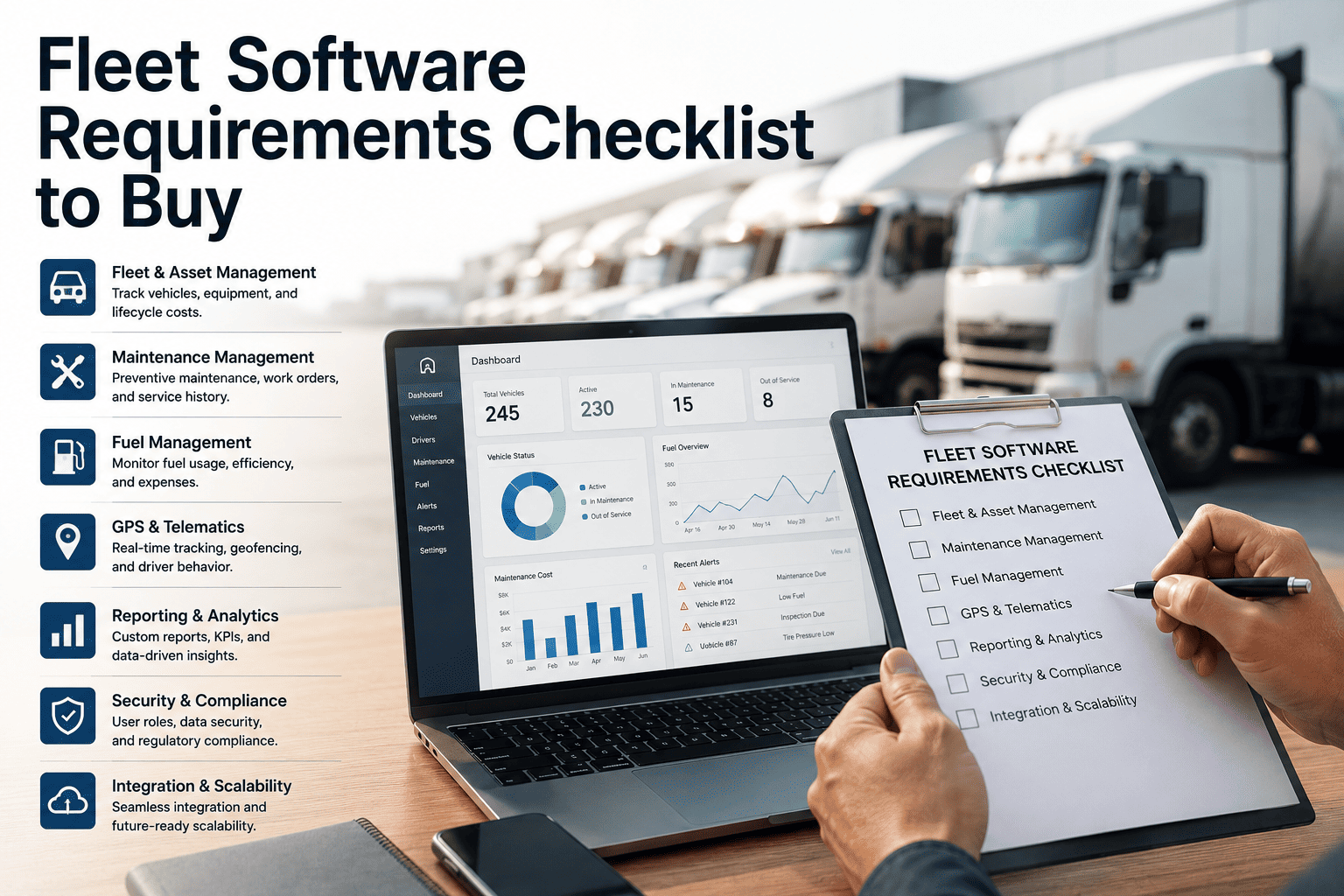
List every feature requirement with priority weight (Must-Have, Important, Nice-to-Have). Cover asset tracking, maintenance scheduling, fuel management, driver safety, and compliance reporting.
Required integrations with ERP, telematics, fuel cards, HR systems, and accounting platforms. Specify API requirements, data formats, and real-time sync expectations.
SOC 2 Type II, GDPR, data residency requirements, encryption standards, and role-based access controls. 43% of RFPs fail to adequately address data security — resulting in costly remediation.
Request a phased implementation timeline with milestones, resource requirements from your team, data migration approach, and training methodology. Average fleet software implementation takes 8-14 weeks.
Request itemized pricing across license fees, implementation, training, integrations, support tiers, and annual escalation caps. Hidden costs account for 35% of total 5-year spend in poorly structured deals.
Company history, financial stability, customer count in your industry, case studies with measurable ROI, and three reference contacts from comparable fleet operations.
Uptime guarantees (target 99.9%+), support response times, data export rights, termination clauses, and price lock periods. These terms determine your leverage for the entire contract lifecycle.
Vendor Scoring Matrix — How to Evaluate Responses
A weighted scoring matrix transforms subjective vendor impressions into defensible, quantitative comparisons. This framework allocates evaluation weight based on operational impact — not vendor presentation polish. Teams using weighted scoring select vendors that deliver 3.1x higher ROI than those choosing based on demo impressions alone.
| Evaluation Category | Weight | Scoring Criteria | Max Points |
|---|---|---|---|
| Functional Fit | 30% | Coverage of must-have features, workflow alignment, mobile capability | 300 |
| Integration Capability | 20% | API maturity, pre-built connectors, real-time sync support | 200 |
| Total Cost of Ownership | 20% | 5-year TCO, pricing transparency, escalation caps | 200 |
| Implementation Approach | 10% | Timeline, migration methodology, training plan quality | 100 |
| Vendor Stability | 10% | Financial health, customer retention, product roadmap | 100 |
| Support and SLA | 10% | Response times, uptime guarantees, escalation paths | 100 |
Need a fleet management platform that scores high across every evaluation category? See how OxMaint's unified CMMS and asset management platform handles preventive maintenance, work orders, and multi-site portfolio reporting — start a free trial or book a demo to walk through a live evaluation.
Common RFP Mistakes That Cost Fleet Operations
Even experienced procurement teams make errors that undermine the entire vendor selection process. These six mistakes are the most expensive — and the most preventable.
When you define requirements after vendor demos, you unconsciously anchor to features you have seen rather than problems you need solved. 54% of organizations that demo before RFP select the first vendor presented.
License fees represent only 40-55% of 5-year cost. Implementation, integrations, training, support tier upgrades, and annual escalations are where budget overruns hide. Always demand itemized 5-year TCO.
67% of fleet software implementation delays stem from integration failures that were not tested during evaluation. Require a proof-of-concept integration with your telematics or ERP system before signing.
When only fleet ops evaluates vendors, IT discovers security gaps post-contract and finance discovers hidden costs at renewal. Include IT, finance, compliance, and end-users in scored evaluation.
23% of fleet managers report difficulty extracting their data when switching vendors. Your contract must specify data export format, extraction timeline, and cost — before you sign, not after.
Vendor-provided case studies are marketing materials. Require three customer references from fleets of comparable size and complexity — and actually call them. Ask about implementation pain points and support responsiveness.
Before vs After: Structured RFP Impact on Fleet Software Selection
The difference between ad-hoc vendor evaluation and a structured RFP process is measurable across every dimension of the procurement cycle and post-implementation outcome.
Contract Negotiation Levers — What to Push For
Once you have selected your top vendor, these negotiation points protect your investment and ensure long-term value. Fleet managers who negotiate these terms save an average of 18% on 5-year contracts.
Without a cap, vendors can increase pricing 8-15% annually at renewal. Lock in maximum annual escalation at contract signing — the industry standard is 3-5%.
Uptime guarantees without financial penalties are marketing promises. Require service credits for any month below 99.9% availability — calculated as percentage of monthly fee.
Your fleet data belongs to you. Contract must specify that all data is exportable in standard formats (CSV, API) at any time during or after the contract, at no additional charge.
Multi-year contracts should include a termination-for-convenience clause with 90-day notice. This protects you if the vendor is acquired, pivots their product, or degrades support quality.
Ready to evaluate a fleet management platform that offers transparent pricing, no hidden implementation fees, and full data export rights from day one? See how OxMaint compares — start a free trial or book a demo to see the platform in action.
Frequently Asked Questions
How many vendors should we invite to respond to our fleet software RFP?
What is the typical timeline for a fleet management software RFP process?
Should we require a proof-of-concept before signing a contract?
How do we handle vendors who want to bypass the RFP and go straight to demo?
Run Your Fleet Software RFP With Confidence
OxMaint welcomes structured RFP evaluation because our platform scores on operational capability — not sales polish. Transparent pricing, no hidden implementation fees, full API documentation, and customer references from multi-site fleet operations across six countries. See why fleet managers who evaluate thoroughly choose OxMaint.