Fleet transmission failures account for some of the highest unplanned repair costs in commercial operations — yet most failures are preventable with a structured maintenance schedule. Whether your fleet runs automatic transmissions, manual gearboxes, or automated manual transmissions (AMT), a consistent service checklist covering fluid condition, filter replacement, clutch wear, shift quality, and torque converter health keeps vehicles on the road and repair bills predictable. Sign Up Free to track transmission service intervals automatically across every vehicle in your fleet — no spreadsheets, no missed service windows.
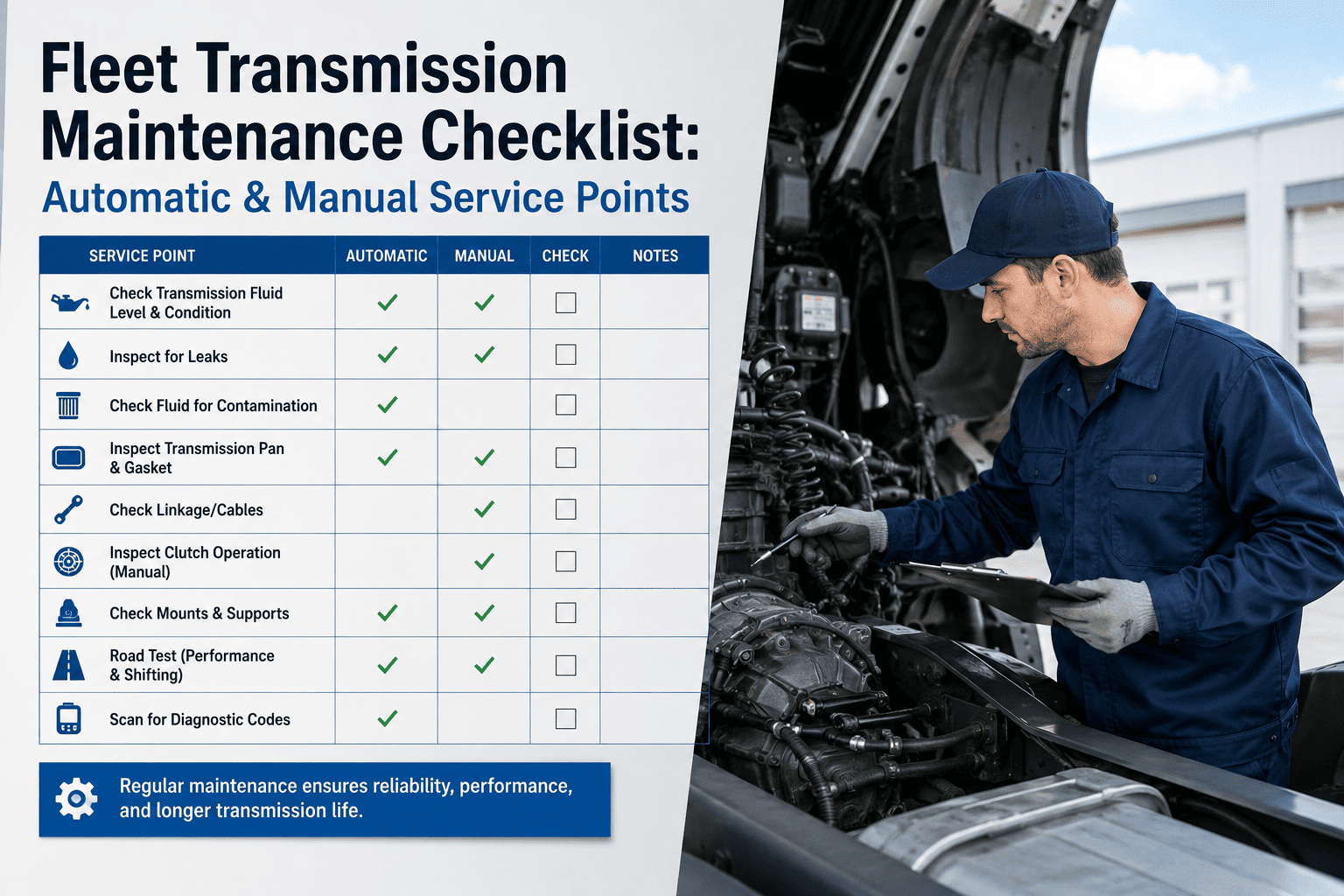
1. Automatic Transmission Service Checklist
Automatic transmissions in commercial fleets operate under sustained load cycles that degrade fluid faster than OEM general-use intervals suggest. Checking fluid condition — not just level — at every PM service catches heat-degraded fluid before it causes valve body wear or solenoid contamination. Sign Up Free to set automatic PM triggers by mileage or engine hours in Oxmaint.
Transmission fluid level and condition check
Check fluid level with engine warm and at operating temperature. Inspect fluid color and smell on the dipstick — dark brown or burnt smell indicates oxidation requiring immediate fluid change regardless of mileage interval. Critical — burnt fluid = imminent damage
ATF fluid change — interval by duty cycle
Replace automatic transmission fluid at 30,000 miles for severe duty (frequent stops, towing, high ambient heat) or 60,000 miles for standard fleet cycles. Always verify OEM-specified fluid grade — mixing ATF types contaminates the hydraulic circuit and voids warranty coverage. Deficiency — wrong fluid grade used
Transmission filter replacement
Replace the internal filter on the same interval as the fluid change. A clogged filter restricts hydraulic pressure to shift solenoids, producing delayed engagement and erratic shift timing before causing complete solenoid failure. Audit failure — filter skipped at fluid service
Pan gasket and drain plug inspection
Inspect transmission pan gasket for seepage and drain plug for cross-threading at every fluid service. A weeping pan gasket loses fluid slowly between services, creating low-fluid damage that is attributed to the wrong root cause during diagnosis. Deficiency — undetected seep causes low-fluid damage
Shift quality road test — all gear positions
Perform a brief loaded road test after every transmission service. Confirm smooth engagement in each forward gear and reverse, no slipping under load acceleration, and no harsh or delayed downshifts. Any abnormality post-service requires workshop diagnosis before return to duty. Violation — vehicle returned without shift verification
Transmission cooler and cooler lines inspection
Inspect transmission cooler for fin blockage and cooler lines for chafing, corrosion, or fitting seepage at every PM. A blocked transmission cooler raises fluid operating temperature by 20–40°F — directly accelerating fluid degradation and friction material wear. Deficiency — cooler blockage undetected
2. Manual Transmission Fleet Maintenance Checklist
Manual transmissions in fleet vehicles are often under-serviced because they lack the fluid colour indicators and electronic monitoring of automatics. Gear oil contamination, synchroniser wear, and clutch adjustment are the three issues that transition a routine service into a gearbox replacement if intervals are missed. Book a Demo to see how Oxmaint tracks manual transmission service windows per vehicle across mixed fleet types.
Gear oil level check and top-up
Check manual gearbox oil level via fill plug with vehicle on level ground. Oil should reach the bottom of the fill hole. Low level in a manual box indicates a leak at input or output shaft seal — locate and seal before refilling. Critical — low gear oil = bearing failure
Gear oil change — 60,000 mile interval
Drain and replace manual gearbox oil at 60,000 miles or as OEM specified for the vehicle application. Inspect drained oil for metal particles — shiny fine particles indicate normal wear; chunky or magnetic debris indicates bearing or gear damage requiring teardown. Deficiency — metal debris in drain oil ignored
Clutch pedal free play and adjustment
Measure clutch pedal free play at every PM — typically 1–2 inches for hydraulic systems, adjustable via hydraulic master cylinder or cable adjuster. Pedal free play outside specification causes clutch drag or slipping, accelerating friction disc wear and flywheel damage. Deficiency — out-of-spec free play not adjusted
Clutch hydraulic fluid level and condition
Check clutch master cylinder fluid at every PM for vehicles with hydraulic clutch actuation. Fluid below minimum indicates internal or external leak. Dark or contaminated clutch fluid absorbs moisture over time, lowering boiling point and causing spongy pedal feel under sustained use. Deficiency — contaminated hydraulic fluid
Shift linkage and selector rod inspection
Inspect external shift linkage, selector rods, and pivot bushings for wear, looseness, or binding. Worn linkage bushing creates vague or notchy gear selection that drivers often adapt to — masking a progressive fault that eventually prevents complete gear engagement. Deficiency — worn linkage not flagged by driver
Input and output shaft seal inspection
Inspect both shaft seals for oil weeping at every gearbox service. A leaking input shaft seal contaminates the clutch friction disc with gear oil — destroying clutch performance within weeks. External seal replacement costs under $150; clutch replacement costs $800–$2,400 per vehicle. Critical — oil-contaminated clutch disc
Oxmaint's CMMS links transmission service history to each vehicle's asset record — so technicians see the full gearbox service timeline, last fluid change, and any open fault codes before starting each PM. Sign Up Free to build per-vehicle transmission maintenance histories across your fleet today.
3. AMT (Automated Manual Transmission) Checklist
Automated manual transmissions combine mechanical gearbox internals with electronic actuators and ECU control — requiring both the mechanical service points of a manual box and the electronic calibration checks of an automatic. Skipping actuator calibration after a fluid service is the most common AMT maintenance error in fleet workshops. Book a Demo to see how Oxmaint documents AMT-specific service steps per vehicle type.
Gear actuator and clutch actuator function check
Test gear selection actuator response and clutch actuator engagement speed via diagnostic tool before and after every fluid service. Slow actuator response indicates low pneumatic or hydraulic pressure, a failing actuator motor, or a position sensor fault — each with a distinct repair path. Critical — actuator fault = no gear selection
AMT control unit fault code scan
Scan the AMT ECU for stored and pending fault codes at every PM. AMT systems log clutch slip events, gear engagement faults, and sensor range errors as fault codes before they produce driver-noticeable symptoms — early detection prevents the fault from escalating to an actuator or friction disc replacement. Deficiency — stored codes unread at PM
Clutch wear position recalibration
Perform clutch position recalibration via diagnostic tool after every clutch adjustment or replacement. AMT systems use a learned clutch wear position to time engagement — a mis-learned position causes harsh engagement, clutch slip, or failure to engage that diagnostic codes won't flag until the wear margin is exceeded. Deficiency — recalibration skipped post-service
Pneumatic supply pressure check — air-actuated systems
For pneumatically actuated AMT systems, verify air supply pressure to the gear and clutch actuators meets OEM specification. Low supply pressure causes slow or incomplete gear engagement — often misdiagnosed as actuator failure when the root cause is an air compressor or governor issue. Deficiency — low air pressure misdiagnosed
4. Universal Fleet Transmission Inspection Points
Regardless of transmission type, every fleet PM should include the following universal inspection points — applicable to automatic, manual, and AMT gearboxes across all commercial vehicle classes.
Transmission mount condition check
Inspect transmission mount rubber for cracking, collapse, or separation. A failed transmission mount transfers drivetrain torque reaction directly to the tailshaft yoke and driveshaft — causing vibration, premature driveshaft bearing failure, and eventually cracked gearbox housings. Deficiency — failed mount causes secondary damage
Output shaft yoke and driveshaft slip spline inspection
Inspect output yoke for radial play and driveshaft slip spline for dry or worn splines. A dry slip spline binds under chassis articulation, transmitting axial forces back through the tailshaft output bearing — the most common source of premature output shaft seal failure. Deficiency — dry slip spline unlubricated
Wiring harness and connector inspection — all transmission sensors
Inspect transmission wiring harness for chafing against the gearbox case, corroded connectors, and loose sensor plugs. An intermittent speed sensor or solenoid connector produces fault codes that can ground a vehicle unnecessarily — a harness inspection costs 10 minutes; a breakdown call costs $400–$900. Deficiency — chafed harness causes intermittent fault
Torque converter lock-up clutch function verification
For automatic and AMT transmissions, verify torque converter lock-up engagement via live data scan at highway cruise speed. A lock-up clutch that fails to engage increases fluid operating temperature by 30–50°F and reduces fuel economy by 3–7% — detectable on a scan tool before it fails completely. Deficiency — lock-up failure undetected
Service history recorded in fleet CMMS
Log every transmission service — fluid change, filter, calibration, fault codes cleared — against the vehicle asset record in your CMMS immediately after completion. Unrecorded services create false service gaps that trigger duplicate maintenance or missed warranty claims, and remove the audit trail needed for warranty and insurance disputes. Violation — unrecorded service = compliance gap
Oxmaint's work order system automatically logs technician-completed transmission service steps with timestamps, fluid grades used, and fault codes found — building a complete transmission history per vehicle without manual data entry. Sign Up Free to start building audit-ready fleet transmission records today.
Frequently Asked Questions
Common questions from fleet maintenance managers and workshop supervisors about transmission service intervals, fluid specifications, and CMMS tracking for commercial vehicle gearboxes.
Every 30,000 miles for severe duty operations (frequent stops, towing, hot climates) and every 60,000 miles for standard highway cycles. Always inspect fluid colour and smell at every PM — degraded fluid should be changed regardless of mileage interval.
Contaminated or degraded fluid — responsible for over half of commercial fleet transmission failures. Heat-degraded ATF loses its lubrication and friction properties, causing accelerated clutch pack, valve body, and bearing wear that presents as shift quality issues before complete failure.
Yes. Oxmaint supports per-vehicle PM schedules by mileage, engine hours, or calendar — allowing separate transmission service intervals for automatic, manual, and AMT vehicles within the same fleet, each with their own fluid spec and service checklist steps.
No. A transmission flush exchanges fluid volume but does not replace the internal filter. The filter must be replaced separately at the same service interval — a clogged filter restricts hydraulic pressure to shift solenoids and causes erratic shifting even after a complete fluid flush.
Log fault code numbers, freeze frame data, and corrective action taken against the vehicle's work order in your CMMS before clearing codes. Cleared codes without documentation remove the diagnostic history needed for warranty claims and repeat-fault analysis across the fleet.
Clutch recalibration re-teaches the AMT control unit the clutch contact and slip points after any clutch adjustment or replacement. It is performed via the vehicle diagnostic tool using the OEM calibration routine — required any time the clutch actuator travel or friction disc position changes.