Fleet maintenance in 2026 is no longer a back-office function — it is a measurable competitive advantage. Yet the Fleetio 2026 Fleet Benchmark Report, drawing on data from 1.2 million vehicles, 17.5 billion miles, and over 9 million work orders, found something striking: most fleets are absorbing a steady operational tax of reactive work, coordination delays, and administrative drag that top performers have learned to eliminate entirely. The single most consistent differentiator between high-performing fleets and average ones is not fleet size, vehicle age, or budget — it is process discipline, beginning with how maintenance data is captured, reported, and acted upon. Manual reporting is where that discipline breaks down. When maintenance records live in spreadsheets, paper logs, and disconnected systems, fleet managers are always working with yesterday's data to solve today's problems. Automated maintenance reporting closes that gap — replacing manual compilation with real-time dashboards, automated work order triggers, and predictive alerts that turn fleet data into decisions before failures happen. If you want to see what automated reporting looks like in practice, sign up for Oxmaint free or book a demo today.
$27B
Global fleet management market in 2025 — growing to $122.3B by 2035 at 16.9% CAGR
65%
Of maintenance teams plan to use AI-driven automation by end of 2026 — only 27% have started
25–40%
Maintenance budget reduction achievable with automated predictive workflows in 2026
60–90
Days to first measurable ROI for fleets deploying automated maintenance reporting platforms
Automate Your Fleet Maintenance Reporting — Start Seeing Results in Weeks
Oxmaint replaces spreadsheets, paper logs, and disconnected maintenance tools with a unified automated reporting platform. Real-time dashboards. Predictive work order triggers. DOT-ready compliance records. Deploy in days, not months.
What It Is
What Is Automated Maintenance Reporting for Fleet Management?
Automated maintenance reporting is the process of capturing, analyzing, and distributing fleet maintenance data in real time — without manual data entry, spreadsheet compilation, or end-of-month reporting runs. Every vehicle inspection, work order completion, PM schedule trigger, and parts transaction is recorded automatically and surfaced through dashboards, scheduled reports, and real-time alerts.
Real-Time Data Capture
Maintenance events — inspections, repairs, defect flags, PM completions — are recorded at the point of action on mobile, with no paper form or manual entry required.
Automated Work Order Triggers
Mileage thresholds, engine hours, time intervals, and defect flags automatically generate work orders and assign them to technicians — no dispatcher required.
Live Maintenance Dashboards
Fleet health, open work orders, PM compliance rates, cost per vehicle, and downtime trends are visible in real time — not compiled once a month from three separate systems.
Scheduled Report Distribution
Weekly fleet health summaries, compliance reports, and cost breakdowns are generated and delivered automatically to managers, supervisors, and leadership without anyone building them manually.
The Problem
8 Fleet Management Pain Points That Automated Reporting Eliminates
01
Maintenance Data Living in Spreadsheets
Fleet managers spend hours each week manually compiling maintenance records from multiple spreadsheets. The Fleetio 2026 benchmark found this administrative drag is one of the primary differentiators between average and high-performing fleets.
02
Reactive Maintenance Cycle — Breakdown Before Repair
Without automated PM triggers, vehicles miss scheduled services. Emergency repairs cost 4–5x more than planned maintenance, and unplanned downtime costs $2,000–$10,000 per vehicle per day in lost operations.
03
No Visibility Into Fleet Health Until It's Too Late
Vehicles over 10 years old account for just 12.1% of miles driven but represent 33.5% of total service spend (Fleetio 2026). Without real-time cost tracking per asset, fleet managers cannot identify which vehicles are draining the budget.
04
Compliance Records Assembled Manually Under Pressure
DOT, FMCSA, and OSHA audits require organized maintenance histories per vehicle. When records are scattered across paper logs, email threads, and disconnected systems, compliance documentation takes hours to produce.
05
Inspection Defects Not Actioned Until Next Shift
Paper DVIR forms and manual inspection processes mean defects flagged by drivers are not visible to maintenance teams until someone physically delivers the form. Automated reporting connects inspection defects to work order triggers in real time.
06
Parts Inventory Managed on Instinct, Not Data
Without automated parts consumption tracking tied to work orders, maintenance managers over-stock low-use parts and run out of high-use components — creating both capital waste and emergency procurement at premium costs.
07
No Multi-Site Maintenance Visibility for Portfolio Managers
Fleet managers overseeing multiple depots or locations have no consolidated view of maintenance performance across their portfolio without automated reporting. Benchmarking between sites requires manual report compilation across all locations.
08
CapEx Decisions Made Without Total Cost of Ownership Data
Vehicle replacement decisions require total maintenance cost per asset over the asset's lifetime. Without automated cost capture from work orders, parts usage, and labor time, fleet managers are making $50,000+ decisions on incomplete data.
Oxmaint Solution
How Oxmaint Automates Fleet Maintenance Reporting — End to End
Automated PM Scheduling
Maintenance schedules based on mileage, engine hours, or time intervals trigger work orders automatically. No manual tracking, no missed services. PM compliance rates are visible on the live dashboard at all times.
Digital Vehicle Inspections — DVIR to Work Order in Seconds
Drivers complete pre-trip and post-trip inspections on mobile with guided checklists. Defects flagged in the inspection automatically trigger a work order and notify the maintenance team — eliminating the paper form handoff entirely.
Work Order Management with Full Cost Capture
Every work order captures labor time, parts used, technician attribution, and completion timestamp. Total cost per vehicle accumulates automatically — powering TCO analysis, vehicle replacement decisions, and budget forecasting without manual data assembly.
Real-Time Fleet Health Dashboard
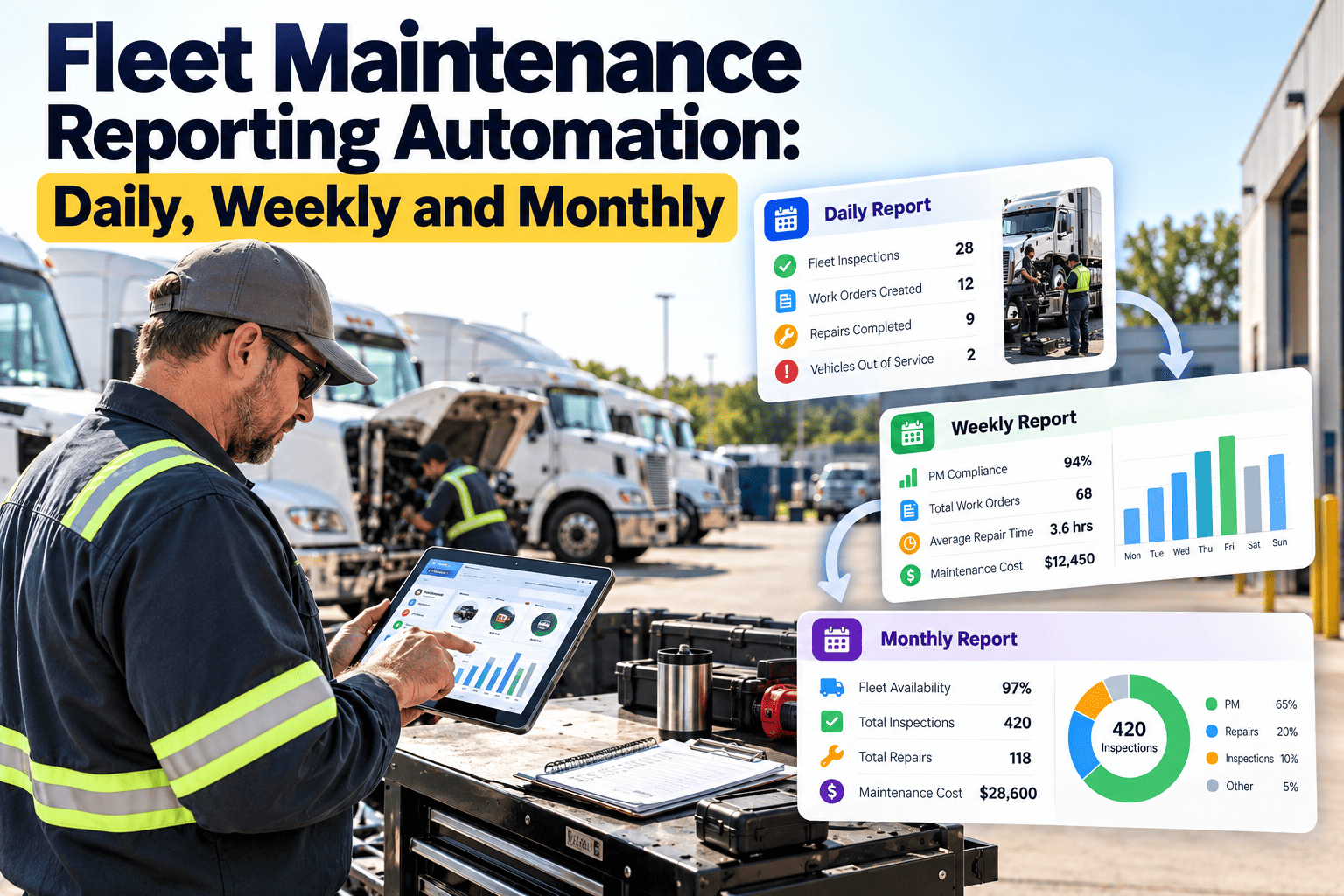
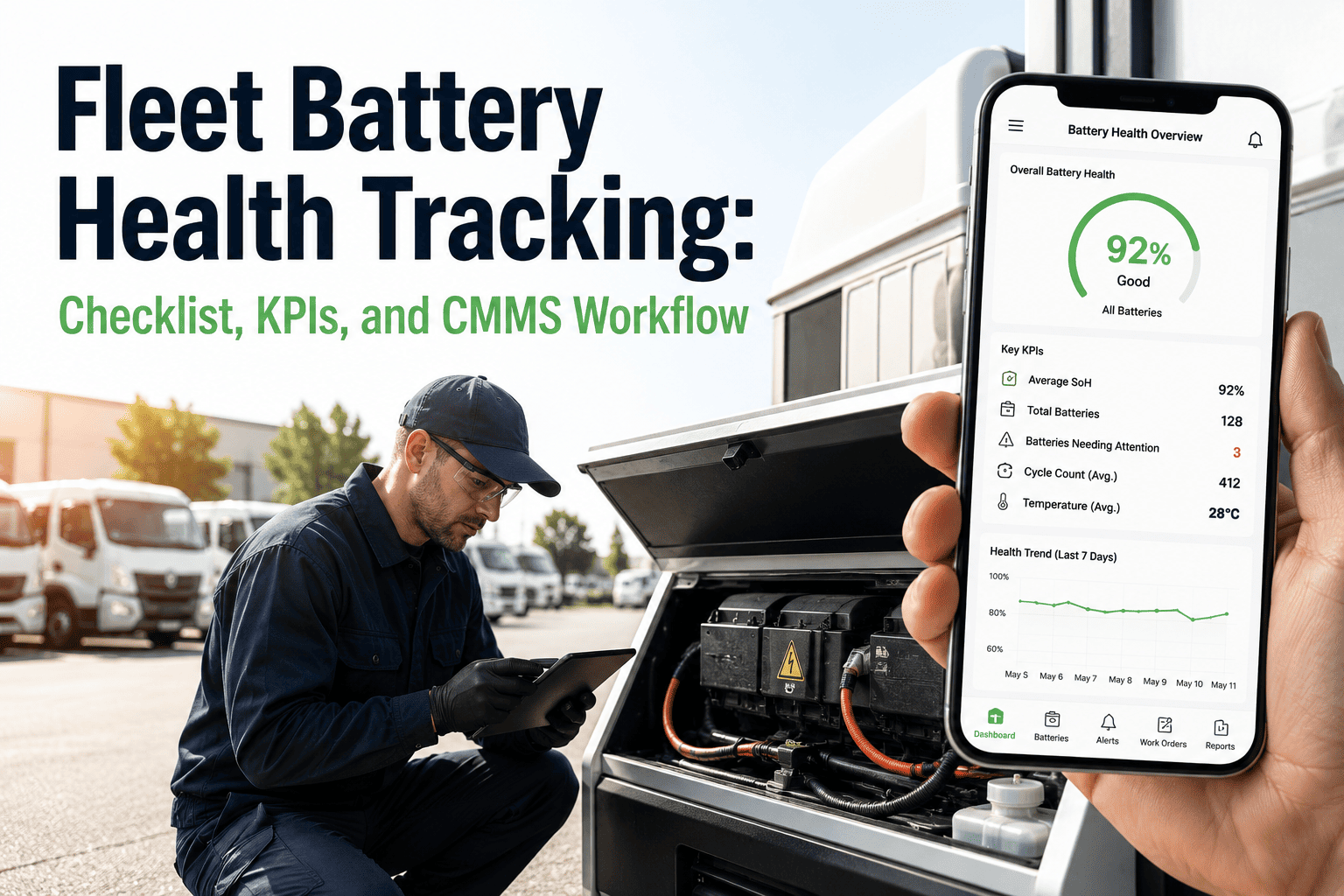
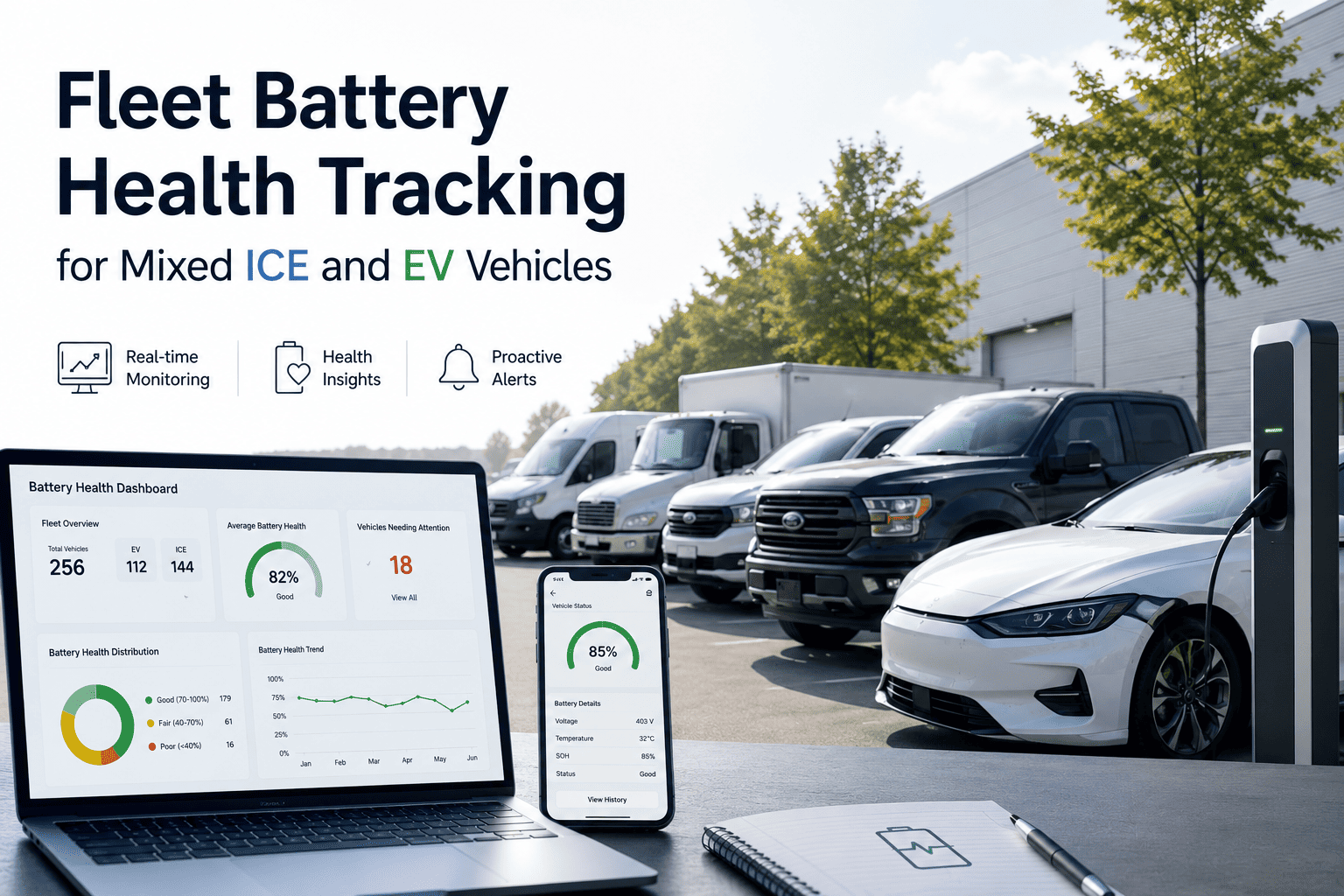
Live visibility into open work orders, PM compliance rates, vehicle availability, maintenance cost by asset, and technician utilization — all updated in real time as events occur. Fleet managers see the complete picture without asking anyone to compile a report.
Automated Compliance Documentation
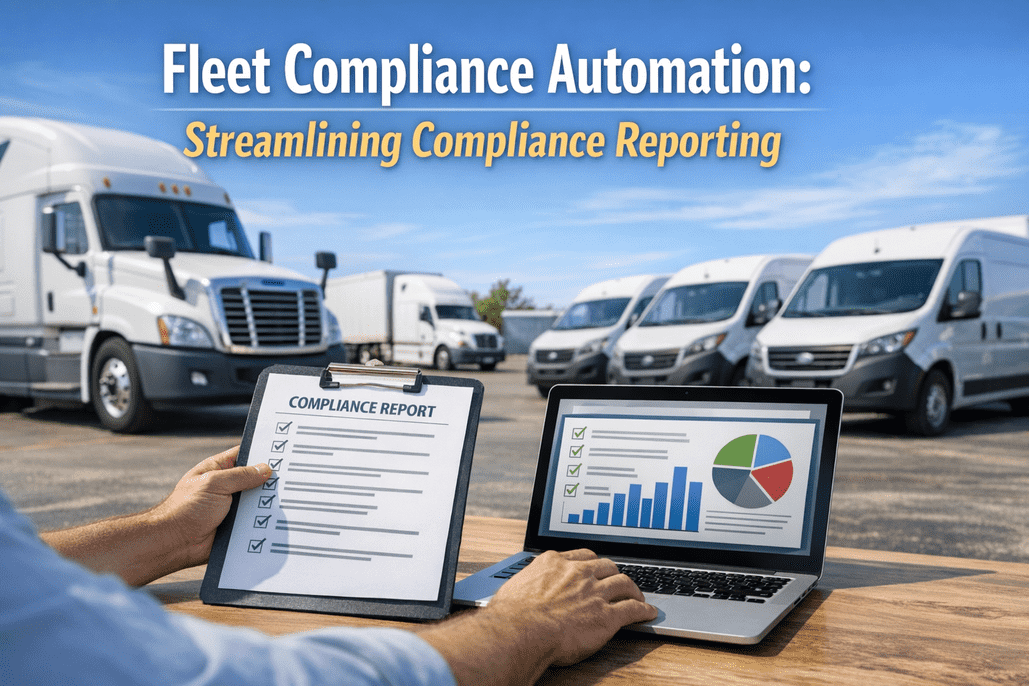
DOT, FMCSA, and OSHA audit-ready records are generated automatically from inspections, work orders, and maintenance events. Retrieve complete compliance documentation for any vehicle, any date range, in seconds — not hours.
Predictive Maintenance Alerts
AI-powered analysis of telematics data, engine diagnostics, and maintenance patterns generates failure predictions 2–4 weeks before breakdown risk. Alerts automatically create work orders — turning predictive intelligence into actionable maintenance.
Spare Parts Inventory Automation
Parts usage is tracked automatically from work orders. Minimum stock thresholds trigger automated purchase requests. Fleet managers eliminate emergency procurement and capital tied up in unused inventory through data-driven parts management.
Multi-Site Portfolio Reporting
Oxmaint's multi-depot architecture delivers consolidated maintenance reporting across every location in your portfolio — benchmarking performance between sites, identifying maintenance outliers, and giving leadership a unified operational picture.
See Automated Fleet Maintenance Reporting Running in a Live Environment
Oxmaint connects every vehicle inspection, work order, PM schedule, and compliance record into a single automated reporting layer. Deploy in days. See measurable results within weeks. No IT project, no hardware procurement.
Before vs. After
Manual Fleet Reporting vs. Oxmaint Automated Reporting
ROI and Results
What Automated Maintenance Reporting Delivers — By the Numbers
25–40%
Maintenance Cost Reduction
Fleets deploying automated predictive maintenance workflows reduce maintenance budgets 25–40% through prevention versus reactive repair — the single largest cost driver in fleet operations.
4–5x
Emergency vs. Planned Repair Cost Ratio
Emergency repairs cost 4–5x more than planned maintenance. Automated PM triggers and predictive alerts eliminate the conditions that create emergency repairs — the highest-ROI impact of automated reporting.
30–50%
Administrative Burden Reduction
Automated reporting eliminates manual data compilation. Fleet managers and administrative staff recover 30–50% of the time previously spent building reports — reallocated to operational decision-making.
60–90
Days to First Measurable ROI
Most fleets implementing digital maintenance reporting and automated PM workflows see measurable ROI within 60–90 days. First prevented breakdown often pays for the entire system investment.
20–30%
Unplanned Downtime Reduction
Predictive maintenance and automated inspection defect workflows reduce unplanned vehicle downtime 20–30% — recovering revenue from vehicles that would otherwise sit idle waiting for reactive repair.
73%
Component Failure Reduction (Case Study)
A Texas-based contractor implementing automated predictive maintenance reduced hydraulic failures by 73%, extended equipment life 18%, and cut their maintenance budget from $620K to $410K — a $210K annual saving.
FAQ
Automated Fleet Maintenance Reporting — Common Questions
What is the difference between manual maintenance reporting and automated maintenance reporting for fleet management?
Manual maintenance reporting requires fleet managers to collect data from paper logs, spreadsheets, driver reports, and work order records — then compile them manually into reports that are typically delivered weekly or monthly. By the time a manual report reaches decision-makers, it reflects conditions that existed days or weeks ago. Automated maintenance reporting captures every vehicle event — inspection results, PM completions, defect flags, work order closures, parts usage, fuel consumption — in real time at the point of action, and surfaces that data instantly through live dashboards and automated alerts. The operational difference is decisive: manual reporting tells you what went wrong last month; automated reporting shows you what is about to go wrong today and enables intervention before the failure or cost occurs. For fleet managers, the Fleetio 2026 benchmark shows that this data discipline — not fleet size or budget — is what separates high-performing fleets from average ones. To see automated reporting in action,
sign up for Oxmaint free or
book a demo.
How does automated maintenance reporting help fleet managers achieve DOT and FMCSA compliance without manual documentation effort?
DOT and FMCSA compliance documentation requires organized, timestamped records of vehicle inspections, maintenance services, defect corrections, and driver qualification records — retrievable on demand for any vehicle, any time period. When these records are maintained manually across paper DVIR forms, binders, and spreadsheets, compliance documentation for a single audit request can take 4–8 hours of staff time to assemble. Automated maintenance reporting generates all compliance-relevant documentation automatically as a byproduct of daily operations. Every digital inspection creates a timestamped, driver-attributed record linked to the vehicle. Every defect triggers a work order with a documented resolution timestamp. Every PM service is recorded with technician attribution and cost data. When a DOT inspector arrives or an audit request comes in, the complete compliance record for any vehicle is retrievable in seconds from the Oxmaint dashboard — not hours of manual binder search.
Book a demo to see Oxmaint's compliance documentation interface live, or
sign up free to start generating audit-ready records from day one.
How quickly can a fleet deploy automated maintenance reporting with Oxmaint, and what does the implementation process involve?
Most fleet operations are creating digital work orders and running automated PM schedules within their first week of Oxmaint deployment. Full implementation — including vehicle data import, PM schedule configuration, inspection checklist setup, and team training — typically takes 1–3 weeks depending on fleet size and complexity. Because Oxmaint is cloud-based and mobile-first, there is no server installation, no IT infrastructure project, and no hardware procurement required. Your team accesses everything through web browsers and mobile apps. Vehicle and driver data can be imported in bulk. Inspection checklists are configured to your existing pre-trip and post-trip formats. Technicians and drivers are typically productive within 2–4 hours of their first app session. The Fleetio 2026 benchmark confirms that most fleets see measurable ROI within 60–90 days of deployment — and the first prevented breakdown event often pays for the entire platform cost many times over. For a specific deployment timeline based on your fleet size,
book a demo or
sign up free to start immediately.
Can automated maintenance reporting work for mixed fleets with different vehicle types and compliance requirements?
Oxmaint manages any combination of vehicle types within a single automated reporting platform — heavy-duty trucks, light commercial vehicles, vans, electric vehicles, construction equipment, and specialty vehicles. Each vehicle type operates under its own maintenance schedule, inspection checklist, and compliance documentation template while sharing a unified fleet-wide reporting dashboard. For mixed compliance requirements — DOT and FMCSA for commercial trucks, OSHA for yard equipment, manufacturer-specified service intervals for EVs — Oxmaint maintains separate compliance documentation streams per vehicle type automatically. Portfolio-level reporting aggregates performance across all vehicle types and all locations in a single dashboard, giving fleet managers and executive leadership visibility into total maintenance spend, PM compliance rates, and fleet health regardless of the operational complexity underneath. Oxmaint's multi-site architecture also means fleets operating across multiple depots get consolidated cross-location reporting without any manual aggregation.
Sign up free to configure your vehicle types, or
book a demo to see multi-site reporting in a live environment.
What is the measurable ROI of switching from manual to automated fleet maintenance reporting, and how quickly does payback occur?
The ROI of automated fleet maintenance reporting comes from five quantifiable sources that compound over time. Maintenance cost reduction: automated PM scheduling and predictive alerts reduce maintenance costs 25–40% by shifting spend from emergency repair to planned intervention — the most significant single savings category. Administrative labor savings: eliminating manual report compilation, data entry, and spreadsheet management recovers 30–50% of administrative burden across the maintenance team. Downtime recovery: automated inspection-to-work-order workflows and predictive alerts reduce unplanned downtime 20–30%, recovering revenue from vehicles that would otherwise sit idle during reactive repair. Compliance overhead reduction: automated compliance documentation reduces audit preparation time from hours to seconds per audit request, eliminating the staff cost of manual record assembly. Capital optimization: automated TCO tracking per vehicle enables data-driven replacement and CapEx decisions, avoiding both early replacement and costly over-maintenance of vehicles past their economic life. Combined, these five ROI drivers deliver payback within 60–90 days for most fleet operations. The Fleetio 2026 Benchmark Report confirms that fleets with disciplined automated maintenance processes consistently outperform those relying on manual reporting — not because of technology, but because of the data discipline automated reporting creates. For an ROI calculation specific to your fleet size,
book a demo with the Oxmaint team or
sign up free to start measuring your baseline today.
65% of Fleet Teams Plan to Automate Maintenance by End of 2026. The Fleets That Move First Win the Advantage.
Oxmaint automates every layer of fleet maintenance reporting — from inspection defect to work order, from PM trigger to compliance record, from cost capture to CapEx forecast. Real-time dashboards. Automated alerts. Audit-ready documentation. Multi-site visibility. Deploy in days, see results in weeks.