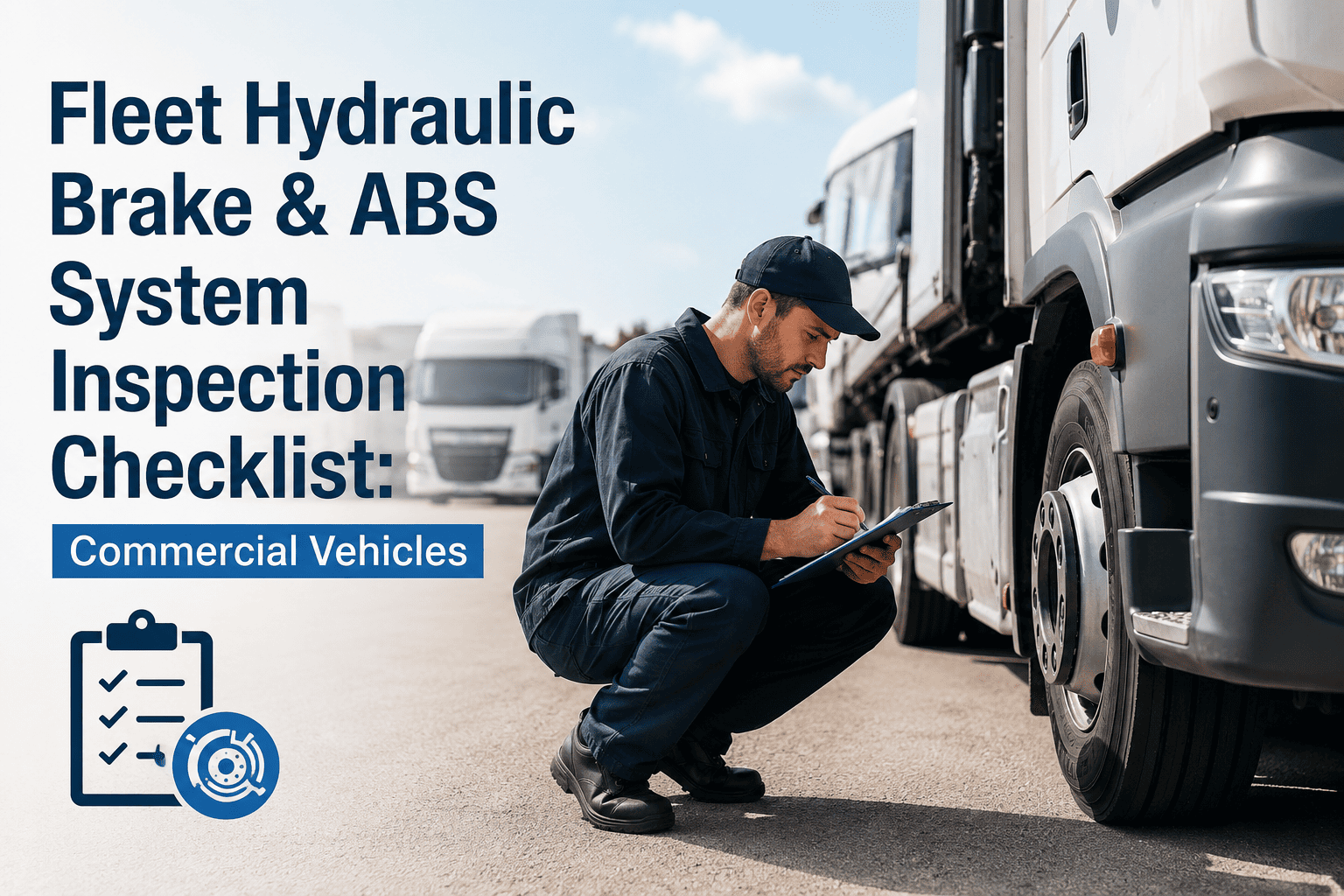
Brake System Maintenance for Commercial Fleets: Safety, Compliance, and PM Schedules
By Alex Jordan on March 21, 2026
Brake system failures are the leading mechanical cause of commercial vehicle accidents — and the most preventable. FMCSA data consistently shows brake-related violations in the top three categories at roadside inspection, and brake defects account for 29% of commercial vehicle out-of-service orders nationwide. The technical challenge for fleet maintenance managers is that commercial brake systems are not homogeneous: a mixed fleet operates air brake systems on Class 7–8 vehicles, hydraulic disc and drum systems on Class 4–6, and increasingly ABS-integrated electronic systems across all classes. Each system type has different inspection requirements, different adjustment procedures, different failure modes, and different PM interval logic. OxMaint's CMMS supports brake PM scheduling across all commercial brake system types — with vehicle-class-specific templates, inspection checklists, and automatic work order generation at the correct interval for each system.
Fleet Maintenance
Brake System Maintenance for Commercial Fleets: Safety, Compliance, and PM Schedules
Complete guide to commercial fleet brake maintenance — air brake systems, hydraulic disc and drum, ABS integration, adjustment procedures, FMCSA inspection requirements, and CMMS-scheduled brake PM programs for mixed-class fleets.
$12,400Avg OOS event cost including tow, delay, and penalty
85%Of brake violations are preventable with structured PM
Air Brake Systems: The Most Complex and Most Cited
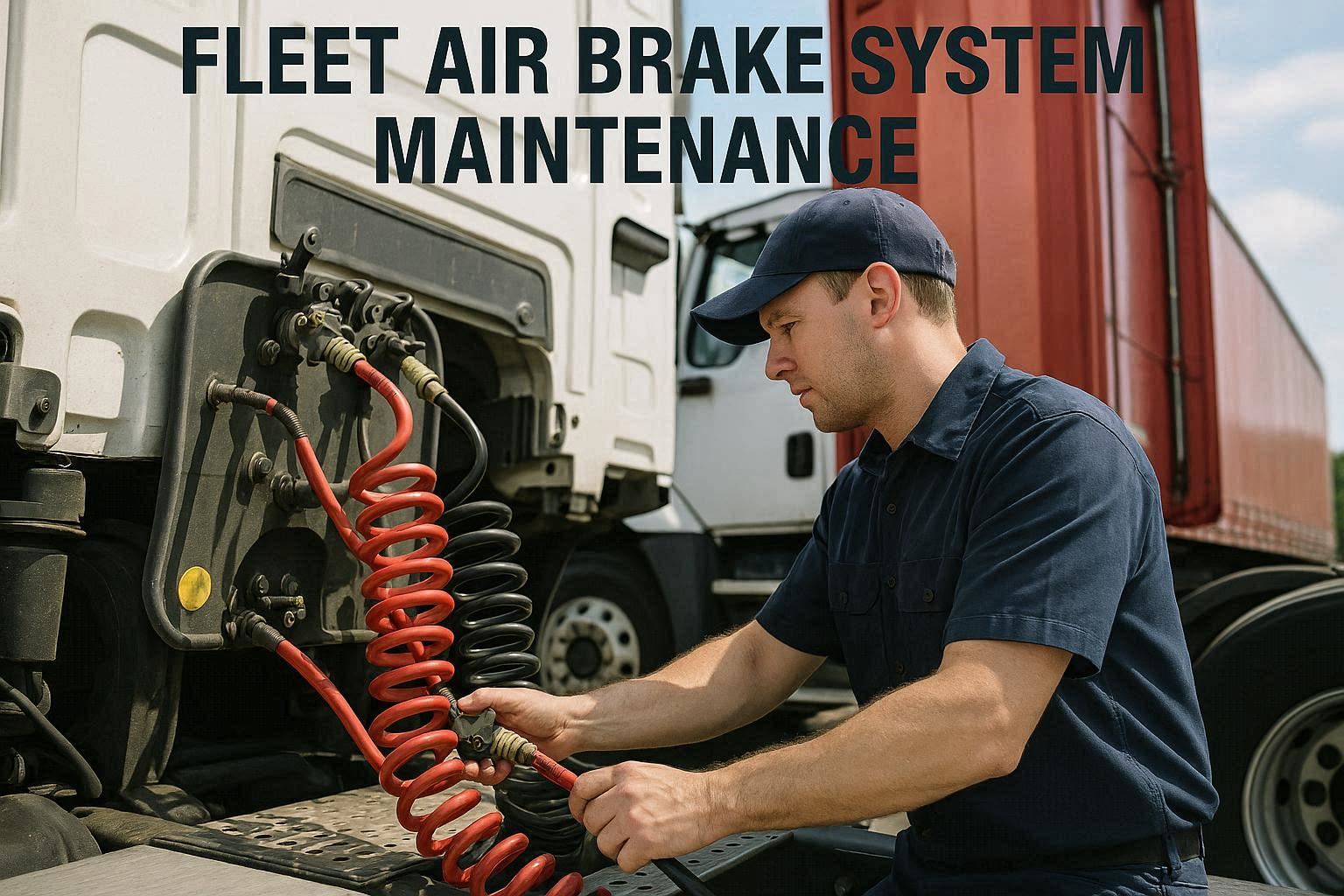
Air brake systems on Class 7–8 commercial vehicles are the brake system most frequently cited at DOT inspections — and the most technically complex to maintain correctly. The system integrates multiple subsystems: the compressor and air dryer (supply side), reservoirs and governor (storage), service brakes and slack adjusters (application), and the ABS/EBS electronic layer. A failure at any point in this chain generates a citable defect. The most common air brake violations — brake adjustment out of specification, low air pressure warning failure, and air leak exceeding acceptable limits — are all detectable in a properly executed pre-trip DVIR and preventable with correctly scheduled PM. The critical PM intervals for air brake systems are calendar-based (not purely mileage-based) because moisture accumulation in air dryers and reservoir tanks is a time function, not a use function.
Air Brake System — Key Components and PM Requirements
Inspect oil carryover — excessive carryover contaminates air dryer
Verify cut-in / cut-out governor function at 100 and 120–125 PSI
OOS threshold: Unable to maintain pressure or build from 50–90 PSI in 3 min
Air Dryer
PM: Annual or 50,000 mi — highest priority
Replace desiccant cartridge annually — moisture contamination causes system freeze
Check purge valve function — should vent at each compressor cut-out cycle
Inspect heater function in cold-climate operations
Critical: Failed air dryer causes moisture in lines — brake fade in cold weather
Slack Adjusters
PM: Every PM interval + DVIR inspection
Measure pushrod stroke at 90 PSI application — must not exceed legal limit
Automatic slack adjusters: verify auto-adjustment function
Manual slack adjusters: adjust to 5/8" free stroke at pushrod
OOS threshold: Pushrod stroke exceeds limits at 90 PSI (varies by chamber size)
Brake Linings
PM: Inspect every 25,000 mi or 6 months
Measure lining thickness — OOS at 1/4" on steering axle, 3/16" others
Check for cracking, glazing, and contamination (oil, grease)
Inspect drums for heat cracks, scoring, and out-of-round condition
OOS: Missing or non-functional, loose, contaminated linings
Hydraulic Brake Systems: Class 4–6 Fleet Maintenance
Class 4–6 commercial vehicles — medium-duty trucks, delivery vans, service vehicles — predominantly use hydraulic disc and drum brake systems. Hydraulic systems are mechanically simpler than air systems and less frequently cited at inspection, but they have a specific failure profile that fleet maintenance programs consistently underestimate: brake fluid hygroscopicity. Hydraulic brake fluid absorbs moisture from the atmosphere over time regardless of operating hours, lowering its boiling point and creating vapor lock risk under sustained heavy use. A fresh DOT 3 fluid has a dry boiling point of 401°F; after 18–24 months of moisture absorption in service, the same fluid may have a wet boiling point below 284°F — generating brake fade risk on routes with extended downhill grades or frequent hard stops. The FMCSA mandate for hydraulic brake system fluid change is not mileage-based — it is calendar-based, and most small and mid-size fleet operators miss this distinction.
Hydraulic Brake PM Schedule — Class 4–6 Commercial Fleet
Service Item
Interval
Trigger Type
Critical Threshold
Brake fluid replacement
Every 2 years
Calendar — not mileage
Wet boiling point below 284°F
Front disc pad inspection
Every 20,000 mi
Mileage + visual
Below 3mm — replace immediately
Rear drum shoe inspection
Every 25,000 mi
Mileage + visual
Below 3mm or contaminated
Master cylinder inspection
Annual
Calendar
Any seepage, corrosion, or low fluid
Caliper / wheel cylinder
Every 50,000 mi
Mileage + leakage check
Any external fluid leakage
Rotor thickness measurement
Every brake pad change
At pad replacement
Below manufacturer minimum discard
Brake hose inspection
Annual
Calendar + visual
Any cracking, chafing, or swelling
ABS Maintenance: Electronic Integration in Modern Commercial Brakes
Anti-lock Brake Systems have been federally mandated on Class 6–8 vehicles since 1997 and on trailers since 1998 — meaning virtually every commercial vehicle in active service has ABS. ABS maintenance is distinct from mechanical brake service in two critical ways: it requires diagnostic scan tools for fault code retrieval and wheel speed sensor testing, and its failure modes are not always apparent from a physical inspection alone. A wheel speed sensor that is physically intact but generating incorrect speed readings will not produce a visible defect during a visual inspection — it will only surface through a scan tool or through the ABS warning light. FMCSA requires that ABS warning lamps function correctly and illuminate at key-on: a non-functioning ABS lamp is a citable violation independent of whether the ABS system itself is operational.
ABS System — Maintenance Requirements and Failure Modes
Wheel Speed Sensors
Inspect: Every 25,000 mi
Clean debris from sensor faces and tone rings. Check air gap (typically 0.020–0.050"). Replace if damaged or reading erratic. Scan tool required for signal verification.
Fault: C0035–C0050 series — wheel speed sensor circuit faults
ABS Warning Lamp
Check: Every DVIR pre-trip + annual
Must illuminate at key-on and extinguish after self-test. Trailer ABS lamp must also function. Non-functioning lamp is a direct FMCSA citable violation regardless of system status.
Violation: Lamp inoperative = OOS on trailer, citable on tractor
ABS Control Module
Scan: Annual or on fault code
Retrieve and document stored fault codes at every annual service. Clear codes only after addressing root cause. Module replacement requires recalibration on most platforms.
Fault codes: C series (chassis) — require scan tool access
Modulator Valves
Test: Annual functional test
Air brake: test for air leakage through valve body at full application. Hydraulic: verify solenoid operation with scan tool activation test. Valve replacement does not require calibration.
Fault: Valve stuck open/closed — ABS activates during normal braking
“
We had three brake-related OOS events in one quarter before we started using OxMaint for PM scheduling. The system flagged two vehicles with overdue slack adjuster checks that we would have missed. Both needed adjustment. That's potentially two more OOS events — each one would have cost us more than the platform costs in a year.
FMCSA Brake Inspection Requirements: What Triggers OOS
Understanding exactly what triggers an out-of-service order for brakes allows fleet maintenance programs to build inspection checklists that specifically prevent OOS-level defects. The Commercial Vehicle Safety Alliance (CVSA) Out-of-Service Criteria for brakes is specific and documented — it is not inspectors applying judgment, it is a checklist with defined thresholds. The most common OOS triggers are: brake adjustment out of spec (measurable at roadside with a ruler and pressure gauge), brake linings with cracks through to metal backing, missing or inoperative brakes on any axle end, and any brake that is non-functional on application. All four of these defects are detectable in a structured pre-trip inspection and preventable with the PM intervals in this guide.
CVSA Out-of-Service Criteria — Brake Defects That Ground Vehicles
01
Brake Adjustment Out of Specification
Pushrod stroke exceeds legal limits at 90 PSI application on air brake vehicles. Measured at roadside with ruler and pressure gauge. Most common single brake OOS trigger.
Prevention: Slack adjuster check at every PM event. Automatic slack adjusters checked for function, not just for adjustment.
02
Brake Lining Below Minimum or Cracked to Backing
Lining below 1/4" on steering axle or 3/16" on other axles. Any crack extending through lining to metal backing plate. Contamination with oil, grease, or other fluid.
Prevention: Lining thickness inspection every 25,000 mi. Record measurements in CMMS — trend to predict replacement before OOS threshold.
03
Missing, Loose, or Non-Functional Brake
Any brake that does not apply or release fully. Any missing brake on an axle end. Includes seized calipers, broken return springs, and inoperative parking brake mechanisms.
Prevention: Functional brake application test in pre-trip DVIR. Listen for asymmetric application — one side dragging or not releasing.
04
Low Air Pressure or System Leakage
Air system fails to build pressure from 50–90 PSI within 3 minutes. Air leak audible or measurable at system connections, hoses, or chambers. Low-pressure warning device inoperative.
Prevention: Air buildup test and leak-down test in pre-trip. Annual air dryer service to prevent moisture contamination causing valve leakage.
05
ABS / EBS Warning Lamp Inoperative
ABS warning lamp must illuminate at key-on and extinguish after self-test. Trailer ABS lamp (amber, rear) must function. Inoperative lamp on trailer is OOS; on tractor it is citable.
Prevention: ABS lamp check in every pre-trip DVIR. Annual ABS scan for stored fault codes that may illuminate lamp without driver noticing.
Schedule Brake PM Before the Inspector Does It For You
OxMaint generates brake inspection work orders automatically — per vehicle class, per brake system type, at the correct interval. Free to start, no hardware required.
CMMS Brake PM Scheduling: Configuring OxMaint for Mixed-Brake Fleets
A mixed-class commercial fleet has three distinct brake PM requirements running simultaneously — air brake intervals on Class 7–8, hydraulic brake intervals on Class 4–6, and ABS-specific scan intervals across all classes. The CMMS configuration challenge is ensuring each vehicle receives the correct interval logic for its brake system type, not a fleet-wide template that under-services some vehicles and over-services others. OxMaint supports vehicle-class-specific PM templates that allow brake service to be configured per unit — so a Class 8 tractor's air dryer gets its annual desiccant replacement while the Class 5 service truck gets its 2-year brake fluid change, all driven from the same maintenance calendar. Configure your fleet's brake PM templates in OxMaint free — the setup wizard walks through brake system type selection per vehicle and generates your first brake service schedule automatically.
OxMaint Brake PM Templates — Configuration by Vehicle Class
Class 7–8
Air Brake System
Air dryer desiccantAnnual
Slack adjuster checkEvery PM
Lining / drum inspection25,000 mi
Full air system testAnnual
ABS scan / lamp checkAnnual + DVIR
Class 4–6
Hydraulic Disc / Drum
Brake fluid replacement2 years
Front disc pad check20,000 mi
Rear drum shoe check25,000 mi
Rotor / drum measurementAt pad change
ABS scan / lamp checkAnnual + DVIR
All Classes
Inspection & Compliance
Pre-trip DVIR brake checkDaily
Annual DOT inspectionAnnual
Brake hose inspectionAnnual
Parking brake functionEvery PM
ABS fault code retrievalAnnual
29%
Of all OOS orders are brake-related — highest single defect category
Targeting brake PM directly reduces the highest-probability OOS event in your fleet.
One prevented OOS event covers CMMS platform cost for 12–18 months on most fleet sizes.
2 yr
Calendar-based brake fluid interval — most commonly missed PM item in hydraulic brake fleets
Moisture absorption is time-based, not mileage-based. CMMS calendar triggers catch this; odometer triggers miss it.
85%
Of brake violations are preventable with structured pre-trip DVIR and PM scheduling
The remaining 15% are component failures between service intervals — caught earliest by fluid analysis and ABS scans.
Frequently Asked Questions
How often should air brake slack adjusters be checked?
Slack adjusters should be checked at every PM service event — not just at annual inspections. Automatic slack adjusters require functional verification (confirm they are actually adjusting, not just present), while manual slack adjusters require physical measurement and adjustment to 5/8" free stroke. At roadside inspection, brake adjustment is the single most common OOS-triggering defect, and it can develop between service intervals on high-mileage vehicles. OxMaint's air brake PM templates include slack adjuster checks at every scheduled service — configure your fleet's template free today.
Why is hydraulic brake fluid changed on a calendar schedule rather than mileage?
Hydraulic brake fluid absorbs moisture from the atmosphere through micro-permeation in rubber hoses and reservoir seals — a process that occurs continuously regardless of vehicle use. A vehicle that sits parked for six months absorbs as much moisture as one that drives 50,000 miles. Moisture lowers the fluid's boiling point, creating brake fade risk on sustained downgrade or high-frequency stop cycles. The 2-year calendar interval is the standard because it reflects the moisture absorption timeline, not the wear timeline. Book a demo to see how OxMaint handles both calendar and mileage triggers for the same vehicle simultaneously.
Does a non-functioning ABS warning lamp trigger an OOS order?
On trailers, yes — a non-functioning ABS lamp is an automatic OOS on trailers manufactured after March 1, 1998. On tractors, the lamp must illuminate and function correctly; a persistently illuminated ABS lamp (indicating a stored fault) is citable but not automatically OOS. The CVSA guidance is clear: check ABS lamp function at every pre-trip inspection as part of the instrument lamp check. OxMaint's DVIR mobile app includes ABS lamp verification in the instrument cluster inspection category — configure it free today.
How does OxMaint handle different brake PM intervals for mixed-class fleets?
OxMaint creates a separate PM template per vehicle type — a Class 8 tractor template with air brake intervals, a Class 5 van template with hydraulic intervals, and a shared ABS/compliance template applied to both. Each vehicle is assigned to its template, and work orders generate automatically at the correct interval per unit. The maintenance calendar shows all vehicles sorted by urgency — a Class 8 with an overdue slack adjuster check appears alongside a Class 5 with an overdue brake fluid change in one view. Start free — configure your first brake PM template in under 15 minutes.
85% of Brake Violations Are Preventable. OxMaint Prevents Them.
OxMaint's CMMS generates brake inspection work orders automatically — air brake intervals for Class 7–8, hydraulic intervals for Class 4–6, and ABS scan intervals for every vehicle — calibrated per brake system type so no vehicle is over-serviced or under-serviced. Stop absorbing $12,400 OOS events that a scheduled slack adjuster check would have prevented.