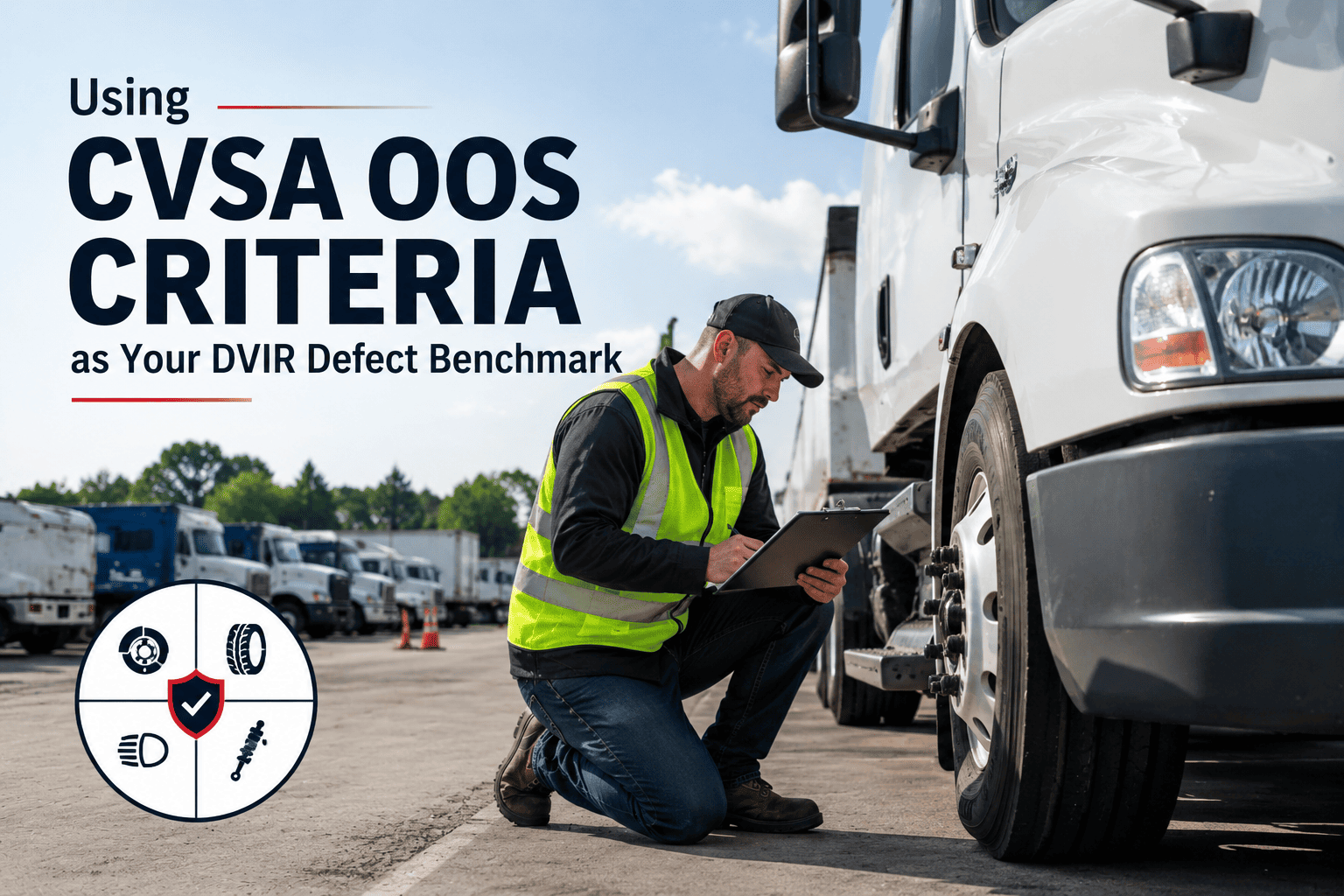
Fleets that win at roadside inspections don't wait for an officer to tell them a truck is broken — they classify every defect during the Driver Vehicle Inspection Report using the same North American Standard Out-of-Service Criteria the officer applies. The Commercial Vehicle Safety Alliance publishes those exact thresholds annually, and any defect that crosses them legally prohibits vehicle movement until repaired and certified. Embedding CVSA OOS thresholds into your DVIR defect-severity logic turns a paper checklist into a precision filter that stops violations before the truck leaves the yard. Oxmaint ships with CVSA OOS thresholds preconfigured so drivers see the same pass/fail standard a roadside inspector would enforce — try it with a Start Free Trial and see the difference at your next dispatch window.
Would your truck pass a Level I inspection right now?
If your DVIR severity logic isn't mapped to the North American Standard Out-of-Service Criteria, the answer is a guess. One missed 4/32" steer tire or a 20% brake loss puts the vehicle out of service — and CSA points on your record for the next three years.
Why CVSA OOS criteria belong inside your DVIR logic
The CVSA North American Standard Out-of-Service Criteria is the single authoritative list of defect thresholds that require a commercial motor vehicle to be placed out of service at roadside. A defect that meets any OOS threshold means the vehicle cannot legally operate until the defect is repaired and certified by a qualified mechanic — no exceptions, no "run it to the next terminal." Fleets running structured DVIRs should use these same criteria as the benchmark for defect-severity classification, so the standard a driver applies at the start of a shift is identical to the standard an inspector will apply at the scale.
A 120-power-unit dry-van fleet running lane work across the Midwest averages 14 roadside Level I inspections per month. Before mapping DVIR severity to CVSA OOS thresholds, roughly 1 in 6 inspections produced an OOS violation — most commonly 4/32"-minus steer tires and leaking brake chambers — costing the fleet about $3,800 per month in tow bills, downtime, and CSA hit. After embedding OOS thresholds into the DVIR so any matching defect auto-holds the unit pre-dispatch, OOS violations dropped to fewer than 2 per month and the tow-and-downtime line item fell by roughly 80%. The repair backlog didn't grow — it just shifted from roadside to the yard, where labor is one-third the cost.
The eight CVSA OOS threshold families every driver should recognize
Each family below is a category where a single, measurable defect threshold flips a truck from "operable" to "out of service." These are the same conditions an inspector checks during a Level I — and the same conditions your DVIR defect-severity rules should auto-flag for an immediate hold.
Brake system
Any wheel with a defective brake component affecting a required brake, or 20% or more of the required brakes not functioning. Brake shoes/pads at 4/32" or less remaining lining thickness.
Tires
Less than 4/32" tread on a steer axle, less than 2/32" on any other axle. Any visible fabric or cord, any sidewall bulge, or any ply separation.
Suspension
Any leaf spring, coil spring, torque rod, or air spring broken, disconnected, or misaligned. Any U-bolt missing or loose on a leaf-spring assembly.
Steering
Any steering component with looseness greater than manufacturer specification. Pitman arm, drag link, tie-rod ends, or steering gear mounting fasteners loose or missing.
Lighting
Head lamps, tail lamps, brake lamps, or turn signals inoperative. Any required lamp that fails to illuminate when the circuit is activated.
Wheels & rims
Cracked wheels, missing or broken lug nuts, or fasteners loose enough to allow wheel movement. Spoked wheels with cracks across spokes or between handholds.
Coupling
Fifth wheel not properly locked or damaged, kingpin damage, sliding fifth-wheel stops missing or ineffective. Locking jaw not closed around the kingpin.
Emergency equipment
Missing, damaged, or uncharged fire extinguisher. Missing emergency reflectors or triangles. Breakaway switch cable damaged or inoperative on trailer.
OOS thresholds at a glance — the numbers a DVIR must enforce
This is the same reference table Oxmaint uses to map a driver-reported defect to a CVSA OOS hold. Print it, post it, and make sure every driver understands that these numbers are not advisory — they are the legal line between "roll" and "park."
| System | CVSA OOS threshold | DVIR action |
|---|---|---|
| Brakes — function | 20% or more of required brakes not functioning | Immediate hold · no dispatch |
| Brakes — lining | 4/32" or less remaining lining thickness | Immediate hold · no dispatch |
| Tire — steer axle | Less than 4/32" tread depth | Immediate hold · no dispatch |
| Tire — drive/trailer | Less than 2/32" tread depth | Immediate hold · no dispatch |
| Tire — sidewall | Any bulge, separation, or exposed fabric/cord | Immediate hold · no dispatch |
| Suspension | Any spring, torque rod, or air bag broken or disconnected | Immediate hold · no dispatch |
| Steering | Looseness exceeding manufacturer specification | Immediate hold · no dispatch |
| Lighting | Any required head, tail, brake, or turn-signal lamp inoperative | Immediate hold · no dispatch |
| Wheels | Cracked wheel, missing or loose lug nuts | Immediate hold · no dispatch |
| Coupling | Fifth wheel not locked, kingpin damaged | Immediate hold · no dispatch |
From paper DVIR to OOS-aware dispatch hold in four steps
Rolling out CVSA OOS thresholds inside Oxmaint is a configuration exercise, not a development project. Most fleets complete the full cycle in under a week and see their first avoided OOS within the first 14 days.
Map defect codes to OOS thresholds
Import the current CVSA North American Standard Out-of-Service Criteria into your Oxmaint defect-code library. Each code is tagged as OOS, Major, or Minor — so the moment a driver selects it, severity is automatic.
Configure the dispatch-hold rule
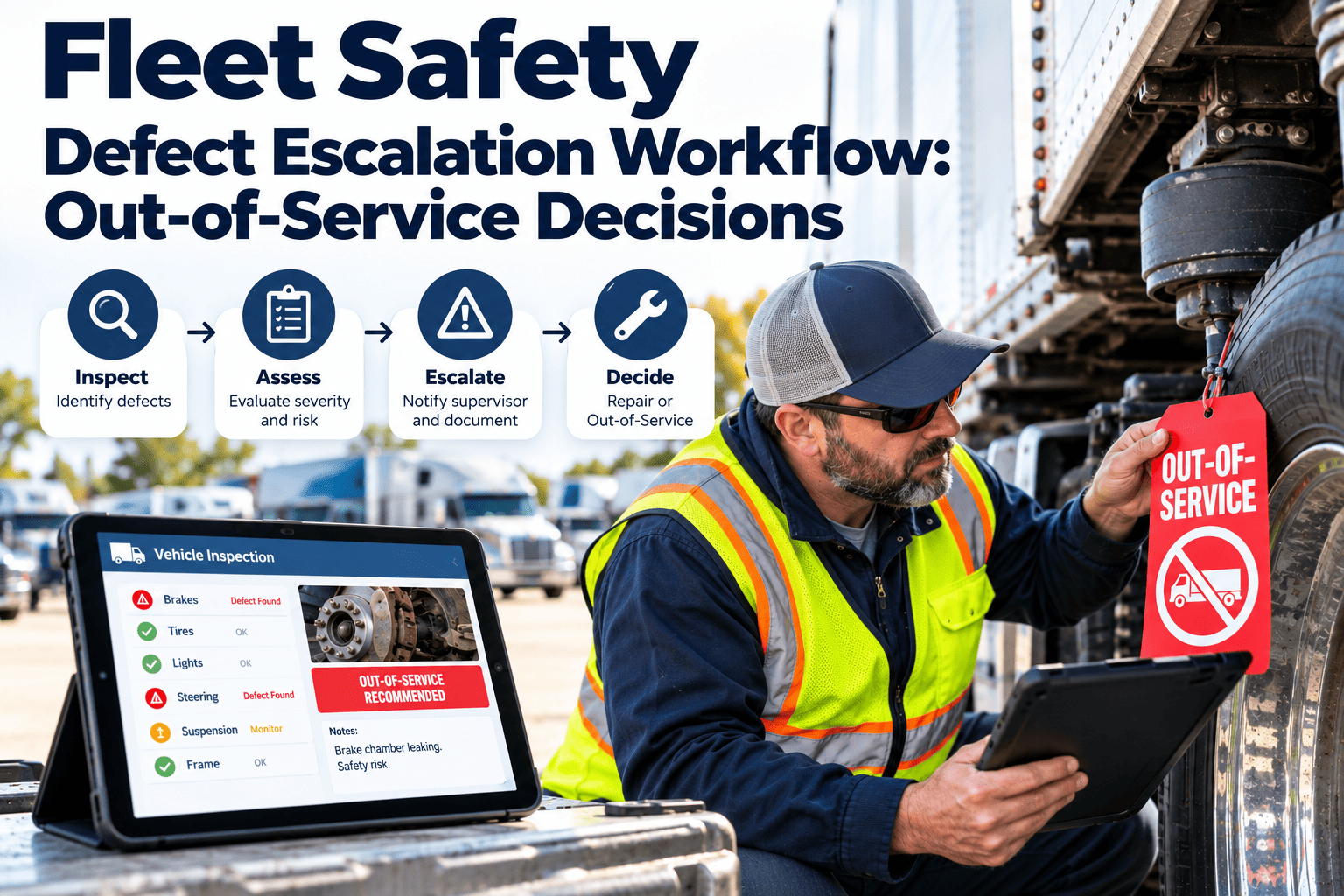
Any DVIR defect tagged OOS triggers an automatic hold on the unit. Dispatch sees a red status flag, the truck cannot be assigned to a load, and the shop receives a work order with the CVSA threshold reference attached.
Train drivers on the new standard
Drivers complete a 20-minute module covering each OOS threshold family with photos of real defects. The goal is simple: when a driver sees a 3/32" steer tire, they already know it's an OOS hold before they tap "submit."
Certify, release, and audit
Repairs are certified by a qualified mechanic inside Oxmaint. The release-to-service record — defect, repair, certifier, timestamp — is permanently attached to the asset, giving you a defensible audit trail for every CVSA threshold event.
What a single missed OOS defect actually costs a fleet
The roadside math is brutal and predictable. Use this framework to size the opportunity inside your own operation — most fleets find the Oxmaint subscription pays for itself on the first avoided tow.
Stop guessing at severity. Enforce the CVSA standard on every pre-trip.
Oxmaint ships with CVSA OOS thresholds preconfigured — your drivers see the same pass/fail line a roadside inspector enforces, and dispatch sees an automatic hold the moment a defect crosses it.
CVSA OOS criteria and your DVIR — five questions answered
How often does CVSA update the Out-of-Service Criteria?
CVSA publishes an updated North American Standard Out-of-Service Criteria annually, effective April 1 each year. The 2026 edition supersedes all prior versions, and fleets should refresh their DVIR defect-code mappings within the same month to stay aligned. Oxmaint pushes the updated thresholds to every account as part of the annual release, so your drivers are always inspecting against the current standard. Book a Demo to see the update workflow.
What happens when a driver reports a defect that meets an OOS threshold?
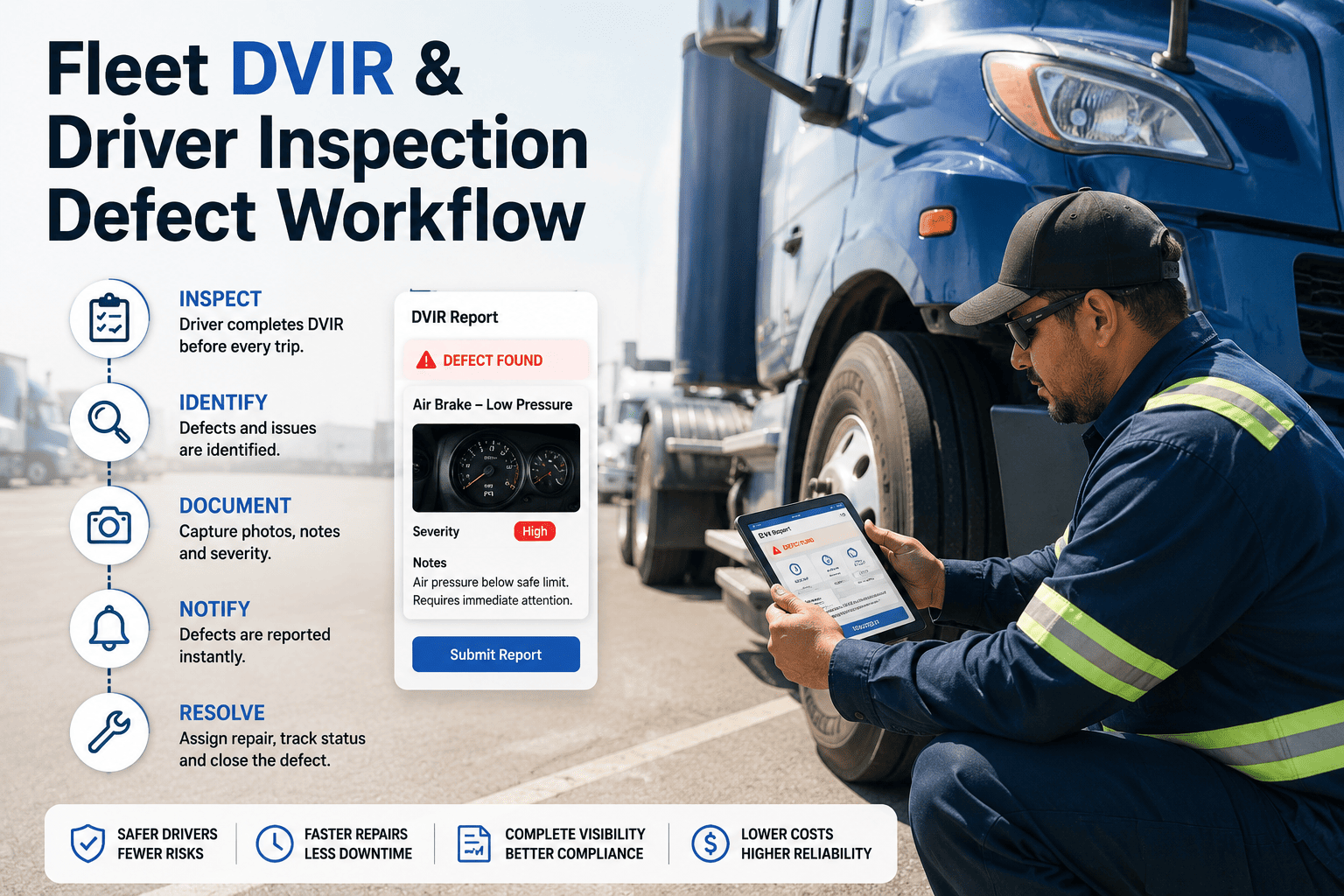
In Oxmaint the defect code is tagged OOS, so the moment the driver submits the DVIR the unit is auto-held from dispatch, a red flag appears on the dispatch board, and a work order opens in the shop queue with the CVSA threshold reference attached. The truck cannot be assigned to a load until a qualified mechanic certifies the repair and releases the unit — creating a permanent, auditable record.
Can a driver still mark a defect "Minor" if it doesn't meet an OOS threshold?
Yes. Not every defect is out of service — a chipped mirror or a slow air leak that still holds pressure can be Major or Minor. Oxmaint's three-tier severity (OOS / Major / Minor) lets drivers log non-OOS defects without triggering a hold, while still routing them to the shop for planned repair. The OOS tier is reserved exclusively for defects that cross the CVSA line.
Does using CVSA OOS criteria in the DVIR reduce CSA scores?
Indirectly, yes. CSA scores are driven by roadside inspection violations, and the single most effective way to reduce those is to catch the defect at the yard before the truck reaches a scale. Fleets that map DVIR severity to OOS thresholds typically see roadside OOS violations drop by 70–90% within the first two quarters, which directly lowers the carrier's Brake, Tire, and Vehicle Maintenance BASIC percentiles.
How long does it take to roll out CVSA OOS thresholds in Oxmaint?
Most fleets complete the full rollout — defect-code mapping, dispatch-hold rule configuration, driver training, and mechanic certification workflow — in five to seven business days. Oxmaint ships with the CVSA OOS thresholds preloaded, so the work is configuration, not custom development. You can start the process with a Start Free Trial and have the first trucks running OOS-aware DVIRs inside a week.
Give every driver the same standard a roadside inspector uses.
Embed CVSA OOS thresholds into your DVIR today and turn your yard into the first line of defense against roadside violations, tows, and CSA points.
Free 14-day trial · No credit card
.png)