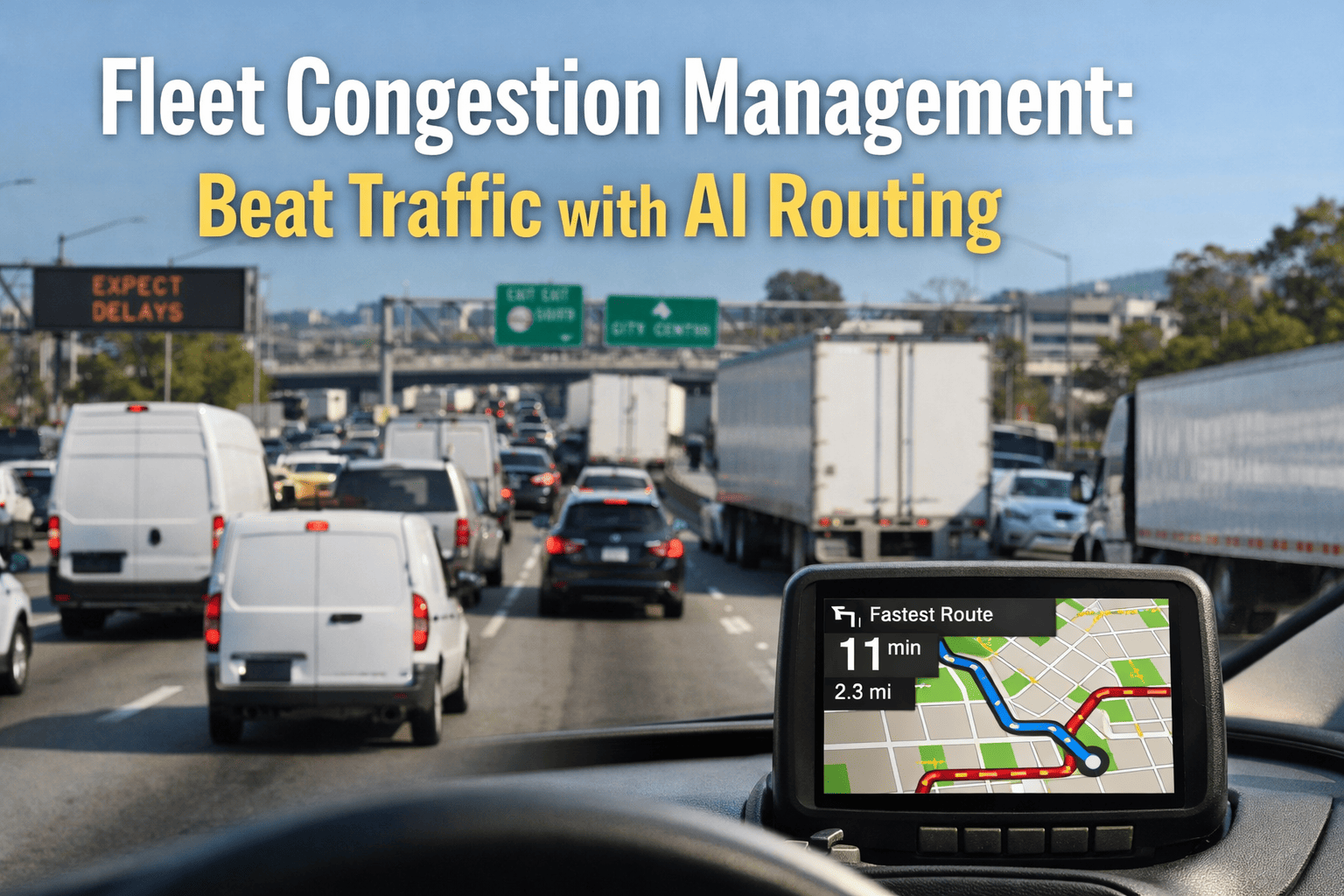
A regional medical supply distributor in Chicago was losing $94,000 a year in overtime, late delivery penalties, and fuel waste — all attributable to one cause: their drivers hit the same three congested highway corridors at the same time every afternoon because their routing was set at 6 AM and never updated. The route plan was based on travel time estimates from maps that assumed free-flow conditions. By 3 PM, those conditions had not existed for six hours. A hospital supply delivery that left the depot at 2:15 PM was dispatched on a route that added 38 minutes of unnecessary congestion exposure because no system was monitoring real-time conditions and re-routing around them. OxMaint's AI congestion management engine monitors traffic conditions across your entire fleet in real time — detecting congestion developing on active routes, calculating alternative paths, and re-routing affected drivers automatically before the delay compounds into a missed delivery window or an overtime shift. Book a demo to see OxMaint congestion management configured for your fleet's primary corridors.
Fleet Congestion Management · AI Traffic Routing · OxMaint
Your 6 AM Route Plan Is Based on Traffic That No Longer Exists. OxMaint Updates Every Route Continuously — All Day, Every Driver.
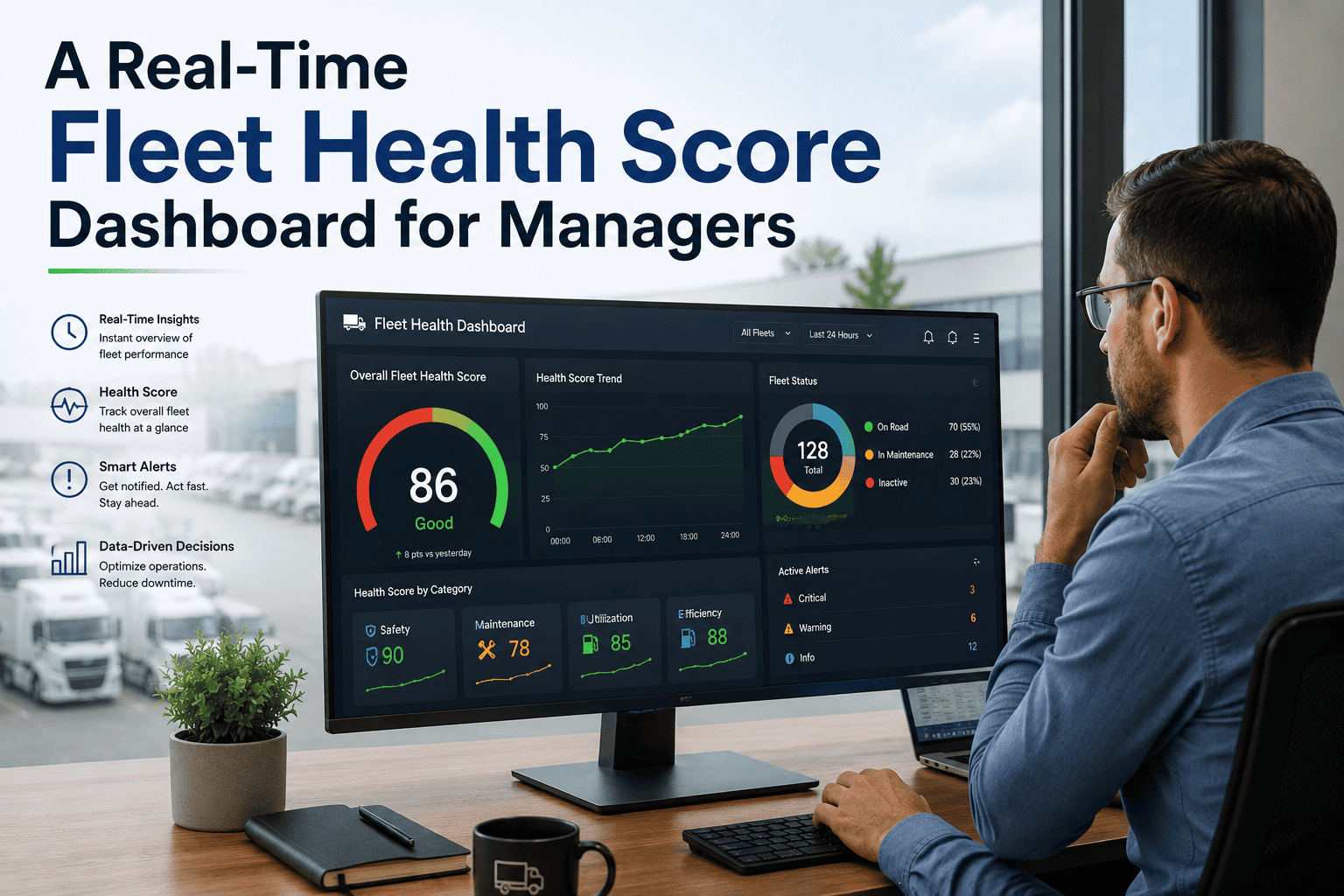
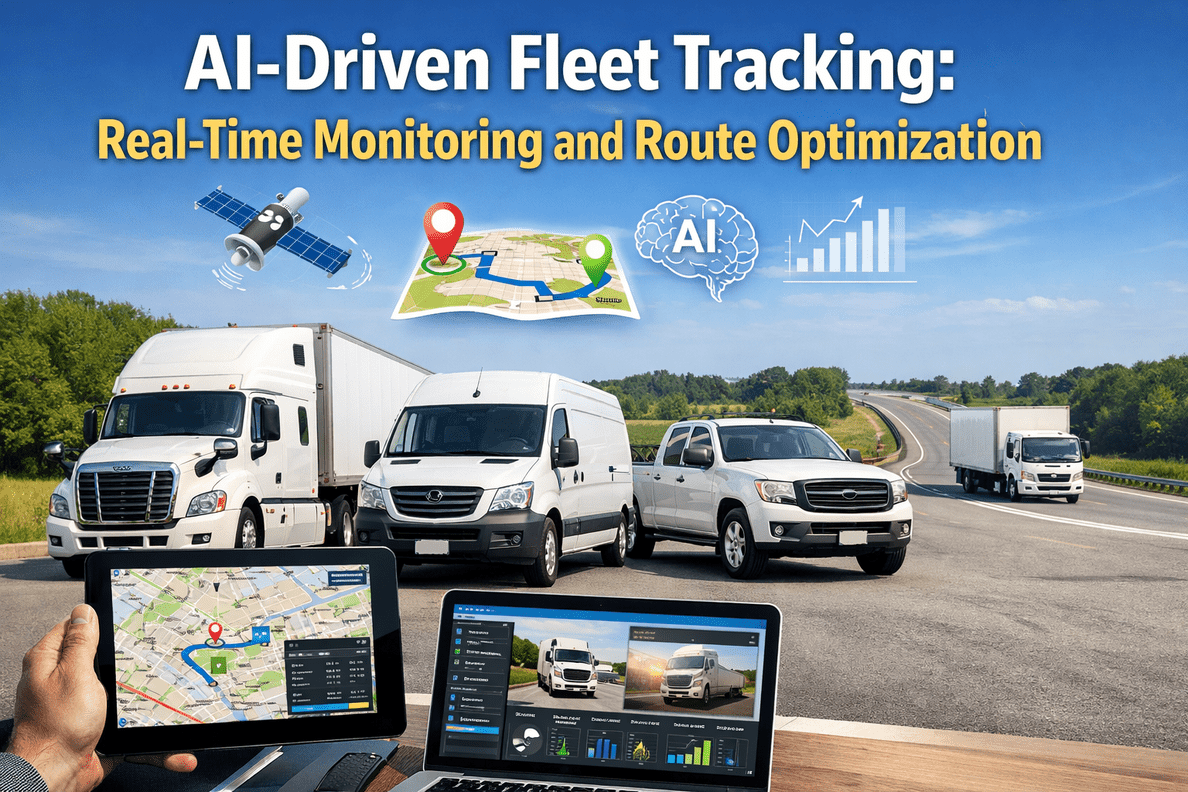
OxMaint's real-time congestion engine monitors traffic across every active route simultaneously — detecting developing congestion, calculating alternatives, and re-routing drivers automatically before delays compound into missed delivery windows.
$94K
Annual overtime and penalty cost at the Chicago medical distributor — eliminated after AI congestion management deployment
38 min
Unnecessary congestion exposure per affected route — from a route plan that had not updated since 6 AM
22%
Average reduction in total daily drive time at fleets using OxMaint real-time congestion re-routing vs static plans
90 sec
OxMaint re-route calculation time when congestion is detected on an active driver route
6h
The average static fleet route plan is based on traffic conditions that are 6 hours old by mid-afternoon. A route planned at 6 AM uses travel times based on morning free-flow or historical averages — neither of which reflects a 3 PM incident on I-90 or a surface street closure from a midday construction update. OxMaint's congestion engine ingests live traffic APIs every 90 seconds, maintains a predictive congestion model for the next 2 hours on all active corridors, and re-calculates every affected driver's remaining route before the delay reaches the threshold that triggers a missed window.
Sign in to OxMaint to activate real-time congestion monitoring for your fleet's active routes today.
Four Congestion Problem Types OxMaint Manages Automatically
INC — Incident-Driven Congestion
Traffic Incident Detection & Instant Re-Route
A vehicle breakdown on a primary artery, a multi-car accident on an interstate interchange, or a road closure from an emergency response — these events create sudden, severe congestion that static routing cannot anticipate. OxMaint ingests traffic incident data from real-time feeds and calculates the delay impact on every driver currently within the affected corridor's catchment zone. If a driver is on a route that will enter the incident zone within 15 minutes, OxMaint generates an alternative route before the driver reaches the congestion — not after they are stopped in it.
Sign in to OxMaint to configure incident alert corridors for your primary fleet routes.
Incident Response Parameters
Incident detection — real-time traffic API feed, sub-5-minute latency
Affected driver identification — all drivers within 15-minute approach window
Alternative route calculation — 90 seconds from incident detection to driver re-route
ETA cascade update — all downstream customer ETAs recalculated automatically
Without Real-Time Detection — What Happens
Driver enters congestion — 20–45 min delay, no warning, cascading ETA failures
Dispatcher learns from driver call — re-route manual, 10–20 min decision lag
PRD — Predictive Congestion
Predictive Congestion Modelling — Act Before the Jam Forms
The highest-value congestion management is avoidance before congestion forms — not re-routing after the queue is already 2 miles long. OxMaint's AI maintains a predictive congestion model that forecasts traffic conditions 90 minutes ahead on every active corridor — using historical patterns, current speed data, weather impact, school dismissal times, and event schedules to predict where congestion will develop and when. Dispatch can see routes colour-coded by predicted congestion risk for the next 2 hours — routing new jobs and afternoon runs around predicted problem areas before drivers are dispatched into them.
Book a demo to see predictive corridor modelling for your fleet's primary operating zones.
Predictive Model Inputs
Historical pattern — day-of-week, time-of-day corridor speed profiles
Weather overlay — rain and severe weather impact on travel speed by corridor
Event calendar — stadium events, school dismissal, construction schedule
Current speed feed — live deviation from predicted used to calibrate forecast
Predictive Model Accuracy
90-minute forecast accuracy: 84% for corridor speed within ±15% of actual
Enabled pre-departure re-sequencing at 68% of predicted congestion events
SCH — Schedule-Based Congestion
Congestion-Aware Dispatch Scheduling — The Right Driver at the Right Time
Many congestion problems are not routing problems — they are scheduling problems. A fleet running 40 deliveries in a metro area between 3 PM and 6 PM is scheduling itself into its own worst-case traffic scenario. OxMaint's congestion-aware scheduling engine analyses the historical traffic profiles of each job's delivery zone and recommends dispatch times that avoid peak congestion windows. Jobs in downtown zones with severe 4–6 PM congestion are scheduled for pre-2 PM or post-6 PM delivery where the time window allows — with the traffic cost of each timing option calculated and displayed alongside the schedule.
Sign in to OxMaint to enable congestion-aware dispatch scheduling for your afternoon run planning.
Schedule Optimisation Parameters
Zone congestion profile — peak hour severity score per delivery area
Time-window flexibility — jobs with flexible windows prioritised for off-peak dispatch
Driver shift constraints — overtime cost vs congestion cost trade-off calculation
Customer SLA — hard delivery windows locked, soft windows shifted to off-peak
Schedule Optimisation Outcomes
18–31% reduction in congestion-related drive time at off-peak-optimised fleets
Overtime reduction: 2–4 driver-hours per day at 25-vehicle metropolitan fleet
COR — Corridor Analysis
Fleet Corridor Performance Analytics — Find the Chronic Congestion Patterns
Individual congestion events are managed reactively. Chronic corridor patterns — the same stretch of I-90 adding 25 minutes every Tuesday and Thursday between 3 and 5 PM for the past six months — require analytical identification and permanent routing adjustment. OxMaint's corridor analytics identifies the road segments that consistently generate the most delay-minutes across your fleet, ranked by total annual fleet impact in hours and dollars. These chronic corridors are the highest-ROI targets for permanent route adjustment — avoiding them permanently delivers more value than re-routing around them repeatedly.
Book a demo to see OxMaint corridor performance analytics for your fleet's primary routes.
Corridor Analytics Reports Generated
Top 10 delay corridors by fleet-hours lost — weekly and monthly
Corridor cost report — delay hours × driver cost × fuel waste
Peak delay window — day-of-week and time-of-day pattern per corridor
Alternative route comparison — time and cost of permanent corridor avoidance
What Corridor Analysis Enables
Permanent route restructuring for chronic bottlenecks — not repeated re-routing
Driver briefings targeted at specific corridor windows — not generic advice
OxMaint Congestion Management · Real-Time Fleet Traffic Intelligence
Real-Time Re-Route. Predictive Avoidance. Chronic Corridor Analysis. All Automatic.
OxMaint connects live traffic data, predictive models, and driver routing into a single system that keeps your fleet moving — all day, every day.
Three Traffic Intelligence Layers — How OxMaint Stays Ahead of Congestion
OxMaint's Congestion Intelligence Stack — From Live Data to Driver Re-Route
Layer 1 · Live Data
Real-Time Traffic Feed Integration
OxMaint ingests live traffic speed data every 90 seconds across all active route corridors — detecting speed drops that indicate developing congestion before the queue has formed. Live data is combined with driver GPS position to calculate the exact delay impact on each driver's remaining route.
Update frequency: 90-second refresh · Coverage: US, Canada, UK, AU, Germany
Layer 2 · AI Prediction
90-Minute Predictive Congestion Model
Historical patterns + current speed data + weather + event calendar = a 90-minute congestion forecast per corridor. Dispatch sees a colour-coded route risk map for the next 2 hours — enabling proactive job sequencing and departure timing to avoid predicted congestion before it develops.
Forecast accuracy: 84% within ±15% of actual corridor speed at 90 minutes
Layer 3 · OBD Context
Driver Position + Job Priority Integration
Re-routing decisions are not made on traffic data alone — OxMaint considers each driver's current position, remaining job priority, vehicle type, and time window constraints before generating an alternative route. A driver with a P1 hospital delivery gets a different re-route decision logic than a driver with 3 flexible afternoon stops.
Re-route considers: driver position, job priority, time windows, vehicle type
Congestion Management Performance — US Fleet Data by City Type
Congestion Impact Classification — Where Re-Routing Delivers the Most Value
Highest Value — Time-Critical Deliveries
Medical, Pharmaceutical, Live Freight
A 40-minute congestion delay on a hospital supply route can trigger emergency sourcing at 3× cost. OxMaint P1 route priority ensures time-critical deliveries receive re-route calculations first — ahead of standard delivery stops — with escalating alerts to dispatch if time window breach becomes unavoidable.
High Value — SLA-Bound Deliveries
B2B with Delivery Window Penalties
Retail distribution, restaurant supply, and manufacturing JIT deliveries carry contractual penalty clauses for late arrivals. OxMaint congestion management prevents the cascading delays that push an on-time morning run into a penalty-triggering afternoon arrival — protecting the revenue that SLA breaches erode.
Standard Value — Volume Deliveries
Consumer Last-Mile and General Freight
Even without hard penalties, congestion delays on consumer last-mile routes produce overtime, re-delivery costs, and customer satisfaction erosion. OxMaint congestion management at this tier is primarily a fuel and labour cost saving — recovering 1–3 driver-hours per day per vehicle in major metro operations.
22%
average total fleet drive time reduction — same routes, same deliveries, AI congestion routing applied continuously
$94K
annual overtime and penalty cost eliminated at the Chicago medical supply fleet after OxMaint congestion management deployment
18%
on-time delivery rate improvement at major metro fleets using OxMaint predictive congestion avoidance and real-time re-routing
90 sec
incident detection to driver re-route — OxMaint congestion response time
90 min
predictive congestion forecast horizon — enabling pre-departure scheduling avoidance
84%
forecast accuracy within ±15% of actual corridor speed at 90-minute horizon
24/7
continuous congestion monitoring — overnight distribution and early morning runs fully covered
Your afternoon drivers are sitting in the same congestion every week. The data to avoid it has been available for years. The routing system to use it automatically has not.
OxMaint closes the gap between real-time traffic intelligence and driver routing — automatically, continuously, across your entire active fleet.
Frequently Asked Questions — Fleet Congestion Management
Does OxMaint congestion management work in real time or based on historical traffic only?
OxMaint uses both — live traffic feeds update every 90 seconds for real-time incident response, combined with AI predictive models that use historical patterns to forecast conditions 90 minutes ahead. The combination allows both reactive re-routing and proactive pre-departure scheduling avoidance.
How does OxMaint re-route a driver who is already in active congestion?
OxMaint monitors driver GPS position continuously. When a driver's speed drops below the congestion detection threshold, OxMaint calculates whether the current route or an alternative produces the lower remaining drive time — and if the alternative is materially faster, a re-route notification is pushed to the driver's app with the updated path and revised ETA.
Can drivers ignore OxMaint re-route suggestions?
Yes — OxMaint re-route notifications are advisory by default. Drivers can accept or dismiss a suggested re-route. Dismissed re-routes are logged, and if the driver's actual arrival time materially exceeds the OxMaint-predicted time for the alternative route, the event is flagged in the driver's compliance record for review.
Does OxMaint automatically update customer ETAs when congestion re-routes occur?
Yes — every congestion re-route triggers an ETA cascade recalculation for all downstream stops on that driver's route. Customers whose ETAs shift by more than the configured threshold (typically 15 minutes) receive automated SMS or push notification updates with the revised arrival time.
How does OxMaint handle construction zones and temporary road closures?
OxMaint integrates with road authority construction closure data and temporary speed limit updates for US, Canada, UK, and Australia networks. Active construction closures are reflected in the routing engine within 15–30 minutes of official notification — faster than most mapping platforms update, and with fleet-specific notification for drivers currently assigned to affected routes.
Stop Planning Routes Once at 6 AM. Start Routing Continuously, All Day.
OxMaint congestion management keeps every driver on the fastest available route — from departure to final drop, in real time, automatically.