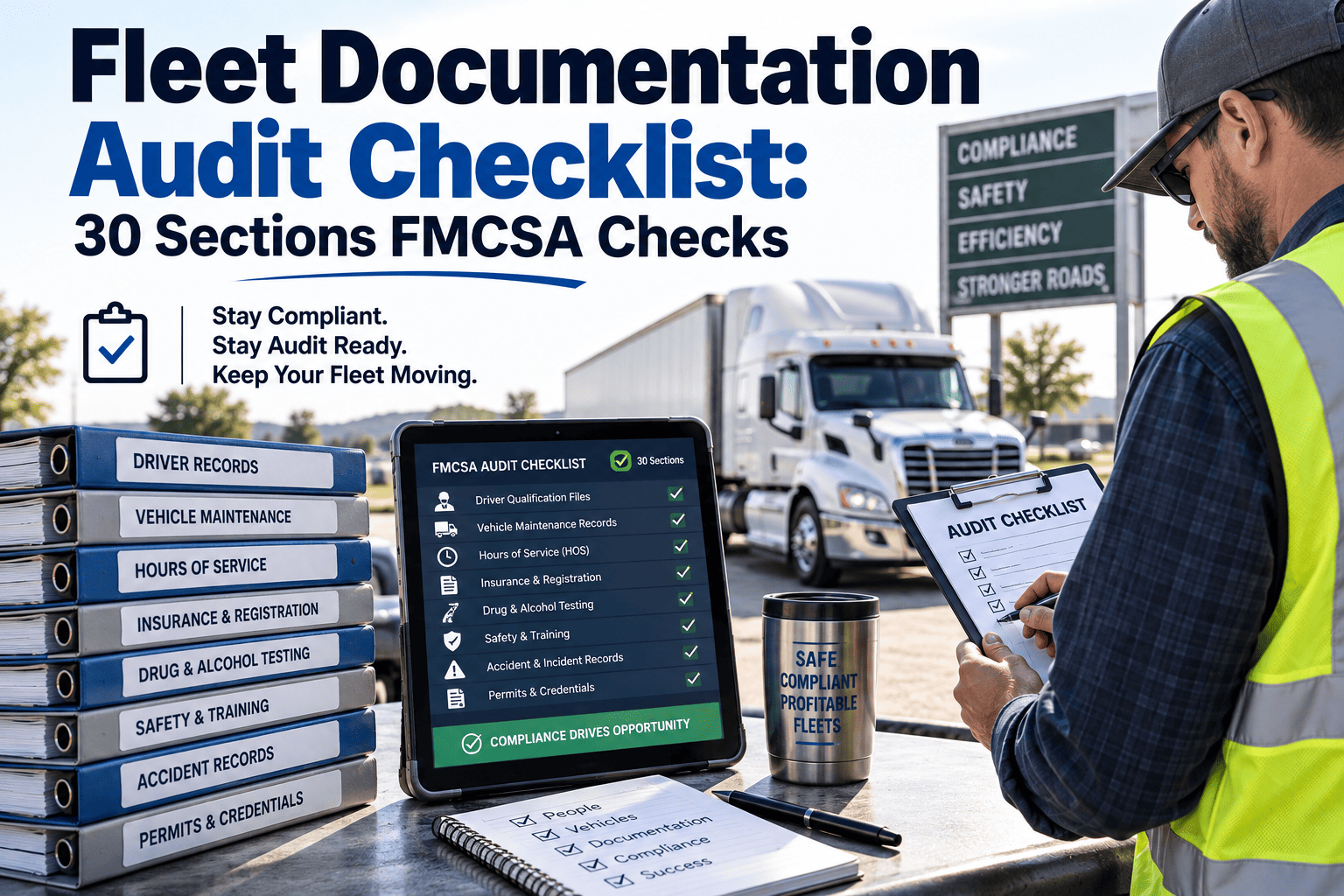
A single FMCSA compliance audit can expose documentation gaps that result in civil penalties up to $16,000 per violation, conditional safety ratings, and in the most serious cases, operating authority revocation. Most carriers who receive conditional or unsatisfactory ratings do not have a safety programme problem — they have a documentation problem: records that exist somewhere but cannot be retrieved in the 15 minutes an investigator gives you to produce them. Compliance documentation is not a background administrative task — it is the evidence layer that either proves or disproves every safety claim your carrier makes. Oxmaint centralises every FMCSA-required document into a single searchable platform — retrievable in under 30 seconds during any DOT compliance review or roadside inspection.
FMCSA Compliance Documentation Hierarchy
FMCSA compliance documentation builds from a foundation of operating authority upward — each layer depends on the layer below it being complete and current. A gap at any level creates exposure across every layer above it. Understanding the hierarchy helps compliance officers prioritise what to audit first when resources are limited.
How Technology Is Transforming Compliance Management
Compliance documentation used to mean filing cabinets, spreadsheet trackers, and a frantic search whenever an investigator or auditor requested records. Four technologies are eliminating the manual effort, the retrieval delays, and the gaps that generate citations — making real-time compliance status visible to every person in the organisation who needs to know. Oxmaint integrates all four into a single fleet compliance platform.
1. Driver Qualification File (DQF) Checklist
The Driver Qualification File is the most frequently cited documentation deficiency in FMCSA compliance reviews. Every commercial driver must have a complete DQF maintained at the carrier — and every element must be present, current, and verifiable. A DQF that is missing a single required element is a complete DQF deficiency, not a partial one. Manage driver qualification files with automated expiry alerts on Oxmaint.
Employment application — completed and signed
FMCSA §391.21 requires a specific employment application format covering 10 years of employment history for CMV drivers. The application must include all commercial driving positions and must be signed by the driver. An unsigned application or one with unexplained gaps in employment history is a DQF deficiency that generates a citation at every compliance review. Violation — missing/incomplete
Motor Vehicle Record (MVR) — pre-employment and annual
Pre-employment MVR required before the driver operates any CMV. Annual MVR review required within the preceding 12 months for every active driver. Review and document the outcome — a carrier that obtains the MVR but does not document the review outcome has an incomplete DQF regardless of what the MVR shows. Violation — no annual review
Medical Examiner's Certificate — current and valid
Medical certificate maximum validity is 2 years, but many drivers have shorter validity due to medical conditions. Track the expiry date for every driver — a single expired medical certificate places the driver out of compliance for HOS purposes regardless of when the carrier discovers it. Verify medical examiner is on the FMCSA National Registry. Violation — expired cert
CDL copy — valid, correct class, and required endorsements
Retain a copy of the driver's current CDL in the DQF. Verify the licence class matches the vehicle being operated and all required endorsements are present — a driver operating a tanker without a tanker endorsement is a CDL violation regardless of the carrier's awareness. Update the copy whenever the driver renews. Violation — wrong class/endorsement
Previous employer safety performance history — verification documented
§391.23 requires carriers to request safety performance information from all CMV employers in the preceding 3 years. Document every request sent and every response received. If an employer does not respond, document the attempt. A carrier that cannot demonstrate it made the required inquiries has a DQF violation regardless of the driver's safety record. Deficiency — no documented request
Road test certificate or equivalent — on file
§391.31 requires a road test before the driver operates a CMV for the carrier, or an equivalent (CDL from the relevant vehicle class is acceptable). The road test certificate must be signed by the examiner and retained in the DQF. Using a CDL as the equivalent must be explicitly documented in the file. Deficiency — missing certificate
AI Digital Twin tip: Each driver's digital twin in Oxmaint tracks every DQF element with its expiry date — MVR review due date, medical certificate expiry, and CDL renewal — sending automated alerts 30, 14, and 7 days before any element lapses. No compliance officer needs to manually track expiry dates across an entire driver fleet. See Oxmaint's automated DQF expiry management.
2. HOS, ELD Records and DVIR Retention Checklist
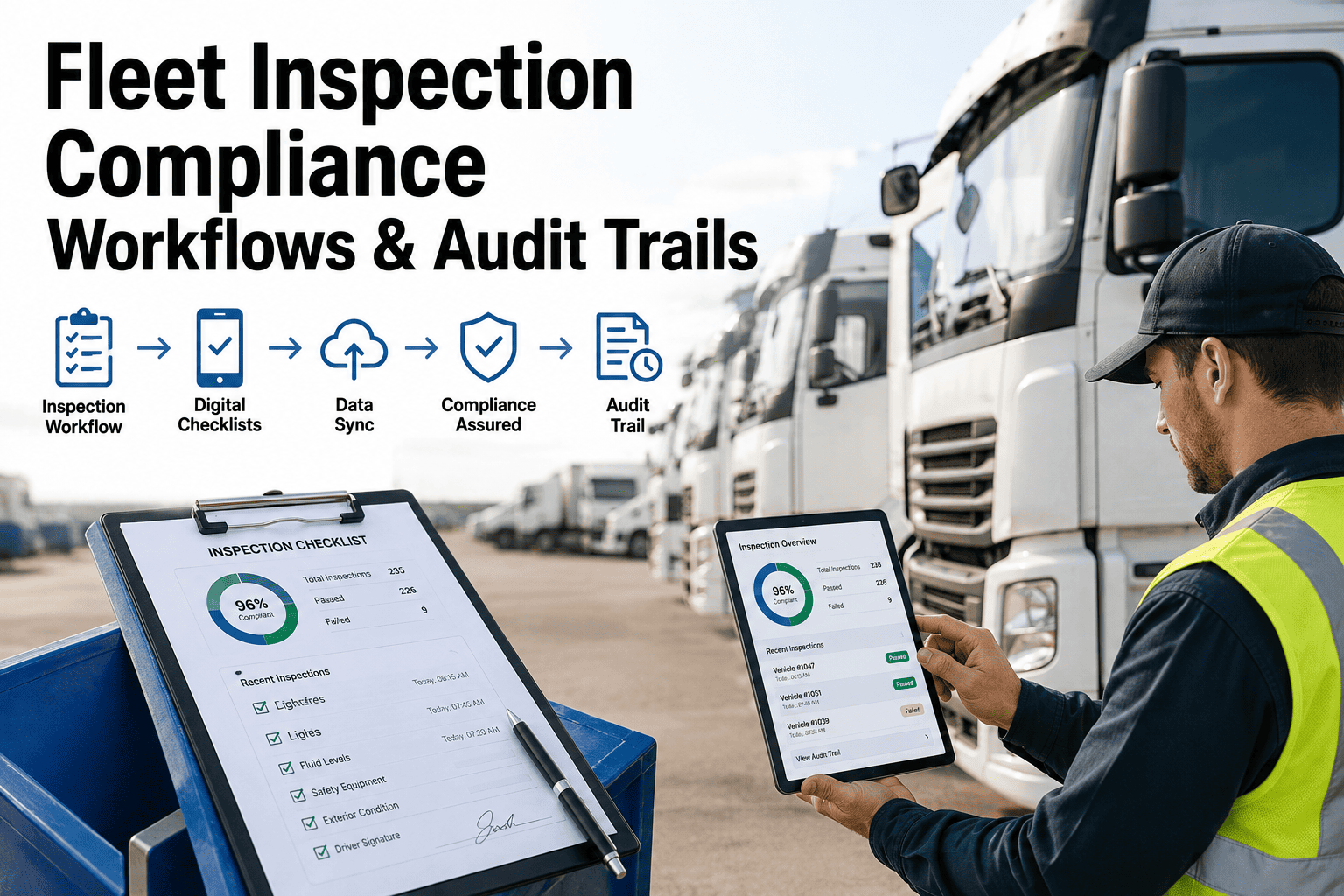
Hours-of-Service and DVIR records are the two most frequently requested document categories in FMCSA compliance reviews — and the two most frequently found to be incomplete, inaccessible, or outside the required retention window. The issue is rarely that records were not created; it is that they cannot be retrieved within the time allowed.
ELD records — 6-month retention, all drivers
All ELD records must be retained for 6 months under §395.8. Verify your ELD provider retains records in an accessible format — not all providers make historical records easily retrievable. Test retrieval by randomly selecting a date 5 months ago and attempting to produce the full day's log for any driver within 2 minutes. Violation — records not retrievable
Supporting documents — fuel receipts, toll records, bills of lading
§395.11 requires carriers to retain supporting documents that corroborate HOS records for 6 months. Fuel receipts, dispatch records, toll transaction records, and bills of lading are the most commonly requested supporting documents. An ELD record that cannot be corroborated with supporting documents is effectively a log falsification risk in an investigation. Deficiency — no supporting docs
DVIR on-vehicle retention — current plus previous day
The most recent DVIR must be carried in the vehicle at all times, and the DVIR from the previous duty day must also be present. A driver who cannot produce the previous day's DVIR on request is operating without required documentation — a §396.11 violation that generates a CSA negative score in the Vehicle Maintenance BASIC regardless of vehicle condition. Violation — not in vehicle
DVIR carrier retention — 3 months minimum, 12 months for defect records
Carriers must retain DVIRs for 3 months minimum. DVIRs that document defects, the mechanic's certification of repair, and the driver's confirmation of next-day review must be retained for 12 months. Build a retention audit into your compliance calendar — DVIR records that are purged before the retention period creates an immediate violation gap. Violation — purged early
ELD malfunction records and ELD provider certification
Retain records of all ELD malfunctions, diagnostic events, and data transfers. Verify your ELD is on the FMCSA registered ELD list — using an unregistered device subjects every HOS record to challenge and every driver to a paper log requirement. Review ELD registration annually — devices can be removed from the registered list if providers fail recertification. Violation — unregistered ELD
3. Vehicle Maintenance and Annual Inspection Records Checklist
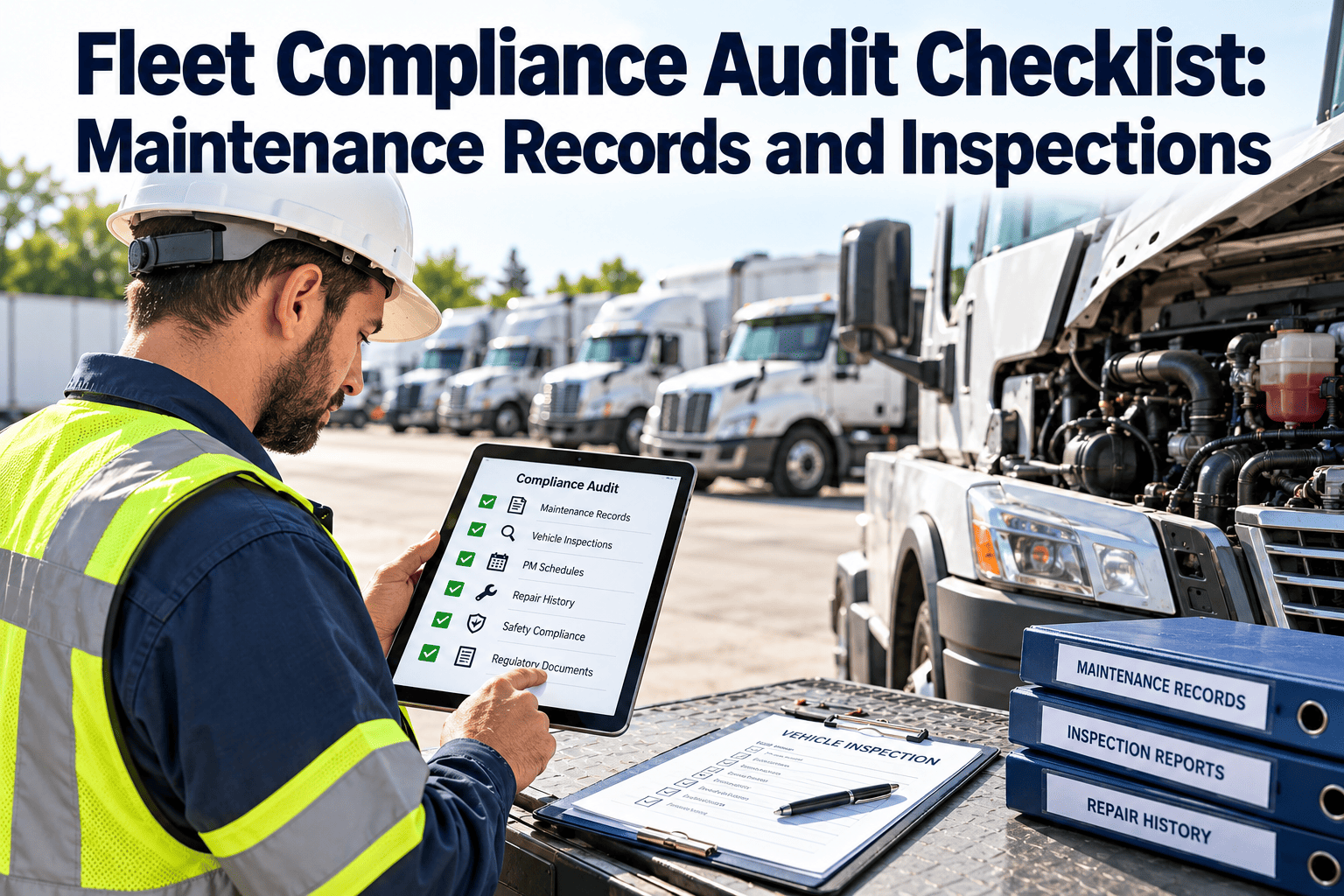
Vehicle maintenance documentation is the most direct evidence of whether a carrier's safety management controls are operational or nominal. An FMCSA investigator reviewing maintenance records can determine within 20 minutes whether brake PM is being performed on schedule, whether OBD fault codes are being actioned, and whether annual inspection certificates are current for every vehicle in the fleet. Store all vehicle maintenance records against each asset profile in Oxmaint — retrievable in 30 seconds.
Annual inspection certificate — current for every CMV in fleet
Every CMV and trailer must have a current annual inspection certificate under §396.17 — no exceptions for vehicles that rarely operate. Maintain a fleet-wide certificate expiry matrix that is reviewed monthly. A vehicle dispatched with an expired annual inspection certificate is an immediate OOS condition that generates a civil penalty and a CSA Vehicle Maintenance BASIC violation. Violation — expired certificate
Annual inspection report — 14-month retention at carrier
The completed annual inspection report must be retained by the carrier for 14 months. The certificate in the vehicle satisfies the on-vehicle requirement; the full inspection report satisfying the carrier retention requirement is a separate document. Many carriers retain the sticker but not the report — producing only the sticker during an audit is a §396.21 violation. Deficiency — report not retained
Vehicle maintenance schedule — systematic inspection programme documented
§396.3 requires carriers to have a systematic inspection, repair, and maintenance programme. Document the programme — interval triggers, inspection scope, and responsible parties. A carrier that performs maintenance but cannot demonstrate a documented systematic programme has a §396.3 violation even if every vehicle is in perfect mechanical condition. Deficiency — no documented programme
Maintenance records — 1 year active, 6 months after vehicle disposition
Maintenance records for each vehicle must be retained for the period the vehicle is in service plus 6 months after sale or disposal. Records must include: vehicle identification, date of inspection, mileage, nature of defect, and the date and name of the person performing the repair. Missing any required field in a maintenance record creates an incomplete record deficiency. Deficiency — incomplete records
SAP Integration tip: Oxmaint's SAP connector syncs maintenance records bi-directionally — every work order completed in the workshop appears in the vehicle's compliance record automatically, with the technician name, date, mileage, and repair description populated from the SAP PM work order data. No manual transcription, no missing fields. Book a demo to see SAP-to-compliance record integration.
4. Drug and Alcohol Testing and Insurance Documentation Checklist
Drug and alcohol clearinghouse compliance and insurance documentation are the two categories most likely to result in immediate operating authority action when deficiencies are discovered. A clearinghouse query not performed before a driver's first dispatch is a §382.701 violation — regardless of the driver's actual drug test history. Insurance lapses, even of a single day, create a gap that can void coverage retroactively for incidents during that period.
Pre-employment clearinghouse query — all new CMV drivers
§382.701 requires a full clearinghouse query before every new CMV driver's first dispatch. A limited query is not sufficient for pre-employment. Retain the query result and the date it was conducted in the driver's DQF. A carrier that dispatches a driver without a completed clearinghouse query is in violation regardless of whether the driver has a positive history in the clearinghouse. Violation — query not conducted
Annual clearinghouse limited query — all active CMV drivers
Carriers must conduct a limited clearinghouse query on every active CMV driver at least once every 12 months under §382.701(b). Build this into the DQF annual review calendar — an annual query due date should be tracked per driver, not managed as a single fleet-wide event. Document query results and dates in each driver's DQF. Violation — annual query missed
Pre-employment drug test — negative result on file before first dispatch
Retain the original negative pre-employment drug test result from a DOT-certified laboratory in the driver's DQF. The test must have been conducted under DOT chain-of-custody protocols. An employer-collected test, a non-DOT lab result, or a test without documented chain of custody does not satisfy §382.301 — regardless of the result. Violation — non-DOT test
Public liability insurance — BMC-91 or BMC-91X on file with FMCSA
Verify current insurance filings are active with FMCSA — check the SAFER system directly, not just your broker's confirmation. Insurance filings can lapse without carrier awareness if a broker fails to refile at renewal. A one-day gap in active FMCSA insurance filing is sufficient grounds for operating authority revocation and leaves the carrier personally liable for any incidents during the gap period. Violation — lapsed filing
Cargo insurance — minimum coverage verified and documented
Verify cargo insurance meets the minimum coverage required for the commodities you transport — general freight minimum is $5,000 per vehicle/$10,000 per occurrence under §387.303. Retain the current policy, the declarations page, and evidence of FMCSA filing. Review coverage at every renewal — rate changes that reduce coverage below the regulatory minimum create an unnoticed violation. Deficiency — below minimum coverage
We had a compliance review that exposed 23 DQF deficiencies across our driver fleet — not because the records didn't exist, but because they were in three different systems and nobody could pull them within the investigator's time limit. After moving everything to Oxmaint, we passed our follow-up review with zero documentation deficiencies. Every record retrieved in under 60 seconds.
DOT Compliance Documentation — Impact Metrics
Digital compliance platforms retrieve any FMCSA-required record in under 30 seconds — vs. 15–45 minutes searching paper files or multiple systems during an investigator's visit.
Maximum civil penalty per documentation violation for carriers with a pattern of non-compliance — a single compliance review can generate multiple simultaneous violations across DQF, HOS, and maintenance categories.
Carriers using automated compliance platforms with expiry tracking and centralised record storage average zero documentation deficiencies in FMCSA compliance reviews vs. 4–6 per review on paper-based systems.
Average time window FMCSA investigators give carriers to produce requested records before citing a failure to produce — the difference between a successful audit and a documentation violation.
Frequently Asked Questions
The most common questions from compliance officers and fleet managers about FMCSA documentation requirements, retention periods, and audit preparation.
DQFs must be retained for 3 years after the driver's employment ends under §391.51. This includes all elements — application, MVR records, medical certificates, road test certificates, and safety performance history documentation. Begin the 3-year retention clock from the date of the driver's last day, not the date the employment was terminated administratively.
A full query returns all clearinghouse violations and is required for pre-employment screening. A limited query returns only whether a violation exists (yes/no) and requires the driver's electronic consent — it is used for annual queries of active drivers. Using a limited query for pre-employment does not satisfy §382.701 and constitutes a violation.
CSA BASIC scores above intervention thresholds, post-accident investigations, driver or shipper complaints, and random selection from the carrier monitoring system. A new carrier's first compliance review is typically triggered 12–18 months after receiving operating authority. High SMS scores in Vehicle Maintenance or Driver Fitness BASICs significantly increase review frequency.
Yes, provided the electronic system maintains record integrity, prevents unauthorised alteration, and produces legible records on demand. FMCSA accepts electronic DQFs, maintenance records, and DVIR records. The system must be capable of producing records immediately during an inspection — a system that requires significant retrieval time or technical support to access records may not satisfy the "readily available" standard.
In order of frequency: missing or expired medical examiner's certificates, DQF elements missing or incomplete, annual inspection certificates expired or reports not retained, HOS records not accessible for the full 6-month period, and clearinghouse query not conducted before first dispatch. All five are 100% preventable with a documented tracking system and automated expiry alerts.
Oxmaint maintains a live compliance dashboard showing every driver's DQF status, medical certificate expiry, clearinghouse query dates, and every vehicle's annual inspection status and maintenance record completeness — with automated 30/14/7-day alerts before any element expires. Any record requested by an investigator is retrievable in under 30 seconds from any device.