Fleet electrification represents one of the most significant operational transformations commercial vehicle operators will undertake this decade, combining capital investment decisions, infrastructure development, regulatory compliance, operational workflow changes, and long-term strategic planning into a complex multi-year transition that touches every aspect of fleet management. Unlike consumer EV adoption driven primarily by personal preference and environmental consciousness, commercial fleet electrification requires rigorous total cost of ownership analysis balancing vehicle acquisition costs, charging infrastructure investment, energy expenses, maintenance savings, resale value projections, and regulatory incentives against operational constraints including vehicle range limitations, charging time requirements, payload capacity reductions, and route feasibility. The complexity intensifies when considering that fleet electrification is not a simple vehicle swap but a complete operational transformation requiring charging infrastructure deployment, electrical service upgrades potentially costing hundreds of thousands of dollars, technician training on high-voltage systems, route optimization for range constraints, and integration with telematics and energy management systems. Organizations approaching electrification strategically rather than reactively achieve 25-40% better TCO outcomes and avoid the costly mistakes that plague rushed deployments. This is where comprehensive fleet management platforms become essential for tracking EV performance data, managing charging operations, and coordinating the complex transition process. Fleet managers can use OxMaint to track EV transition progress, monitor charging infrastructure utilization, and coordinate multi-phase electrification deployments across diverse vehicle classes and operational territories.
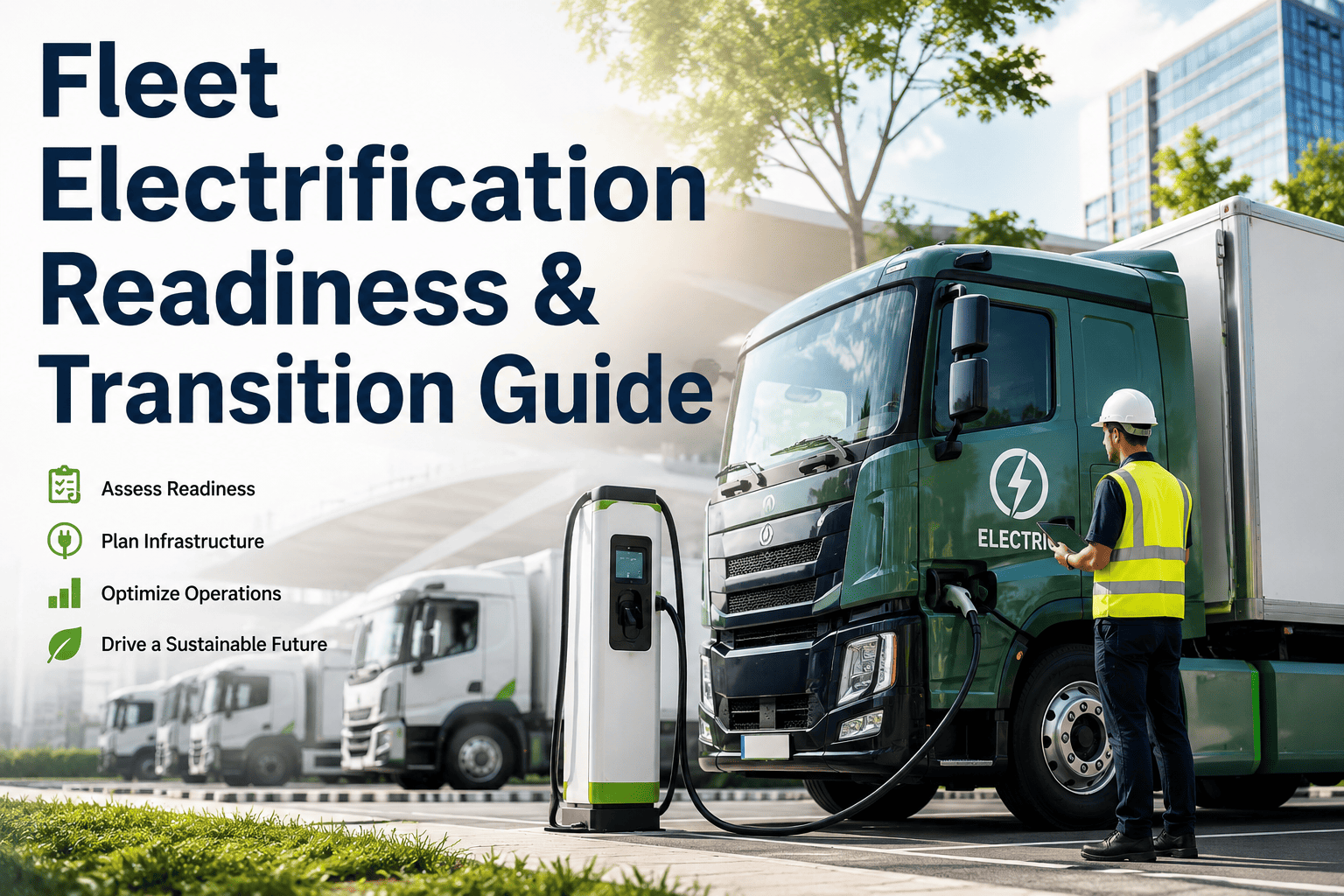
Electrify Your Fleet Without
The Growing Pains
Strategic EV transition roadmap from vehicle selection through charging infrastructure deployment to full-scale operations — with TCO modeling, route analysis, and phased implementation that actually works.
Why Fleet Electrification Requires Strategic Planning
Commercial fleet electrification differs fundamentally from consumer EV adoption because fleet operators cannot afford trial-and-error experimentation with mission-critical transportation assets generating revenue and serving customers daily. Fleet electrification decisions involve capital commitments of $150,000-$400,000 per electric Class 8 truck, $50,000-$150,000 per electric delivery van, plus charging infrastructure investments ranging from $50,000 for basic Level 2 depot charging to $500,000+ for DC fast charging stations and electrical service upgrades. Poor planning leads to predictable failures including vehicles with insufficient range for actual route requirements, charging infrastructure inadequate for overnight fleet charging needs, electrical service capacity constraints requiring expensive utility upgrades discovered after equipment procurement, technician skill gaps creating dangerous situations working with 400-800V systems, and TCO models built on unrealistic assumptions about energy costs, vehicle reliability, and resale values. Strategic electrification planning addresses these risks through comprehensive route analysis identifying which vehicles can transition to electric immediately versus requiring technology maturation, detailed TCO modeling incorporating all lifecycle costs and revenue impacts, phased deployment spreading capital requirements and operational learning across multiple stages, charging infrastructure design matching actual operational workflows, and integration with existing fleet management systems ensuring data visibility into EV performance. Organizations implementing this disciplined approach achieve electrification TCO improvements of 30-45% compared to industry averages while avoiding the operational disruptions that derail poorly planned transitions.
Maintenance cost reduction with EVs — no oil changes, transmission service, exhaust systems, or engine overhauls. Brake wear reduced 40-60% through regenerative braking recovery.
Average electricity cost per mile for commercial EVs compared to $0.15-$0.35 per mile for diesel. Savings multiply across high-mileage fleet operations generating 50,000+ miles annually.
Typical payback period for fleet EV investment depending on duty cycle, fuel savings, incentives, and charging infrastructure costs. High-utilization urban delivery sees fastest ROI.
Potential cost of electrification mistakes — wrong vehicle selection, inadequate charging infrastructure, electrical service upgrades, and operational disruptions from poor planning and rushed deployment.
Fleet Electrification Readiness Assessment Framework
Successful electrification begins with honest assessment of current fleet operations identifying which vehicles, routes, and use cases are electrification-ready today versus requiring future technology improvements or operational modifications. Route and duty cycle analysis examines daily mileage, trip patterns, idle time, terrain, payload, climate conditions, and availability of charging opportunities determining whether available EV ranges meet operational requirements with adequate safety margin. Vehicle application suitability evaluates each fleet segment separately because electrification feasibility varies dramatically between last-mile delivery vans achieving 100-150 mile daily routes, regional trucks requiring 200-300 mile range, and long-haul tractors where current battery technology cannot yet support 500+ mile daily requirements. Charging infrastructure feasibility assesses depot electrical service capacity, available space for charging stations, overnight dwell time sufficient for Level 2 charging, and potential need for en-route DC fast charging requiring different infrastructure investment. Financial viability modeling calculates total cost of ownership including vehicle acquisition premiums, infrastructure investment, energy savings, maintenance reductions, incentives, and resale value projections determining whether specific vehicle classes justify electrification investment today. Organizational readiness evaluates technician training requirements, parts inventory changes, software system integration needs, and operational process modifications required to support EV fleet operations. This comprehensive assessment typically reveals that 20-40% of current fleet vehicles are excellent electrification candidates today, another 30-50% will become viable within 3-5 years as technology improves and costs decline, and remaining vehicles require longer timelines or alternative powertrain solutions. Schedule a consultation to assess your fleet's electrification readiness and develop a strategic transition roadmap aligned with your operational requirements and financial objectives.
Total Cost of Ownership Analysis for Fleet EVs
Accurate TCO modeling is absolutely critical for sound electrification decisions because upfront vehicle acquisition costs represent only 40-60% of total lifecycle expenses, and flawed assumptions about operating costs, residual values, or infrastructure requirements lead to catastrophically wrong investment decisions. Comprehensive TCO analysis spans 5-10 year ownership periods incorporating vehicle acquisition costs including manufacturer pricing, available incentives, tax credits, grants, and any operational modifications required for specific applications. Charging infrastructure costs include equipment procurement for Level 2 or DC fast chargers, installation labor, electrical service upgrades potentially requiring utility transformer upgrades or service panel replacements, ongoing maintenance, network subscription fees, and electricity demand charges. Energy costs calculate kilowatt-hours consumed per mile based on vehicle efficiency and route characteristics, electricity rates including time-of-use pricing if charging during off-peak hours, demand charges that can dramatically increase commercial electricity costs, and fuel cost volatility compared to diesel price fluctuations. Maintenance savings account for elimination of oil changes, transmission service, exhaust system repairs, diesel particulate filter regeneration, and reduced brake wear from regenerative braking while adding new costs for battery conditioning, high-voltage system inspections, and specialized technician training. Operational impacts include any range-induced route modifications, charging time affecting vehicle utilization, cold weather performance degradation requiring operational adjustments, and payload capacity reductions from battery weight. Residual value projections estimate vehicle worth at disposal considering EV resale market maturity, battery degradation concerns, and technology obsolescence risk. The resulting TCO comparison often shows EVs achieving 15-35% cost advantage over diesel equivalents in high-utilization urban duty cycles while remaining 10-25% more expensive for long-haul applications where current technology cannot compete — making vehicle-by-vehicle analysis essential rather than fleet-wide generalizations.
Model Your Fleet's Electrification TCO
OxMaint provides TCO analysis tools comparing electric versus conventional vehicles across your specific duty cycles, energy costs, incentive programs, and operational requirements — generating data-driven electrification recommendations.
Charging Infrastructure Strategy and Design
Charging infrastructure represents one of the largest capital investments and most complex engineering challenges in fleet electrification, requiring careful planning around electrical capacity, charger technology selection, installation logistics, network connectivity, and future scalability. Level 2 charging using 208-240V power delivers 10-20 kW charging rates sufficient for overnight depot charging of most delivery and service vehicles accumulating 80-150 miles daily, with installation costs ranging from $2,000-$8,000 per port including electrical work. DC fast charging delivers 50-350 kW enabling 80% charge in 30-90 minutes supporting higher-utilization vehicles or mid-day opportunity charging, but equipment costs range from $50,000-$150,000 per dispenser plus substantial electrical service upgrades and ongoing demand charges creating operational expenses of $0.02-$0.05 per kWh beyond energy costs. Electrical service capacity assessment is absolutely critical because adding 20 Level 2 chargers drawing 200 kW total often exceeds available service panel capacity requiring utility transformer upgrades costing $100,000-$500,000 and 6-12 month lead times that delay entire electrification projects. Smart charging and load management systems optimize charging schedules to minimize utility demand charges, leverage time-of-use rates by charging during off-peak hours, balance loads across available electrical capacity, and integrate with renewable energy sources or battery storage systems. Network connectivity and software integration enable remote monitoring, energy consumption tracking, billing management for mixed fleet and visitor charging, and integration with fleet management platforms like OxMaint providing operational visibility into charging status, energy costs, and infrastructure utilization. Future scalability planning ensures initial infrastructure can expand without complete redesign by oversizing electrical service, installing conduit for future charger additions, and selecting expandable network management platforms. The total infrastructure investment for electrifying a 50-vehicle delivery fleet typically ranges from $250,000-$750,000 depending on charging speed requirements, electrical service constraints, and site-specific conditions — representing 15-25% of total electrification program costs and requiring as much planning attention as vehicle selection itself.
Depot Overnight Charging
Standard solution for most fleet operations. 208-240V, 10-20 kW charging rate. 6-12 hours to full charge. Minimal electrical infrastructure upgrades. Lowest installation and operating costs.
Opportunity Charging
High-power DC charging for mid-day charging or high-utilization vehicles. 50-150 kW commercial rate. 80% charge in 45-90 minutes. Requires substantial electrical upgrades and creates demand charges.
Heavy-Duty Fast Charging
Emerging standard for Class 7-8 trucks. 350 kW-1 MW charging capability. 80% charge in 30-60 minutes for 300+ mile range batteries. Infrastructure immature but coming 2025-2027.
Load Management Systems
Software optimizes charging schedules across fleet to minimize utility demand charges, leverage time-of-use rates, balance electrical loads, and prevent service panel overload during peak charging.
Stationary Energy Storage
Second-life EV batteries or dedicated storage systems buffer charging loads, reduce demand charges, enable renewable energy integration, and provide backup power during outages.
Renewable Integration
Rooftop or carport solar arrays offset charging energy costs while reducing carbon footprint. Battery storage captures excess solar for evening charging. Improves sustainability metrics.
Phased Deployment Strategy and Risk Management
Phased electrification deployment spreads capital requirements, operational learning, and technology risk across multiple implementation stages rather than attempting risky all-at-once fleet conversion that could cripple operations if problems emerge. Phase 1 pilot deployment typically involves 5-15 vehicles in carefully selected applications with highest electrification readiness — predictable urban routes, adequate overnight charging time, supportive operational teams, and favorable TCO projections. This initial phase validates assumptions about vehicle performance, charging infrastructure adequacy, operational workflows, maintenance requirements, and actual TCO versus projections while building organizational competency in EV fleet management at manageable scale and risk. Phase 2 expansion scales to 20-40% of electrification-suitable vehicles once pilot demonstrates operational viability, incorporating lessons learned into infrastructure design, operational procedures, training programs, and vendor selection. Phase 3 acceleration pushes toward 60-80% electrification of suitable segments as technology costs decline, charging infrastructure matures, organizational expertise deepens, and TCO advantages become increasingly compelling. Final phase completion addresses remaining challenging applications as battery technology improves, charging networks expand, and alternative solutions emerge for applications ill-suited to battery-electric powertrains like hydrogen fuel cells or renewable natural gas. This phased approach typically spans 3-7 years for complete fleet transition compared to 1-2 year aggressive timelines that often result in operational failures, stranded infrastructure investments, and electrification program abandonment. Risk management throughout deployment includes maintaining ICE vehicle availability for backup during EV operational issues, conservative range assumptions building safety margins into route planning, redundant charging infrastructure preventing single-point failures, and comprehensive data collection enabling continuous TCO monitoring and adjustment.
Pilot Deployment: Prove the Concept
Deploy 5-15 EVs in best-case applications with highest electrification readiness. Install minimal viable charging infrastructure. Test operational workflows. Validate TCO assumptions. Build organizational expertise. Duration: 6-12 months before expanding.
Scale-Up: Expand Infrastructure
Increase to 20-40% of electrification-suitable vehicles. Install expanded charging network incorporating pilot lessons. Implement smart load management. Formalize training programs. Begin realizing TCO benefits at scale. Duration: 12-24 months.
Acceleration: Mainstream Operations
Push toward 60-80% electrification of suitable segments as costs decline and expertise deepens. Optimize charging operations. Integrate with renewable energy. Achieve substantial emissions reductions and operating cost savings. Duration: 24-48 months.
Completion: Address Remaining Challenges
Electrify remaining applications as technology improves. Explore alternatives like hydrogen or renewable natural gas for unsuitable applications. Achieve fleet electrification goals while maintaining operational excellence. Duration: 36-60 months total program.
Manage Your Entire Electrification Program
OxMaint tracks EV deployment progress, charging infrastructure utilization, energy consumption patterns, maintenance performance, and actual TCO versus projections — providing complete visibility into your electrification transition.
EV Fleet Maintenance and Technician Training
Electric vehicle maintenance differs fundamentally from conventional fleet service requiring specialized training, safety equipment, diagnostic tools, and operational procedures while simultaneously eliminating 40-60% of traditional maintenance tasks. High-voltage safety training is absolutely mandatory for any technician working on EVs because 400-800V electrical systems present electrocution hazards requiring proper lockout-tagout procedures, personal protective equipment including insulated gloves rated for voltage levels, arc flash protection, and emergency response protocols. EV-specific maintenance focuses on battery system monitoring and conditioning, cooling system service for battery thermal management, high-voltage electrical connections and insulation resistance testing, brake system inspection accounting for reduced wear from regenerative braking, tire wear monitoring often accelerated by instant torque and increased vehicle weight, and software updates increasingly critical for EV performance and safety. Eliminated maintenance includes engine oil and filter changes, transmission service, exhaust system repairs, diesel particulate filter regeneration, fuel system maintenance, and complex engine diagnostics — representing 40-60% cost reduction in scheduled maintenance versus diesel equivalents. Parts inventory transformation involves stocking fewer but more specialized components including HV fuses and contactors, battery management system modules, electric motor components, specialized coolants and thermal interface materials, and high-voltage cables. Diagnostic equipment investment requires manufacturers' diagnostic tools, battery testers, insulation resistance meters, and thermal imaging cameras. The transition creates both challenges in technician training and certification while opening opportunities for more technical, higher-skilled maintenance workforce less focused on routine oil changes and more on complex electrical systems troubleshooting and optimization.
Incentives, Regulations, and Policy Landscape
Fleet electrification financial viability often depends heavily on federal, state, and local incentive programs plus evolving regulatory requirements creating both carrots and sticks driving commercial EV adoption. Federal incentives include Commercial Clean Vehicle Credit providing up to $40,000 tax credit per qualifying electric commercial vehicle under 14,000 lbs GVWR or $7,500 for smaller vehicles, Alternative Fuel Infrastructure Tax Credit covering 30% of charging equipment and installation costs up to $100,000, and various grant programs through DOE, EPA, and DOT supporting electrification pilots and infrastructure deployment. State-level programs vary dramatically with California leading through HVIP vouchers providing $45,000-$120,000 per truck, Low Carbon Fuel Standard credits generating ongoing revenue from EV operations, and stringent Advanced Clean Trucks regulation requiring manufacturers to sell increasing percentages of zero-emission vehicles. Utility incentive programs offer managed charging rebates, time-of-use rates with off-peak discounts, demand charge reductions for smart charging, and infrastructure installation support. Regulatory pressures increasingly mandate electrification through emission standards, zero-emission zones restricting diesel vehicle access in urban cores, and procurement requirements for government fleets. The combined impact of these programs can reduce EV acquisition costs by 30-50% and infrastructure costs by 20-40% fundamentally transforming TCO calculations, but accessing incentives requires navigating complex application processes, eligibility requirements, documentation standards, and compliance obligations. Forward-looking fleet managers incorporate incentive program timelines into deployment planning while recognizing that incentive availability will likely decline as EV adoption accelerates and programs sunset — creating strategic advantage for early adopters capturing maximum financial support.
| Incentive Type | Program Examples | Typical Value | Eligibility | Application Process | Strategic Timing |
|---|---|---|---|---|---|
| Federal Tax Credit | Commercial Clean Vehicle Credit | $7,500-$40,000 per vehicle | New commercial EVs under 14K lbs | IRS Form 8936 with tax filing | Available through 2032 then phase-out begins |
| State Vouchers | CA HVIP, NY Truck Voucher | $45,000-$120,000 per truck | Fleet size limits, first-come funding | Online application, vehicle order proof | Apply before placing orders, funds limited |
| Infrastructure Credits | Alt Fuel Infrastructure Tax Credit | 30% of costs up to $100K | Charging equipment installation | IRS Form 8911 with tax filing | Extended through 2032 under IRA |
| Utility Rebates | Managed charging, TOU rates | $500-$5,000 per charger | Smart charging enrollment | Utility program application | Ongoing programs, apply during install |
| LCFS Credits | California Low Carbon Fuel Std | $0.01-$0.03 per kWh revenue | CA operations, credit generator | ARB reporting, quarterly settlements | Ongoing revenue stream for CA fleets |
| Grant Programs | DOE SuperTruck, EPA Clean Ports | 50-80% cost share | Competitive application process | Detailed proposal, match requirements | Annual solicitations, 6-12 month awards |
Frequently Asked Questions
Which fleet applications are best suited for electrification today versus requiring future technology improvements
Electric vehicles excel today in last-mile delivery and urban service applications with predictable routes under 150 miles daily, return-to-base operations enabling overnight depot charging, and minimal payload sensitivity. Examples include parcel delivery vans, food service trucks, municipal vehicles, utility service trucks, and shuttle buses. These applications achieve 25-35% TCO advantage over diesel with 3-5 year payback periods. Regional distribution and medium-haul applications in the 200-300 mile daily range are becoming viable with current EV technology especially when DC fast charging infrastructure is available, achieving TCO parity or modest advantage depending on duty cycle and energy costs. Long-haul trucking over 500 miles daily remains challenging for battery-electric vehicles due to range limitations, charging time impacting productivity, and infrastructure immaturity, though megawatt charging and improved battery technology expected 2027-2030 will enable these applications. The key is conducting vehicle-by-vehicle analysis rather than fleet-wide generalizations — even within single fleets, some routes are electrification-ready while others require technology maturation or alternative solutions like hydrogen fuel cells or renewable natural gas.
What are the most common and costly mistakes in fleet electrification planning
The biggest electrification mistakes include underestimating charging infrastructure costs and complexity — fleets often budget vehicle acquisition but fail to account for $250,000-$750,000 in charging equipment, installation, and electrical service upgrades for 50-vehicle deployments. Inadequate electrical capacity assessment discovers after equipment procurement that existing service panels cannot support planned charging loads requiring $100,000-$500,000 utility upgrades with 6-12 month delays. Unrealistic TCO assumptions using overly optimistic energy costs, underestimating demand charges, ignoring cold weather performance degradation, or assuming unrealistic residual values lead to failed business cases. Wrong vehicle selection choosing EVs for applications with insufficient range, inadequate charging time, or payload constraints requiring operational compromises. Rushed deployment attempting fleet-wide conversion without pilot validation creates operational chaos when problems emerge at scale. Successful electrification requires comprehensive planning addressing vehicles, infrastructure, operations, training, and financial modeling together rather than as disconnected workstreams. Use OxMaint to coordinate electrification planning and track deployment progress systematically.
How should fleets approach charging infrastructure design and what technologies should they prioritize
Charging infrastructure strategy should match operational requirements and deployment phases. Level 2 AC charging at 10-20 kW serves as foundation for most depot operations providing 6-12 hour overnight charging sufficient for vehicles accumulating 80-150 miles daily at installation costs of $2,000-$8,000 per port. Smart load management systems are critical for optimizing charging schedules to minimize utility demand charges potentially saving 20-40% on electricity costs while preventing electrical service overload. DC fast charging at 50-150 kW supports higher-utilization vehicles requiring mid-day opportunity charging or limited overnight dwell time but involves $50,000-$150,000 per dispenser plus substantial electrical upgrades and ongoing demand charges. Future scalability planning ensures initial infrastructure can expand by oversizing electrical service capacity, installing conduit for future charger additions, and selecting expandable network platforms. Most fleet operations should prioritize Level 2 depot charging with smart load management for Phase 1 deployment, add DC fast charging selectively for high-utilization routes in Phase 2, and consider megawatt charging for heavy trucks as infrastructure matures in Phase 3.
Your Electrification Roadmap Starts Here
OxMaint provides the planning tools, TCO modeling, deployment tracking, and operational visibility you need to transition your fleet to electric vehicles strategically — avoiding costly mistakes while maximizing financial and environmental benefits.