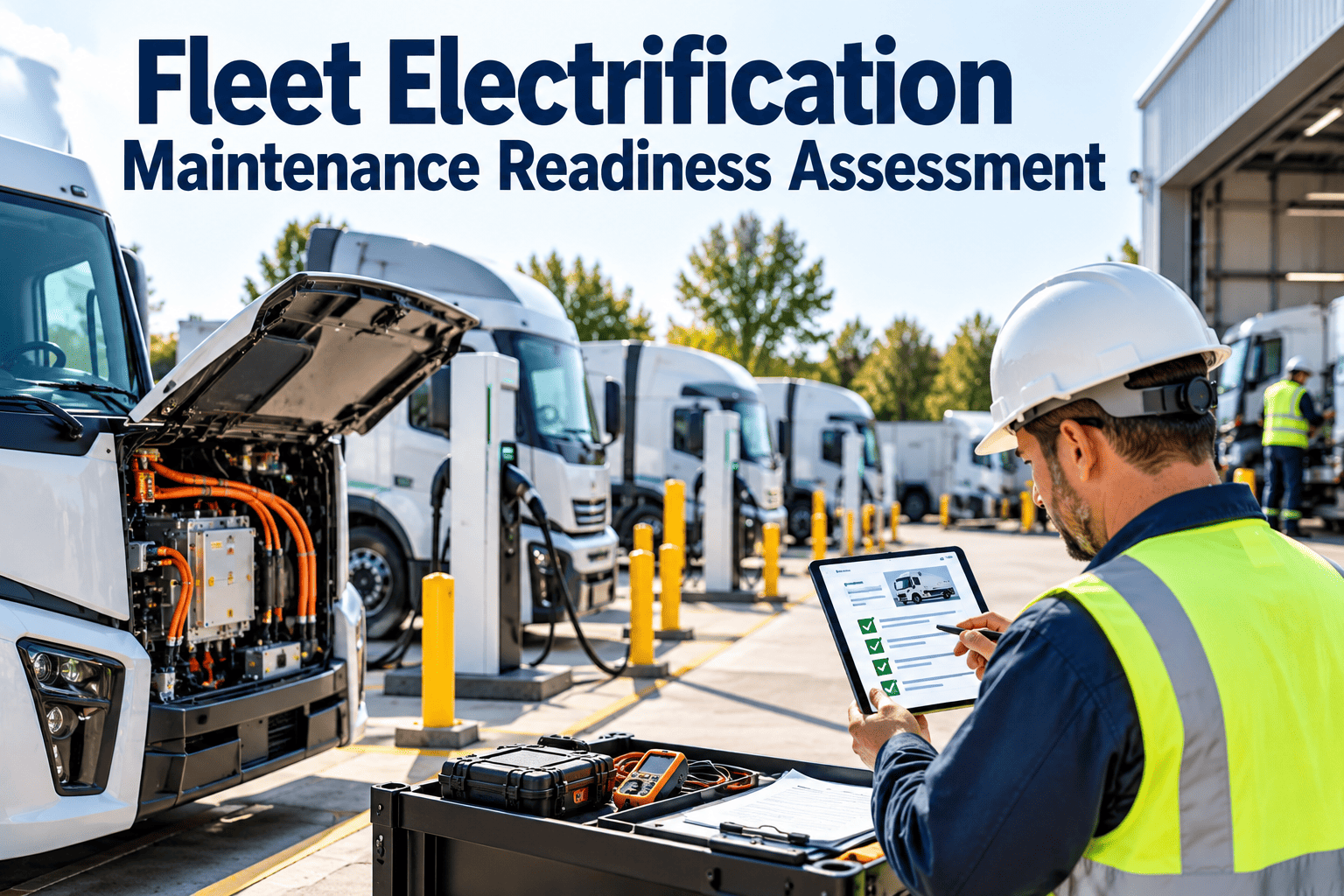
Most electrification plans begin with vehicle selection, charger procurement and grid capacity, and the maintenance question arrives later, usually after the first trucks are already on the road. By then, technicians have not been qualified for high-voltage work, parts and tooling do not match the new asset mix, and inspection routines still assume an engine, a fuel system and an exhaust. A maintenance readiness assessment closes that gap before it costs uptime. This checklist walks fleet, maintenance and safety teams through the people, process, facility and data checks that decide whether an electric fleet runs reliably, and shows where a maintenance management platform keeps the evidence in one place.
Fleet Electrification Maintenance Readiness Assessment
What Changes in Maintenance When a Fleet Goes Electric
- Oil, filter and fuel system service drive most preventive maintenance intervals.
- Exhaust aftertreatment faults dominate diagnostic time.
- Brake linings wear on a predictable mileage curve.
- Technicians work with familiar hazards and standard shop tooling.
- Fuel is dispensed on site or on the road with little scheduling impact.
- Battery health, thermal management and software status drive much of the planning.
- High-voltage isolation faults and coolant circuits need qualified staff.
- Regenerative braking reduces friction brake wear but can leave components under-used and corroded.
- Higher vehicle weight and instant torque change tyre wear patterns.
- Charging windows, not fuel stops, shape when vehicles can be serviced.
The takeaway: electric vehicles remove some maintenance tasks, but they add new ones that existing fleet routines do not cover.
Readiness Scoring Matrix
| Readiness Area | Not Ready | Partly Ready | Ready |
|---|---|---|---|
| High-voltage skills | No qualified technicians; work outsourced ad hoc | Some staff trained, no documented authorisation list | Qualified staff recorded against each task type |
| Charging infrastructure | Installed but not in any asset register | Registered, inspected irregularly | Chargers inspected on a schedule with fault history |
| Inspection templates | Diesel checklists reused | EV items added on paper | EV-specific digital inspections with required fields |
| Parts and tooling | No stocking plan | Critical items identified, not tracked | Minimums, vendors and lead times managed |
| Warranty and recalls | Handled by email | Tracked in spreadsheets | Linked to each vehicle history and work order |
| Data and reporting | No EV baseline | Downtime logged inconsistently | Uptime, charging and defect trends on dashboards |
The Assessment Checklist
- List every task on the EV, from battery coolant service to isolation testing, and mark which need high-voltage qualification.
- Record the training, authorisation date and renewal date for each technician against those task types.
- Confirm lockout and tagout steps, insulated tools and personal protective equipment are defined and available at each bay.
- Write a rule for who may move, tow, jack or store a vehicle that has suffered collision or battery damage.
- Brief drivers on what to report, such as warning messages, unusual smells, reduced range or charging interruptions.
- Assign an asset record to every charger, connector, cable and distribution panel, with location and commissioning date.
- Schedule inspections of cable insulation, connector pins, housings, mounting and ground continuity.
- Check bay layout, ventilation, floor marking and clearance for tall roof-mounted battery packs.
- Agree an emergency response plan with local fire services for damaged or overheated batteries, including designated quarantine space.
- Confirm who owns charger faults, the fleet team, the site team or the supplier, and how quickly each must respond.
- Build EV pre-trip and post-trip inspections that include charge port condition, warning messages, coolant level and tyre condition.
- Replace mileage-only intervals with a mix of time, mileage, energy throughput and condition triggers where the manufacturer allows.
- Add brake inspections for corrosion and seized sliders on vehicles that rarely use friction brakes.
- Plan tyre rotation and pressure checks around the extra weight and torque of the vehicle.
- Keep the manufacturer's service schedule attached to the asset, so warranty conditions are met and evidenced.
- Identify long-lead items such as charge ports, contactors, coolant pumps, DC converters and cabling, and set minimum stock.
- Decide which repairs happen in house, which go to the dealer and which are covered by warranty.
- Record diagnostic tools, software licences and calibration dates as maintainable assets.
- Define how battery packs and high-voltage components are stored, handled and returned.
- Capture a baseline for each vehicle at handover: battery state of health where available, software version and inspection results.
- Log charging faults, derated operation and unplanned stops in a form that can be grouped by vehicle, charger and site.
- Keep training records, inspection records and recall actions retrievable for audits and insurer questions.
- Choose the few metrics you will review monthly and who owns each one.
Turn Readiness Gaps Into Scheduled Work
Where Electrification Maintenance Goes Wrong
A Phased Path to Maintenance Readiness
How a CMMS Supports Each Readiness Area
Metrics to Track After Go-Live
Compliance Evidence Without the Scramble
Practical Tips for a Smoother Transition
- Start with the duty cycle. Route length, payload, dwell time and climate affect energy use and service planning more than any generic schedule.
- Treat the first months as a data collection exercise. Intervals set from manufacturer guidance can be adjusted once real fault and wear history exists.
- Standardise fault descriptions. Drivers who use the same wording for warning messages make trend analysis possible.
- Keep vendors accountable. Log supplier response times against each charger or vehicle fault so service agreements can be reviewed with evidence.
- Review monthly. A short review of open defects, overdue inspections and parts shortages prevents small gaps becoming downtime.
Building a Technician Qualification Matrix
Charging Infrastructure Maintenance Routine
- Daily or per shift. Drivers and yard staff check cable condition, connector cleanliness, holster fit, display messages and obvious damage from vehicle impacts or crushing.
- Monthly. Technicians inspect enclosures, seals, cooling vents, mounting, signage and cable management, and confirm charge sessions complete as expected.
- Annually or per supplier guidance. A qualified electrician or the supplier carries out electrical safety testing, firmware review and protective device checks.
- After any incident. A vehicle strike, flooding, a fault trip or a reported shock must lead to the unit being locked out and inspected before returning to use.
- Record everything against the charger. Fault codes, session failures, outages and repairs build the evidence you need for supplier performance discussions.
Battery and Thermal Management Checks
- Coolant level, hose condition and visible leaks in the battery and power electronics circuits.
- Pack housing damage, underbody impacts and corrosion at mounting points.
- Warning messages, derating events and incomplete charge sessions reported by drivers.
- Software and firmware versions compared with the latest manufacturer release.
- Coolant loss that cannot be explained, or coolant where it should not be.
- Swelling, deformation or heat damage on the pack or surrounding components.
- Repeated isolation fault warnings or sudden loss of range.
- Any smell, smoke or noise that the manufacturer treats as a safety event.
Questions to Put to Vendors Before Delivery
- What training do you provide, and does it satisfy the qualification your insurer and local regulations expect?
- Which components are expected to need replacement in the first years, and what are the lead times?
- Which diagnostics are available to the fleet, and which are restricted to the dealer?
- How are software updates released, and who is responsible for applying and recording them?
- What response times apply to a vehicle or charger fault, and how are they measured?
- What does warranty require from us in terms of service records and approved repairers?