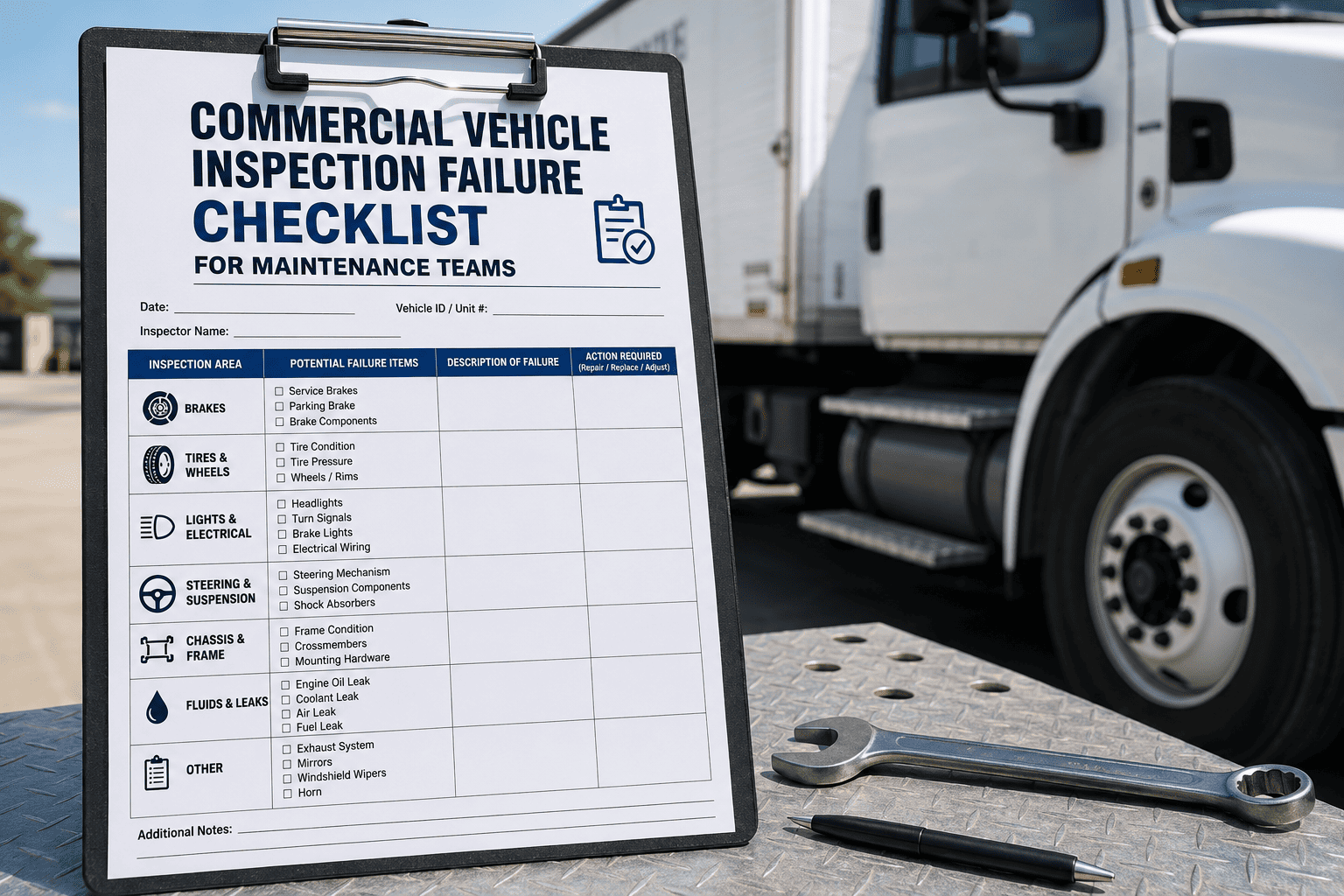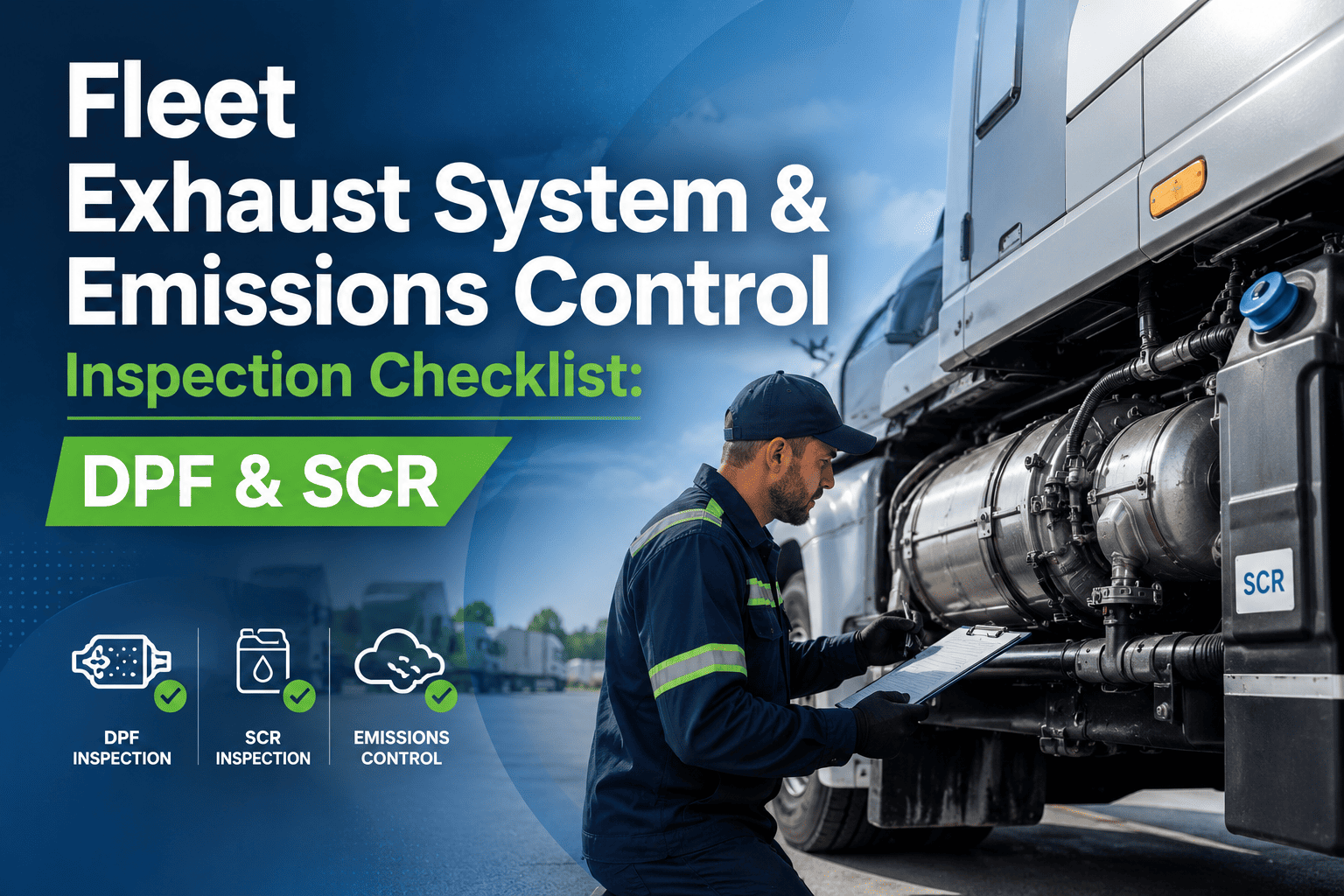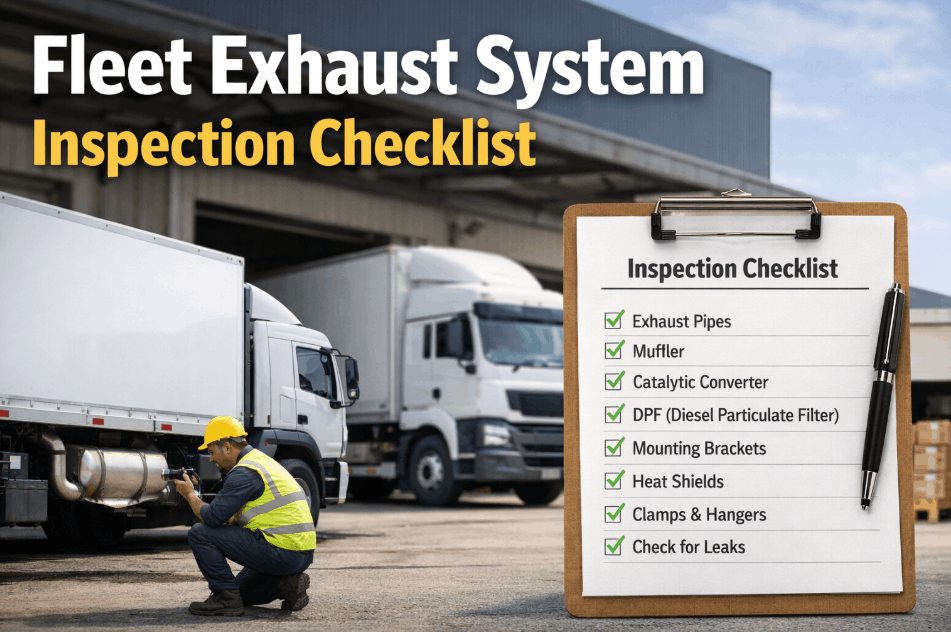
An exhaust leak on a commercial vehicle is not a noise complaint — it is a carbon monoxide risk and an immediate DOT OOS condition under §393.83. A DPF at 100% soot load that fails to regen poisons the SCR catalyst and produces a $6,000+ repair bill. Heat shields rattling loose for weeks are conducting exhaust temperatures directly to brake lines and fuel hoses not rated for that heat. Every one of these failures is detectable before it becomes dangerous. Oxmaint schedules exhaust PM, records DPF regeneration data, and triggers repair work orders for every defect.
Exhaust System — Component Inspection Chain
Modern diesel exhaust systems flow through up to six distinct components before the gas exits the tailpipe. A defect at any stage affects both the performance and compliance status of every component downstream. The inspection chain below shows each component in flow order — inspect from front to rear, never skip a stage.
Technology Improving Fleet Exhaust Compliance
Modern diesel exhaust aftertreatment systems generate more data than any other vehicle subsystem — DPF soot load, SCR NOx conversion efficiency, EGR delta pressure, and regeneration cycle frequency. Four technologies make this data actionable for fleet maintenance teams rather than invisible until a warning light appears. Oxmaint integrates all four into one exhaust compliance PM workflow.
1. Exhaust Manifold, Pipes and Leak Detection Checklist
Exhaust leaks forward of the driver's position are an immediate OOS condition under DOT §393.83 — no warning, no grace period. A cracked manifold that hisses at idle is pumping carbon monoxide into the cab every time the engine is under load. Record exhaust leak findings per vehicle in Oxmaint before releasing for service.
Exhaust manifold — cracks, warped flanges and gasket leaks
Listen for ticking at cold start — manifold cracks close when hot. Black sooting around the gasket face confirms a leak regardless of noise level. OOS — any manifold leak
Down pipe and flex joint — fatigue cracks and separation
Flex joints fail from metal fatigue — inspect for visible cracks in the bellows section and check for separation at the joint face with gloved hand. OOS — any flex joint separation
All clamps and slip joints — correct position and clamping load
A clamp over a slip joint weld rather than the joint itself provides no clamping force — verify position on every clamp. Defect — clamp over weld bead
Exhaust pipe corrosion — wall thickness at stress points
Inspect pipe bends for heavy pitting — a corroded bend that holds pressure at idle will fail under the load vibration of a motorway run. Defect — heavy pitting at bends
Exhaust leak detection — paper torch or propane probe method
Use a propane detector or burning paper near all joints at idle — any flame deflection or blowout confirms a leak location. Never use bare hands near hot exhaust components. OOS — any leak forward of cab
Turbocharger outlet pipe — connection and cracked rubber
The rubber coupling between the turbo outlet and the intercooler pipe is a common failure point — boost pressure splits the rubber and causes an exhaust leak at the pressure side. Defect — split coupling
AI Camera tip: Thermal cameras detect exhaust manifold cracks by the heat signature difference between the cracked section and the surrounding metal — catching leaks that are silent at inspection but active under load, without the technician needing to be under the vehicle. See Oxmaint's thermal exhaust leak detection integration.
2. DPF, SCR and Aftertreatment Checklist
Diesel aftertreatment systems are the most expensive fleet maintenance items per component — a new DPF runs $2,000–$4,000 before labour. Most DPF failures are caused by premature clogging from oil ash contamination, short-distance operation that prevents passive regen, or AdBlue dosing faults that allow SCR catalyst poisoning. Track DPF soot load and regen history per vehicle in Oxmaint.
DPF soot load percentage — read from OBD data
Any vehicle at or above 85% soot load requires a forced regen before the next long dispatch — at 100% the DPF locks out the engine. OOS — soot load above 95%
DPF regen frequency — excessive regens indicate a fault
More than one forced regen per week indicates a DPF that is loading faster than normal — investigate oil consumption, EGR fault, or fuel injection issues. Defect — excessive regen frequency
DPF pressure differential — delta pressure within specification
High delta pressure across the DPF at normal operating temperature indicates ash loading that requires professional cleaning — not a forced regen. Defect — delta pressure above spec
AdBlue/DEF level and dosing — no dosing fault codes
Verify AdBlue level is above minimum and check for NOx aftertreatment fault codes — an SCR that is not dosing is producing illegal NOx emissions on every run. OOS — active dosing fault
SCR catalyst — DEF crystal deposits and conversion efficiency
White crystalline deposits around the SCR injector port indicate DEF weeping — a partially blocked injector produces urea crystallisation that reduces SCR efficiency over time. Defect — crystal deposits at injector
EGR system — no exhaust soot deposits in intake manifold
Inspect the intake manifold for soot deposits — heavy soot indicates EGR cooler failure or EGR valve stuck open, which accelerates DPF loading. Defect — heavy soot in intake
3. Muffler, Heat Shields and Mounting Checklist
Heat shields, mounting brackets, and the muffler are the exhaust components most likely to fail between PM events — because they are attacked by road salt, vibration, and heat cycling on every run. A heat shield that has detached and is resting on a brake line or fuel hose is conducting exhaust temperatures directly to a component not designed to operate above 80°C. Log mounting and heat shield inspection findings per vehicle in Oxmaint.
Muffler — corrosion, physical damage and internal rattle
Tap the muffler and listen for internal baffle rattle — a detached baffle restricts gas flow and creates a drone that drivers often adapt to rather than report. Defect — audible internal rattle
All heat shields — securely mounted with no contact with fuel or brake lines
A missing or detached heat shield adjacent to fuel or brake components is an immediate OOS condition — fuel ignition and brake fluid vapour lock risk. OOS — shield touching fuel/brake line
All exhaust mounting hangers and brackets — no cracks or detachment
A missing hanger allows the exhaust to sag — loading remaining hangers asymmetrically and fatigue-cracking joints within weeks of onset. Defect — missing or cracked hanger
Tailpipe direction and extension — does not discharge toward cab or tyres
Per §393.83, the tailpipe must not discharge in a direction that directs exhaust gas toward a passenger area or fuel filler cap. OOS — discharging toward cab
Exhaust rubber isolators and vibration mounts — condition check
Cracked or missing rubber isolators allow exhaust vibration to transmit directly to the chassis — accelerating crack initiation at manifold flanges and welded joints. Defect — cracked isolators
Exhaust clearance from chassis and body panels — minimum 50mm
Verify all exhaust routing maintains minimum 50mm clearance from chassis members, wiring, and body panels at all load positions. Defect — below minimum clearance
OBD Integration tip: Oxmaint pulls DPF soot load percentage, delta pressure, and regen cycle count from OBD at every telematics sync — flagging any vehicle above 80% soot load with a service alert before the driver receives a regen warning lamp, preventing the 100% lockout event that requires a forced workshop regen. Book a demo to see Oxmaint's DPF monitoring dashboard.
We had a $7,200 DPF and SCR repair on a vehicle that had been triggering more than three forced regens per week for two months — visible in the OBD data the entire time. After connecting Oxmaint's DPF monitoring, our technicians receive a workshop alert at 75% soot load. We haven't had a single DPF lockout event since deployment across 38 Euro 6 vehicles.
Frequently Asked Questions
The most common questions from maintenance technicians and fleet managers about exhaust inspection, DPF management, and DOT compliance requirements.
DOT §393.83 requires no leaks, secure mounting, and exhaust discharging away from passenger areas and fuel fill points. Any leak forward of the driver's seat is an immediate OOS — no inspector discretion.
At 80–85% — before the engine management initiates an automatic regen at 95%. This keeps the process controlled in the workshop, not on-route at speed.
Excess oil consumption, EGR cooler failure, injector over-fuelling, and short-distance operation preventing passive regen. More than one forced regen per week always signals an underlying engine fault.
Listen for ticking at cold start that disappears after warm-up — a crack that closes as metal expands. Confirm with a propane probe at idle — any flame deflection confirms the leak location.
Any shield that has touched a fuel line or brake component must be replaced — internal heat damage may not be visible. Re-securing a distorted shield does not restore its designed thermal gap.
Oxmaint pulls OBD DPF soot load and regen frequency per vehicle — alerting at 80%, logging inspection findings, and auto-generating repair work orders before the vehicle is dispatched.