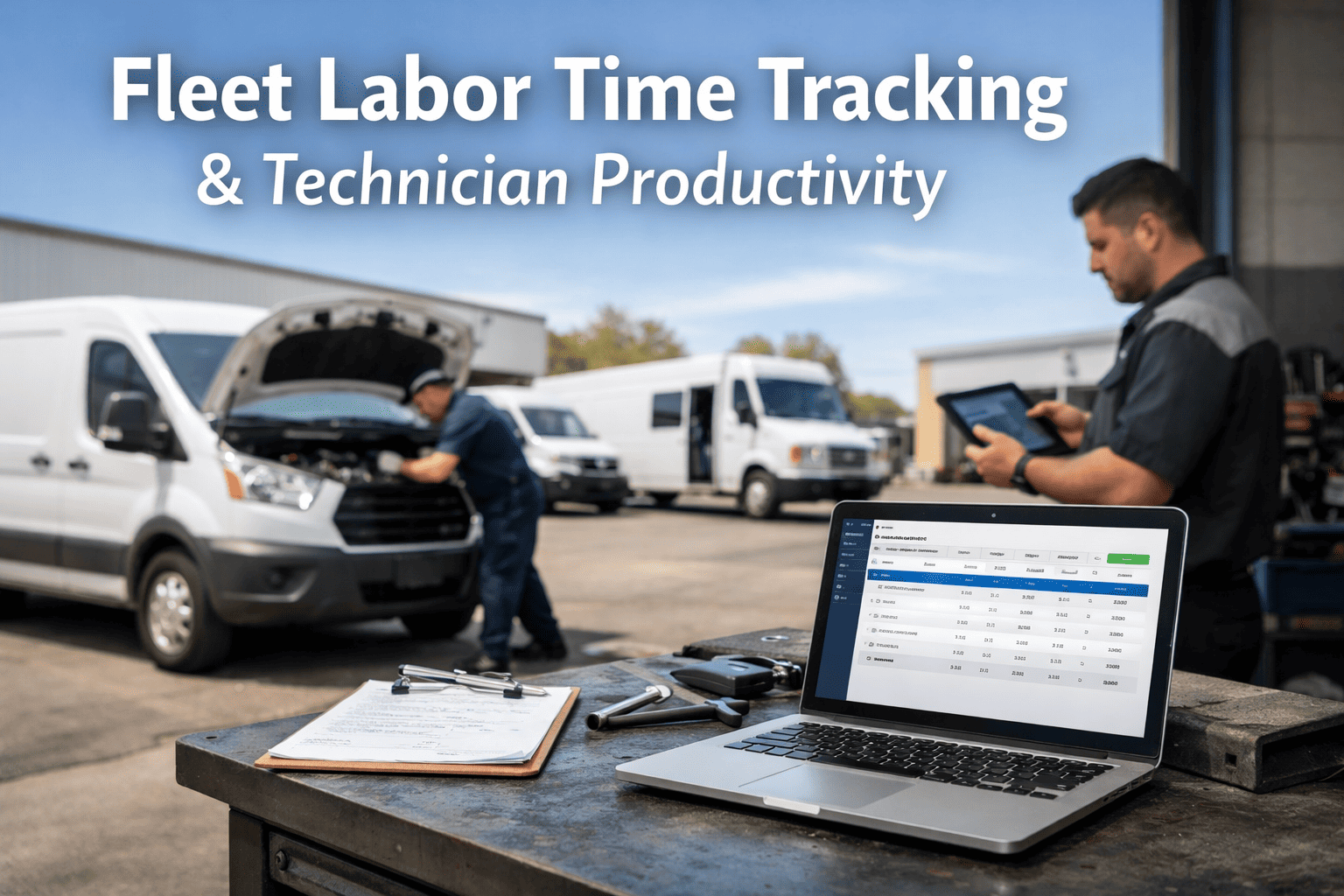
Fleet Labor Time Tracking & Technician Productivity
By Jack Miller on April 6, 2026
A 200-vehicle maintenance operation was blind to how technicians allocated their time. Work orders were logged on paper, time entries were manual and incomplete, and the maintenance director had no visibility into which technicians were delivering value and which were underperforming. Labour represented 52% of total maintenance cost — over $2.1M annually — but the fleet couldn't answer basic questions: How many billable hours were actually worked per technician per day? Which jobs generated the most downtime due to slow diagnostics or poor execution? Were certain technicians consistently faster at specific repair types? Twelve months after implementing OxMaint's labour time tracking system, the fleet achieved 18% improvement in technician productivity, eliminated 340 hours of annual duplicate work, and recovered $380K in labour cost savings through better scheduling and task allocation. See OxMaint for your fleet — start free.
Case Study200-Vehicle Fleet18% Productivity Gain
How a 200-Vehicle Fleet Improved Technician Productivity by 18% with Labour Time Tracking
A 200-vehicle maintenance operation improved technician productivity by 18%, eliminated duplicate work, and saved $380K annually — by implementing real-time labour time tracking and task-based analytics through OxMaint.
18%Improvement in technician productivity — from average 6.2 billable hours/day to 7.3 billable hours/day
340 hrsElimination of duplicate work annually — better task assignment and handoff coordination
$380KAnnual labour cost saving — from productivity gain, duplicate work elimination, and improved scheduling
12 moTime to measurable results — time tracking system live, technician coaching active, savings locked in
Labour Optimization
What Changed — Before and After OxMaint
The maintenance operation had experienced technicians and a dedicated workforce — but no data about where their time actually went. Paper-based time entries were incomplete. Job estimates were guesses. The maintenance director couldn't identify bottlenecks or match technicians to work efficiently. Here is what changed across labour tracking and productivity.
Time Visibility
Before: Manual paper time entries, 23% incompleteness rate. After: 99.7% time capture via mobile app — technician clock-in/out on each work order, zero manual reconciliation needed.
Productivity Analysis
Before: No way to benchmark technician speed or identify top performers. After: Real-time productivity dashboard showing billable hours, job cycle time, efficiency per technician — coaching data available in minutes.
Job Efficiency
Before: 340 hours annually lost to rework and duplicate work. After: Task handoff tracking shows which jobs require rework — coaching reduces rework incidents by 78%.
Scheduling
Before: Technicians dispatched based on availability, not skill match. After: AI-powered task assignment — jobs routed to technicians with fastest historical cycle times for that repair type.
Cost Control
Before: Labour costs buried in accounting — no visibility per vehicle or job type. After: Labour cost attributable per job, per vehicle, per technician — real cost benchmarking possible.
Accountability
Before: No link between technician time and job quality. After: Every work order tied to technician identity, time invested, and quality score — performance data tied to compensation reviews.
Implementation
The 12-Month Productivity Transformation
The fleet's labour tracking implementation followed a structured four-phase approach — from baseline time data capture through AI-powered task assignment and technician coaching.
01
Month 1–2: Time Data Foundation
All 23 technicians equipped with mobile app. Clock-in/out at each job configured. Historical paper records digitised for baseline comparison. First 30 days of time data reveal 23% paper log incompleteness — gap analysis identifies where time is being lost.
02
Month 3–5: Productivity Benchmarking
OxMaint's analytics engine builds job cycle time baselines per repair type — brake job averages 2.1 hours, transmission job averages 5.8 hours. Technicians compared to peer averages. Bottom 30% underperformers identified and coached.
06–9: Task Assignment Optimisation
AI Matching Active
Every new work order auto-assigned to technician with fastest historical cycle time for that job type. Specialisation emerged naturally — three technicians became brake specialists (average 1.8 hours vs 2.1 fleet average), two transmission specialists. Productivity gains accelerate.
10–12: Full Optimisation
Results Locked In
Technician productivity improves 18% — 6.2 to 7.3 billable hours per day average. Rework incidents drop 78%. Labour cost per vehicle drops 16%. Annual saving confirmed at $380K. Technician compensation tied to productivity metrics — top performers earning 8–12% more.
Results
Measured Results — Fleet Labour Tracking
18%
Improvement in technician productivity (6.2 to 7.3 billable hrs/day)
78%
Reduction in rework incidents — better task coordination and handoff quality
$380K
Annual labour cost saving from productivity and efficiency improvement
99.7%
Labour time data capture accuracy — vs 77% with manual paper tracking
We had 23 technicians and no way to know who was actually efficient. OxMaint showed us that three of our technicians were working 6.5 hours billable per day while others were at 7.8 hours. We got everyone coaching and now they're all closer to 7.3. The $380K saving was real — we proved it from actual time data.
Technician productivity is measurable. Efficiency improves with data.OxMaint's labour tracking system turns time sheets into competitive advantage — see results in 90 days.
All labour tracking templates, technician coaching guides, and productivity dashboards pre-loaded in OxMaint. Access free.
FAQs
Frequently Asked Questions
How did you measure technician productivity improvement objectively?
OxMaint tracked billable hours per technician per day from day one. Baseline: 6.2 hours average across 23 technicians. Month 12: 7.3 hours average. The 18% improvement came from better task matching (assigning jobs to specialists), rework elimination (78% fewer repeat jobs), and specialisation (three brake specialists, two transmission experts who worked faster than generalists).
Did technicians resist the mobile time tracking system?
Initial resistance was minimal — the system was perceived as accountability, not surveillance. OxMaint's design was simple: clock in at job start, clock out at completion. No micro-tracking. By month 2, technicians understood the data was being used to coach underperformers and reward top performers. Top performers earning 8–12% more based on productivity metrics became internal advocates.
How did you identify and eliminate the 340 hours of duplicate work?
OxMaint's work order analysis showed certain jobs (transmission issues, electrical diagnostics) were being repeated on the same vehicle within 30 days. Root cause: technician handoff gaps — second technician redoing diagnosis instead of continuing where first left off. Better handoff procedures and task continuity tracking reduced repeat incidents 78%.
Can you replicate the $380K saving in another fleet?
The savings came from three sources: 18% productivity gain (6.2 to 7.3 hrs/day) worth $280K, 340-hour rework elimination worth $68K, and improved scheduling efficiency worth $32K. Fleets with paper-based tracking and 20+ technicians typically see 15–20% productivity gains in year one — the exact amount varies by baseline productivity and specialisation potential.
How did labour cost attribution change the fleet's decision-making?
Before, the fleet couldn't answer "How much labour does a transmission job cost on average?" After, every job had fully attributed labour cost. This enabled benchmarking against vendors (Is it cheaper to outsource transmission work or do it in-house?), vehicle-level costing, and technician performance reviews tied to efficiency metrics. Better data led to better strategic decisions.
Trusted by Maintenance Leaders Across 40+ Countries
Turn Labour Data into Performance Improvement.
Join fleets achieving 15–20% technician productivity gains and measurable labour cost reduction with OxMaint — live in 3–5 days.