A technician signs off a brake job, and months later an auditor, insurer or investigator asks one simple question: was that person qualified to do it on that date? If the answer lives in a filing cabinet, an HR folder or someone's memory, the fleet is exposed. Certification and training records prove that skilled people did safety-relevant work, and they show where the next skills gap will appear. Here is how to keep those records usable, current and linked to the work itself, using a maintenance management platform.
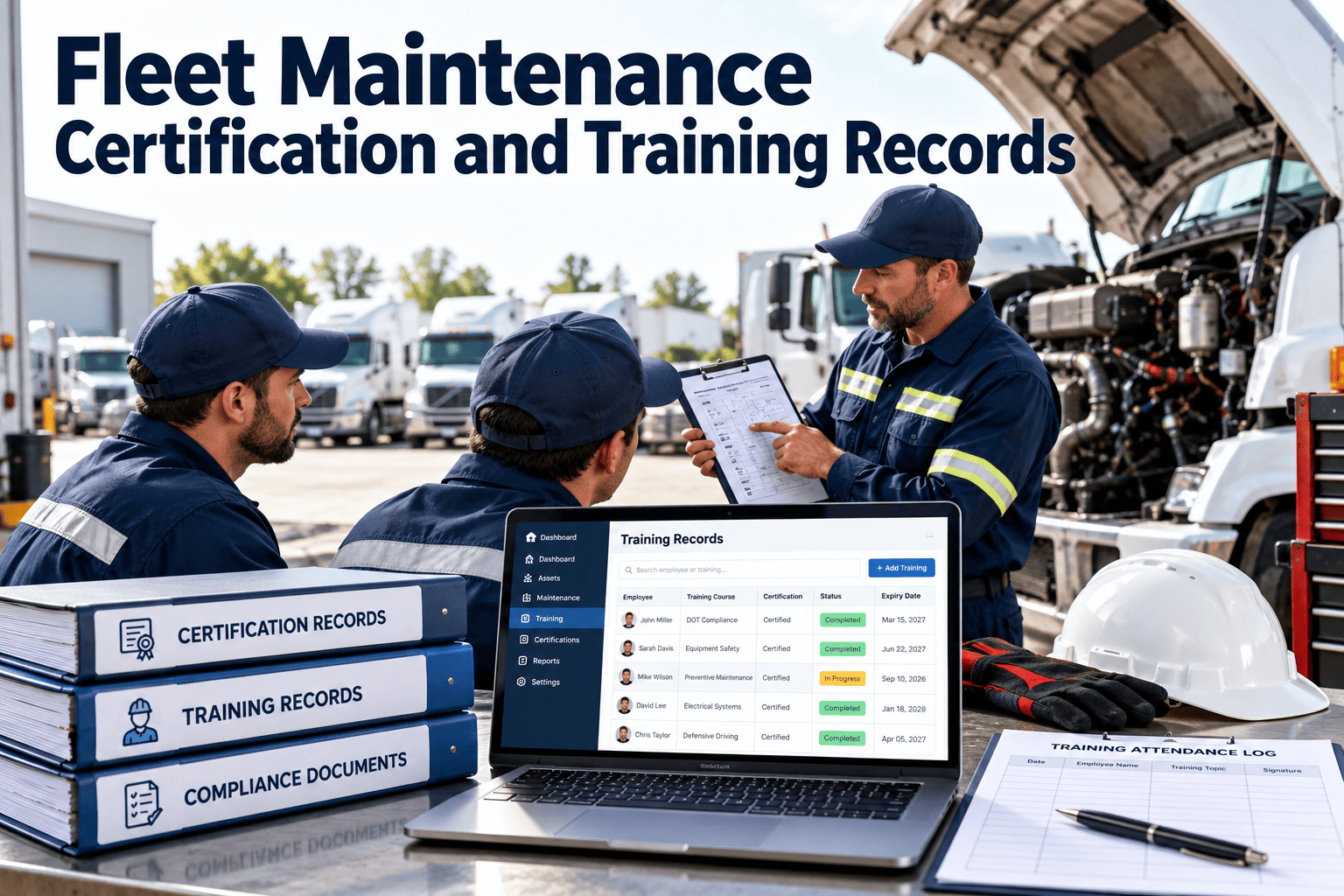
Fleet Maintenance Certification and Training Records
Keep every technician credential, training event and expiry date in a record that is tied to the work orders they perform, so audits, assignments and renewals stop depending on spreadsheets.
Why Qualification Records Belong in the Maintenance System
Training files are often kept by human resources, while the work is planned and recorded somewhere else. That split creates two problems. Supervisors cannot see who is qualified when they assign a job, and auditors cannot easily connect a credential to a completed repair.
The cost of weak records
Missing or expired credentials rarely cause a failure by themselves. They show up as audit findings, rejected inspections, insurance questions, warranty disputes and, in the worst case, a defensible-looking repair that cannot be defended. Good records reduce that exposure and also save supervisors time.
Credential Families a Fleet Shop Typically Tracks
The exact list depends on your jurisdiction, vehicle types and customers. The table below groups common categories so you can build your own requirements matrix. Always confirm current rules with the regulator or standards body that applies to your operation.
| Category | Examples | Who it usually applies to | Record to keep |
|---|---|---|---|
| Technical competence | ASE-type medium and heavy vehicle certifications, OEM service training | Diagnostic and repair technicians | Certificate, issue date, renewal date |
| Regulated inspection roles | Annual vehicle inspector and brake inspector qualifications under US FMCSA rules (49 CFR Part 396) | Staff who perform periodic or brake inspections | Evidence of qualification, kept per the rule |
| Electrical safety | High-voltage awareness and qualified-person training aligned with NFPA 70E and OEM procedures | Hybrid and EV technicians | Training date, scope, assessor |
| Hazardous energy | Lockout and tagout training | Authorized employees in the shop | Training record, refresher date |
| Refrigerants and A/C | EPA Section 609 for vehicle A/C, and EPA Section 608 where it applies | Technicians servicing cooling systems | Certificate number, certifying body |
| Equipment operation | Lift, hoist, crane and forklift operator training | Shop and yard staff | Operator evaluation, date, trainer |
| Hot work and specialty | Welding qualifications, confined space, working at height | Fabrication and body staff | Test records, permit history |
Do not forget drivers who test vehicles
Road tests after repair are often done by technicians or drivers. Where a commercial license or medical certificate is required to move the vehicle, track those dates alongside the maintenance qualifications.
Which Skills Gaps Carry the Most Risk
Not every gap is equal. Prioritise by two questions: how serious is the consequence if the task is done wrongly, and how well is that task covered by qualified people today.
Know Who Is Qualified Before the Job Is Assigned
Keep credentials, expiry dates and evidence next to the work orders and assets they relate to.
The Credential Lifecycle, From Requirement to Audit
A credential is not a one-time event. It moves through a cycle, and records fail when any step is skipped. Treat the cycle as a maintenance process with owners and due dates.
Linking Credentials to Work Orders
The strongest control is simple: the work order records who did the job, and the person record shows they were qualified on that day. Here is how the process changes.
Practical ways to do it
Many shops start with a simple structure: a skills field on each technician profile, a required-credential note on the checklist for each regulated task, and a recurring renewal task per credential. The structure can be refined once the data is reliable.
What an Audit-Ready Training File Contains
Auditors want evidence that is complete, dated and easy to retrieve. The checklist is split into what to hold per person and what to hold per event.
- Name, role and start date
- List of authorised task types
- Every credential with issue and expiry dates
- Copies of certificates or letters of competence
- Supervisor sign-off for on-the-job assessment
- Record of restrictions or supervised-only status
- Course title, provider and date
- Learning objectives or scope covered
- Attendee list and assessment outcome
- Trainer name and qualification
- Materials or procedure revision used
- Follow-up actions or refresher date
Retention and access
Retention periods differ by rule and by region. In the United States, for example, FMCSA rules require inspector and brake inspector qualification evidence to be retained for a period that runs past employment, and vehicle maintenance records have their own retention times. Check the current text of the rule that applies to you, then configure reports so records can be retrieved by person, vehicle and date.
Training Types Beyond the Certificate
Certificates are only part of competence. Mature fleets also record the learning that happens on the shop floor, because that is where most skills are actually built.
Measures That Keep Training Compliance Honest
Choose a few indicators and review them monthly with shop leaders. The aim is early warning, not paperwork.
| Indicator | Meaning | Action it triggers |
|---|---|---|
| Credentials expiring in 90 days | Count of upcoming renewals by role | Book courses, plan cover for absences |
| Expired credentials in use | Work done by staff with a lapsed requirement | Stop assignment and investigate immediately |
| Coverage per task type | Qualified people available per shift | Cross-train where coverage is thin |
| Time to qualify | Days from hire to independent sign-off | Improve onboarding and mentoring |
| Audit retrieval time | Minutes needed to produce proof for a task | Fix record structure and tagging |
How Oxmaint Supports Qualification Tracking
Oxmaint is built around work orders, assets and scheduled tasks, which are the same building blocks a competence programme needs. Depending on how you configure it, the platform can support the following.
- Recurring scheduled tasks that act as renewal reminders for certificates and refresher training
- Work order checklists that state the required qualification for regulated tasks
- Technician and team records with notes, attachments and assigned work history
- Inspection and compliance records that sit beside the vehicle's service history
- Reports and dashboards to review open renewals and completed training
- Mobile access so supervisors can check status from the shop floor
Start small and expand
Begin with the credentials that carry the highest risk, such as brake inspection and high-voltage work. Once those are reliable, extend to equipment operation, refrigerants and general safety. If you want to see a setup for your shop, schedule a short demo.
Where Training Records Usually Fail
Most record problems are process problems, not software problems. The patterns below appear in many shops, and each has a simple structural fix.
| Failure | Why it happens | Structural fix |
|---|---|---|
| Expiry dates found too late | Dates live in a spreadsheet nobody reviews | Recurring renewal tasks with a named owner |
| Certificate cannot be located | Copies are held by the individual or by a training provider | One record per person with the file attached |
| Scope unclear | The certificate exists but nobody knows which tasks it covers | Authorised task list recorded beside each credential |
| Trainees working alone | Supervision is assumed and never recorded | Supervised-only status on the person and on the work order |
| Skills leave with the person | No cross-training and no succession view | Coverage report by task type and shift |
| Training not linked to change | New vehicles or procedures arrive without matching courses | Add a training task to every new asset class introduction |
Supervised work and restricted status
New hires, apprentices and technicians learning a new system need a clear status. Recording that a person may only work under supervision, and who the supervisor was, protects both the individual and the fleet.
Who Does What in a Competence Programme
Records stay accurate when each role knows its part. Without clear ownership, the same few people end up chasing everyone else's paperwork.
Keep a short review rhythm
A monthly fifteen-minute review of upcoming expiries and coverage gaps catches most problems. A quarterly review should ask whether new vehicles, regulations or customer contracts have created requirements that are not yet on the list.
A Five-Step Starter Plan
Keeping Records Accurate When Staff and Vehicles Change
Records drift when people leave, move between sites or take on new equipment. Build a few routine checks into the events that change your workforce, rather than relying on an annual clean-up.
- When someone joins, create the record and list their authorised tasks before their first assignment.
- When someone moves site or role, review which credentials still apply and update the authorised task list.
- When a new vehicle type arrives, add the training requirement before the first unit enters the shop.
- When someone leaves, keep their records for the retention period that applies and remove them from active assignment lists.
Treat gaps as maintenance risks
A missing credential is a risk to schedule, safety and compliance, just like a missed inspection. Log it as an open item with an owner and a due date, and review it with the same discipline you apply to overdue preventive maintenance.
Frequently Asked Questions
HR may hold the master file, but maintenance needs the working view. Link both so assignments use current status. Sign up to try a shared structure.
Set the alert to match course lead time. Ninety days works for many shops, longer where courses book out.
Yes, in proportion to risk. Regulated and safety-critical roles need full evidence, while general skills can use simpler notes.
Yes. Record the assigned technician and keep their credential evidence on file, so both can be produced together.
It does, because high-voltage tasks need clear authorisation. Book a demo to see how.
Make Every Repair Traceable to a Qualified Technician
Bring certificates, renewals and work orders into one maintenance record that is ready when auditors ask.