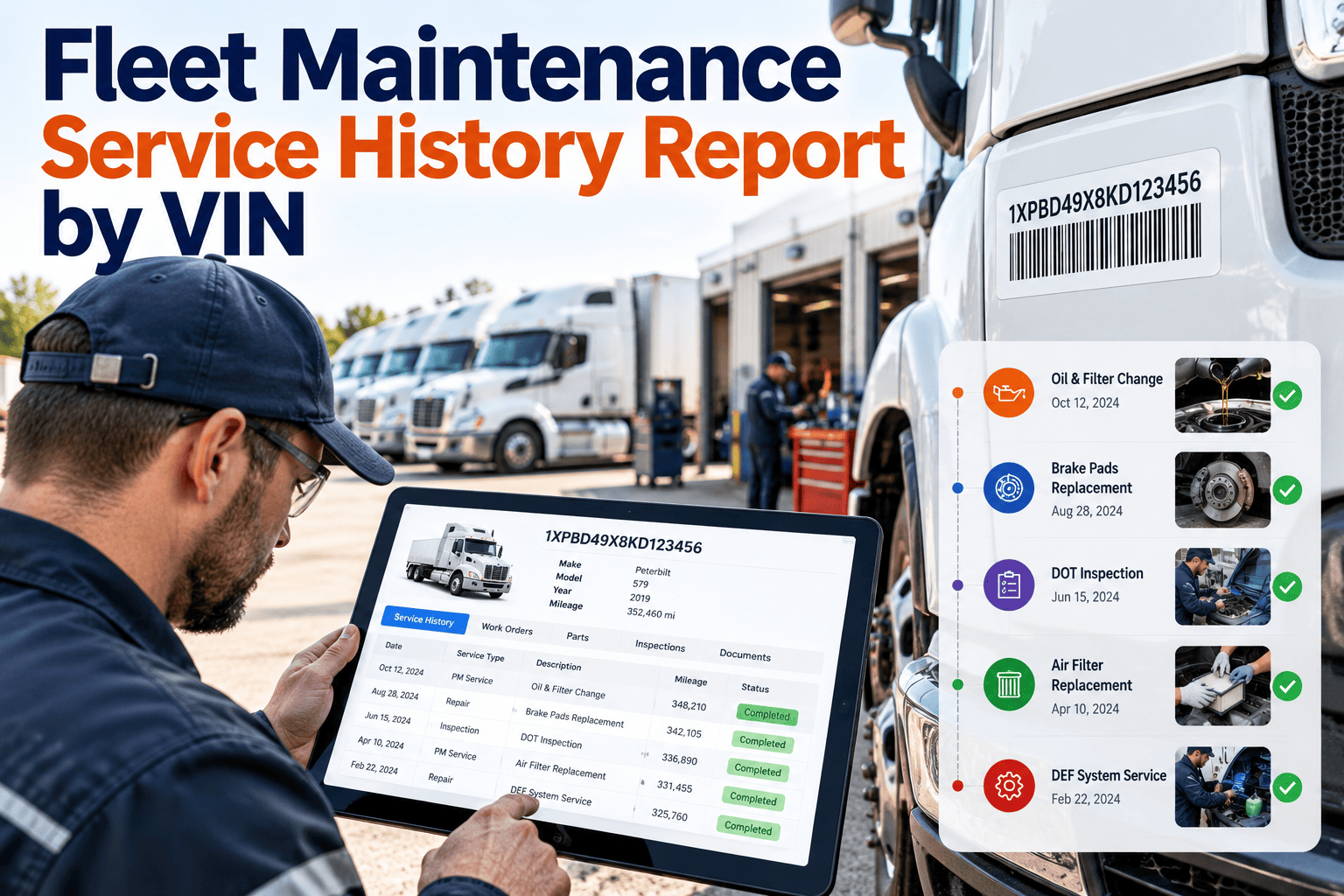
A fleet maintenance service history report by VIN gives you every inspection, repair, part, and cost recorded against one vehicle in a single chronological record. When a unit goes down, heads to auction, or lands in a DOT audit, the VIN is the one identifier that never changes, even when drivers, depots, and vendors do. Without a clean VIN-level record, teams rebuild history from invoices, text messages, and memory, which slows decisions and hides repeat failures. A maintenance-first approach, such as the one used in Oxmaint fleet maintenance software, keeps that record current as the work happens instead of after the fact.
Fleet Maintenance Service History Report by VIN
One vehicle, one record, every repair. Stop piecing together service history from invoices and start making repair, replace, and resale decisions from verified data.
Why the VIN is the right key for fleet service history
What a VIN-based report solves
Unit numbers get reassigned, plates change, and vehicles move between depots. The VIN stays with the vehicle for life, so it is the safest anchor for history.
What it replaces
Paper folders, vendor portals, and spreadsheets that each hold part of the story but never the whole thing in one place.
- Warranty claims need dated proof that required service was done on schedule.
- Resale and trade-in values depend on documented maintenance, not verbal assurances.
- Safety audits ask for inspection and repair evidence tied to a specific vehicle.
- Replacement planning needs true lifetime cost, not just the last invoice.
Where fleet service history breaks down
Records split across vendors
Dealers, tire shops, and roadside providers each keep their own invoices. Nobody sees the combined picture for a VIN.
Unit numbers instead of VINs
When a vehicle is renumbered or transferred, its history gets orphaned, and the new record starts from zero.
Repeat repairs go unnoticed
The same alternator, sensor, or brake component fails three times in a year, but each invoice looks routine on its own.
Missing odometer and hour readings
Without meter values on every work order, you cannot calculate intervals, cost per mile, or reliable warranty eligibility.
Defects reported but never closed
Driver-reported issues live in a notebook or message thread, so there is no proof of when a problem was fixed.
Parts and labor not linked to the vehicle
Stock is issued from the storeroom without a VIN reference, so true repair cost per vehicle is always understated.
What a complete VIN service history report contains
A useful report is more than a list of invoices. It is a structured record where every entry carries the same core fields, so the data can be filtered, totaled, and audited.
| Report section | Key fields | Why it matters |
|---|---|---|
| Vehicle profile | VIN, make, model, year, engine, GVWR, in-service date | Confirms identity and drives correct PM templates |
| Preventive maintenance | Interval, due and completed dates, meter reading, checklist | Proves schedule compliance for warranty and audits |
| Inspections | DVIR, annual, pre-trip, results, defects, sign-off | Shows defects were found and closed on time |
| Corrective work | Complaint, cause, correction, technician, labor hours | Reveals recurring failure modes |
| Parts and materials | Part number, quantity, unit cost, supplier, warranty | Supports true cost and warranty recovery |
| Vendor and outside work | Invoice, vendor, labor rate, approval record | Keeps external spend tied to the right vehicle |
| Documents | Photos, inspection forms, certificates, receipts | Gives audit-ready evidence in one place |
| Cost summary | Total cost, cost per mile, downtime days | Feeds repair-versus-replace decisions |
How the VIN record gets built, step by step
A report is only as good as the habits behind it. The strongest fleets capture data at the moment work happens, not at month end.
Register the asset
Create each vehicle by VIN with specs, location, and warranty terms.
Schedule preventive work
Attach PM templates triggered by miles, engine hours, or calendar time.
Capture issues in the field
Drivers and technicians log defects from a phone, with photos and meter readings.
Close the work order
Record cause, correction, labor, parts, and sign-off before the unit returns to service.
Review and act
Run the VIN report to spot repeat repairs, rising cost, and replacement candidates.
Build a service history you can defend
See how a single VIN record can pull together PM, inspections, work orders, parts, and documents for every unit in your fleet.
Who relies on the VIN history report
Compliance and recordkeeping considerations
Requirements differ by region and vehicle class, so confirm the rules that apply to your operation. In the United States, FMCSA regulations in 49 CFR Part 396 cover inspection, repair, and maintenance for commercial motor vehicles.
Systematic maintenance records
Records must identify the vehicle and show inspection, repair, and maintenance work, and be kept for the period the rule specifies after the vehicle leaves your control.
Driver vehicle inspection reports
Reported defects must be certified as repaired or not needed before the vehicle is dispatched again, and reports are retained for a set period.
Periodic inspections
Annual inspection documentation must be available, and a VIN-keyed record makes it easy to retrieve on request.
KPIs you can calculate from VIN-level history
Once every work order carries a VIN, meter reading, cost, and downtime, these measures become simple to produce and trust.
Spreadsheet history versus a maintenance-first VIN record
Before: scattered records
- History assembled by hand before audits and sales.
- Odometer readings missing or entered late.
- Vendor invoices filed by date, not by vehicle.
- Repeat failures found only by memory.
After: VIN-keyed records
- Report generated from live work order data.
- Meter reading required at work order close.
- Parts, labor, and vendor cost tied to the VIN.
- Repeat failures flagged from history filters.
Data quality checklist for reliable VIN reports
Use this list to test whether your current records could stand up to a warranty review or audit tomorrow.
How Oxmaint supports VIN-level maintenance history
Oxmaint is a maintenance management platform, so the history report is a by-product of daily work rather than a separate project.
Asset management
Hold every vehicle as an asset with specs, location, documents, and a full work history.
Preventive maintenance
Schedule PM by mileage, hours, or calendar and record completion against the VIN.
Work orders and inspections
Create, assign, and close corrective and inspection work from mobile devices.
Inventory and reporting
Track parts used per vehicle and use dashboards to review cost, downtime, and repeat repairs.
A practical 30-day rollout for VIN history
Frequently asked questions
What is a fleet maintenance service history report by VIN?
It is a chronological record of all inspections, repairs, parts, and costs for one vehicle, identified by its VIN.
Why use the VIN instead of the unit number?
Unit numbers and plates change, while the VIN stays constant, keeping history intact across transfers.
Can I import older service records?
Yes, key past records can be loaded, and you can book a demo to discuss your data.
Does the report help with warranty claims?
Dated PM and repair records tied to the VIN make it easier to show required service was performed.
How do I start building VIN histories?
Register each vehicle by VIN and get started logging work orders and inspections.
Give every VIN a complete, audit-ready record
Replace scattered invoices with one connected maintenance history, built from the work your team already does every day.