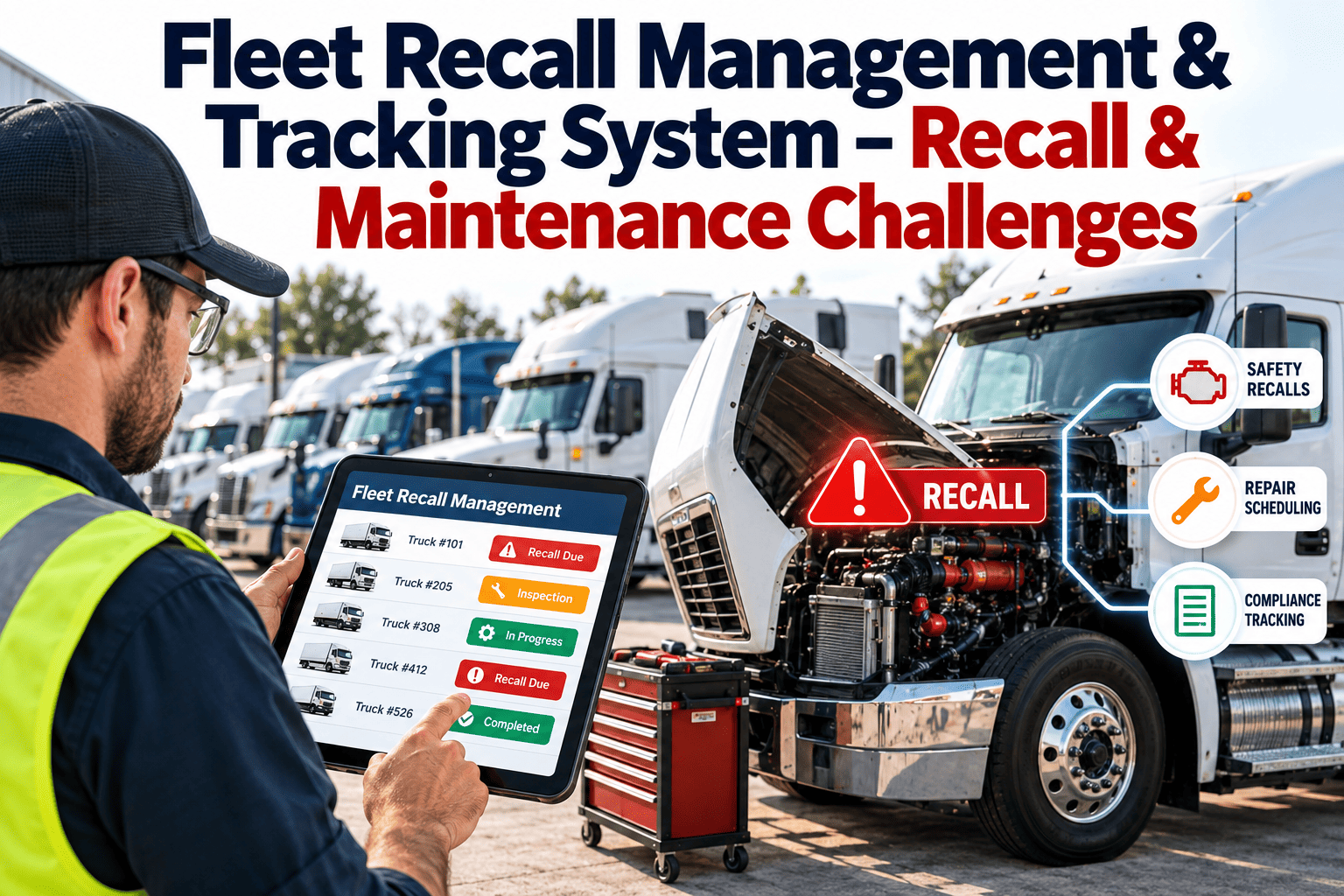
Vehicle safety recalls are climbing across every commercial segment as emissions systems, braking electronics, and software-controlled components grow more complex, and most fleets discover just how exposed they are only when a compliance review or a roadside inspection surfaces a VIN that should have been in the shop months earlier. A recall that never reaches a work order is not a paperwork gap — it is a vehicle on the road with a known safety defect. This guide walks through why recalls slip past fleets, what an automated tracking workflow looks like, and how Oxmaint connects recall data directly to maintenance action.
Fleet Recall Management & Tracking System
Match every VIN against live recall data, route open campaigns straight into a work order, and prove closure without digging through inbox folders during an audit.
Recalls Are Rising Faster Than Most Fleets Can Track Them
Manufacturer recall volume has climbed sharply over the past several years as brake systems, steering, emissions controls, and onboard software grow more interconnected, and campaign counts that once numbered in the dozens now regularly run into the hundreds annually for major OEMs.
Resolving a recall typically means pulling a vehicle out of service and routing it to a dealer or authorized shop, which disrupts schedules — but the disruption of a planned repair is far smaller than the risk of an open safety defect that stays in dispatch rotation because nobody matched the notice to the vehicle.
Why Open Recalls Slip Through the Cracks
Notices Land in the Wrong Inbox
Manufacturer recall notices often go to a generic company email or a single point of contact who may have changed roles, leaving the notice unread indefinitely.
No VIN-to-Roster Matching
A recall notice lists affected VINs, but without an automated match against the fleet roster, someone has to manually cross-reference every notice against every vehicle — a process that scales poorly past a few dozen units.
No Connection to a Work Order
Even when a recall is identified, there is often no automatic step that converts "this VIN is affected" into a scheduled repair appointment, so the notice sits as a static record rather than an actionable task.
Fleet Roster Drift
Vehicles added, sold, or transferred between locations create roster gaps, so a recall check run against an outdated vehicle list misses units that should have been flagged.
The Recall Lifecycle: From Notice to Closure
Find out how many open recalls are sitting in your fleet right now
Most fleets have never run a full VIN match against live recall data — and are often surprised by what surfaces.
Manual Recall Tracking vs. an Automated System
| Factor | Manual / Spreadsheet Process | Automated VIN Monitoring |
|---|---|---|
| Notice detection | Depends on someone reading a generic inbox | Continuous check against live recall data |
| VIN matching | Manual cross-reference, error-prone at scale | Automatic match against the full fleet roster |
| Do-not-drive campaigns | Easy to miss until a breakdown or inspection | Flagged instantly to dispatcher and maintenance manager |
| Path to repair | Separate step, often delayed or forgotten | Work order generated automatically, tied to the asset |
| Audit readiness | Reconstructed from email threads under time pressure | Complete closure record available on demand |
How Oxmaint Turns Recall Data Into a Maintenance Workflow
Recall management works best when it is not a separate system a fleet manager has to remember to check, but a native part of the same platform that already tracks preventive maintenance, work orders, and asset history.
Every vehicle in the fleet is checked against recall data on an ongoing basis, so a campaign filed the week after onboarding is still caught rather than missed until the next manual review.
An open campaign matched to a VIN generates a work order in the same queue as routine PM tasks, so recall repairs are scheduled instead of tracked separately in a spreadsheet.
Recall notices, repair dates, and closure documentation attach directly to the vehicle's service history, giving a complete record the moment an insurer or shipper asks for it.
Dashboards summarize open, in-progress, and closed campaigns fleet-wide, making it possible to answer a DOT compliance review question in minutes instead of days.
Recall Compliance Checklist for Fleet Managers
- Confirm the fleet roster is current. Vehicles added, sold, or reassigned should update the roster automatically so recall checks never run against stale data.
- Separate do-not-drive campaigns from routine ones. A campaign that grounds a vehicle needs a different response speed than one that can wait for a scheduled bay slot.
- Tie every open recall to a work order. A recall record with no associated repair task is a compliance gap waiting to be discovered during an audit.
- Keep closure documentation attached to the asset. Repair dates, parts used, and technician sign-off should live with the vehicle record, not in a separate filing system.
- Review open-campaign dashboards on a fixed cadence. A weekly review catches new recalls before they accumulate into a backlog.
Frequently Asked Questions
How is a recall matched to a specific vehicle in the fleet?
The system checks every VIN in the fleet roster against recall data on a continuous basis, so a match is caught whether the campaign was filed before or after the vehicle was onboarded.
What happens when a do-not-drive recall is identified?
The maintenance manager and dispatcher are alerted immediately so the vehicle can be pulled from rotation before its next assignment, rather than after a breakdown or roadside stop.
Does recall tracking replace the need for dealer or OEM repair?
No — recall repairs typically still route to an authorized dealer or shop, but Oxmaint tracks the notice, generates the work order, and stores the closure record so the process is managed inside your existing maintenance workflow.
How does this help during a DOT compliance review?
Every open, in-progress, and closed recall is stored against the vehicle's asset history, so a reviewer's question about a specific VIN can be answered from the dashboard instead of reconstructed from old emails.
Can recall tracking be set up without disrupting current operations?
Yes. Once the fleet roster is imported, VIN monitoring runs continuously in the background alongside existing maintenance processes — you can schedule a demo to see the setup for your fleet size.
Close the gap between a recall notice and a repaired vehicle
Match your fleet against live recall data and turn every open campaign into a tracked work order automatically.