When an auditor, insurer or plaintiff attorney asks for a vehicle maintenance history, nobody cares how well the work was done. They care whether you can produce the record, and whether it was kept for the right length of time. Fleets that store inspection reports, repair orders and certifications in glove boxes, shared drives and email threads lose evidence long before the retention period ends. This checklist covers what to create, keep, protect and dispose of, using a fleet maintenance software record structure that makes audit requests routine.
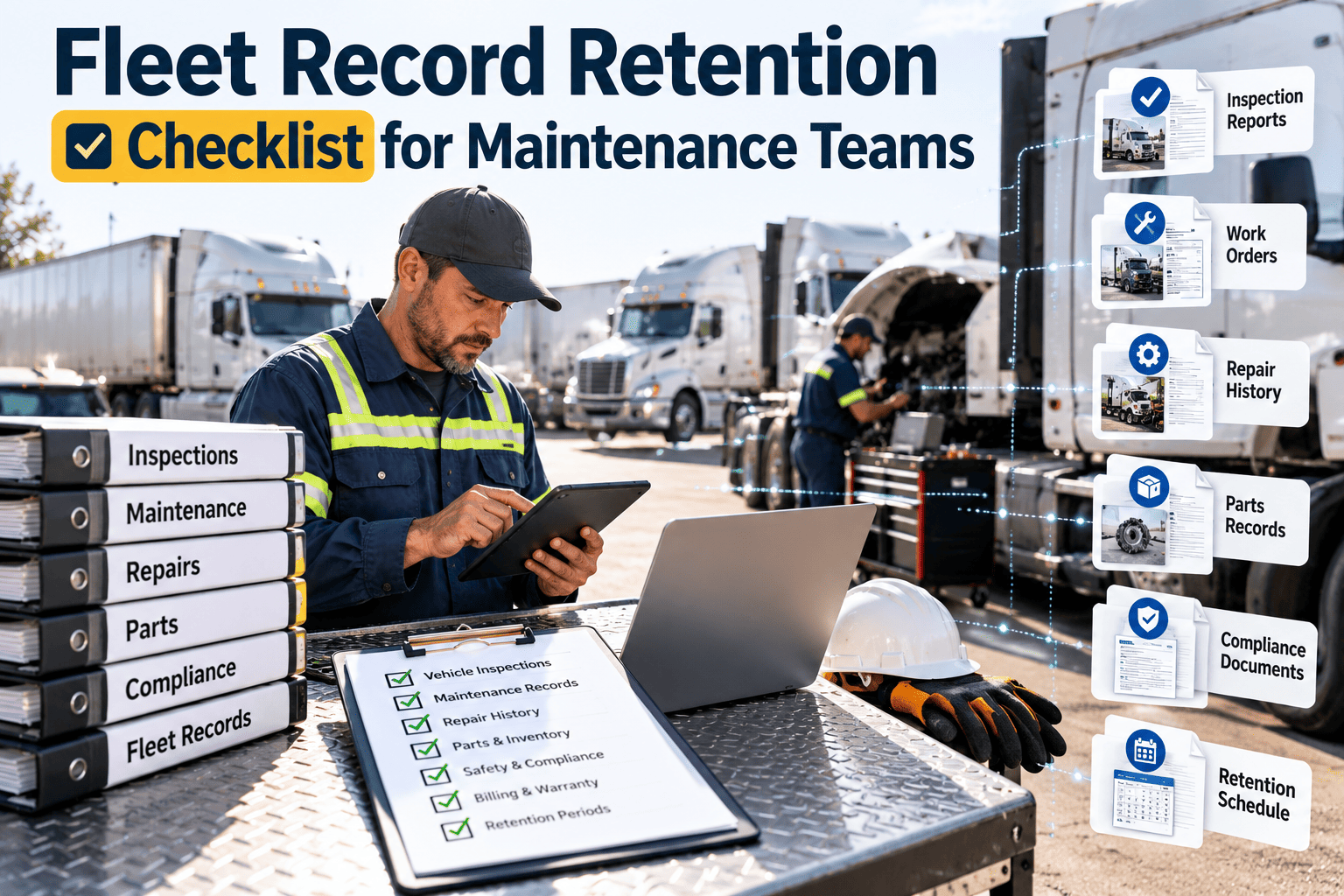
Fleet Record Retention Checklist for Maintenance Teams
Seven checklist categories covering inspection reports, repair orders, annual inspections, roadside findings, parts records, storage and disposal, so every record is complete, findable and kept for the right period.
Typical federal retention horizons for common fleet recordsDriver vehicle inspection reports3 months
Hours of service records6 months
Roadside inspection reports12 months
Periodic inspection reports14 months
Driver qualification fileEmployment plus 3 years
DDaily
WWeekly
MMonthly
QQuarterly
AAnnual
EEvent-driven
Read This Before Adopting a Schedule
The periods here reflect common US Federal Motor Carrier Safety Regulations. State rules, insurers, contracts, other countries and active litigation can require longer retention.
- Confirm each period against the current regulation text.
- Where two sources conflict, keep the record for the longer period.
- Have counsel or your compliance lead approve the final policy.
Fleet Maintenance Record Retention Schedule
Use this as a starting schedule. The last column shows where each record is best captured in a digital maintenance workflow.
The Record Lifecycle the Checklist Protects
Stage 1CreateCapture at the point of work
Stage 2VerifySupervisor checks completeness
Stage 3StoreOne searchable system per asset
Stage 4RetainTrack the retention end date
Stage 5Dispose or holdDestroy on schedule or freeze
Category 01Driver Vehicle Inspection Reports
Daily reports are the highest-volume record and the shortest retention period, which makes them the easiest to lose.
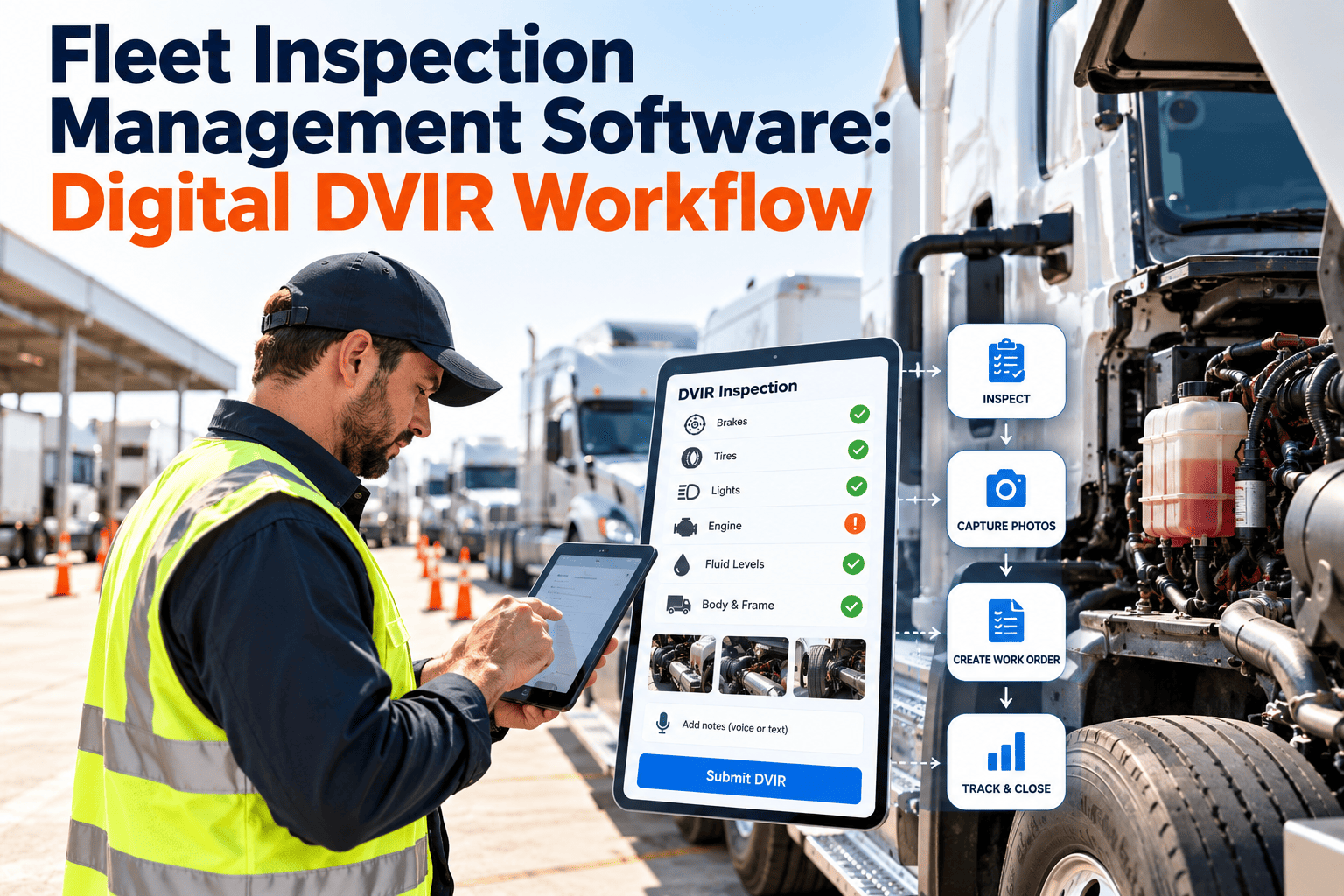
DVIR completed and signed each operating day. The report covers required inspection items with date, unit, driver and signature, and states defects found or that none were found.DDriver · DVIR completion log
DVIR attached to the asset record before departure. Upload or scan the report against the unit ID so it can be found by unit and date, not by digging through a folder.DDriver / Dispatcher · DVIR upload log
Reported defects routed to a work order. Each defect becomes a work order so the report, repair and sign-off form one chain.DDispatcher · Defect routing log
Repair certification and next-driver review recorded. The record shows whether defects were repaired or judged not to affect safety, and that the next driver reviewed it before operating.DShop supervisor · Repair certification log
Paper reports scanned within 24 hours. If paper is still used, scan promptly and confirm legibility, then follow your policy for the original.DRecords administrator · Scan quality check
Retention end date assigned. Calculate the end date from the report date and flag any record under legal hold so it is never removed automatically.MRecords administrator · Retention clock report
Category 02Maintenance, Inspection and Repair Records
This category carries the longest and most audited retention obligation, and it follows the vehicle even after it leaves your fleet.
Unit identification record complete. Company number, make, serial number, year, tire size, and owner if leased are recorded and match the registration.ERecords administrator · Asset identity record
Maintenance schedule documented. Each unit has a written plan showing service types and intervals, and any change to the plan is logged with a reason.AMaintenance planner · Preventive plan review
Work orders closed with all required details. Date, nature of work, labor, parts, meter reading and technician sign-off are present before closure is allowed.DTechnician · Work order closure record
Lubrication and preventive services tied to meter readings. Services are recorded against odometer or engine hours so intervals can be demonstrated, not assumed.DTechnician · Preventive service record
Outside shop and dealer invoices attached. Vendor paperwork is uploaded to the matching work order, not left in email or a driver's pocket.WService writer · Vendor invoice log
Records available at the right location. Confirm records can be produced where the vehicle is housed or maintained, including for units at remote terminals.MRecords administrator · Record location audit
Component records kept for tires and brakes. Tire serials, positions, brake lining measurements and pushrod stroke readings are stored as values, not just pass or fail.DTechnician · Component record
Extended retention applied when a unit leaves. Records stay for 6 months after the vehicle leaves your control, so sold, transferred or returned units are flagged.ERecords administrator · Unit disposal checklist
Category 03Periodic Inspections and Inspector Qualifications
Annual inspection paperwork is often the first thing requested by an auditor, and expired inspections are an immediate finding.
Periodic inspection completed within 12 months. Each unit has a scheduled due date and the inspection is done before the previous one expires.AFleet manager · Periodic inspection schedule
Report contains the required information. Carrier name and address, inspection date, inspector signature, vehicle identification and a statement of the standard used are present.AInspector · Periodic inspection report
Report or certificate available on request. A copy or equivalent proof can be produced for a roadside inspector or auditor for the vehicle in question.DDriver / Fleet administrator · Inspection currency log
Report retained for 14 months. Keep the report for at least the commonly required period, with the end date recorded.MRecords administrator · Retention clock report
Inspector qualification evidence on file. Training, experience and certifications are kept while the person performs inspections and for a year after.ASafety manager · Inspector qualification file
Brake inspector qualification verified. Confirm anyone performing brake work or inspections meets the applicable qualification requirements and that evidence is stored.ASafety manager · Brake inspector record
Expiry reminders issued 60 days ahead. The system warns before inspections and qualifications expire, so renewal is planned rather than urgent.MMaintenance planner · Expiry reminder report
Category 04Roadside Inspection and Violation Records
Roadside paperwork links external findings to your internal repairs. A missing link looks like an unrepaired defect.
Report logged the same shift it is received. The inspection report is attached to the unit and a work order is created for every violation.ESafety manager · Roadside finding log
Violations tied to a closed repair. Each violation shows the repair performed, the date, the technician and any re-inspection.EShop supervisor · Violation repair record
Repair certification returned on time. Where the report requires carrier certification of repairs, complete it and return it within the required window, commonly 15 days.ESafety manager · Certification return log
Out-of-service orders cleared and documented. Record when the unit was placed out of service, what was fixed and who approved its return to service.EShop supervisor · OOS clearance record
Reports retained for 12 months. Keep each report for at least the commonly required period and track the end date.MRecords administrator · Retention clock report
Violation patterns reviewed by unit and system. Look for repeating brake, lighting or tire findings so inspection frequency and training can be adjusted.QSafety manager · Violation pattern review
Make Every Maintenance Record Easy to Find and Easy to Defend
Capture inspections, work orders and certificates against each asset in one system built for fleet compliance.
Category 05Parts, Tires, Warranty and Vendor Records
Purchase and warranty records are often held by finance or the parts counter and never reach the unit history.
Parts installed recorded with part number. Each work order shows the part number, quantity and source, which supports warranty and recall checks.DParts counter · Parts transaction log
Tire records complete. Serial number, position, installation date and removal reason are recorded for every tire.DTechnician · Tire history record
Warranty claims filed with evidence. Diagnostic notes, photos, meter readings and invoices are attached to each claim and kept until it is settled.EService writer · Warranty claim file
Recall and campaign work recorded. Open and completed recalls are logged against the unit with the completion date.EMaintenance planner · Recall tracker
Vendor invoices coded to the unit. Invoices are linked to the asset and work order for cost reporting and audit support.WAccounts payable · Invoice coding log
Finance and tax retention rules confirmed. Purchase and cost records follow your tax and finance retention policy, which may be longer than maintenance rules.AFleet manager / Finance · Retention policy review
Category 06Storage, Access and Backup
A record that exists but cannot be found, or can be changed without a trail, is a weak record.
All records in one searchable system. Records are searchable by unit, date and type, with no parallel folders per terminal.MRecords administrator · System audit
Role-based access enforced. Technicians can add records but cannot delete closed ones, and access changes are reviewed.QFleet manager · Access review
Audit trail enabled. Every change shows the user and timestamp, which supports the credibility of the record.MRecords administrator · Audit trail report
Backups tested by restoring a sample. Restore a sample record each quarter to prove backups work, and log the result.QIT / Records administrator · Backup test record
Retrieval drill run on a random unit. Request a full history for one unit and time the response, then fix any gaps found.QSafety manager · Mock audit record
Naming and tagging standards followed. Consistent file names, unit IDs and record types make search reliable across all users.DAll staff · Record tagging standard
Category 07Disposal, Legal Hold and Unit Disposal
Destroying records too early creates exposure, and keeping everything forever creates cost and clutter. Control both.
Retention end date calculated for each record. Every record has a retention end date derived from the right trigger, such as report date or unit exit date.MRecords administrator · Retention clock report
Disposal approved and logged. Destruction needs a named approver and a log of what was destroyed, when and by whom.QRecords administrator · Disposal log
Legal hold placed after an incident. After an accident, claim or audit notice, related records are frozen from disposal immediately.ESafety manager / Counsel · Legal hold register
Legal hold released in writing. Holds are removed only with written confirmation, and the retention clock resumes.ECounsel · Hold release record
Sold or transferred units exported. Export the full unit history before the unit leaves the system and keep it for the required period.ERecords administrator · Unit export record
Retention policy reviewed each year. Compare the schedule with regulation changes, insurer requirements and contracts, and update it.ACompliance lead · Policy review record
Who Owns Which Part of Retention
Metrics That Show Your Records Are Audit-Ready
How Oxmaint Supports Fleet Record Retention
Oxmaint ties every record to the asset it belongs to, so retention is a by-product of daily work.
- Mobile inspection forms capture driver and technician findings with timestamps, signatures and photos.
- Defects convert to work orders, which keeps defect, repair and sign-off in one chain.
- Asset history shows every service, repair and certificate for a unit in date order.
- Preventive maintenance and inspection due dates reduce expired or missed records.
- Reports help compliance teams answer records requests by unit, date range or work type.
Frequently Asked Questions
How long should fleet maintenance records be kept?Federal rules commonly require 1 year at the location plus 6 months after the vehicle leaves your control. Check state and insurer rules for longer periods.
Can maintenance records be stored electronically?Yes, if they are complete, legible and retrievable on request. A digital maintenance system also improves search and traceability. What happens to records when a vehicle is sold?Keep the unit history for the required period after it leaves your control, and export the full file before removing it from your system.
When should we stop disposing of records?As soon as an accident, claim, audit or investigation is reasonably expected. Ask counsel to confirm the hold scope.
How can we test audit readiness?Run a quarterly mock request on a random unit and time the response. You can book a demo to see this in Oxmaint. Be Ready for the Next Records Request Before It Arrives
Build one connected maintenance record for every unit, with retention dates your team can actually manage.