Mile 847 of a 1,200-mile haul. Your driver notices the engine temperature climbing but dismisses it—the gauge has been "running hot" for weeks. Sixty miles later, the truck is on the shoulder with a blown head gasket. A $200 thermostat replacement has become a $12,000 engine repair, a missed delivery deadline, an angry customer, and a driver stranded 400 miles from home.
Long-haul trucking operates at the intersection of maximum stress and minimum margin for error. Vehicles spend weeks away from home terminals, accumulate hundreds of thousands of miles annually, and face regulatory scrutiny at every weigh station. A single preventable breakdown doesn't just cost money—it cascades through your operation, affecting driver morale, customer relationships and compliance standing.
This comprehensive checklist framework transforms fleet safety and maintenance from reactive firefighting into systematic optimization. Fleets implementing structured preventive maintenance fleet management programs reduce roadside breakdowns by 60-75% while extending vehicle lifecycles by 30-40%. Ready to build a safer, more reliable operation? Sign up free to digitize your fleet maintenance checklists.
What if every safety check and maintenance task was tracked, verified, and available for instant compliance reporting?
The Long-Haul Safety Challenge
Long-haul operations face safety and maintenance challenges that regional fleets never encounter. Vehicles operate far from maintenance facilities, drivers make critical equipment decisions without supervisor oversight and the consequences of failure compound with every mile from home base.
FMCSA data shows that mechanical failures contribute to approximately 10% of large truck crashes, with brake problems and tire failures leading the list. More critically, post-crash inspections frequently reveal that these failures were preceded by warning signs that went unaddressed—often documented in pre-trip inspections that never triggered maintenance action.
Pre-Trip Inspection Checklist
The pre-trip inspection is your first line of defense against roadside failures and DOT violations. Federal regulations require drivers to complete inspections before operating commercial vehicles, but compliance alone isn't the goal—catching problems before they strand your driver 500 miles from help is what matters.
Engine Compartment
Brake System
Tires and Wheels
Lights and Electrical
Digital pre-trip inspections eliminate paper forms that get lost, damaged, or filed without review. Oxmaint CMMS captures inspection data in real-time, automatically generating work orders for reported defects and maintaining compliance logs for DOT audits. Get started free with digital inspection forms.
Operationalizing AI Insights — A Fleet Management Framework with IoT
Pre-trip inspections catch problems drivers can see—but what about the failures building inside components? IoT sensors and AI analytics extend your visibility into equipment condition, identifying degradation patterns weeks before they become visible symptoms or roadside failures.
IoT Sensor Applications for Long-Haul Fleets
Sensors: Oil condition, coolant temperature, exhaust gas temperature, crankcase pressure
AI Insight: Detects oil degradation, cooling system problems, and combustion issues 2-6 weeks before failure
Action Trigger: Automatic work order when parameters exceed learned baselines
Sensors: Real-time pressure and temperature monitoring for all wheel positions
AI Insight: Identifies slow leaks, overloading patterns, and alignment issues from pressure trends
Action Trigger: Driver alert when pressure drops below threshold, maintenance alert for trending issues
Sensors: Brake stroke measurement, pad wear indicators, temperature sensors
AI Insight: Predicts brake adjustment needs based on stroke travel trends and usage patterns
Action Trigger: Service scheduling before brakes reach adjustment limits
Sensors: Transmission temperature, vibration analysis, fluid condition monitoring
AI Insight: Detects gear wear, bearing degradation, and lubrication problems
Action Trigger: Maintenance scheduling during planned stops rather than roadside emergencies
From Data to Decision: The AI Analytics Pipeline
Raw sensor data becomes actionable maintenance intelligence through a structured analytics pipeline. AI analytics don't replace human judgment—they amplify it by surfacing the patterns that human observation would miss.
IoT sensors continuously transmit operating parameters—temperatures, pressures, vibrations, electrical readings—to cloud analytics platform.
AI compares real-time data against learned baselines for each vehicle, identifying deviations that indicate developing problems.
Machine learning models estimate time-to-failure based on degradation rates and historical failure patterns across the fleet.
System automatically creates prioritized maintenance tasks with diagnostic context, parts requirements, and scheduling recommendations.
Outcomes from completed repairs refine prediction models, improving accuracy over time for your specific fleet and operating conditions.
Scheduled Maintenance Checklists
Preventive maintenance fleet management follows manufacturer specifications as a baseline, then adjusts intervals based on actual operating conditions. Long-haul trucks face different stress patterns than regional vehicles—extended highway operation differs fundamentally from stop-and-go urban delivery.
Weekly Maintenance Checks
Monthly Maintenance Checks
Mileage-Based Service Intervals
Fleet Management Compliance Requirements
DOT compliance isn't optional—violations result in out-of-service orders, fines, and CSA score impacts that affect insurance rates and shipper relationships. Digital compliance logs eliminate the documentation gaps that create audit exposure.
Required Documentation
Requirement: Written report at completion of each day's work for each vehicle operated
Content: Any defects or deficiencies discovered that would affect safe operation or result in breakdown
Retention: 3 months minimum, with certification that defects have been corrected
Digital Advantage: Automatic timestamping, photo attachments, immediate work order generation, searchable archive
Requirement: Annual inspection by qualified inspector with certification
Content: Inspection of all FMCSR Part 393 components with pass/fail determination
Retention: 14 months, with copy carried in vehicle or available within 2 business days
Digital Advantage: Automatic reminder scheduling, inspector certification tracking, instant retrieval during roadside inspections
Requirement: Systematic inspection, repair, and maintenance records for all vehicles
Content: Vehicle identification, date, odometer, nature of inspection/maintenance, repairs performed
Retention: For period vehicle is controlled, plus 6 months after disposal
Digital Advantage: Complete maintenance history accessible fleet-wide, automatic SLA reporting, audit-ready export
Requirement: Documented qualification for anyone performing brake inspections or repairs
Content: Training completion, experience documentation, certification records
Retention: Duration of employment plus additional periods per state requirements
Digital Advantage: Certification expiration alerts, automatic assignment validation, training history tracking
Spare Parts Planning for Long-Haul Operations
Long-haul trucks break down far from parts warehouses. Effective spare parts planning balances inventory investment against downtime risk—stocking critical components while avoiding capital tied up in slow-moving inventory.
Critical Parts for Driver Emergency Kits
Safety and Compliance
- Reflective triangles (3)
- Fire extinguisher
- First aid kit
- Spare fuses (assorted)
- Reflective vest
- Flashlight with batteries
Common Breakdown Prevention
- Spare bulbs (headlight, marker, brake)
- Air line fittings and hose
- Electrical tape and wire
- Coolant (1 gallon)
- Motor oil (2 quarts)
- DEF (2.5 gallon)
Basic Tools
- Tire pressure gauge
- Adjustable wrench
- Screwdriver set
- Pliers
- Tire thumper
- Work gloves
Terminal Inventory Optimization
AI-driven spare parts planning analyzes work order history to predict demand, automatically reordering high-turn items before stockouts occur. For multi-site rollouts, the system balances inventory across locations based on fleet distribution and historical failure patterns.
Spare Parts Planning Benefits
Fleet Management CMMS Best Practices
Maintenance software fleet management succeeds when the system becomes integral to daily operations—not an administrative burden layered on top of existing work. These best practices maximize the value of your CMMS investment.
Define consistent failure codes, repair categories, and severity levels across all terminals. Inconsistent data entry undermines analytics accuracy and makes cross-fleet comparisons meaningless. Create dropdown menus rather than free-text fields wherever possible.
Connect your telematics platform to your CMMS to automatically capture mileage, fault codes, and operating conditions. This integration eliminates manual data entry, ensures accuracy, and enables condition-based maintenance triggers.
Mandate before/after photos for significant repairs. Visual documentation supports warranty claims, training programs, and dispute resolution. Photos also help remote managers understand field conditions without site visits.
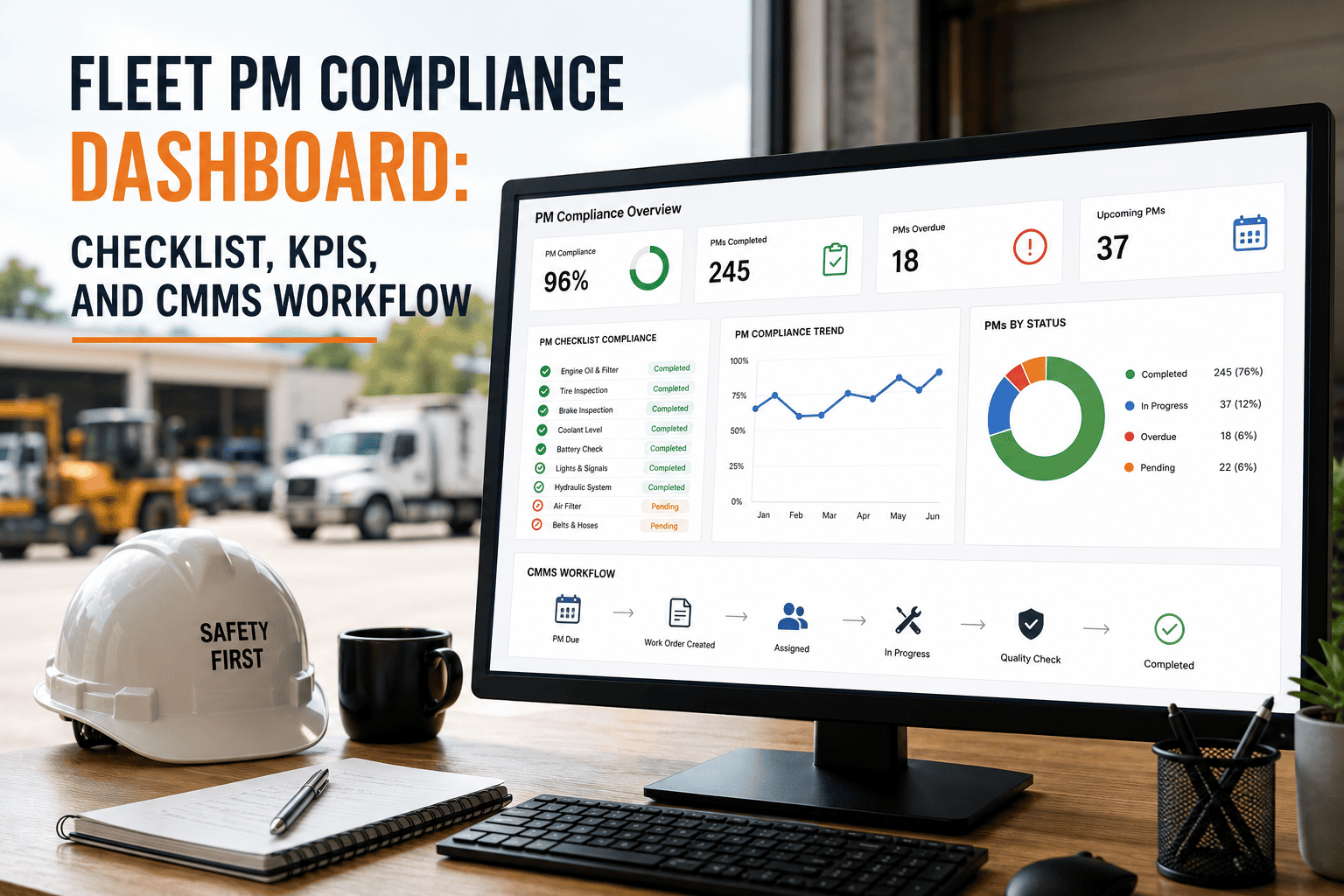
Establish weekly management review of key metrics: PM compliance, work order completion rates, breakdown frequency, and cost trends. Regular review creates accountability and surfaces problems before they compound.
Every inspection finding should generate a tracked work order. "No defects found" inspections are as important to document as problem reports—they establish the vehicle's condition for compliance purposes and liability protection.
Measuring Safety and Maintenance Performance
What gets measured gets managed. These key performance indicators track the health of your safety and maintenance program, providing early warning when performance degrades.
Build a safer fleet with systematic checklists, AI-powered predictions, and audit-ready compliance documentation.