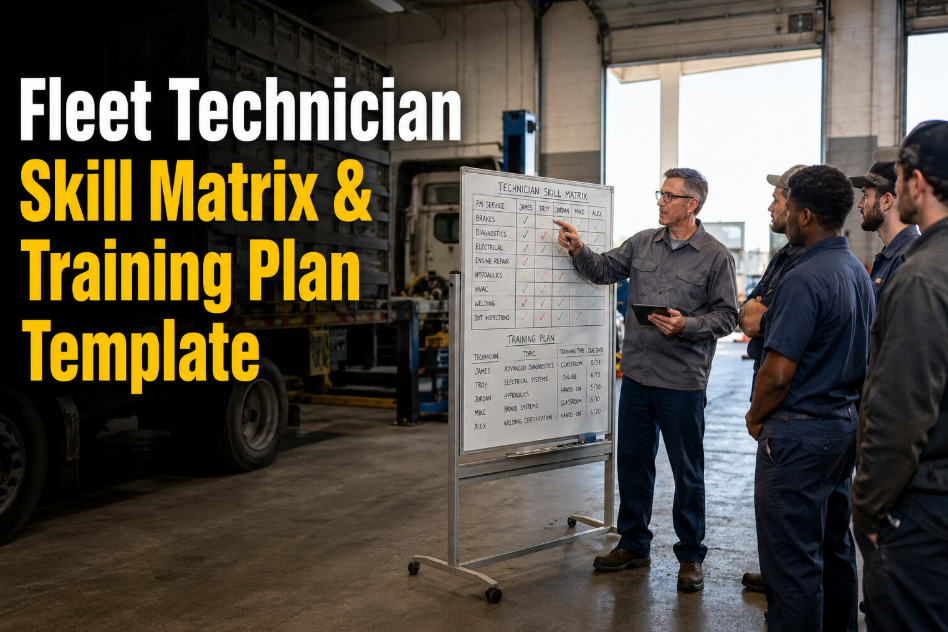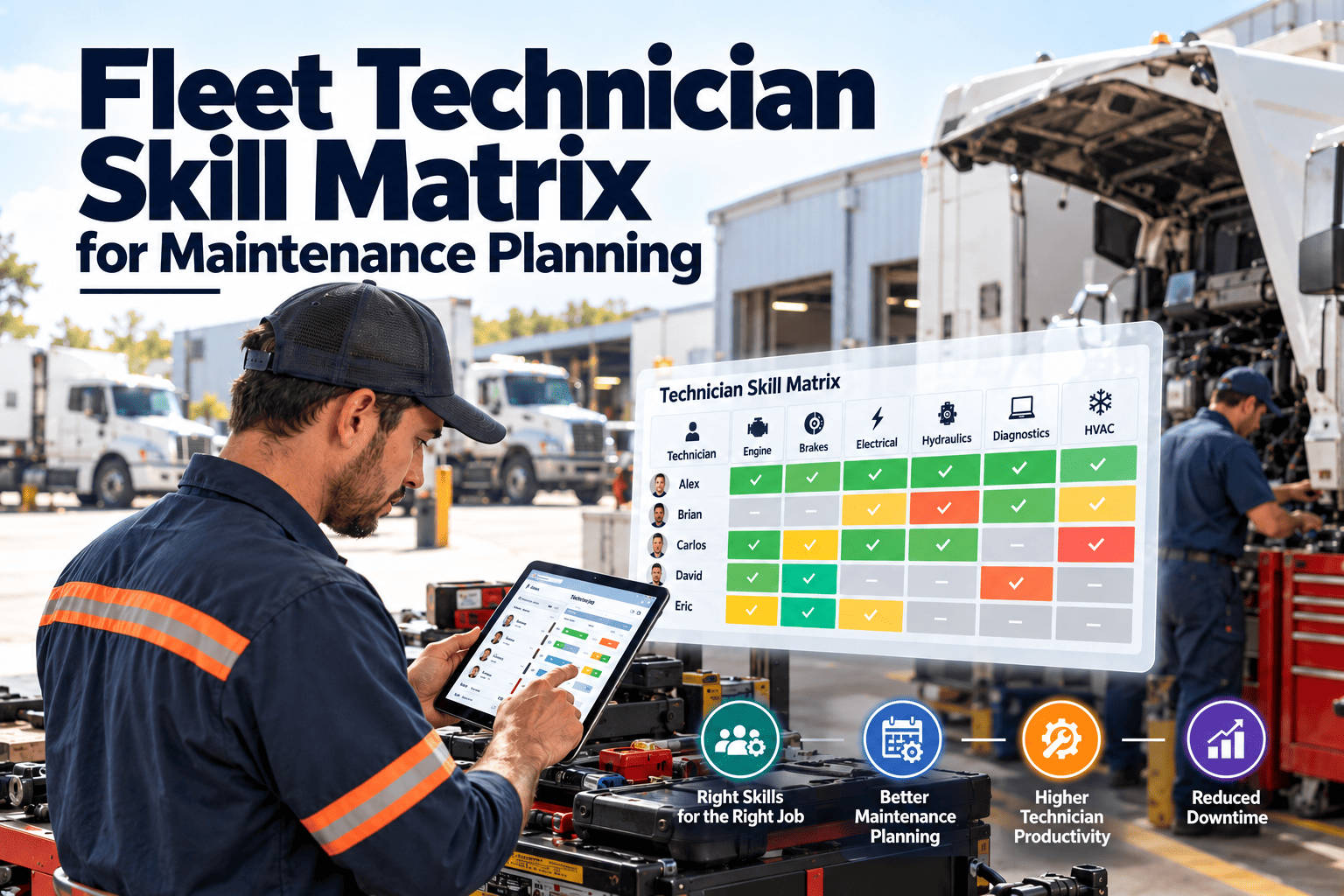
Every fleet shop has a technician who gets the hard jobs, and every shop feels it when that person is on leave. Work gets assigned by habit, repairs stall because the right skill is missing, and certification dates slip past unnoticed. A skill matrix turns this hidden knowledge into a planning tool that shows who can do what, at what level, and where coverage is thin. This checklist guide shows how to build one and how Oxmaint maintenance management software can connect it to daily work orders.
Fleet Technician Skill Matrix for Maintenance Planning
Tick through this checklist to match every work order to a qualified technician, find single-person skill gaps early, and keep certifications current.
Checklist 1: Is a Skill Matrix Worth Building Now?
Capacity planning usually counts heads. A skill matrix counts the right heads for each job, which is what decides whether a vehicle returns to service on time.
- Complex diagnostics are not left to whoever is free.
- Rework drops when jobs go to people trained on that system.
- Training budgets target real gaps instead of general courses.
- Leave and turnover become manageable because backup skills are known.
The matrix is also a safety record. It shows who is authorized for high-risk work such as air brakes, lifts and high-voltage systems.
Checklist 2: Define the Proficiency Scale
Keep the scale short so supervisors score consistently. Five levels are enough for most fleet workshops.
Expert and trainer
Diagnoses unusual faults and can sign off others.
Independent
Completes the job to standard without supervision.
Supervised
Can do the work with a qualified person nearby.
Learning
Has had training but limited hands-on practice.
No exposure
Should not be assigned this work.
Checklist 3: Choose Skill Columns for Your Fleet
Start with the systems that generate the most work orders in your asset history, not a generic list.
| Skill group | Examples to score | Why it matters |
|---|---|---|
| Brakes and air systems | Foundation brakes, air dryers, ABS faults | Safety-critical and inspection-sensitive |
| Engine and aftertreatment | Fuel systems, DPF, SCR, turbochargers | Common cause of long downtime |
| Electrical and diagnostics | Wiring faults, sensors, scan tool work, telematics | Hard to diagnose without practice |
| Driveline and suspension | Axles, bearings, alignment, steering | Wear-driven, often predictable |
| Tires and wheels | Mounting, tread checks, wheel-end service | High volume, high safety impact |
| Body and auxiliary equipment | Lift gates, reefer units, PTOs, hydraulics | Specialist equipment on many fleets |
| High-voltage and EV | Battery isolation, charging, thermal systems | Requires formal authorization |
Add or remove columns to suit your vehicles. A fleet of vans does not need the same matrix as a mixed truck and trailer operation.
Checklist 3b: Score Technicians and Read Coverage
The example below uses illustrative scores. The bottom row counts how many technicians are at level 3 or higher.
| Technician | Brakes | Engine | Electrical | Reefer | High voltage |
|---|---|---|---|---|---|
| Tech A | 4 | 3 | 2 | 0 | 0 |
| Tech B | 3 | 4 | 3 | 1 | 0 |
| Tech C | 2 | 2 | 4 | 0 | 3 |
| Tech D | 3 | 1 | 1 | 3 | 0 |
| Level 3+ count | 3 | 2 | 2 | 1 | 1 |
Reefer and high-voltage work each depend on one person. That is the planning risk the matrix exists to expose.
Reading Coverage Risk
Put Skill Data Next to Your Work Orders
Track assets, work orders and technician assignments in one system so planning reflects who can actually do the job.
Checklist 4: Assign Work Using the Matrix
A matrix only helps if planners use it when releasing jobs. Apply a few clear rules.
- Safety-critical jobs go only to level 3 or higher, or a level 2 with a named supervisor.
- Complex diagnostics start with a level 4 technician, then repair steps are handed on.
- Routine PM goes to level 2 and 3 staff to build experience and free experts.
- Specialist equipment jobs are booked early because few people can cover them.
- Planners check the matrix before releasing large jobs.
Checklist 5: Track Certifications and Authorizations
Skill level is not the same as authorization. Keep both visible and record expiry dates.
| Record | Detail to store | Planning action |
|---|---|---|
| Manufacturer or trade training | Course, date, provider | Schedule refreshers before they lapse |
| Safety authorizations | Lifts, high voltage, confined space | Block assignment when expired |
| Regulatory qualifications | Local inspection or emission credentials | Match to compliance work in your region |
| Supervisor sign-off | Date and name of assessor | Support level changes with evidence |
Requirements vary by country and vehicle type, so confirm the credentials that apply to your operation.
Checklist 6: Close Gaps With Training Sign-Off
- Learner shadows a level 3 or 4 technician on live jobs.
- Learner performs tasks under direct supervision.
- Learner completes a job while the trainer reviews the result.
- Supervisor records the new level and date in the matrix.
Master Skill Matrix Checklist
Set up- Skill columns reflect the systems that cause most of your work orders.
- A 4 or 5 level proficiency scale is written down and shared.
- Every technician has been scored by a supervisor, not self-assessed alone.
- Skills with fewer than two level 3 technicians are flagged.
- Skills with zero qualified technicians have an outsourcing or training plan.
- Backup cover is named for each high-risk skill.
- Certification and authorization expiry dates are recorded.
- Safety-critical jobs are blocked from unqualified assignment.
- Supervisor sign-off evidence is stored for each level change.
- Planners check the matrix before scheduling large jobs.
- Training plans exist for each fragile skill.
- Scores are reviewed after training, new hires and departures.
Score your readiness
How Oxmaint Fits Into Skill-Based Planning
Oxmaint does not replace supervisor judgment, but it gives the matrix the maintenance context it needs.
- Work orders record who performed each job and how long it took.
- Asset history shows which systems fail most often, guiding skill priorities.
- Preventive maintenance schedules show upcoming workload by type.
- Mobile workflows let technicians log inspections, findings and completion on the shop floor.
- Reports help compare repeat repairs against the technicians and skills involved.
Teams can also attach training and compliance records to asset or personnel workflows, so evidence stays with the work.
Measures That Show the Matrix Is Working
Fleet Skill Matrix FAQs
What is a fleet technician skill matrix?
It is a grid showing each technician's proficiency across maintenance skills, used to assign work and plan training.
How many skill levels should we use?
Four or five levels work best because supervisors can score them consistently.
How often should we update it?
Review it after training, hires and departures, and at least twice a year.
Can a CMMS help with this?
Yes. Work orders and asset history show where skills are used. Start with Oxmaint.
Does it suit small workshops?
Yes, and gaps are often more visible there. Book a demo to discuss your setup.
Plan Maintenance Around the Skills You Really Have
Connect work orders, asset history and preventive maintenance with Oxmaint, and give planners the context to assign the right technician every time.