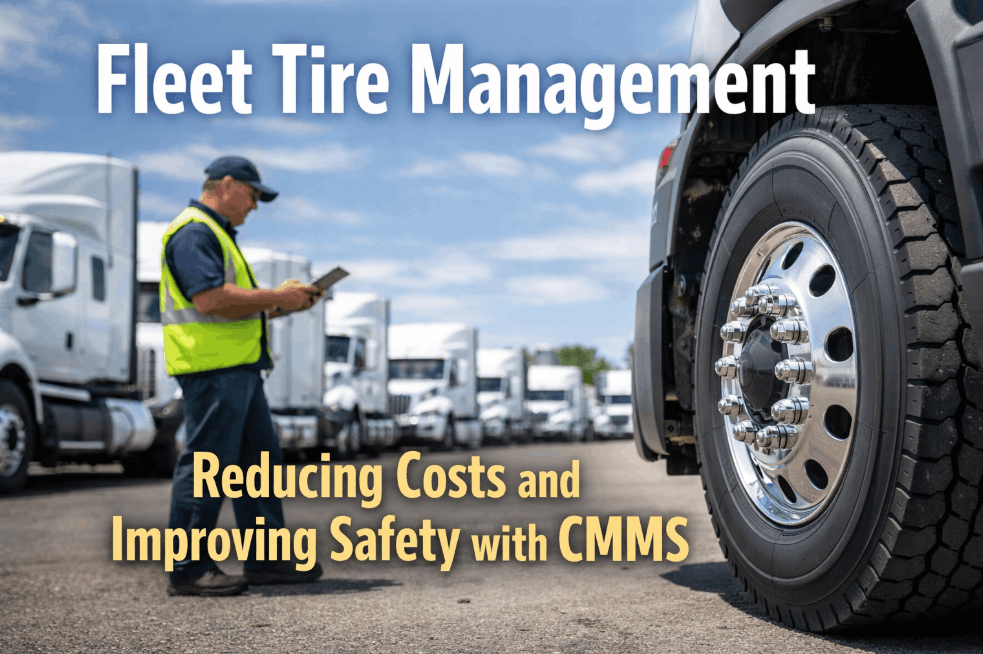
Tires are one of the largest controllable costs in any fleet, and also one of the most common causes of roadside failures. A tire program that relies on driver complaints and occasional gauge checks usually pays twice: once in early removals and again in downtime. Treating each tire as a tracked asset, with pressure, tread, position, and casing history, turns tire spend into something you can plan. This guide lays out a practical lifecycle approach and shows where a fleet maintenance CMMS keeps the records connected.
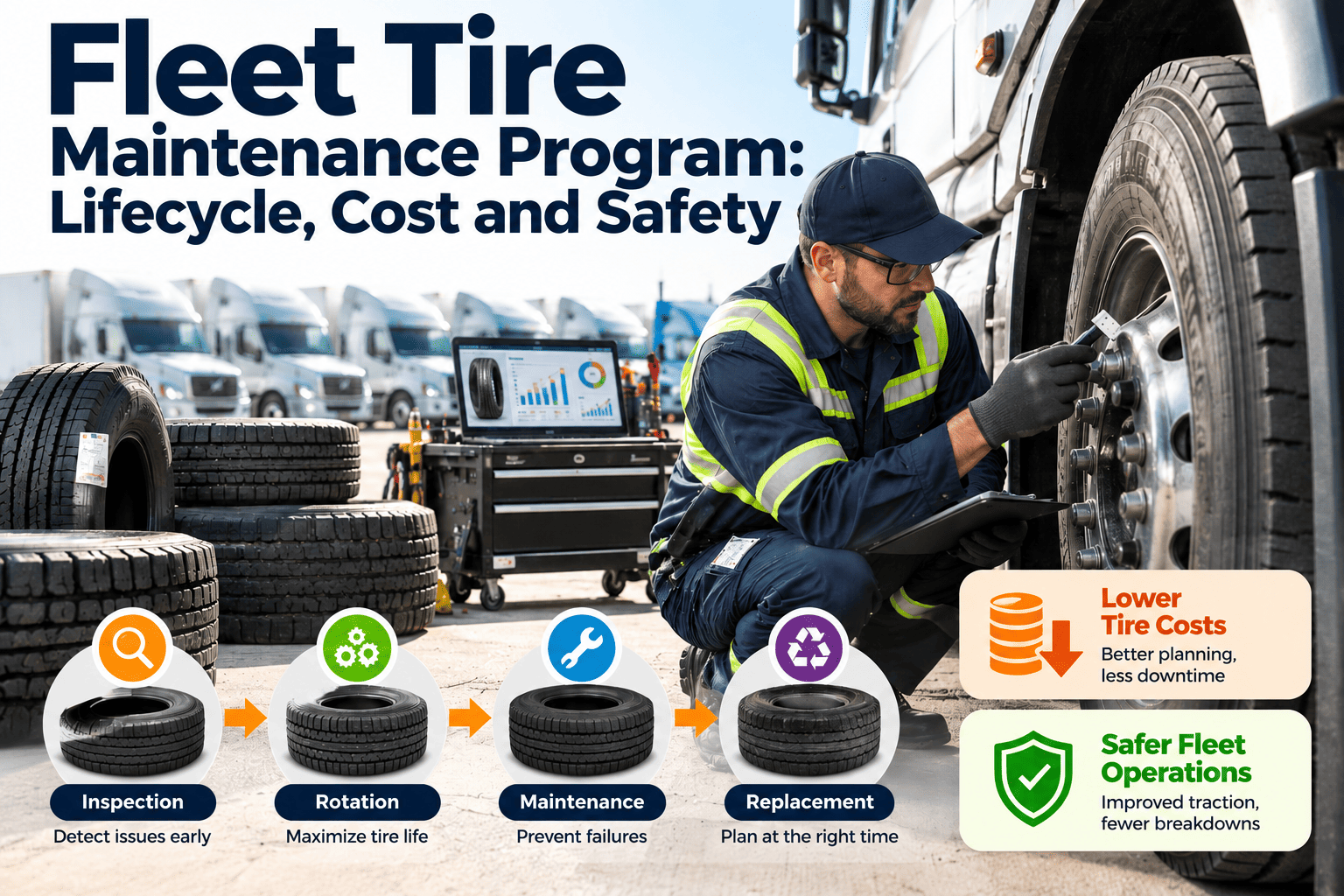
Fleet Tire Maintenance Program: Lifecycle, Cost and Safety
Follow each tire from purchase to casing retire, catch pressure and wear problems early, and bring cost per distance down without cutting safety margins.
Five reasons tire programs lose money quietly
- Pressure is checked only when a driver reports a problem
- Tread depth is measured at removal, not during service
- Tires are tracked by vehicle only, so position history is lost
- Casings are scrapped without checking retread eligibility
- Vendors set replacement timing, not the fleet
- Pressure and visual checks are built into scheduled inspections
- Tread readings are logged at every PM and trended by position
- Each tire has a record that follows it between positions
- Casing condition is graded at removal for retread decisions
- Removal reasons are coded so patterns become visible
Where tire failures cluster: a simple risk matrix
Rank each failure mode by how often it appears in your fleet and how severe it is when it happens. Your own removal data should replace the placeholders below.
- Low pressure sits in the top-right because it is common and drives heat, wear, and blowouts.
- Mixed duals is frequently overlooked because each tire looks acceptable on its own.
- Uneven wear is low severity per event but expensive over time and often points to an alignment or suspension fault.
The tire lifecycle, stage by stage
Each stage has an owner, a record, and a decision. Skipping any of them leaves a gap in cost data.
Specify and purchase
Match tire type to axle position, load, and duty cycle. Record brand, model, size, load range, and DOT code at receipt.
Mount and baseline
Log the position, starting tread depth, set pressure, and vehicle meter. Without this baseline, wear rates cannot be calculated.
Inspect on schedule
Capture cold pressure, tread depth, sidewall condition, valve and wheel-end condition at every PM and defined pre-trip checks.
Rotate, align, and correct
Move tires between positions based on wear patterns, and trigger alignment or suspension work when the pattern points to a mechanical cause.
Repair or remove
Apply your repair policy, record the removal reason code, and keep the casing history attached.
Retread or retire
Send eligible casings to retread, track the new tread cycle, and scrap only when the casing fails inspection.
Inflation is the cheapest lever in the program
Pressure drives heat, wear rate, and casing life. Set targets from load and tire manufacturer data, not from a single number for the whole fleet.
- Measure when tires are cold, meaning the vehicle has been parked for several hours, as your tire manufacturer defines it.
- Keep dual tires matched in pressure and in tread depth so one tire does not carry extra load.
- Replace missing valve caps and damaged valve stems during the same visit, since they cause slow leaks.
- Calibrate gauges on a schedule and record which gauge was used.
| Monitoring option | Strength | Limit |
|---|---|---|
| Manual gauge checks | Low cost and works on any vehicle | Depends on discipline and gauge accuracy |
| Tire pressure monitoring system | Continuous alerts on pressure and often temperature | Sensor batteries and trailer pairing need upkeep |
| Automatic inflation on trailers | Maintains pressure between checks | Can mask a leak, so alerts and inspections still matter |
| Vendor service visits | Specialist tools and labor | Records must be returned and attached to the vehicle |
What to check, how often, and who does it
| Check | Typical timing | Performed by | Record |
|---|---|---|---|
| Visual walk-around for bulges, cuts, missing valve caps | Every pre-trip | Driver | Inspection report |
| Cold inflation pressure on every position | Per PM and a defined routine interval | Technician or tire vendor | Pressure by position |
| Tread depth at multiple grooves | Every PM | Technician | Depth by position |
| Dual matching and spacing | Every PM | Technician | Pass or fail with note |
| Wheel-end and lug nut condition | After any wheel service and at PM | Technician | Work order task |
| Casing review at removal | Each removal | Tire lead | Casing grade and reason code |
Set the intervals from your own duty cycle and your tire manufacturer guidance, then adjust based on what removal data shows.
Read the wear pattern before replacing the tire
Wear patterns are a free diagnostic. Recording them in the work order helps you fix the cause, not just the tire.
| Pattern | Likely cause | Action |
|---|---|---|
| Wear on both shoulders | Chronic underinflation | Audit pressure routine and check for slow leaks |
| Center wear | Overinflation | Verify pressures against load and spec |
| One-sided wear | Alignment or camber problem | Align and inspect suspension components |
| Cupping or scalloping | Worn shocks, imbalance, or loose components | Inspect suspension and wheel-end |
| Feathered edges | Toe misalignment | Check toe and steering linkage |
| Flat spots | Brake lockup or dragging brakes | Inspect brake system and ABS function |
Retreading only pays when casings are protected
A casing is a reusable asset. Running it underinflated or overloaded shortens its life and removes the retread option.
| Removal situation | Decision | Record to keep |
|---|---|---|
| Normal wear to retread depth, no damage | Send to retread | Casing number, miles on first life |
| Repairable puncture in the repair area | Repair per policy, then continue or retread | Repair type, vendor, date |
| Sidewall damage or run-flat evidence | Scrap | Cause code and photo |
| Irregular wear from a mechanical fault | Fix the fault, then inspect the casing | Linked corrective work order |
| Age or prior-repair limits exceeded | Scrap per retreader criteria | Retreader reject reason |
Code every removal so patterns become visible
A short, fixed list of removal codes is more useful than free-text notes, because it can be counted.
Normal wear-out, irregular wear, alignment-related wear
Puncture, impact, sidewall cut, bead damage, curb contact
Run flat, overheating, overload, mismatched dual
- Require a code before a tire work order can be closed.
- Review the top three codes monthly and assign a corrective action to each.
Tune the program to how each vehicle actually works
A regional delivery van, a line-haul tractor, and a refuse truck wear tires in very different ways. One inspection plan rarely fits all three.
| Duty cycle | Main tire stress | Program emphasis |
|---|---|---|
| Line haul | Sustained speed and heat | Pressure discipline, dual matching, casing protection for retread |
| Urban delivery | Curb contact, tight turns, frequent stops | Sidewall inspection, steer tire wear, alignment checks |
| Vocational and refuse | Cuts, heavy loads, low speed scrubbing | Damage inspection and tire type selection |
| Off-road and yard | Punctures and impact | Shorter inspection intervals and repair policy clarity |
- Review pressure targets again when payload or route type changes.
- Check pressures more often when ambient temperature swings sharply, since pressure moves with temperature.
- Use removal codes by duty cycle to see which operations drive the most premature removals.
Keep outside tire work inside your records
Many fleets use a tire dealer for mounting, repairs, and retreads. The work is only useful for planning if the data comes back.
- Require vendors to report position, tread, pressure, and removal reason on every invoice or service report.
- Match vendor invoices to completed work orders before payment.
- Review repeat repairs by vendor and by location to spot quality issues.
- Agree on casing return rules so retreadable casings are not lost.
Stop guessing when your tires will run out
Log pressure, tread, and removals by position, and let scheduled work orders keep your program on track.
Tire rules that your records should be able to prove
In the US, FMCSA regulations set minimum tread depths and require defects to be reported and repaired. Confirm local rules if you operate elsewhere.
4/32 inch
Minimum tread depth in a major groove under 49 CFR 393.75.
2/32 inch
Minimum tread depth in a major groove for other positions.
DVIR defects
Tire defects reported by drivers need a documented repair or sign-off.
- Keep dated tread and pressure readings so you can show a removal was driven by policy.
- Link roadside tire events to the vehicle, position, and tire record for later review.
- Follow your own stricter removal thresholds where they exist, and record them in the program policy.
- Treat repairs on tires and wheels as quality-controlled work with a completed work order.
Where the cost per distance really comes from
Cost per distance is more than purchase price divided by miles. Track each component of it separately.
Tire KPIs worth reviewing every month
| KPI | How to calculate | What it tells you |
|---|---|---|
| Cost per distance by position | Total tire cost divided by distance run | Whether steer, drive, and trailer positions are performing as specified |
| Pressure compliance | Positions within target range divided by positions checked | Quality of your inflation routine |
| Removal reason mix | Removals by code over total removals | Dominant failure and wear causes |
| Retread rate | Casings accepted for retread divided by casings removed | Casing care and early-removal damage |
| Tire-related road calls | Count per distance | Reliability and inspection effectiveness |
| Inspection completion | Completed tire checks over scheduled checks | Whether the program is actually being followed |
The tire record that makes the numbers possible
A tire must be its own asset, linked to a vehicle and position, not a line in a work order note.
Serial or DOT code, brand, model, size, load range, purchase date, casing number, status
Vehicle, axle, wheel position, mount and dismount dates, meter readings
Tread depth readings, cold pressure, inspection results and wear notes
Removal reason code, casing grade, retread cycle, scrap or credit outcome
Running the program inside Oxmaint
Oxmaint maintenance management software keeps tire tasks tied to the vehicles and technicians who perform them.
| Program need | Oxmaint capability |
|---|---|
| Recurring pressure and tread checks | Preventive maintenance schedules with checklists |
| Driver and technician defect reports | Mobile inspections that create corrective work orders |
| Tire and wheel assets by vehicle | Asset management with parent and child records |
| Tire stock and spare control | Inventory tracking and parts issue on work orders |
| Cost and removal trend review | Reporting and dashboards by vehicle or depot |
Start the program in four moves
Audit current pressure and tread on a pilot group to set a baseline.
Define removal reason codes and a simple casing grading scale.
Add tire checks to PM checklists and train technicians on data entry.
Review monthly KPIs, adjust intervals, and expand to the whole fleet.
A repeatable response to a roadside tire event
Log the event
Create a work order with the vehicle, position, location, and symptoms.
Dispatch service
Assign the vendor or mobile technician, and record arrival and completion times.
Capture the cause
Photograph the failed tire and record the removal code and casing outcome.
Inspect the neighbors
Check the mating dual, the other tires on the axle, and the wheel-end for a shared cause.
Who does what
- Drivers report defects, check visible condition, and do not ignore pressure warnings.
- Technicians measure, correct, and record every reading at each PM.
- The tire lead reviews removals, vendor performance, and monthly KPIs.
- Storekeepers handle spares so tires are stored upright or on racks, away from heat, oil, and sunlight, and issued oldest first.
Give drivers and technicians a short, specific checklist
| Role | Skill to build | How to verify |
|---|---|---|
| Driver | Spot low tires, bulges, cuts, and heat at pre-trip | Defect reports match technician findings |
| Technician | Measure tread and pressure correctly and read wear patterns | Spot audits of recorded readings |
| Tire lead | Grade casings and review removal codes | Retread acceptance rate |
| Dispatcher | Report roadside tire events with position details | Complete road call work orders |
- Use short refreshers after every audit that finds recurring errors.
- Share one monthly example of a wear pattern and its root cause with the whole shop.
Fleet tire maintenance questions
How often should fleet tire pressure be checked?
At every PM and on a routine interval set by duty cycle, always with tires cold.
Do tires need individual records?
Yes. Individual records let you trend wear by position and judge casings for retread.
What is the biggest cause of early tire removal?
Underinflation and misalignment are common causes. Your removal codes will confirm it for your fleet.
Can tire checks be part of the PM?
Yes. You can sign up and add tire tasks to existing PM checklists.
How do we handle outside tire vendors?
Log vendor work on the work order so the record stays complete. You can book a demo to see how.
Make every tire earn its full life
Bring pressure, tread, and removal data into one maintenance system and turn tire cost into a managed number.