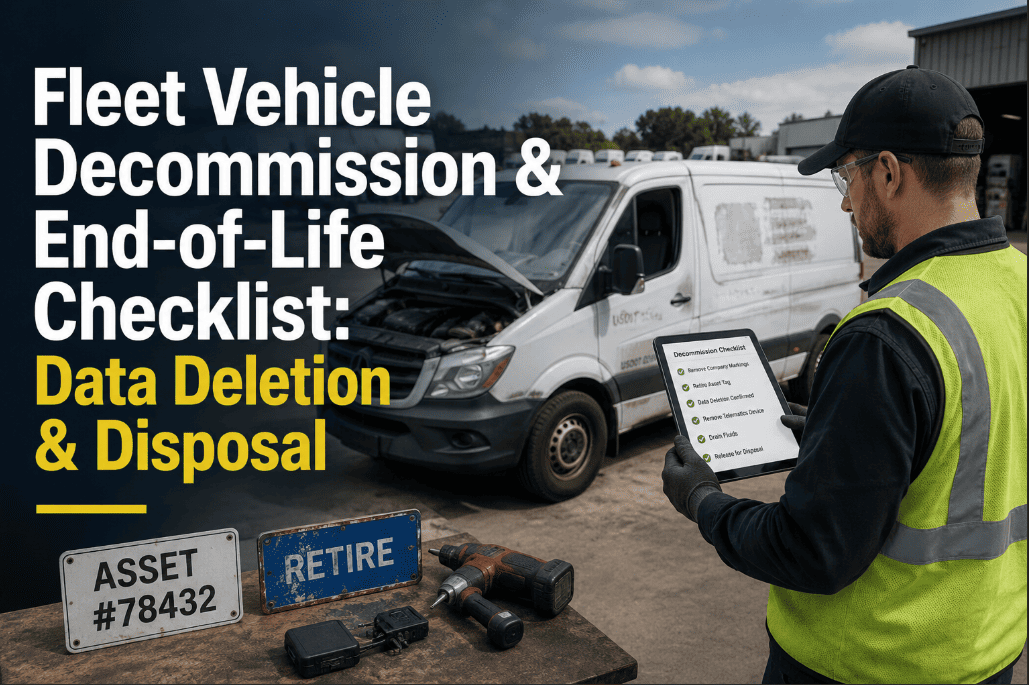
A vehicle that leaves the fleet incorrectly is an active liability — an unretired telematics device still reports location, an uncancelled insurance policy keeps billing, and an open CMMS record generates phantom PM work orders for a vehicle that no longer exists. Decommissioning is not disposal. It is a structured compliance process that ends the vehicle's legal, financial, and operational relationship with the fleet — completely and permanently. Oxmaint's asset retirement module guides fleet administrators through every decommission step in a single guided workflow.
Vehicle Decommission — 6-Step Process Flow
A vehicle decommission is not a single event — it is a six-step process where each step creates conditions for the next. Skipping step 2 (telematics removal) means step 5 (insurance cancellation) still generates data charges. Skipping step 4 (data wipe) creates a GDPR or state privacy violation at step 6 (disposal). Every step must be completed in sequence.
Technology That Streamlines Fleet Decommissioning
Manual decommissioning is a paperwork marathon — cancelling insurance, returning plates, archiving records, and notifying six different systems separately. Four technologies compress the process and eliminate the gaps that create post-disposal liability. Oxmaint coordinates all four in a single decommission workflow.
1. CMMS Record Closure and Telematics Removal Checklist
The CMMS record and telematics device are the two digital artefacts that keep a disposed vehicle alive in systems after it has left the fleet. Both must be formally closed before the vehicle moves to disposal — not after. Retire assets and archive records in Oxmaint's decommission workflow.
All open work orders closed or transferred — no pending WOs at disposal
Close or reassign every open PM and repair work order before retiring the asset record. Open work orders against a retired asset create system errors and distorted fleet cost data. Required — before asset retirement
CMMS asset record retired — not deleted, archived with full history
Archive the asset record — do not delete it. The vehicle's full maintenance, inspection, and compliance history must be retained for 4 years post-disposal for DOT audit and litigation purposes. Violation — deleted vs. archived
Telematics device physically removed — subscription cancelled
Remove the OBD or hardwired telematics unit before sale. A device left in a sold vehicle continues transmitting data charges to the fleet account and may report the buyer's location under the fleet's account. Required — before sale
ELD deregistered from FMCSA registered device list — vehicle VIN unlinked
Deregister the ELD device from the vehicle's VIN on the FMCSA registered ELD system. A VIN linked to a decommissioned ELD creates a compliance gap for the vehicle's new owner and a phantom HOS record for your carrier. Violation — VIN still linked
Driver data and trip history wiped — ECU and telematics unit cleared
Perform a complete data wipe of the ECU and telematics memory before disposal. Driver biometric data, trip history, and location logs constitute personal data under GDPR, CCPA, and most state privacy laws. Violation — data left on device
AI Digital Twin tip: Oxmaint generates the vehicle's complete lifecycle report at retirement — total cost of ownership, cost per mile by year, maintenance reliability score, and remaining component life estimates — providing the data set that maximises resale or auction valuation. See Oxmaint's vehicle lifecycle report at decommission.
2. Fluid Removal, Hazmat Compliance and Physical Preparation Checklist
A vehicle offered for sale with engine oil, coolant, brake fluid, or refrigerant still in the system creates environmental liability, transport classification issues, and in the case of refrigerant, an EPA Section 608 violation if the buyer vents it. Fluid removal must be documented — not assumed. Record fluid removal and disposal certificates in Oxmaint's decommission record.
Engine oil, coolant, and brake fluid drained — documented disposal
Drain all fluids and obtain a waste oil disposal receipt. Fluids left in a vehicle sold to a private party create environmental liability for the fleet if the buyer disposes of them incorrectly. Required — documented disposal
Refrigerant recovered by certified technician — EPA §608 compliant
Refrigerant must be recovered by an EPA §608 certified technician using approved recovery equipment before vehicle disposal. Venting refrigerant is a federal violation with fines up to $44,539 per day per violation. Violation — vented refrigerant
DEF tank drained and battery disconnected for storage or transport
Drain DEF (diesel exhaust fluid) if the vehicle will be stored over 12 months before disposal — crystallised DEF blocks injectors and destroys the SCR system. Disconnect the battery if in storage more than 30 days. Required — before storage
Pre-disposal condition inspection — photos for auction or sale record
Complete a documented walk-around inspection with photos of all four sides, interior, and undercarriage. These photos are the baseline for any post-sale damage dispute and support insurance settlement if the vehicle is sold damaged. Required — before handover
3. Legal, Registration and Financial Closure Checklist
The legal and financial closure steps are the ones most commonly deferred — because the vehicle is physically gone and the urgency evaporates. Title not transferred, plates not returned, and insurance not cancelled are three separate ongoing liabilities that accumulate costs and risk every day they remain open. Track all decommission closure tasks and deadlines in Oxmaint.
License plates returned to state DMV or transferred to replacement vehicle
Return plates to the issuing authority or transfer to a replacement vehicle within the state-mandated window — typically 10–30 days after sale. Plates not returned continue to accumulate registration fees and toll violation liability. Required — within state deadline
Vehicle title transferred — lien released and title signed over to buyer
Sign the title over to the buyer at the point of sale — do not leave a blank title with a vehicle. A blank signed title is a negotiable instrument; an unsigned title leaves the fleet liable for the vehicle. Violation — title not transferred
Insurance cancelled — confirmation letter retained
Cancel the vehicle's insurance policy and obtain written confirmation. Do not assume the insurer will auto-cancel on notice of sale — obtain a specific cancellation confirmation with effective date and retain for 4 years. Required — written confirmation
IFTA decals removed — base jurisdiction notified of disposal
Remove IFTA decals before sale and notify the base jurisdiction of the vehicle's disposal. IFTA decals are issued to the carrier — a sold vehicle displaying your IFTA decals creates filing complications for the new owner. Required — before sale
SAP asset retirement posted — disposal value and write-off recorded
Post the vehicle's disposal in SAP Fixed Assets on the same day as the physical sale — the disposal value, book value write-off, and any gain/loss on disposal must be recorded in the correct accounting period. Required — same day as sale
SAP Integration tip: Oxmaint's decommission workflow triggers SAP asset retirement automatically on completion — posting disposal value, clearing remaining depreciation, and archiving the vehicle's full cost ledger to the correct fiscal period without manual SAP journal entries. Book a demo to see Oxmaint's decommission-to-SAP workflow.
We were carrying 14 decommissioned vehicles in our CMMS for 6–18 months after disposal — generating phantom PM alerts, distorting our cost-per-mile metrics, and in two cases still accumulating insurance premiums. Oxmaint's decommission workflow closed all 14 records in two days, triggered the SAP write-offs, and gave us our first accurate fleet size report in three years.
Frequently Asked Questions
The most common questions from fleet directors and finance teams about vehicle decommissioning, disposal, and record retention.
Minimum 4 years from the date of disposal for DOT maintenance records under §396.3. Retain for 7 years if the vehicle was involved in any accident during its service life — litigation timelines can extend beyond the standard retention period.
EPA Section 608 requires certified recovery of all refrigerant before disposal. Venting or knowingly releasing refrigerant carries penalties up to $44,539 per day per violation. Recovery must be performed by EPA-certified technicians using registered recovery equipment — no exceptions.
Always archived — never deleted. The archived record contains the full compliance documentation, maintenance history, and inspection certificates required for DOT record retention compliance and any post-disposal insurance or litigation matters. Deletion creates an immediate audit liability.
Remove the decals and notify the base jurisdiction in writing of the vehicle's disposal date and VIN. Some jurisdictions require a formal cancellation form — check your base jurisdiction's IFTA administrative guidelines. Decals must not remain on a vehicle sold to a new operator.
No. Trip history, driver behaviour scores, and location logs constitute personal data under GDPR (EU/UK), CCPA (California), and equivalent laws in Canada and Australia. All data must be wiped before the device is removed or the vehicle is transferred — retain a wipe certificate as evidence.
Oxmaint guides administrators through all 6 decommission steps in sequence — archiving the asset record, triggering SAP write-off, generating the lifecycle summary report, and confirming all compliance items are closed before the disposal record is finalised.