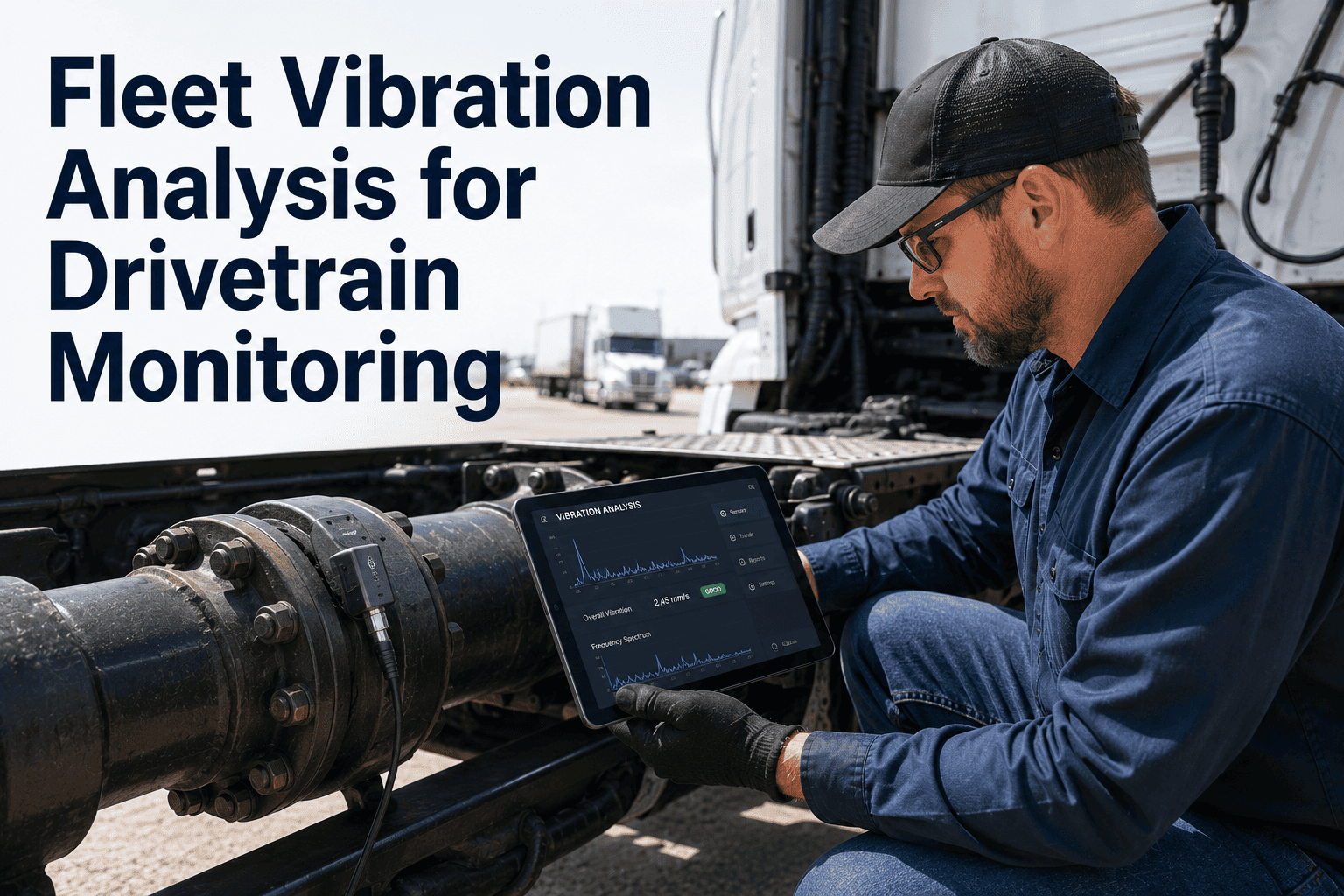
Fleet vibration analysis for drivetrain monitoring detects bearing, gear, and shaft defects weeks before catastrophic failure — and modern wireless sensors have made it scalable across entire fleets. By tracking changes in vibration signatures at the component level, reliability engineers catch spalling, misalignment, and imbalance early enough to plan repairs during scheduled downtime instead of reacting on the roadside. OxMaint's AI-powered CMMS integrates drivetrain vibration data directly into work-order workflows, so fleet managers can move from raw spectral alerts to scheduled maintenance without spreadsheets or manual handoffs. Start Free Trial to see how predictive analytics transforms your maintenance strategy.
Fleet Drivetrain Reliability
Bearing and drivetrain faults announce themselves in vibration first. Are you listening?
Fleet vibration analysis catches inner-race spalling, gear-tooth pitting, and shaft misalignment up to 12 weeks before secondary damage turns a $400 bearing repair into a $9,000 drivetrain replacement. OxMaint turns those vibration signatures into scheduled work orders — automatically.
The Cost of Late Detection
Why fleet drivetrain vibration monitoring pays for itself
A single undetected bearing fault on a Class 8 drivetrain cascades into collateral damage — gear teeth, seals, shafts, and ultimately a $9K–$18K remanufactured axle assembly plus 3–5 days of unplanned downtime.
A 180-vehicle regional haul fleet spending $42K annually on reactive drivetrain repairs cut unplanned downtime 38% in eight months after deploying vibration sensors and routing automated alerts through OxMaint — recovering the $28K sensor investment in under 11 weeks.
Fault Detection Guide
What fleet bearing vibration monitoring reveals — and when to act
Each drivetrain defect type produces a characteristic vibration signature at a predictable frequency. Matching the signature to the severity stage determines whether you schedule maintenance next quarter or next shift.
| Fault Type | Signature Frequency | Stage 1 (Early) | Stage 3 (Critical) | Recommended Action |
|---|---|---|---|---|
| Outer-race bearing | BPFO harmonics | 3–5 g RMS peak | 12+ g RMS, sidebands present | Schedule within 30 days |
| Inner-race bearing | BPFI + 1× sidebands | 4–6 g RMS | 15+ g, broadband rise | Schedule within 14 days |
| Gear tooth pitting | GMF sidebands | Slight amplitude rise | Multiple sideband families | Inspect at next PM |
| Shaft misalignment | 1× and 2× RPM dominant | 2× exceeds 1× by 50% | 3× and 4× harmonics emerge | Laser align within 7 days |
| Coupling wear | 2× and 3× RPM | Moderate peak | Radial and axial shift | Replace coupling at PM |
How It Works
From vibration signal to scheduled work order in four steps
The gap between detecting an anomaly and acting on it is where most fleets lose money. OxMaint closes that gap by connecting spectral data directly to the CMMS work-order engine — no spreadsheets, no email chains, no missed alerts.
Tri-axial sensors transmit RMS, peak, and crest factor every 15 minutes
Wireless accelerometers mount magnetically on axle housings, transmission cases, and differential covers. Battery life exceeds 5 years. No wiring harnesses or telematics integration required.
OxMaint's AI engine compares spectra to asset-specific baseline signatures
The platform isolates bearing defect frequencies (BPFO, BPFI, BSF, FTF), gear mesh frequencies, and running-speed harmonics — then trends them against the baseline established during the first 14 days of monitoring.
Threshold breaches generate prioritized alerts routed to the right technician
Yellow alerts (Stage 1–2) create a planned work order flagged for the next PM window. Red alerts (Stage 3) trigger an immediate high-priority work order with diagnostic data attached — including the spectrum plot and recommended repair procedure.
Post-repair vibration readings confirm the fix and reset the baseline
Technicians log the repair in OxMaint, the CMMS automatically schedules a 7-day follow-up reading, and the AI validates that the defect signature has disappeared — creating a closed-loop audit trail for FMCSA compliance.
Software Integration
How OxMaint turns fleet vibration data into scheduled maintenance
Vibration sensors without a CMMS are just dashboards. OxMaint connects drivetrain vibration analysis to work orders, parts inventory, and PM scheduling — so every alert becomes an actionable, traceable repair.
Automated Work-Order Generation
Threshold breaches auto-create work orders pre-filled with asset history, defect type, recommended parts, and repair procedures — cutting administrative time 60% and eliminating missed alerts.
Predictive PM Scheduling
AI-driven PM intervals adjust dynamically based on vibration trend data — extending oil-change intervals on healthy assets and pulling forward repairs on degrading ones, cutting unnecessary PM labor 25–35%.
Parts Inventory Linkage
When a vibration alert triggers, OxMaint checks bearing and gear stock levels in real time, auto-reserves parts, and generates purchase orders if below safety stock — eliminating repair delays from missing components.
Compliance & Audit Trail
Every vibration alert, work order, repair, and post-repair verification is time-stamped and logged — producing FMCSA-ready documentation and DOT audit reports in one click, eliminating paper-based compliance gaps.
Deployment Economics
What fleet vibration monitoring costs — and what it saves
Wireless tri-axial sensors now cost $120–$280 per mounting point, and a typical Class-8 drivetrain needs 3–4 sensors (transmission output, drive axle pinion, wheel-end). The payback math is straightforward.
See OxMaint catch drivetrain failures before they happen
Book a 30-minute demo and we'll show you exactly how vibration alerts flow into work orders, parts reservations, and PM schedules — on your assets, with your fault codes.
Frequently Asked Questions
Fleet vibration analysis for drivetrain monitoring: your questions answered
How does fleet vibration analysis detect bearing failures before they cause downtime?
Fleet vibration analysis detects bearing failures by identifying characteristic defect frequencies — BPFO for outer-race faults, BPFI for inner-race — that appear in the vibration spectrum long before audible noise or temperature rise. A tri-axial sensor captures acceleration data, the CMMS platform compares it to a baseline, and when amplitudes cross predefined thresholds, an automated work order is generated. This typically provides 4–12 weeks of lead time before functional failure.
How many vibration sensors does each fleet vehicle need for drivetrain monitoring?
A typical Class-8 truck drivetrain requires 3–4 sensor mounting points: transmission output shaft, drive axle pinion bearing, and both wheel-end hubs. For vocational vehicles with multi-axle configurations, add one sensor per driven axle. Total hardware cost ranges from $360–$1,120 per vehicle depending on sensor count and whether you choose continuous-monitoring or walk-up polling sensors. OxMaint integrates with all major wireless vibration sensor brands — see how it works when you Book a Demo.
Can vibration monitoring replace scheduled preventive maintenance on fleet drivetrains?
Vibration monitoring complements — but does not fully replace — scheduled PM. Oil sampling, visual inspections, and fluid changes still catch issues that vibration may not detect early (lubrication degradation, seal leaks). However, condition-based monitoring via vibration analysis lets you extend PM intervals on healthy assets by 25–35% and pull forward repairs on degrading ones, shifting from time-based to condition-based maintenance strategy.
What is the difference between fleet vibration monitoring and traditional oil analysis?
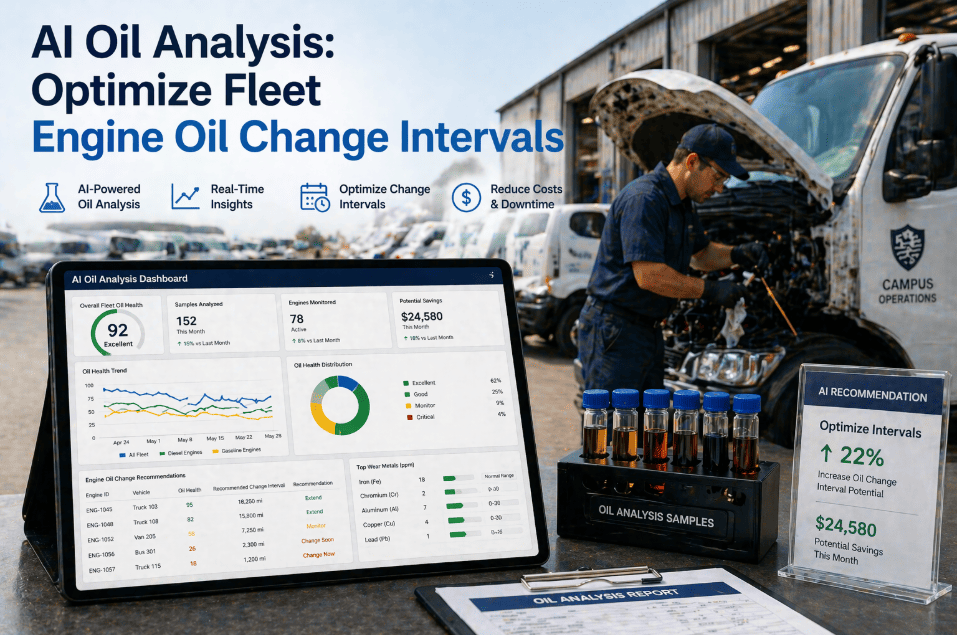
Oil analysis detects wear-metal particles after damage has already begun shedding material — typically at Stage 2 or 3 of bearing failure. Vibration monitoring detects the mechanical signature of defects at Stage 1, before significant material loss occurs, providing 4–8 additional weeks of lead time. The two techniques are complementary: vibration catches the fault earliest, oil analysis confirms severity and lubricant condition, and together they provide a complete picture of drivetrain health.
How long does it take to deploy fleet vibration monitoring with OxMaint?
A 120-vehicle fleet can be fully instrumented and live in OxMaint within 4–6 weeks: 1–2 weeks for sensor installation, 2 weeks for baseline signature acquisition, and 1 week for threshold tuning and technician training. OxMaint's onboarding team handles sensor-to-asset mapping, alert threshold configuration, and work-order template setup. You can Start Free Trial immediately and begin configuring your asset hierarchy while sensors ship.
Stop reacting to drivetrain failures. Start predicting them.
Join the fleet reliability teams using OxMaint to catch bearing faults weeks early, cut unplanned downtime 30–50%, and turn vibration data into scheduled maintenance — not roadside emergencies.
Free 14-day trial · No credit card