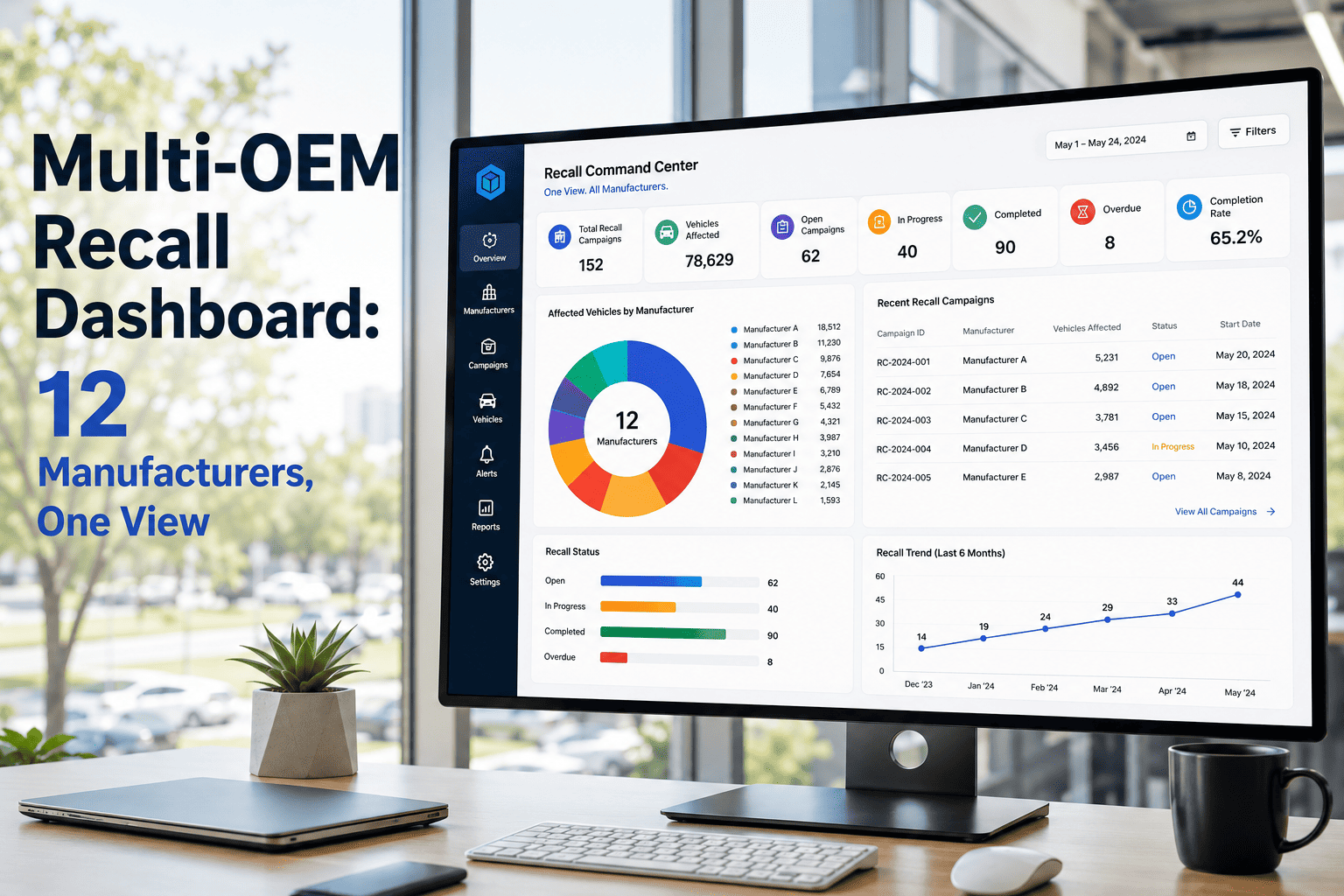
Multi-OEM Recall Dashboard: 12 Manufacturers, One View

By Corin Hale on September 1, 2026

multi-oem-recall-dashboard-fleet

Mixed fleets rarely stay loyal to one manufacturer. A regional carrier might run Freightliner tractors, Ford and Ram pickups, Isuzu box trucks, and trailers from three different builders — and every one of those manufacturers publishes recall notices through its own portal, its own file format, and its own notification cadence. A fleet manager checking twelve separate OEM systems every week is not managing recalls, they are hunting for them, and the gaps between portals are exactly where VINs fall through. The safer approach is pulling every open campaign into one normalized, VIN-matched view instead of chasing twelve logins — start a free trial to see your fleet's exposure across every manufacturer at once.

Fleet Compliance · Cross-OEM Recall Management

Multi-OEM Recall Dashboard: 12 Manufacturers, One View

Mixed fleets get recall notices from a dozen manufacturers in a dozen different formats. Here's how aggregation, normalization, and single-pane VIN matching turn that chaos into one dashboard.

12+
Manufacturers commonly represented in a single mixed commercial fleet
24 hrs
Typical window to match a newly published campaign against every fleet VIN
1
Federal source — NHTSA's recall database — behind every manufacturer's campaign
0
OEM portals a fleet team should need to check manually once feeds are unified

The Twelve-Portal Problem

Every OEM recall notice ultimately traces back to a single federal source, but the delivery experience is anything but unified. Manufacturers issue campaign numbers in their own numbering schemes, send notifications through their own dealer and owner channels, and format remedy details — free repair, over-the-air update, parts replacement — however their own systems output them. For a fleet running five or more brands, that means five or more separate checking habits, and habits are exactly where recalls slip through.

Format Chaos
One OEM sends a PDF bulletin, another emails a dealer notice, a third only updates its own owner portal. None of it arrives in a shape your CMMS can read automatically.
Notification Gaps
Recall emails go to whichever contact was on file when the vehicle was purchased — often years before the current fleet manager ever saw the account.
No Cross-Fleet View
Even if every OEM notification arrived on time, nothing shows total recall exposure across trucks, trailers, and equipment from different builders in one place.
Manual VIN Matching
Cross-referencing a spreadsheet of VINs against a dozen recall bulletins by hand is slow, and a single transposed digit misses a match entirely.

How Aggregation Actually Works

Every manufacturer's recall campaign — regardless of brand — is required to be filed with NHTSA. That shared federal source is what makes a single dashboard possible: instead of monitoring twelve OEM channels, the dashboard monitors one, then does the normalization work manufacturers never coordinate on.

01
Pull
A daily sync retrieves every open campaign across all manufacturers from the NHTSA recall database, regardless of brand.
02
Normalize
Campaign number, component, consequence, and remedy are mapped into one consistent structure no matter how the OEM originally formatted it.
03
Match
Every VIN currently on the fleet roster is checked against every normalized campaign — across all brands — in the same daily pass.
04
Alert and Track
Matches trigger an alert, repair scheduling begins, and remediation is tracked to a documented, audit-ready close.

Built for Whoever Owns Recall Exposure

Fleet Safety Directors
See total open-recall exposure across every brand in the fleet in one number, not twelve separate tallies pulled from twelve portals.
Maintenance Managers
Work orders for recall remediation land in the same queue as routine PM work, regardless of which manufacturer built the vehicle.
Compliance Officers
Produce one audit-ready remediation record across the full mixed fleet instead of assembling evidence from a dozen separate systems.

Manual Portal Checking vs. a Unified Dashboard

Factor Checking Each OEM Portal Unified Recall Dashboard
Data Sources One login per manufacturer, checked separately One synced source covering every brand in the fleet
Update Frequency Depends on when someone remembers to check Daily automatic sync against the federal database
VIN Matching Manual spreadsheet cross-reference Automatic match against the full fleet roster
Format Consistency Different fields and terms per OEM One normalized record structure fleet-wide
Audit Trail Assembled manually from scattered notices Documented automatically from alert to closure
See Your Cross-OEM Exposure

Stop Checking Portals. Start Checking One Dashboard.

Upload your fleet roster and see every open recall across every manufacturer in your fleet, matched to your actual VINs, in one sync.

Frequently Asked Questions

How does a multi-OEM dashboard handle manufacturers that don't publish in standard formats?
Every campaign, regardless of how the OEM presents it publicly, is filed with NHTSA in a structured format. Normalization maps each manufacturer's data into one consistent record, so formatting differences at the OEM level never reach your dashboard. See it applied to your fleet.
Does this replace checking each OEM's recall portal directly?
Yes, for fleet compliance purposes. Since every manufacturer's campaign is required to be filed with the same federal database, a daily sync against that source covers all brands without visiting each OEM portal separately.
How current is the recall data compared to checking NHTSA.gov directly?
The dashboard syncs against the same live federal data NHTSA.gov reflects, typically within 24 hours of a new campaign's publication, so the fleet view stays current with the source of record.
Can the dashboard flag Park It or Do Not Drive advisories separately from routine recalls?
Yes. Advisory severity is part of the normalized record, so a Do Not Drive campaign surfaces distinctly from a routine free-repair recall instead of being buried in a single undifferentiated list. Ask about advisory handling on a call.
What happens when a vehicle is sold or removed from the fleet mid-recall?
Removing the VIN from the active roster stops future matching against it, while the remediation history up to that point stays in the audit record for any compliance review that references the vehicle's time in the fleet.
One Fleet. Every Manufacturer. One Dashboard.

Bring Every OEM's Recalls Into a Single View

Stop splitting recall compliance across a dozen manufacturer logins. See how a normalized, VIN-matched dashboard covers your entire mixed fleet from one screen.
Share This Story, Choose Your Platform!