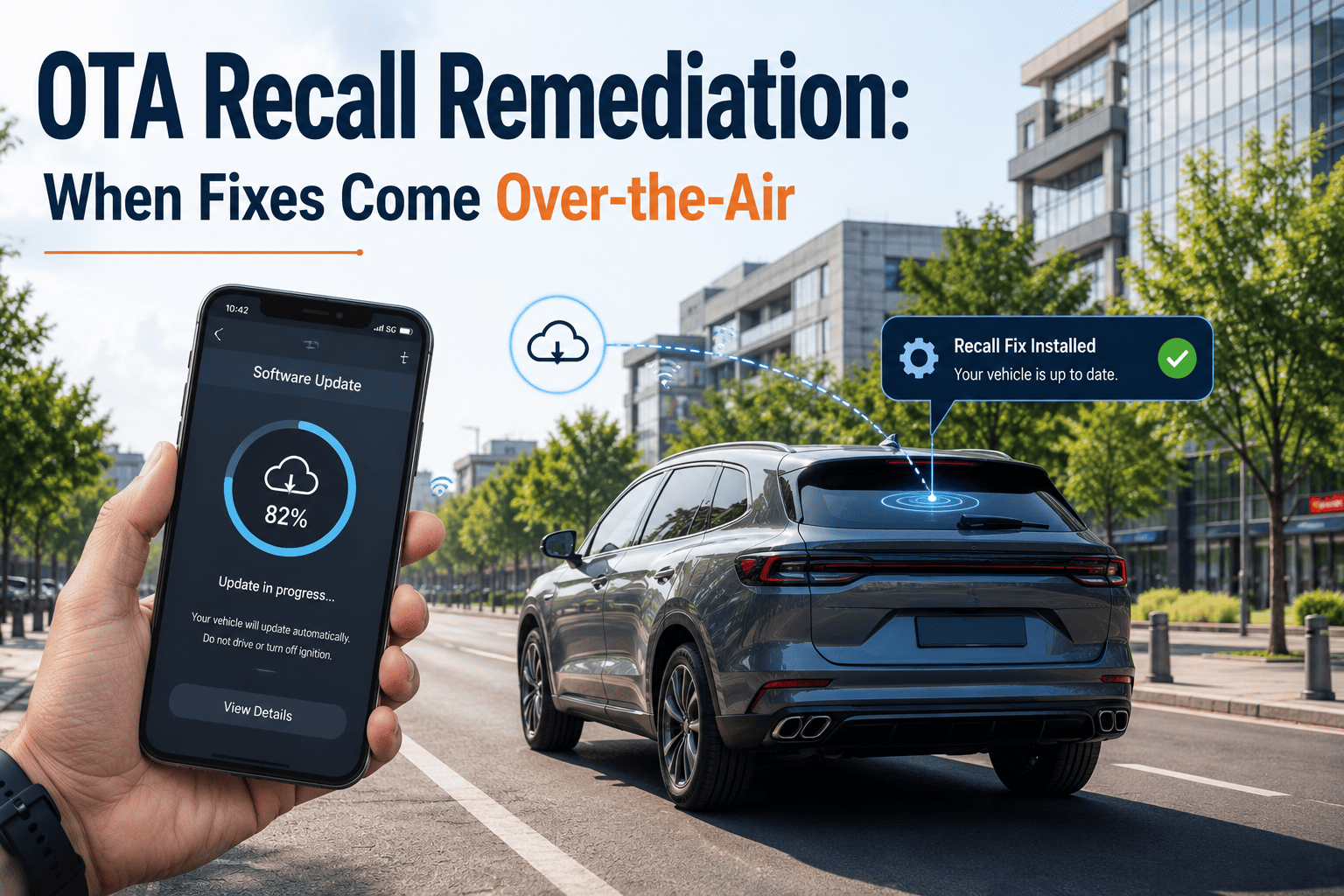
When a manufacturer pushes a recall fix over the air, nothing rolls into your yard, no technician signs a work order, and no paper trail lands on your compliance director's desk. The vehicle is simply supposed to be safe again, sometime between the notice and the next time it's driven. That gap is manageable for one consumer car parked in a driveway overnight. It is a very different problem for a fleet running dozens or hundreds of connected vehicles across multiple depots, where an auditor, insurer, or shipper eventually asks whether every unit on the road actually received the fix. Software recalls are becoming one of the most common ways manufacturers close a safety defect, and fleets that cannot prove an update landed on every affected VIN are carrying risk they cannot see. OxMaint turns every OTA recall campaign into a trackable, VIN-level record inside the same system that already manages your fleet's maintenance.
See Every OTA Recall Confirmed, VIN By VIN
OxMaint matches every over-the-air recall campaign against your fleet roster, tracks which units actually received the update, and flags the ones that didn't — before a driver, an auditor, or a claims adjuster finds out first.
The scale of the shift is easy to underestimate from inside a single depot. Zoom out to the industry level, and the numbers make it clear that software recalls are no longer a rare edge case — they're becoming a routine part of how safety defects get closed across nearly every vehicle segment on the road.
How an OTA Recall Actually Reaches Your Fleet
An over-the-air recall doesn't behave like a shop recall, and that difference is exactly what creates the fleet-side blind spot. There is no appointment, no vehicle off the road, and no signature confirming the work was done. The remedy is supposed to happen automatically, in the background, on the manufacturer's schedule rather than yours. Understanding the four stages a software recall actually moves through is the first step to knowing where your fleet's visibility disappears.
Recall Notice Filed With NHTSA
Federal guidance requires a manufacturer to file a formal recall notice even when the planned remedy is a software update, if that update mitigates a safety-related defect. This filing is where the campaign, affected VIN range, and remedy description first become public, and it's the earliest point a fleet can start tracking exposure.
Vehicle Eligibility Checked
Not every VIN in a recall population becomes eligible for the update at the same time. Hardware revision, software version, and production date all affect which vehicles are enrolled in which rollout wave, so a fleet with mixed model years can see the same recall apply unevenly across its own roster.
Update Downloaded And Installed
Most updates install overnight while the vehicle is parked and connected. Installation can silently fail from weak signal, insufficient battery, low storage, or a vehicle that simply wasn't parked long enough — and none of those failures generate a driver-facing warning or a fleet-facing alert of any kind.
Completion Logged — By the Manufacturer, Not You
Completion status lives in the OEM's system first. Unless a fleet separately checks VIN-level status, a vehicle can sit "recall open" for weeks while it continues to be dispatched, because nothing about its appearance or behavior signals an unresolved defect.
Every one of those four stages depends on connectivity and manufacturer visibility, not fleet visibility. A vehicle parked in a dead cellular zone overnight, or one whose owner has declined data-sharing permissions, can sit at stage two indefinitely without anyone on the fleet side knowing it never advanced. That is exactly why stage four — completion — is where most fleets quietly lose the thread.
OTA Recall vs. Shop-Based Recall
The two remedy types look similar on a recall notice but behave completely differently once they reach a fleet. Shop-based recalls are inconvenient but visible — the vehicle is physically gone, and someone signs a work order when it returns. OTA recalls are convenient but invisible, which shifts the entire compliance burden onto whoever is tracking VIN status on the fleet side. That shift is easy to underestimate until the first time an insurer or a DOT investigator asks a fleet to produce proof for a campaign nobody remembers hearing about.
| Aspect | Shop-Based Recall | OTA Recall |
|---|---|---|
| Owner Action Required | Schedule and attend a service appointment | Usually none — update applies automatically |
| Typical Time to Remedy | Weeks to months, depending on parts and slots | Hours to days, if the vehicle has connectivity |
| Paper Trail Created | Signed work order and parts record | None, unless the fleet captures it separately |
| Fleet Visibility | Dispatcher knows the vehicle is off the road | Vehicle appears normal and stays in rotation |
| Risk If Remedy Fails | Vehicle is visibly still at the shop | Vehicle looks fine but the defect may remain |
The Fleet-Side Blind Spot
A software recall is designed around a single owner and a single vehicle, checking their own phone or infotainment screen for a completion message. Stretch that same design across a fleet of a hundred connected trucks or vans, spread across several depots and multiple drivers per shift, and four risks appear that a manufacturer's consumer-facing process was never built to solve.
Unconfirmed Installation
Manufacturer OTA completion data doesn't always sync cleanly into a fleet's telematics feed. A vehicle can show as "eligible" or "pending" for months after the fix should have already landed, with no alert generated at any point, and no one assigned to notice.
No Driver Notification Trail
Because drivers don't have to do anything for an OTA fix to apply, there's often no written record that anyone told them a defect existed, what it affected, or when it was resolved — a gap that matters if the vehicle is later involved in an incident.
Compliance Record Gap
DOT and insurance audits ask for proof that a known defect was remediated. "The software fixed itself" is not a record an auditor, underwriter, or plaintiff's attorney can verify without a VIN-level export tying the campaign to a confirmed install date.
Dispatch Risk
Without VIN-level tracking, dispatchers can send a vehicle on a route while its recall sits unconfirmed. Every day it runs in that state extends the fleet's exposure on a defect that was, on paper, already supposed to be closed, and that gap is invisible until something goes wrong.
Taken together, these four gaps mean a fleet can be technically compliant on paper — every campaign filed, every remedy theoretically available — while still carrying vehicles on the road with unresolved defects and no record showing anyone checked.
We used to find out about a software recall the same way our customers did — a headline. Now every campaign gets matched against our VIN list automatically, and the dashboard tells us exactly which vans are confirmed and which ones we still need to chase down.
Turn Every Software Recall Into a Documented Fix
OxMaint matches active recall campaigns to your VIN roster, tracks confirmation status per vehicle, and keeps a compliance-ready export on hand for the day someone asks for proof, so nothing depends on memory or a manufacturer's own notification schedule.
How OxMaint Captures OTA Confirmation
Closing the fleet-side blind spot doesn't require replacing the systems you already run. It requires one place where every recall campaign, every VIN, and every confirmation status lives together, so nobody has to remember to go check a manufacturer portal that may not even expose the answer, or dig through a spreadsheet nobody has updated since the last quarterly review.
Automatic Campaign Matching
New NHTSA recall filings are checked against your live VIN roster continuously, so a campaign that affects even a handful of your units is surfaced the same day it's published rather than discovered weeks later by accident.
Telematics-Fed Status
Where a manufacturer or telematics provider exposes install status, OxMaint pulls it automatically into the vehicle's record. Where it doesn't, the status can be logged manually by whoever confirms it, so no vehicle sits undocumented.
Driver-Facing Notices
A short digital notice goes to the driver assigned to an affected vehicle, describing the defect and confirming when the remedy applied — closing the notification gap a silent software fix otherwise leaves wide open.
One-Click Compliance Export
Every campaign, VIN, and confirmation date rolls into a single exportable report, filterable by vehicle or by campaign, ready to hand to an insurer, a DOT auditor, or a shipper's safety review without a scramble through inboxes and spreadsheets.
Building an Audit-Ready OTA Recall Record
Proving a software recall was remediated requires the same discipline as proving a physical repair was completed — it just has to be built differently, since there is no work order to anchor it to. A defensible record needs four things, regardless of which system produces them.
Campaign Match
Every NHTSA recall number is checked against your VIN roster automatically, so no affected vehicle is missed simply because it wasn't cross-referenced by hand.
Confirmation Status
Per-vehicle install status is pulled from a telematics or OEM feed where one exists, or logged manually against the campaign where it doesn't, so nothing sits in an unknown state indefinitely.
Driver Acknowledgment
A digital notice goes to the assigned driver confirming the defect that existed and the remedy applied, closing the notification gap that a silent software fix leaves open for the rest of the vehicle's service life.
Compliance Export
A single exportable report, filterable by VIN or by campaign, ready to hand to an insurer, a DOT auditor, or a shipper's safety review on short notice.
Recall Volume Is Not Slowing Down
The numbers explain why fleets can no longer treat software recalls as someone else's problem. Recall activity accelerated through the back half of 2025, and OTA remedies now cover a meaningful and growing share of it. Electrical systems, driver assistance features, and rearview camera defects — all commonly resolved through software — have become some of the most frequently cited categories in recent quarterly recall reports, which means the share of a fleet's recall exposure that arrives as an invisible fix, rather than a shop visit, is only going to grow from here.
None of that volume is a reason to panic, but it is a reason to stop treating VIN-level recall confirmation as optional paperwork. A fleet that can produce a clean export the moment it's asked spends minutes on a request that otherwise costs days of chasing manufacturer portals, telematics logs, and driver memory — and it walks into every insurance renewal and DOT review with an answer instead of an assumption.
Frequently Asked Questions
Does an OTA recall still require formal NHTSA notification?
Yes. A manufacturer that mitigates a safety-related defect through a software update is still required to file a timely recall notice with NHTSA, the same as a traditional shop-based recall. Skipping that filing carries its own regulatory risk for the manufacturer, not the fleet.
How do I know if my fleet's vehicles actually received the update?
Manufacturer portals vary widely in how they report install status, and not all of them expose it at all. Cross-checking your own VIN roster against each campaign through a system like OxMaint is the only reliable way to confirm status fleet-wide instead of assuming it.
Do drivers need to do anything when an OTA recall applies?
Usually no action is required from the driver for the remedy itself to install. That doesn't remove the value of notifying them — a written acknowledgment protects the fleet if the vehicle is later questioned about the defect during a claim.
What happens if an OTA update fails to install?
The vehicle remains in its original, defective condition with no visible sign of it. Fleets need a secondary verification step rather than assuming a campaign is closed just because time has passed — book a demo to see how that verification works in practice for fleets your size.
How long should OTA recall completion records be kept?
Most compliance teams retain OTA recall records for as long as they retain the vehicle's accident and inspection history, since either could be relevant if the vehicle is involved in an incident tied to the original defect years later.
Confirm Every OTA Recall Before It Becomes a Liability
Match campaigns to your fleet automatically, track confirmation per VIN, and keep an audit-ready export on hand at all times — so the next recall notice is a checklist item, not a scramble.