Your delivery driver just called—another roadside blowout, the third this month from the same tire vendor. Meanwhile, the brake pads you ordered "next-day" still haven't arrived after five days, and three trucks are sitting idle in the yard. Your parts room looks like a graveyard of obsolete filters, yet you're somehow always short on the one O-ring that keeps failing. Welcome to regional delivery fleet management without vendor accountability.
Regional delivery fleets live and die by uptime. Unlike long-haul operations with planned layovers, your trucks need to roll every single day—early morning pharmacy deliveries, afternoon restaurant restocks, evening e-commerce drops. When parts delays or tire failures ground a vehicle, you're not just losing that truck; you're scrambling to cover routes, disappointing customers, and watching delivery windows slip.
This guide delivers the framework for building vendor performance scorecards that transform your parts inventory and tire programs from cost centers into competitive advantages. Fleets implementing structured vendor accountability report 25-40% reduction in stockouts and 30-45% improvement in tire cost-per-mile. Ready to hold your vendors accountable? Start tracking vendor performance free with Oxmaint CMMS.
What if every parts order and tire purchase generated data that automatically scored your vendors—revealing who delivers and who costs you money?
Parts Inventory and Tire Programs: Vendor Performance Scorecard for Regional Delivery
The Hidden Cost of Poor Vendor Performance
Most fleet managers know their fuel costs to the penny. But ask about the true cost of vendor underperformance—late deliveries, defective parts, inconsistent tire quality—and you'll get a shrug. That blind spot is costing regional delivery fleets thousands monthly.
Optimize Fleet Management Reliability Through Condition Monitoring
Vendor scorecards don't exist in isolation—they connect directly to your condition monitoring and preventive maintenance fleet management programs. When you know exactly when parts will be needed, you can measure whether vendors deliver on time. When you track tire wear patterns, you can verify if premium tire programs actually deliver promised mileage.
Building Your Vendor Performance Scorecard
Effective scorecards measure what matters and weight metrics appropriately. A vendor with 99% on-time delivery but 10% defect rates isn't actually serving your fleet—they're creating downstream problems that cost more than the original savings.
| Metric Category | Specific Measure | Weight | Excellent | Acceptable | Unacceptable |
|---|---|---|---|---|---|
| Delivery Performance | On-time delivery rate | 25% | ≥97% | 90-96% | <90% |
| Delivery Performance | Order accuracy (correct parts) | 15% | ≥99% | 95-98% | <95% |
| Quality | Defect/return rate | 20% | <0.5% | 0.5-2% | >2% |
| Quality | Warranty claim processing | 10% | <5 days | 5-14 days | >14 days |
| Pricing | Invoice accuracy vs. quote | 10% | 100% | 97-99% | <97% |
| Pricing | Competitive positioning | 10% | Below market | At market | Above market |
| Support | Emergency response time | 5% | <2 hours | 2-4 hours | >4 hours |
| Support | Technical assistance quality | 5% | Proactive | Responsive | Unresponsive |
| Metric Category | Specific Measure | Weight | Excellent | Acceptable | Unacceptable |
|---|---|---|---|---|---|
| Performance | Cost per mile (CPM) | 30% | <$0.025 | $0.025-0.035 | >$0.035 |
| Performance | Tread life vs. warranty | 20% | ≥100% | 85-99% | <85% |
| Reliability | Roadside failure rate | 15% | <1 per 100K mi | 1-2 per 100K mi | >2 per 100K mi |
| Service | Mobile service response | 15% | <90 min | 90-180 min | >180 min |
| Service | Scheduled service availability | 10% | Same week | Within 2 weeks | >2 weeks |
| Program | Reporting and analytics | 10% | Real-time portal | Monthly reports | On request only |
Parts Inventory Optimization Strategy
Smart parts inventory isn't about having everything—it's about having the right things at the right time. Maintenance software fleet management platforms with barcode/QR tracking transform guesswork into precision.
- Brake components (pads, rotors, calipers)
- Starter motors and alternators
- Fuel system components
- Belts and tensioners
- Common electrical sensors
- Oil and filters (all types)
- Brake fluid and coolant
- Wiper blades and bulbs
- Air and cabin filters
- Transmission fluid
- Shock absorbers and struts
- CV joints and axles
- Water pumps and thermostats
- Wheel bearings
- Exhaust components
Every part in, every part out—tracked, traced, and tied to vendor performance. No more mystery inventory.
Aligning Teams and Vendors — A Fleet Management Action Plan with AI
AI-powered CMMS platforms don't just track data—they surface insights that transform vendor relationships. When algorithms identify patterns humans miss, you move from reactive vendor management to strategic partnership optimization.
AI analyzes vehicle age, mileage accumulation, historical failure patterns, and seasonal factors to forecast parts requirements 30-60 days ahead. Share forecasts with vendors to negotiate better pricing and guaranteed availability.
Machine learning identifies when a vendor's performance deviates from their historical baseline or industry benchmarks. Early warning alerts trigger before pattern becomes costly trend.
AI calculates true cost-per-mile for each tire brand/model across your actual operating conditions—not manufacturer claims. Identifies which premium products justify their price and which don't.
Algorithms balance carrying costs against stockout risks, recommending order quantities and timing that minimize total cost while maintaining target service levels.
Tire Program Deep Dive
Tires represent the second-largest operating expense after fuel for most regional delivery fleets. Yet many fleets lack basic visibility into actual tire performance versus vendor promises. Structured tire programs with mobile inspections fleet management create the data foundation for accountability.
| Factor | Ad-Hoc Purchasing | Managed Tire Program | Advantage |
|---|---|---|---|
| Pricing | Retail pricing, varies by purchase | Contracted fleet pricing, volume discounts | 15-25% cost reduction |
| Brand Consistency | Whatever's available when needed | Specified brands with proven performance | Predictable wear patterns |
| Service Access | Find a shop, hope they're available | Nationwide network, guaranteed response | 90% faster service |
| Data & Reporting | Manual tracking (if any) | Automated CPM, wear rate, failure analysis | Data-driven decisions |
| Warranty Support | Individual claims, paperwork burden | Program handles claims, credits automatic | 100% claim capture |
| Inventory Management | Stock everything or wait for orders | Vendor-managed inventory at your location | Zero capital in tire stock |
Mobile Inspections: The Data Foundation
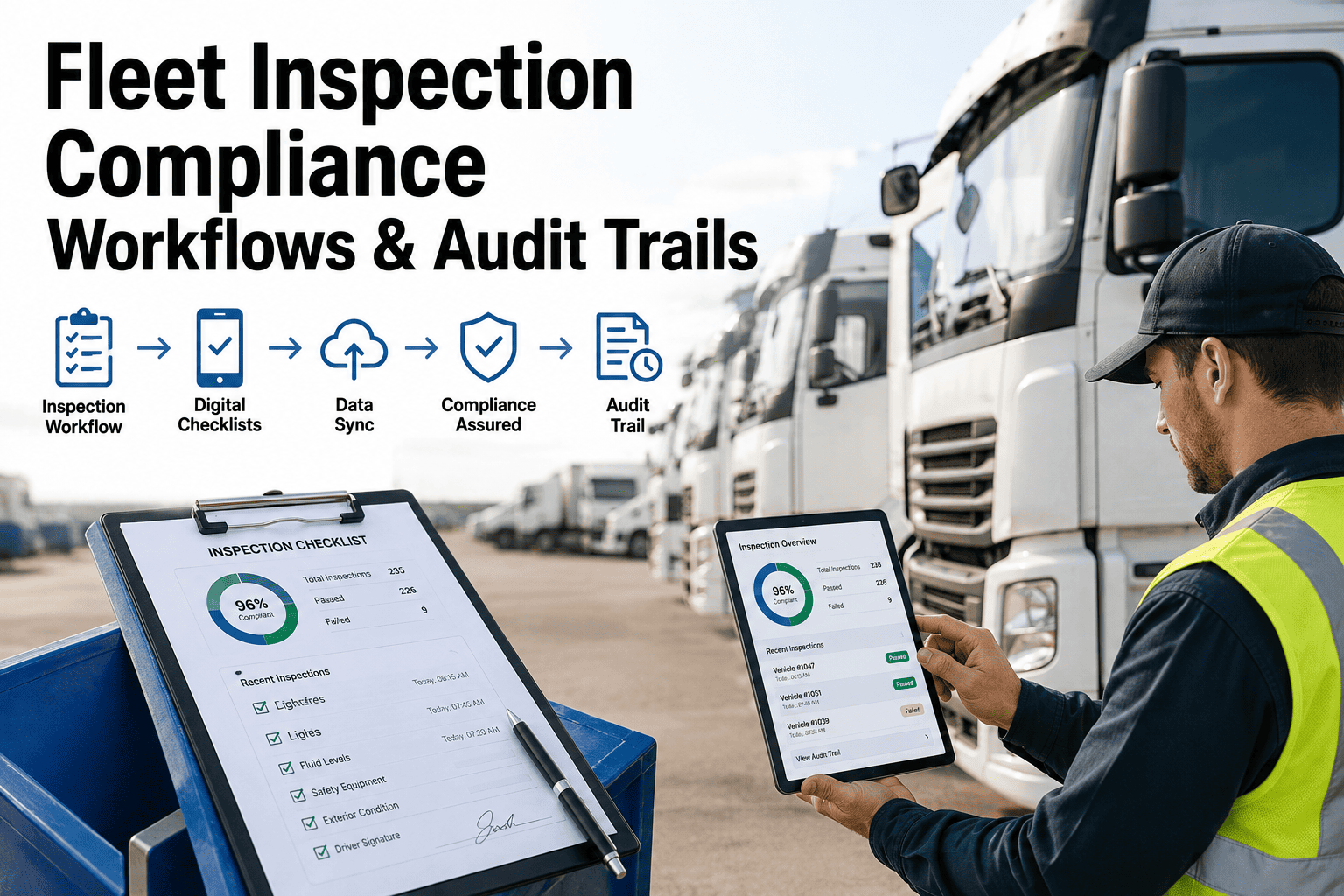
Vendor scorecards are only as good as the data feeding them. Mobile inspections fleet management tools ensure consistent, timestamped data collection that creates defensible audit trails and actionable vendor intelligence.
Drivers record tread depth, pressure, and damage observations via mobile app. Photos automatically tagged with vehicle, location, and timestamp. Abnormal wear patterns flagged for review.
Receiving staff scan incoming shipments, verify quantities and part numbers against PO, document any discrepancies with photos. Creates instant record of vendor delivery performance.
Post-installation checklists verify proper procedures followed. Torque specs confirmed, fluid levels checked, test drive completed. Links installed part to vehicle for lifecycle tracking.
When parts fail, technicians capture failure mode, mileage since installation, operating conditions. Creates evidence package for warranty claims and vendor quality discussions.
Work Order Automation for Vendor Accountability
Manual data entry is where vendor tracking programs die. Work order automation connects the dots automatically—from condition monitoring alert to parts order to installation record to performance analysis.
Brake wear sensor indicates 15% pad remaining
PM task scheduled for next available window
PO sent to preferred vendor with delivery deadline
Receipt scanned, on-time status recorded automatically
Vendor metrics refresh in real-time dashboard
Compliance and Audit Trail
Fleet management compliance requirements extend beyond vehicle safety to vendor documentation. DOT audits, insurance renewals, and customer due diligence increasingly require proof of parts sourcing and quality control programs.
Implementation Timeline
Building vendor accountability doesn't happen overnight, but results come faster than most expect. This timeline reflects typical regional delivery fleet implementations.
- Import current vendor list and contracts into CMMS
- Configure parts inventory with barcode/QR labels
- Define scorecard metrics and thresholds
- Train receiving staff on mobile scanning procedures
- All parts orders routed through CMMS with delivery tracking
- Mobile inspections capturing tire and parts data
- Work order automation linking parts to vehicles
- Initial baseline metrics established
- First vendor scorecard reviews with procurement team
- Identify underperforming vendors for discussion
- Adjust reorder points based on actual lead times
- Initiate conversations with problem vendors
- Vendor consolidation decisions based on data
- Contract renegotiations with performance-based terms
- Inventory levels optimized to actual consumption
- 25-40% reduction in stockouts achieved
Fleet Management CMMS Best Practices
Every parts delivery and tire service creates data. Capture it all—on-time status, quantity accuracy, quality issues. Small variances compound into major insights over time.
Vendor performance meetings should be data-driven conversations, not relationship maintenance. Share scorecards openly and set improvement targets with timelines.
Every installed part should trace to a specific vehicle. When parts fail early, you need to know if it's a vendor quality issue or vehicle-specific problem.
Tire purchase price means nothing without service life data. Track CPM religiously and hold vendors accountable for warranty commitments.
Manual inventory checks miss the mark. Set system-driven reorder triggers based on consumption rates and vendor lead times.
Warranty claims, quality disputes, and contract negotiations all require evidence. Digital audit trails protect your position and strengthen vendor accountability.
Expert Review
Conclusion
Parts inventory and tire programs determine whether your regional delivery fleet runs profitably or bleeds money through invisible vendor failures. Every late delivery, every premature tire failure, every defective part creates costs that compound across your operation—downtime, emergency orders, frustrated drivers, disappointed customers.
Vendor performance scorecards transform these hidden costs into visible, measurable, improvable metrics. When vendors know you're tracking their performance with precision data, accountability follows naturally. When you can prove which tire brand actually delivers promised mileage on your routes, procurement decisions become obvious.
Start with the data. The scorecards build themselves.