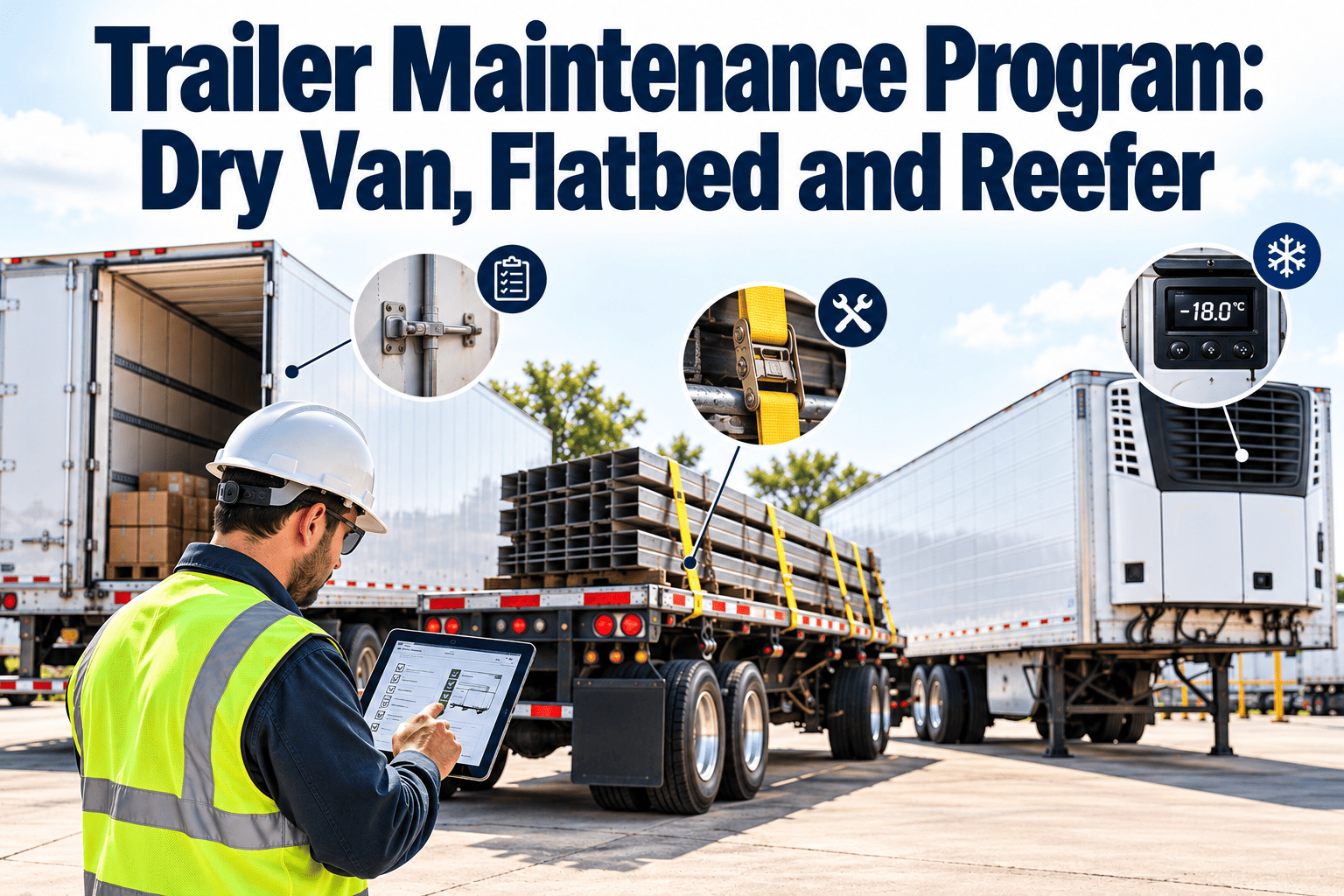
Trailers rarely get the attention that tractors do. They have no engine hours, drivers swap between them constantly, and many sit in yards between drop-and-hook moves. That makes a written trailer maintenance program essential, especially when dry vans, flatbeds, and reefers each fail in different ways. A good program defines inspections, preventive services, and repair records for each trailer type and keeps them in one place. A maintenance management platform can hold that history against every trailer number.
Trailer Maintenance Program: Dry Van, Flatbed and Reefer
Build one core program for running gear, then add the checks that make each trailer type different.
Dry Van
Doors, floor, roof, liner, lightsFlatbed
Deck, winches, tie-down points, tarpsReefer
Refrigeration unit, fuel, door seals, airflowWhy Trailers Are Easy to Neglect
Four conditions that create gaps in trailer maintenance
No single owner
A tractor has a driver who notices changes. A trailer may be hooked by a different driver every day.
No built-in meter
Most trailers lack an engine or odometer, so time-based schedules and hubometers fill the gap.
Yard time hides wear
Trailers parked in a yard still age, and problems found at pickup delay loads.
Defects get passed along
A driver who finds a problem may swap trailers without reporting it, so the next driver finds it again.
- Each gap is a record-keeping problem as much as a mechanical one.
- A trailer number on every inspection and work order solves most of them.
Inspect the Trailer by Zone
A walk-around path from nose to rear keeps inspections consistent
- Use the same order every time so technicians and drivers build a habit.
- Record findings by zone so repeat problems in one area become visible.
The Shared Core: Running Gear for Every Trailer
| System | What to check | Why it matters |
|---|---|---|
| Brakes | Adjustment, linings or pads, drums or rotors, chambers | Safety and out-of-service risk |
| Tires and wheels | Pressure, tread, sidewall damage, mismatched pairs, lug hardware | Blowouts and delays |
| Wheel-ends | Seal leaks, hub temperature, bearing play, lubricant level | Heat failures and roadside repairs |
| Suspension | Springs, air bags, bushings, hangers, alignment | Tire wear and ride damage |
| Air and ABS | Lines, glad hands, leaks, ABS lamp and wiring | Brake performance and compliance |
| Lighting and conspicuity | Lamps, wiring, connectors, reflective tape | Inspection violations |
| Landing gear and kingpin | Operation, bracing, plate wear, mounting | Coupling safety |
- These checks apply to every trailer, so build them once and reuse across the fleet.
Give Every Trailer a Maintenance History
Track trailer numbers, inspections, and repairs in one system so the next driver and the next technician start with the facts.
Dry Van Program Priorities
Protect the cargo space and keep doors working
- Doors and seals: inspect hinges, latches, locking bars, gaskets, and door tracks for damage that lets in water or causes failed closures.
- Roof and sidewalls: look for punctures, delamination, or leaks that damage freight.
- Floor and liner: check for soft spots, broken boards, protruding fasteners, and torn liners.
- Rear impact guard: inspect mounts and welds for damage and corrosion.
- Interior lighting and vents: confirm they work if the trailer is used for loading inspection.
What to record
- Damage location by zone, so patterns of dock or loading damage appear.
- Repeat water intrusion, which often points to a seal or roof problem rather than a single event.
Flatbed Program Priorities
Flatbeds work with the load exposed, so securement hardware gets the focus
Deck and structure
- Crossmember and main beam cracks
- Deck boards or steel surface condition
- Bulkhead or headache rack damage
- Stake pockets and rub rails
Securement equipment
- Winches and ratchets operation
- Straps, chains, and binders condition
- Tarps, bows, and hardware where used
- Edge protection and dunnage supply
- Damaged straps and chains should be removed from service and logged, not left in the toolbox.
- Securement equipment often has its own inspection and rating requirements, so check the rules for your region and load types.
Reefer Program Priorities
The refrigeration unit adds an engine, fuel, and cold-chain responsibility
| Area | Typical checks | Records to keep |
|---|---|---|
| Unit engine | Oil, filters, belts, coolant, fuel level, run hours | Reefer hours and service dates |
| Refrigeration cycle | Cooling performance, defrost, leaks, alarms | Alarm codes and repair actions |
| Airflow | Chute, bulkhead, floor channels, return air | Damage found and corrected |
| Insulation and seals | Door gaskets, panel damage, floor wear | Inspection findings by zone |
| Temperature records | Setpoint, recorder or data download, pre-cool process | Load-specific logs when required |
- Reefer units use separate hours from the trailer, so track them as their own meter.
- Refrigerant handling has regulatory and certification requirements, so use qualified technicians and keep their records.
Setting Preventive Maintenance Intervals
Start from OEM guidance, then adjust with failure history
Every dispatch or pickup
Driver pre-trip: tires, lights, air connections, doors, securement hardware, reefer alarms.
Regular scheduled service
Time-based or hours-based PM: brake measurements, wheel-end checks, lubrication, structural review, reefer unit service.
Annual inspection
Full periodic safety inspection with documented results, where required for your operation.
- Trailers without meters can use calendar intervals, hubometer readings, or telematics miles.
- Shorten intervals for severe duty, such as dusty yards or frequent loading damage.
From Driver Defect to Verified Repair
Report
Driver records the defect against the trailer number during inspection.
Triage
Maintenance decides whether the trailer is safe to dispatch or must be tagged out.
Repair
A work order captures labor, parts, and cause, with photos where useful.
Verify
A second check confirms the defect is corrected before release.
Learn
Repeat issues by trailer type or zone lead to PM or specification changes.
Compliance Records for Trailers
- Keep periodic inspection records with trailer identification, date, inspector, and results.
- Retain brake and axle repair records with the unit history.
- Store driver vehicle inspection reports with the corrective action that followed.
- Keep reefer unit service and refrigerant handling documentation where it applies.
- Rules differ by country and operation, so confirm retention periods and inspection requirements for your fleet.
Tire and Wheel Management on Trailers
Tires are one of the most visible and repeated trailer costs
- Record tire position, brand, size, and install date so wear patterns link to the correct axle.
- Check pressure on a schedule, since a slow leak on one dual affects the tire beside it.
- Match duals by size and tread depth to avoid uneven load sharing.
- Log removal reasons, such as puncture, sidewall damage, or irregular wear, to separate road hazards from alignment or suspension faults.
- Inspect wheel-end hardware and torque after tire work, and document who did it.
- Irregular wear on one axle usually points to a mechanical cause that tire replacement alone will not fix.
Brake and Air System Details
Measure and record
- Brake adjustment or stroke
- Lining or pad thickness
- Drum or rotor condition
- Chamber and slack adjuster condition
Look for early signs
- Air leaks at fittings and lines
- Moisture in the air system
- Uneven wear between axles
- ABS warning lamp faults
- Recording actual measurements, not just pass or fail, shows how fast components are wearing.
- Brake findings are among the most common reasons trailers are taken out of service, so they deserve consistent records.
Common Trailer Problems and Their Early Signs
| Problem | Early sign | Preventive action |
|---|---|---|
| Door failure | Hard latching, bent locking bars, worn hinges | Lubricate and adjust at each service |
| Floor damage | Soft spots, loose fasteners, forklift marks | Inspect floors at each dock-heavy turn |
| Wheel-end overheating | Seal weeping, hot hub on arrival | Check lubricant and seals on schedule |
| Lighting faults | Flickering lamps, corroded connectors | Clean and protect connections |
| Securement wear | Frayed straps, damaged chain links | Remove from service and replace |
| Reefer alarms | Repeated defrost or temperature codes | Review unit service and airflow path |
- Use this list as a starting point for your own failure codes.
Seasonal and Duty-Based Adjustments
- Cold weather: watch air system moisture, door seals, lighting connections, and reefer fuel and heat settings.
- Hot weather: watch tire pressure, wheel-end temperature, reefer load, and condenser cleanliness.
- Wet or salted roads: increase corrosion checks on frames, lighting, and brake components.
- Dusty or rough yards: shorten intervals for suspension, wheel-end, and air filter checks.
- Heavy dock use: inspect floors, doors, and rear structure more often.
- Review these adjustments each year using your own failure history.
Reefer Pre-Trip Sequence
- Check fuel and fluids. Confirm unit fuel level, oil, and coolant before loading.
- Inspect the trailer. Review door seals, floor channels, and airflow chute for damage.
- Run the unit. Start it and confirm it reaches and holds the required setpoint.
- Review alarms. Record any codes and resolve them before dispatch.
- Document the setpoint. Note the load requirements and any temperature recorder settings.
- Store this checklist with the trailer type so drivers use the same sequence each time.
Managing a Shared Trailer Pool
Challenges
- Trailers move between terminals
- Defects reported to the wrong location
- Unclear who owns follow-up
Practices
- One trailer number across every record
- Tag-out status visible to dispatch
- Last inspection date shown at pickup
- If dispatch can see which trailers are tagged out, repaired trailers return to service faster.
- Track location where possible so technicians know where a trailer is when service is due.
Metrics That Show Whether the Program Works
| Metric | What it shows | Useful split |
|---|---|---|
| PM completion on time | Whether services are happening as planned | By trailer type and terminal |
| Roadside events per trailer | Failures that escaped inspection | By system and age |
| Repeat repairs | Fixes that did not hold | By technician or shop |
| Out-of-service findings | Compliance and condition risk | By zone and component |
| Cost per trailer | Total maintenance spend | By trailer type and age |
- Compare each trailer type with itself rather than with the others, since they have different duty.
What to Keep on Each Trailer Record
| Record item | Examples | Why it helps |
|---|---|---|
| Identity | Trailer number, VIN, type, length, year | Prevents mix-ups across terminals |
| Configuration | Axle type, suspension, tire size, reefer model | Guides parts and service tasks |
| Inspection history | Driver reports, periodic inspections | Shows condition over time |
| Repair history | Work orders, causes, parts, labor | Reveals repeat problems |
| Meters | Hubometer, telematics miles, reefer hours | Supports usage-based services |
| Documents | Registration, inspection certificates, manuals | Speeds audits and repairs |
- A complete record turns a trailer number into a history that anyone in the shop can use.
Trailer Parts and Inventory Control
Stock what fails often, and issue it against the trailer
- Keep common items on hand, such as lamps, wiring, air fittings, brake components, hub seals, door hardware, and filters for reefer units.
- Issue parts against the trailer number so cost and failure history match.
- Set minimum stock levels using actual usage, not guesses.
- Track securement equipment, such as straps and chains, as inventory with replacement dates.
- Review rarely used parts to avoid tying up money in unused stock.
- Linking parts to work orders also shows which trailer types consume the most parts.
Training Drivers and Yard Staff
- Show drivers what a useful defect report looks like, including location and a short description.
- Give yard staff a simple tag-out process so unsafe trailers are not dispatched.
- Train technicians on trailer-specific systems, such as reefer units and securement equipment.
- Share repeat-defect findings with drivers, so they see that reports lead to repairs.
- Reports improve when drivers see quick action on what they submit.
Retiring or Rebuilding a Trailer
Use the record to decide when repair stops making sense
- Compare recent repair cost with the cost of refurbishing or replacing the trailer.
- Look for structural issues, such as frame cracks or floor corrosion, that return after repair.
- Check how often the trailer is tagged out compared with others of the same type.
- Consider specification changes, such as different door hardware or wear surfaces, when replacing.
- Record the disposal or sale details so the asset history is complete.
- A consistent record makes these decisions defensible when budgets are reviewed.
How Oxmaint Supports a Trailer Maintenance Program
A maintenance-first workflow from inspection to history
- Asset management stores each trailer with type, trailer number, specification, and full history.
- Inspection checklists can differ for dry vans, flatbeds, and reefers while sharing the same core items.
- Preventive maintenance scheduling supports calendar, meter, or reefer-hour triggers.
- Work orders connect defects, repairs, labor, parts, and verification.
- Inventory helps control common parts such as tires, lamps, brake components, and filters.
- Mobile workflows let drivers and yard technicians report defects from the trailer.
- Reports and dashboards show overdue service and repeat issues by trailer type.
Trailer Maintenance Program FAQs
How often should trailers be serviced?
Follow OEM guidance, then adjust for duty and failure history. Many fleets use time or meter-based intervals.
How do I track trailers without odometers?
Use calendar intervals, hubometers, or telematics miles, and record the reading at each service.
What is different about reefer maintenance?
Reefers add a unit engine, refrigeration cycle, fuel, and airflow checks, plus separate unit hours.
What should flatbed inspections include?
Deck structure, winches, straps, chains, and tarps, along with the shared running gear checks.
Can software handle all trailer types?
Yes. You can book a demo or sign up to set up type-specific checklists.
Put Every Trailer on a Maintenance Plan
Set up inspections, preventive schedules, and repair records for dry vans, flatbeds, and reefers in one maintenance system.