AI-Based Fill Level Monitoring for FMCG Production
By Oxmaint on February 9, 2026
Your beverage line runs 1,200 bottles per minute. At that speed, a fill-head drifting just 2% high doesn't look like a crisis—but it is. Over a single 16-hour shift, that 2% overfill on one head gives away 4,300 units worth of product. Across 24 fill heads, with normal mechanical drift, your plant is shipping $1.4 million in free product every year—liquid you've already purchased, processed, and pumped into containers that customers never asked you to overfill. Meanwhile, the occasional underfill slips past your checkweigher's sampling rate and reaches a retail shelf, where a single consumer complaint triggers a regulatory inquiry that costs $85,000 in investigation, documentation, and corrective action. Traditional fill monitoring—periodic manual checks, statistical sampling, and threshold-based reject systems—was designed for an era when production lines ran at 200 bottles per minute. At modern FMCG speeds, you need eyes on every single container. AI vision gives you exactly that. See AI fill monitoring eliminate giveaway on your line.
This guide explains how AI-powered vision systems monitor fill levels across every container format in FMCG production—from clear glass bottles to opaque HDPE jugs, aluminum cans to flexible pouches. You'll learn how the technology works, what it catches that traditional methods miss, and how to implement a system that eliminates product giveaway while ensuring every unit meets fill specifications. Sign up free to start tracking fill accuracy digitally.
The Hidden Cost of Fill Inaccuracy
Fill level problems cost FMCG manufacturers in two directions simultaneously. Overfills give away product you've already paid to manufacture. Underfills create regulatory exposure, consumer complaints, and retail chargebacks. Most plants optimize for one risk while unknowingly accepting massive losses from the other. AI vision monitoring eliminates both—by measuring every single container and providing real-time feedback that keeps fill heads operating at their tightest possible tolerance band.
Fill Accuracy Failures That Cost FMCG Plants Millions
Chronic Overfill
1–3% systematic overfill across all heads
$800K–$2.4M annual giveaway per line
Underfill Escapes
Units below declared volume reaching shelves
$50K–$250K per regulatory action
Head-to-Head Variance
Individual fill heads drifting at different rates
Quality inconsistency & excess rejects
Post-Changeover Drift
Fill levels unstable for 10–20 min after product switch
200–500 rejected units per changeover
How AI Vision Fill Monitoring Works
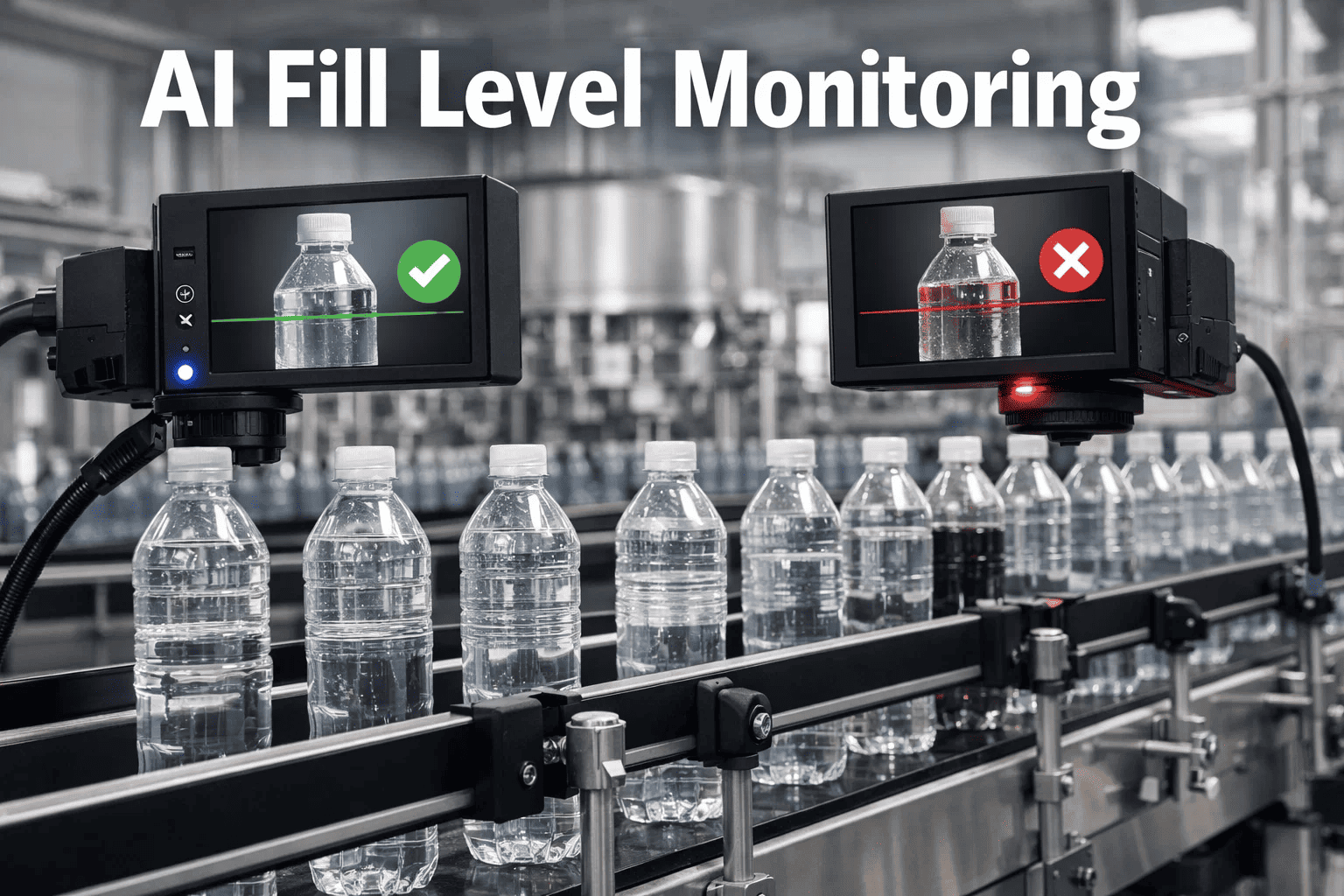
AI vision fill monitoring uses high-speed cameras positioned at the discharge of your filler to capture an image of every single container. Deep learning algorithms trained on millions of container images analyze each frame in milliseconds, measuring fill level against target specifications and detecting anomalies that checkweighers and sampling methods miss entirely. The system doesn't just reject bad units—it provides real-time fill-head-level performance data that enables operators to make micro-adjustments before giveaway accumulates or underfills escape. When integrated with Oxmaint's CMMS, fill drift patterns trigger automatic maintenance work orders for the specific fill head showing degradation.
From Capture to Correction in Milliseconds
1
Image Capture
Every container
→
2
AI Analysis
<15 ms
→
3
Pass/Fail Decision
Instant reject
→
4
Trend Analysis
Per head, per shift
→
5
Operator Action
Data-driven adjustment
The Real Cost of Fill Inaccuracy
Most FMCG plant managers know they have some product giveaway. Very few know how much. When AI vision monitoring is installed on a line for the first time, the results are consistently surprising—and the financial impact of correction is immediate. A mid-size beverage plant running 4 filling lines discovered $3.8 million in annual giveaway that had been invisible to their checkweigher-based monitoring system. The checkweighers were working perfectly—but they only sampled 1 in 50 containers, missing the systematic overfill pattern on 6 of 96 fill heads.
Annual Financial Impact: Traditional vs. AI Vision Monitoring
Without AI Fill Monitoring
Product giveaway (2% avg overfill)$1,400,000
Underfill regulatory actions (2/year)$170,000
Post-changeover rejects$220,000
Manual fill checks labor$85,000
Annual Loss$1,875,000
VS
With AI Vision Fill Monitoring
Residual giveaway (0.3% controlled)$210,000
Underfill escapes$0
Post-changeover rejects (70% reduction)$66,000
AI system annual cost$48,000
Annual Cost$324,000
Net Annual Savings Per Line$1,551,000
Container Formats and Detection Methods
Different container types present different vision challenges. AI fill monitoring systems use multiple sensing technologies—visible light cameras, infrared sensors, X-ray, and gamma-ray—to achieve accurate fill measurement across every packaging format in FMCG production. The key is selecting the right technology for your specific container and product combination.
AI Vision Technology by Container Type
HIGH
Clear Glass Bottles
Visible-light cameras with backlit illumination. Highest accuracy (±0.3%). AI detects meniscus, foam, and bubble interference automatically. Ideal for beer, spirits, juice, and water lines.
HIGH
PET & Plastic Bottles
Infrared or visible-light depending on opacity. Handles clear, translucent, and colored PET. AI compensates for wall thickness variation and label interference. Accuracy ±0.5%.
MED
Aluminum Cans
Gamma-ray or X-ray sensing required for opaque containers. AI analyzes absorption patterns to determine fill height. Handles foaming products and carbonation variability. Accuracy ±0.5%.
MED
Flexible Pouches & Cartons
Checkweigher integration with AI trending. Vision verifies seal integrity and detects fill anomalies from pouch shape analysis. Combined weight+vision achieves ±1% fill accuracy.
Eliminate Giveaway Across Every Container Format
Whether you're running clear glass at 1,200 BPM or opaque HDPE at 600 BPM, AI vision adapts to your specific container types, products, and line speeds. Our system handles everything from backlit meniscus detection on glass bottles to gamma-ray fill measurement through aluminum cans—all from a single integrated platform. Get a customized giveaway reduction estimate based on your actual line data, container formats, and current fill variance during your demo.
What AI Vision Catches That Traditional Methods Miss
Checkweighers, float sensors, and periodic manual checks were the gold standard for decades. But at modern FMCG line speeds—800 to 1,500+ containers per minute—these methods have fundamental blind spots that AI vision eliminates. The difference isn't just speed; it's the ability to analyze every unit and correlate fill performance with specific machine conditions in real time.
AI Vision Fill Monitoring Capabilities
100% Container Inspection
Every unit measured—not 1-in-50 sampling. Catches the fill heads that drift between sample intervals.
Per-Head Performance Tracking
AI maps every container to its fill head, revealing which specific heads are drifting and by how much.
Real-Time Drift Detection
Alerts operators when fill levels trend toward limits—before they cross thresholds and cause rejects or giveaway.
CMMS Work Order Integration
Fill head degradation patterns auto-generate maintenance work orders with specific head ID and performance data.
Giveaway Reduction: The Tightest Tolerance Band
The core financial value of AI fill monitoring is giveaway reduction. Every FMCG filler is set slightly above the declared volume to ensure compliance—the question is how far above. Traditional monitoring forces plants to overfill by 2–4% to account for head-to-head variance and measurement uncertainty. AI vision monitoring—by measuring every container and providing real-time head-level feedback—allows plants to tighten their target fill to just 0.3–0.8% above declared volume. The difference between 3% overfill and 0.5% overfill on a high-speed line is worth $500,000 to $2 million annually in recovered product. Sign up free to start tracking giveaway per fill head.
Giveaway Reduction: Tightening the Tolerance Band
Traditional Fill Control (Wide Band)
Target overfill safety margin2.5–4.0%
Head-to-head variance (undetected)±3.0%
Worst-case underfill detection1-in-50 sampling
Time to detect drifting head2–8 hours
Effective Giveaway2.0–3.5%
VS
AI Vision Fill Control (Tight Band)
Target overfill safety margin0.3–0.8%
Head-to-head variance (real-time)±0.5%
Underfill detection rate100% inspection
Time to detect drifting head<30 seconds
Effective Giveaway0.2–0.5%
Recovered Product Value Per Line$500K–$2M/yr
Implementation and Integration
AI fill monitoring installs directly into your existing production line without mechanical modifications to the filler itself. Camera systems mount at the filler discharge, capturing images of containers as they pass. Integration with your CMMS ensures that fill performance data flows into maintenance and quality workflows automatically—turning raw fill data into operational intelligence.
Oxmaint CMMS Integration for Fill Monitoring
Fill Head Maintenance Alerts
Degrading fill accuracy on specific heads triggers work orders with head ID, drift trend, and recommended calibration action.
Giveaway Trending Dashboards
Real-time and historical giveaway tracked by line, product, shift, and operator with financial impact quantification.
Changeover Optimization Data
Track fill stabilization time per product changeover. Identify which transitions require the most post-change adjustment.
Regulatory Compliance Records
Automated documentation of fill accuracy for weights and measures audits with complete traceability per batch and lot.
Frequently Asked Questions
How accurate is AI vision fill monitoring compared to checkweighers?
AI vision fill monitoring achieves ±0.3–0.5% accuracy on clear containers and ±0.5–1.0% on opaque containers—comparable to or better than checkweighers on a per-unit basis. The critical difference is coverage: AI vision inspects 100% of containers at full line speed, while checkweighers typically sample 1 in 20 to 1 in 50 units. This means vision catches fill head drift within seconds of onset, while checkweighers may not detect a drifting head for hours. For maximum accuracy, many plants combine both technologies: vision for 100% real-time monitoring and trend detection, checkweighers for gravimetric verification of the vision system's calibration.
Can AI vision monitor fill levels through opaque containers like cans or HDPE bottles?
Standard visible-light cameras cannot see through opaque containers, but AI fill monitoring systems use alternative sensing technologies for non-transparent packaging. Aluminum cans and opaque bottles are monitored using gamma-ray or X-ray fill level sensors that measure material density through the container wall. AI algorithms analyze the absorption patterns to determine fill height with ±0.5% accuracy. For flexible pouches and cartons, the system combines weight data from checkweighers with visual analysis of package dimensions and seal characteristics. The AI analytics platform normalizes data from all sensor types into a unified fill performance dashboard regardless of container format.
What's the typical ROI timeline for AI fill monitoring on a high-speed beverage line?
Most beverage lines see positive ROI within 60–90 days of installation. The calculation is straightforward: a line running 1,000 BPM with 2% average giveaway on a $0.15/unit product cost is losing approximately $1.2 million annually in product giveaway alone. AI monitoring typically reduces effective giveaway to 0.3–0.5%, recovering $900,000–$1.1 million per line per year. System cost including cameras, processing hardware, software, and installation typically runs $35,000–75,000 per line, with annual software costs of $8,000–15,000. Add underfill prevention (avoiding $50K–$250K regulatory actions) and the ROI case becomes even stronger. Schedule a demo for a customized giveaway analysis for your lines.
How does the system handle product changeovers with different fill targets?
AI vision systems store fill specifications (target volume, tolerance band, container profile) for every SKU in a recipe database. During changeover, operators select the new product recipe and the system automatically adjusts its fill target, tolerance thresholds, and container detection parameters. The AI also monitors post-changeover fill stabilization, tracking how many containers fall outside specification during ramp-up and alerting operators to specific fill heads that are slow to settle. Over time, the system learns the typical stabilization profile for each product transition, enabling operators to predict and reduce post-changeover waste. Sign up free to start optimizing your changeover fill performance.
Stop Giving Away Product. Start Seeing Every Fill.
AI vision monitoring eliminates the giveaway hiding on your lines—the overfills your checkweighers miss between samples, the drifting heads that go undetected for hours, and the post-changeover waste that gets written off as normal. With 100% container inspection at full line speed, per-head performance tracking, and real-time drift alerts, your operators get the data they need to keep every fill head running at its tightest possible tolerance band. Plants typically recover $500K–$2M per line annually in product that was previously given away for free.