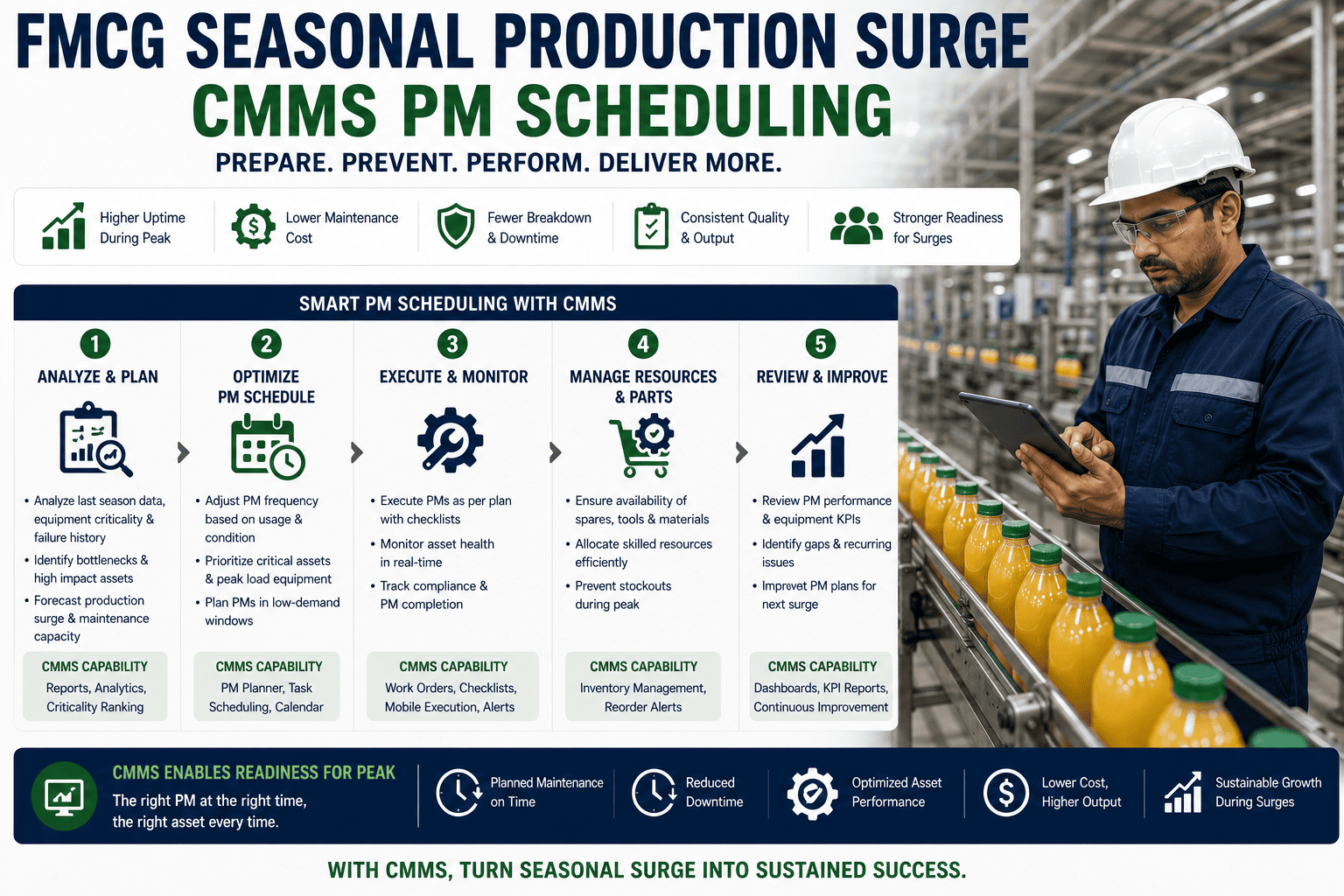
FMCG seasonal surge CMMS PM 4-step framework is the structured approach that separates plants that sail through peak season from those that suffer a surge of breakdowns at the worst possible moment. In fast-moving consumer goods, seasonal demand spikes — Ramadan, Christmas, back-to-school, summer beverage peaks — can push production volumes 40–80% above baseline. Equipment that runs fine at 70% capacity shows its true maintenance needs when you push it to 110% for eight consecutive weeks. Plants without a structured preventive maintenance adjustment process before peak hits spend the surge firefighting breakdowns instead of running at full output. Start a free trial to see how OxMaint helps FMCG maintenance teams execute this 4-step framework automatically.
Seasonal Production Surge in FMCG: 4-Step CMMS Guide to Adjusting PM Before Peak Hits
Protect Uptime · Front-Load PM Before Peak · Zero Surge Breakdowns
OxMaint lets FMCG maintenance teams create season-specific PM schedules, front-load critical maintenance before peak hits, and track surge-period compliance in real time — all from a CMMS that goes live in days. Start a free trial before your next seasonal peak, or book a demo and we'll map the 4-step framework to your season calendar.
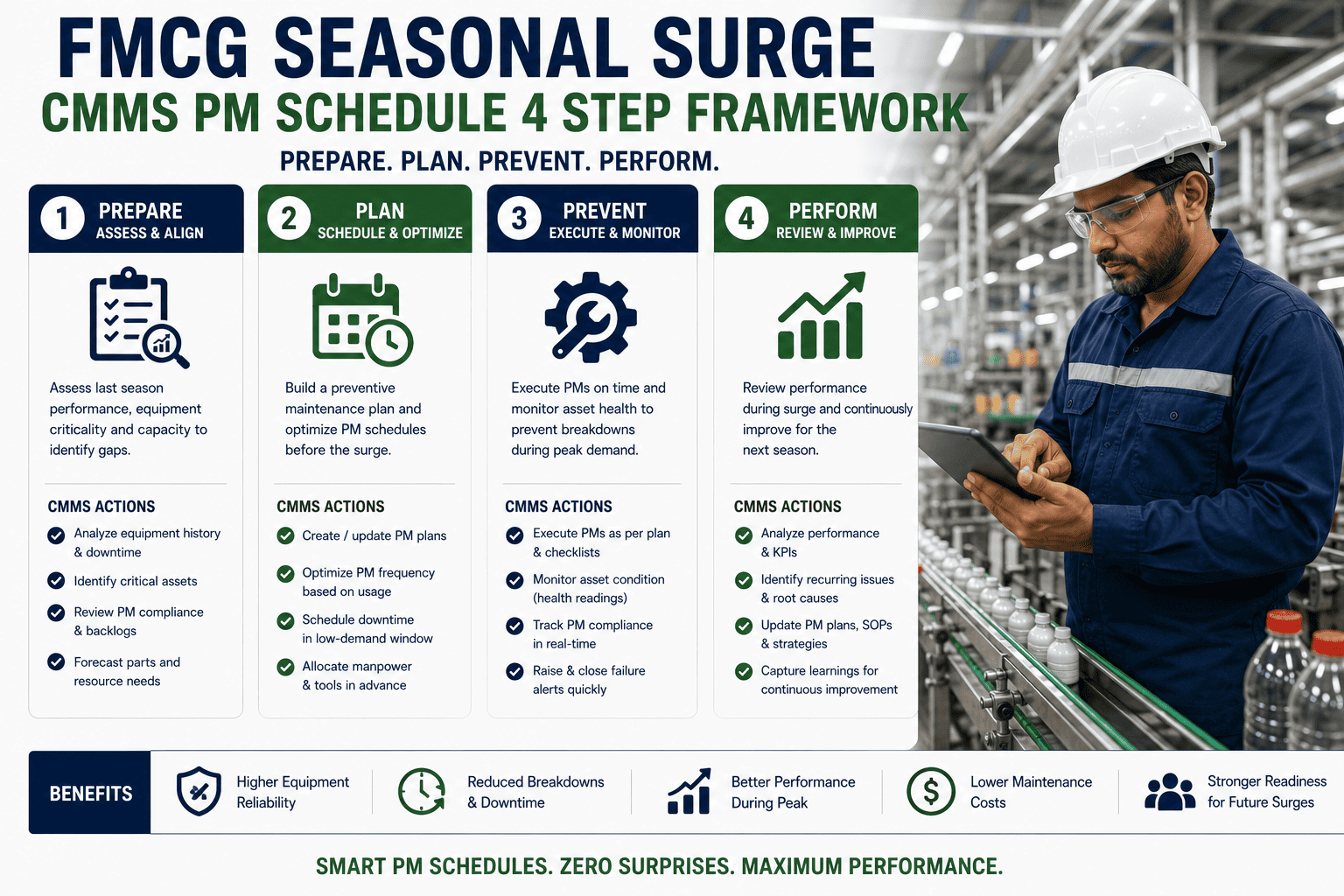
The FMCG seasonal surge CMMS PM 4-step framework is a structured approach to adjusting preventive maintenance schedules before high-demand seasons to protect production uptime during the periods when downtime costs the most. In FMCG environments — food, beverage, personal care, household products — seasonal demand is predictable but preparation is often reactive. The 4-step framework uses CMMS data to identify critical assets, front-load PM before surge begins, pre-stock parts, and monitor compliance through peak production.
Without this framework, FMCG plants fall into the seasonal failure trap: base PM schedules designed for 70% production capacity are maintained unchanged when output jumps to 130% for 8–10 weeks. A filling line that gets lubricated every 45 operating days at baseline needs that interval tightened to 28 days under surge conditions. A packaging machine that runs 16 hours daily at baseline runs 22 hours during peak — accelerating wear on every wear component beyond the PM interval designed for normal conditions. The CMMS is the only tool that can execute these interval adjustments at scale, across every asset, before the season starts. Explore OxMaint preventive maintenance scheduling for how interval adjustment works in practice.
OxMaint ties PM intervals to runtime meters and production counters — not just calendar dates. When output increases, PM frequency automatically increases with it. Seasonal surge triggers the right PM frequency without manual reconfiguration.
CMMS asset criticality scores tell you which assets stop production if they fail vs which are inconvenient but not line-stopping. Seasonal PM adjustment prioritizes critical assets — ensuring the machines that matter most get the most intensive pre-peak attention.
OxMaint shows which assets generated the most work orders during the previous peak season — by failure type, frequency, and downtime hours. Last year's surge failures are this year's pre-peak PM priorities. Data-driven, not guesswork.
CMMS lets maintenance managers create a pre-season PM batch — a set of work orders targeting all critical assets in the 6 weeks before peak. These are tracked, assigned, and closed like any other work order, with full completion visibility for management.
OxMaint's parts and inventory module supports seasonal minimum stock levels — increasing reorder points for high-failure-risk parts 8 weeks before surge begins. During peak, the right parts are always on hand.
During peak season, PM compliance is tracked in real time — showing which scheduled PMs are on track, which are at risk, and which assets are being skipped under production pressure. Deviations are visible before they become failures.
OxMaint's predictive maintenance module adds an IoT sensor layer during peak — monitoring vibration, temperature, and runtime for assets under increased load. Alerts fire before assets fail, not after. 94% prediction accuracy means fewer surprise shutdowns during the most expensive weeks of the year.
After every surge season, OxMaint generates a failure mode analysis — which assets failed, what was missed in pre-season PM, which parts ran out. This post-mortem feeds next year's pre-season framework automatically, improving with every seasonal cycle.
A filling line PM scheduled every 45 days at baseline needs adjustment to every 28 days during peak season — when daily runtime increases 38% and wear accelerates proportionally. Plants running unchanged base PM schedules through surge season are systematically under-maintaining their highest-volume assets during the weeks when a failure costs the most.
The bearing that fails at 2 AM on December 20th requires a part that's out of stock because standard reorder levels were designed for baseline consumption rates. Emergency shipping at holiday freight rates, combined with line downtime, can easily cost $15,000–$50,000 per incident — for a $40 bearing that should have been in stock.
During surge season, production supervisors pressure maintenance to defer PMs — "we can't stop the line now." Without a CMMS tracking deferred PMs and their risk escalation, these deferrals are invisible to management until a failure makes them painfully visible. Plants defer their way into surge-season breakdowns systematically.
Paper-based FMCG plants have no structured record of which assets failed during last peak season, what the failure modes were, and how much each incident cost in production and repair. Pre-season PM planning is therefore based on intuition rather than data — meaning the same assets fail in the same ways every peak, year after year.
See how OxMaint analytics and reporting creates the historical failure data that makes pre-season PM planning data-driven rather than intuition-based.
| Seasonal PM Factor | Reactive Approach (No Pre-Season Framework) | OxMaint CMMS 4-Step Framework |
|---|---|---|
| PM interval during surge | Base schedule unchanged — intervals designed for baseline output, not 140% surge volume | Production-linked intervals auto-tighten during surge — PM frequency tracks actual runtime, not calendar |
| Pre-season critical asset prep | Standard PM route — same work done regardless of asset criticality or previous surge failure history | Data-driven pre-season campaign targeting top-20% assets that generated 80% of last peak's downtime |
| Parts availability during peak | Standard reorder levels — stockouts on high-consumption parts during surge, emergency freight costs | Seasonal minimum stock levels set 8 weeks before peak — right parts on hand when lines are running hardest |
| PM deferrals under production pressure | Invisible to management — deferrals accumulate until failure makes them visible | Deferred PMs flag automatically in real time — managers see risk before it becomes a line stoppage |
| Failure detection during surge | Detected when line stops — full production impact before response begins | IoT sensor alerts fire before failure — 94% prediction accuracy gives technicians a response window |
| Post-season learning | Same assets fail next peak — no structured data to improve pre-season planning year over year | Post-season failure analysis feeds next year's 4-step framework — improving with every seasonal cycle |
OxMaint client outcome in FMCG and manufacturing — directly linked to structured PM execution including seasonal adjustment
Multiplier for unplanned failure repair cost vs planned PM — highest impact during peak when production revenue per hour is maximum
OxMaint predictive maintenance — IoT sensor alerts fire before surge-season failures during maximum-load operations
Time to pull last peak season's failure data from OxMaint dashboard — vs 2–3 hours of spreadsheet consolidation
Estimate your seasonal surge ROI — use the OxMaint ROI Calculator to see what pre-season PM saves vs reactive surge-season breakdowns.
How does CMMS automatically adjust PM intervals during FMCG seasonal surges?
How far in advance should FMCG plants start seasonal PM preparation using CMMS?
What should FMCG maintenance managers do when production supervisors pressure them to defer surge-season PM?
How does FMCG seasonal surge PM planning work for multi-site operations?
OxMaint gives FMCG maintenance teams the tools to execute the 4-step seasonal surge PM framework: historical surge failure analysis in 20 minutes, bulk pre-season PM campaigns with live completion tracking, production-linked interval adjustment that tightens automatically during surge, seasonal parts pre-stocking, and 94%-accurate predictive alerts during the weeks when downtime costs you the most.