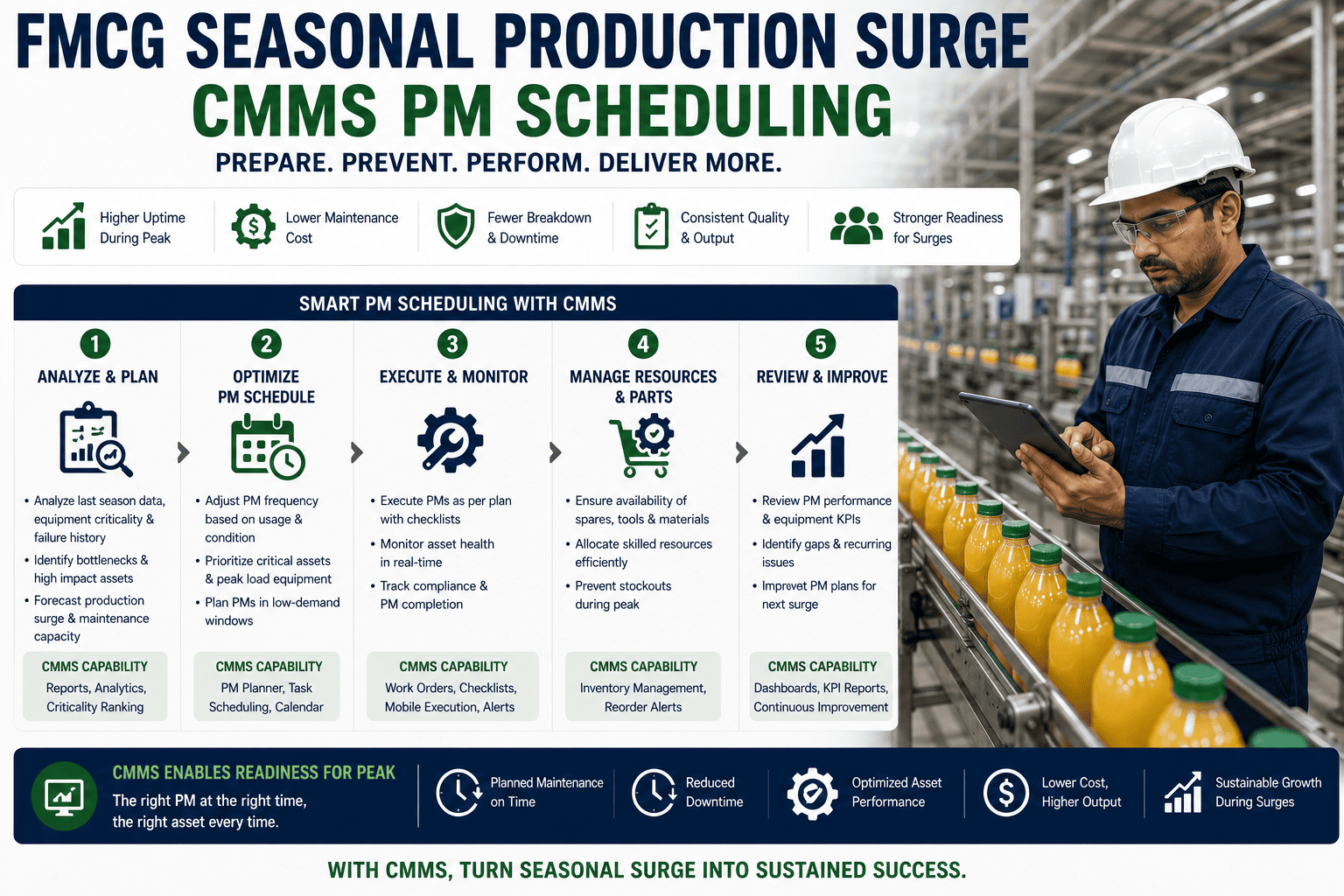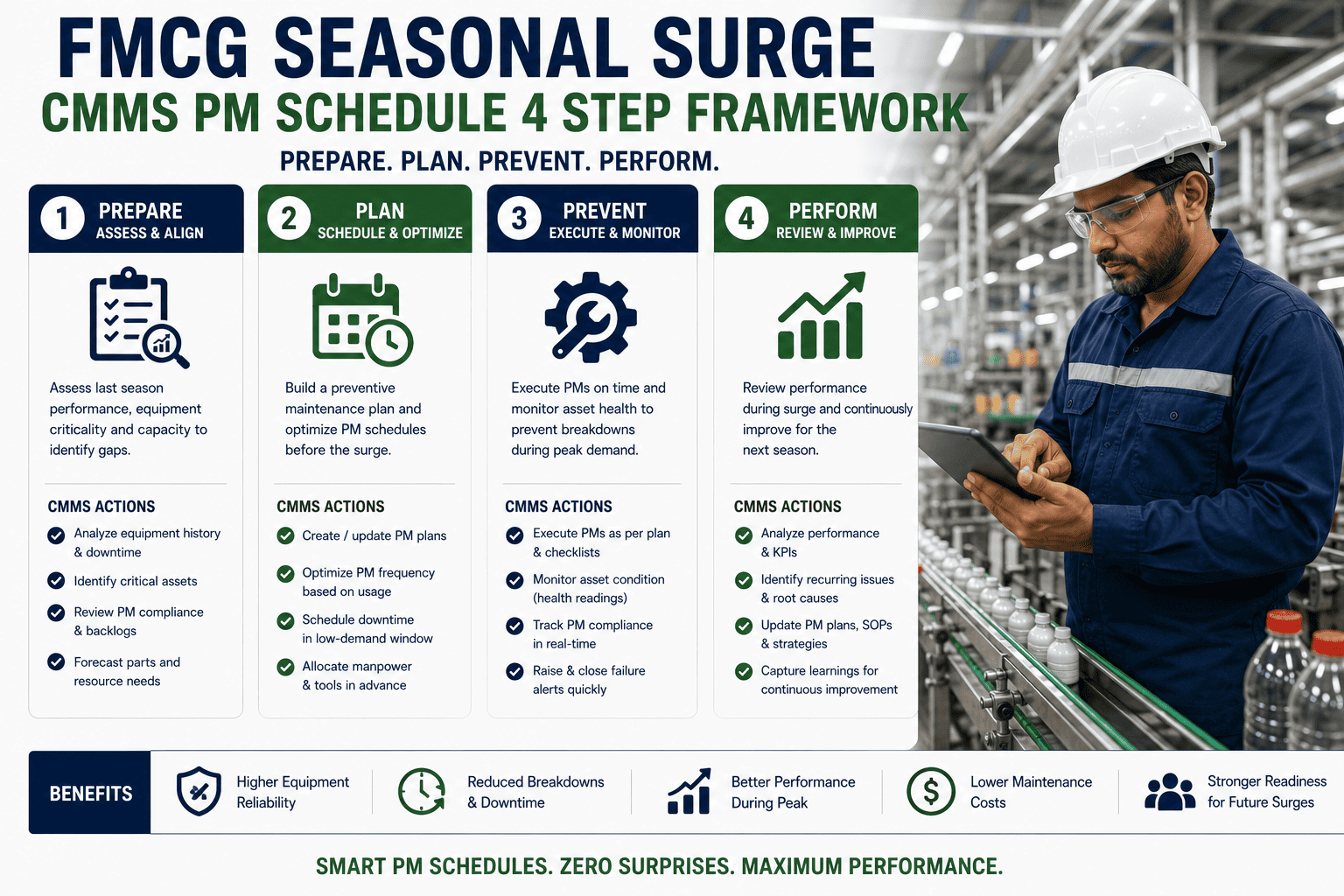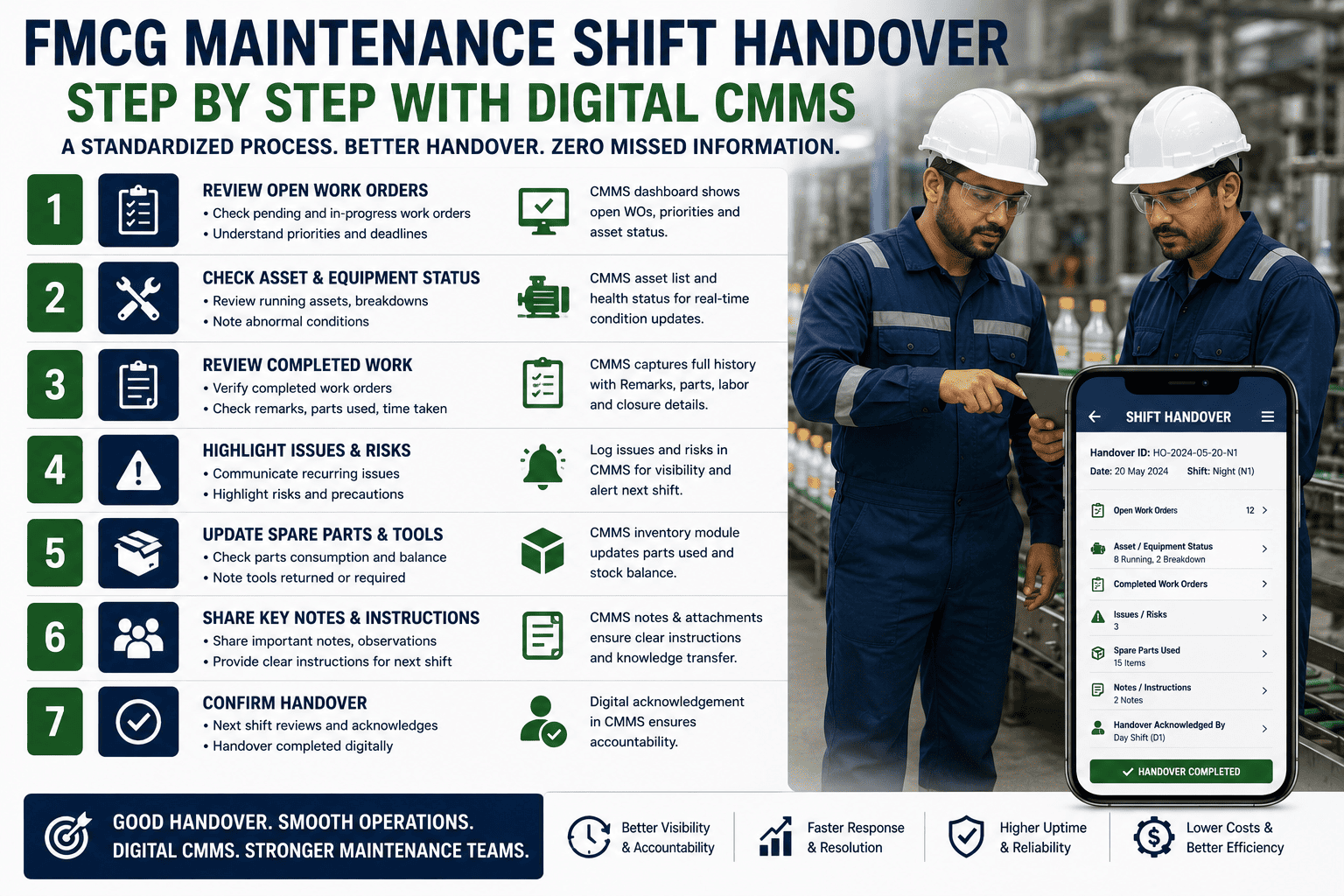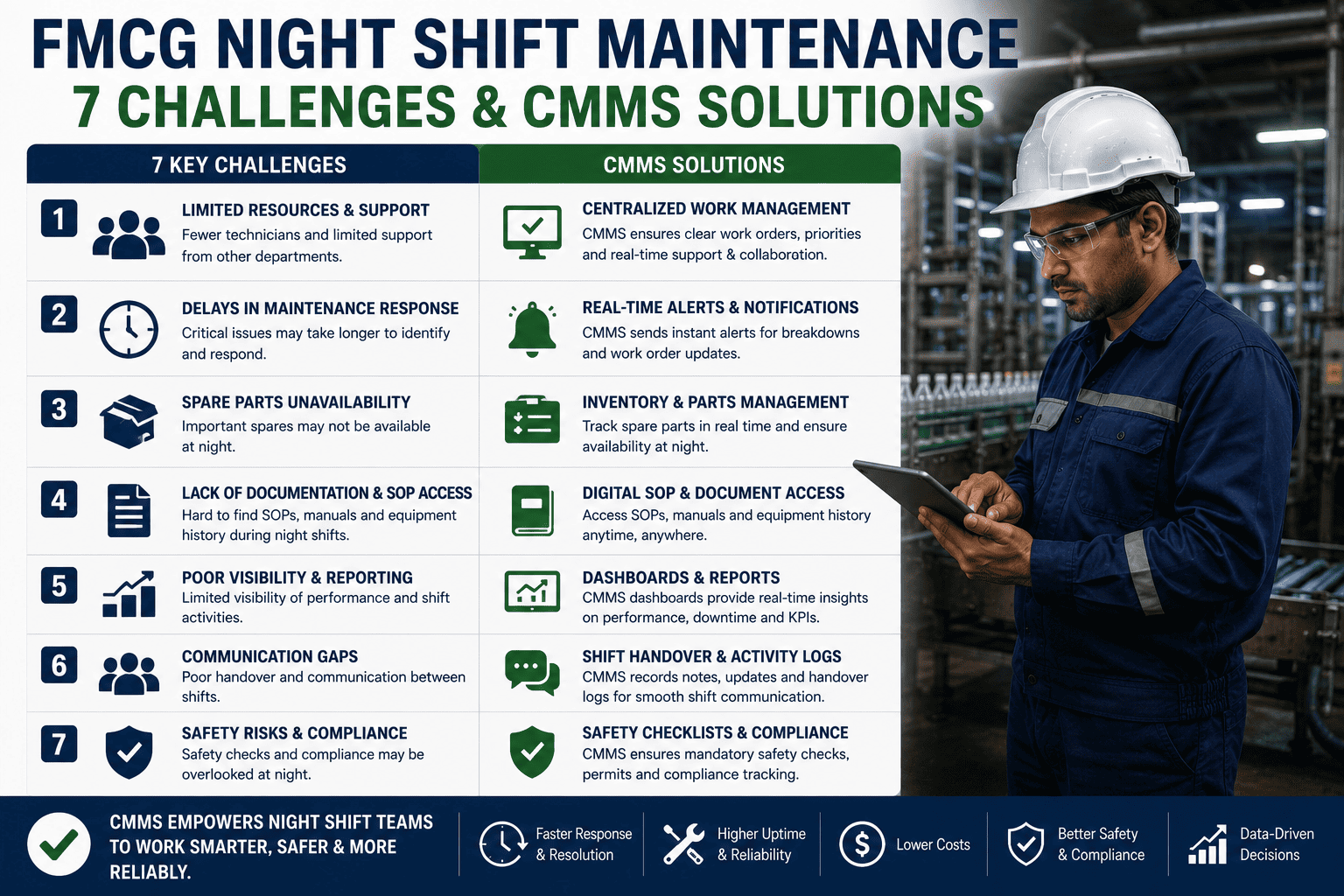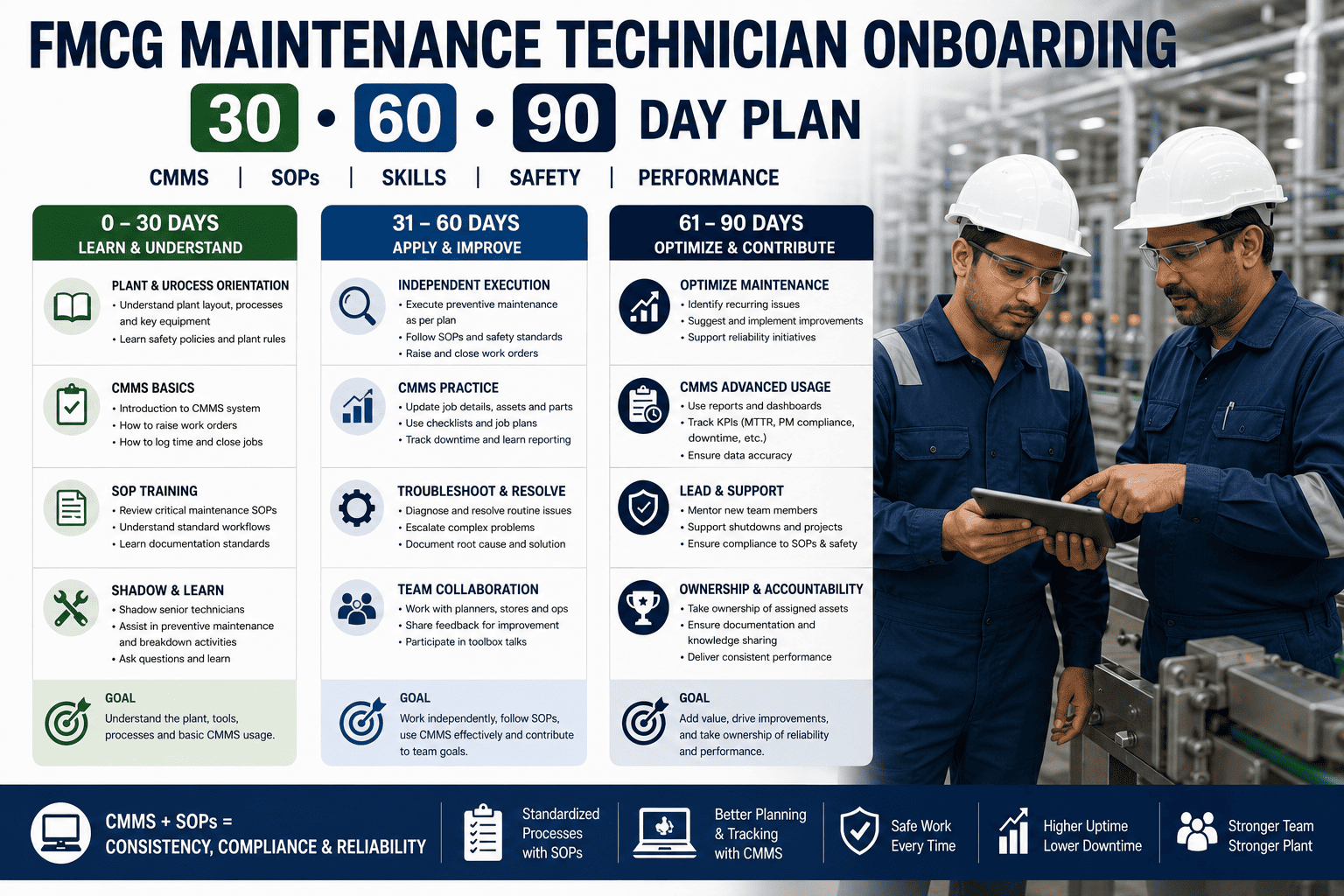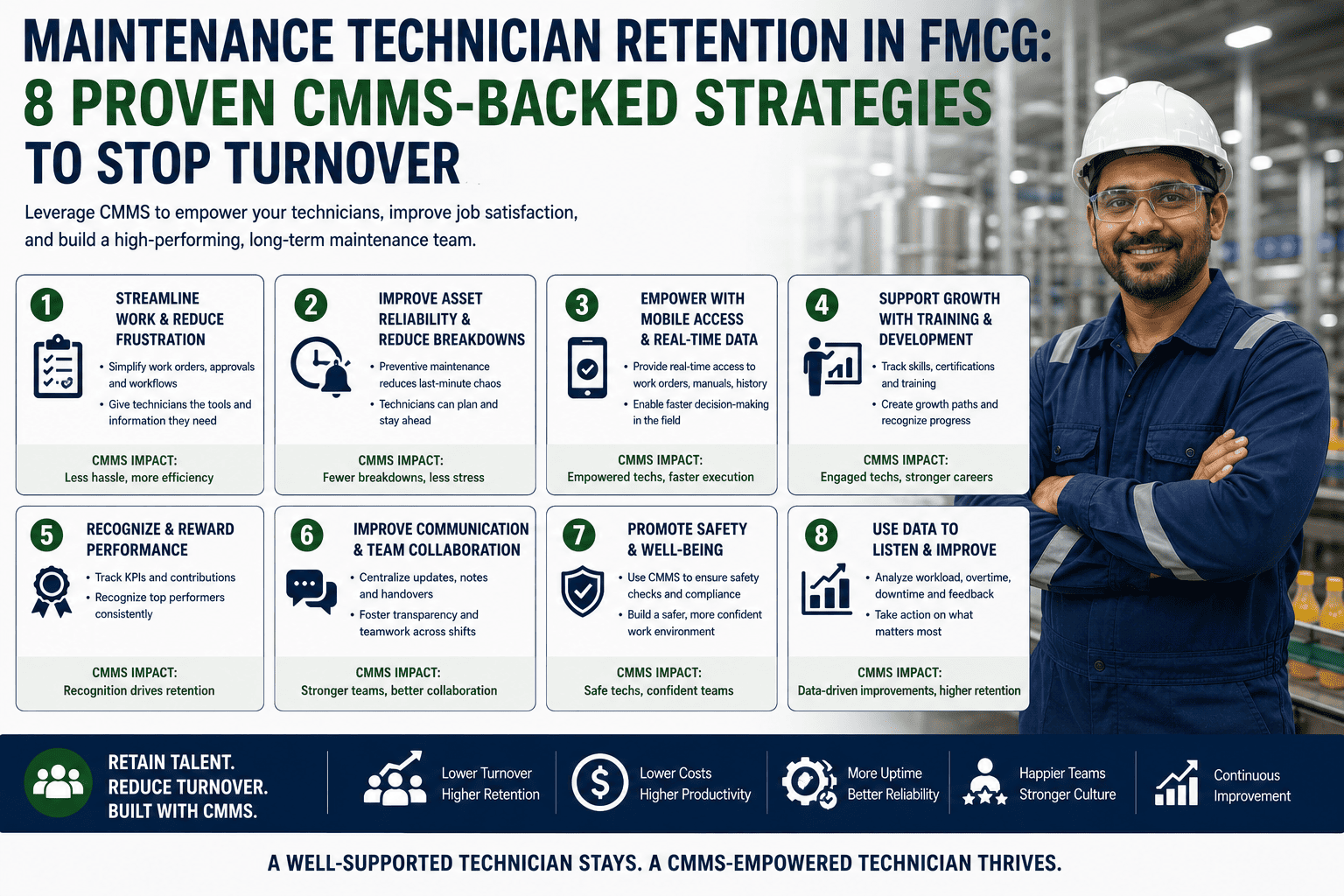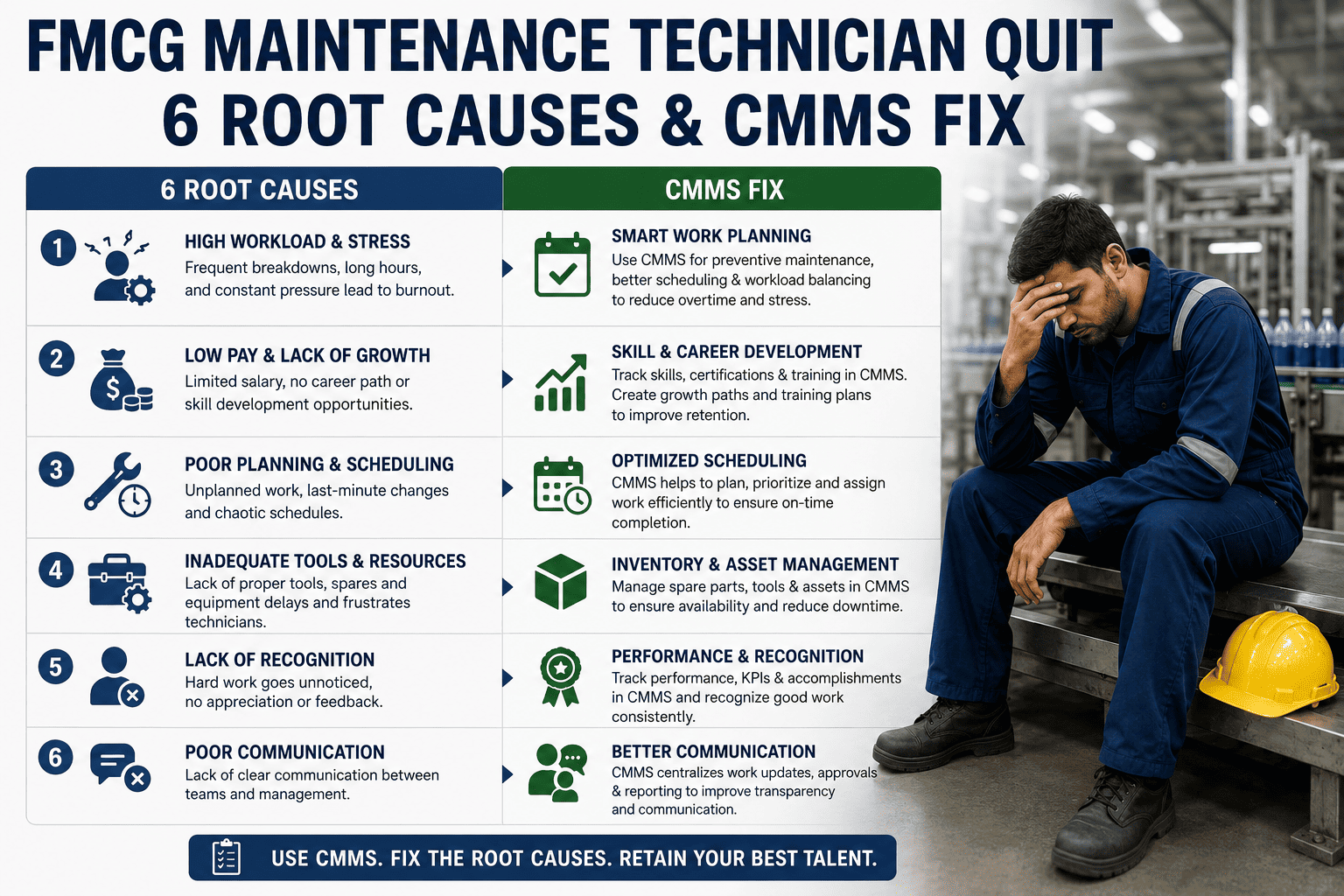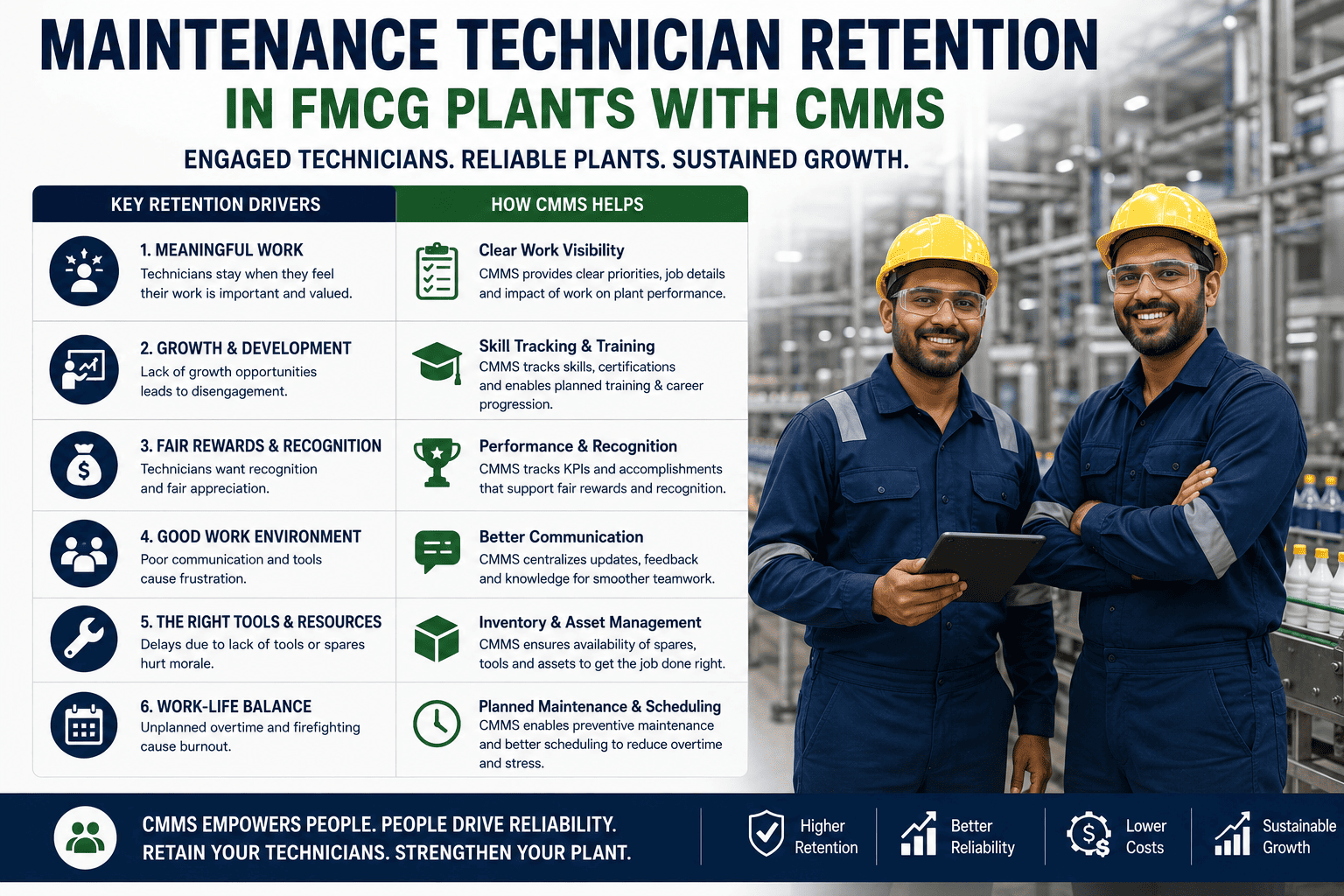
Maintenance technician retention in FMCG plants is one of the costliest and least-discussed workforce challenges in operations today. Turnover rates among industrial maintenance staff run 25–35% annually in high-throughput food and consumer goods plants — and every departure costs an estimated 1.5x to 2x that technician's annual salary when you factor in recruitment, onboarding, lost tribal knowledge, and productivity drag during the gap. The research is clear: technicians don't leave for pay alone. They leave because the work is disorganized, tools are inadequate, and nobody seems to track what they actually accomplish. Start a free trial to see how AI-native CMMS gives your maintenance team the tools that make skilled technicians want to stay.
Maintenance Technician Retention in FMCG Plants: Why They Leave and How CMMS Helps
Reduce Turnover · Improve Tech Satisfaction · Build a Maintenance Team That Stays
OxMaint gives FMCG maintenance teams QR-driven work orders, digital SOPs, and AI-prioritized scheduling — the tools that reduce daily friction and make experienced technicians want to stay. Start a free trial or book a demo and we'll show you what this looks like on your plant floor.
Maintenance technician retention in FMCG plants refers to an organization's ability to keep skilled maintenance staff employed and engaged over time. In fast-moving consumer goods environments — food processing, beverage, personal care, household products — maintenance roles are uniquely demanding: 24/7 uptime expectations, strict hygiene compliance, high-speed automated lines, and constant pressure to minimize every minute of downtime. These conditions amplify dissatisfaction when tools, processes, or management systems fail to meet technician needs.
The retention problem is structural, not interpersonal. FMCG maintenance technicians are skilled tradespeople with real options. When they leave, they cite five consistent reasons: disorganized work order systems, unclear job prioritization, no visibility into their own performance, poor shift handover leading to repeated rework, and the sense that management doesn't value their knowledge. None of these are pay issues. All of them are CMMS and workflow issues — which means they are fixable. Explore how smart work order management directly reduces these friction points.
When 40+ open work orders land in a shared inbox with no priority ranking, experienced techs spend more time figuring out what to do than actually doing it. Decision fatigue and repeated interruptions from supervisors erode job satisfaction fast.
In plants without digital tracking, a technician who closes 12 work orders in a shift gets the same visibility as one who closes 4. No performance data means no recognition, no progression conversations, and no reason to go the extra mile.
Night-shift technicians arrive with no context on what day shift left unfinished. They repeat diagnostics already done, order parts already ordered, and fix issues already partially addressed. Rework is demoralizing for skilled tradespeople.
FMCG plants face HACCP, GMP, and OSHA documentation requirements. When compliance paperwork is manual, technicians spend 45–90 minutes per shift on forms instead of maintenance work. Skilled tradespeople resent administrative overload on top of physical work.
Without accessible digital SOPs, every unfamiliar asset requires hunting down a senior tech or a paper manual. New hires struggle. Even experienced staff waste time. The absence of a knowledge base makes every technician feel underequipped.
Plants running 80%+ reactive maintenance put technicians in perpetual firefighting mode. Constant emergency response without preventive structure is physically and mentally exhausting. Techs who want to build skills in PM and predictive maintenance leave for plants that support it.
When a technician can't fix a critical asset failure, there's no clear escalation process. They're blamed for delays they couldn't prevent. This ambiguity — being held accountable without authority — is one of the top drivers of voluntary departure in FMCG maintenance.
In reactive plants, overtime spikes unpredictably. A technician who planned a family event gets called in for a line failure at 10 PM. Without predictive scheduling, overtime is always reactive — and the most skilled technicians, who have the most options, are the first to leave when this becomes chronic.
Technicians in purely reactive environments never build PM expertise, never touch predictive tools, and never see their certifications used. The best techs are also the most ambitious. A plant that doesn't develop technician skills through structured preventive and predictive programs will lose its top performers within 18–24 months.
Work orders in one system, asset history in another, parts requests on paper, compliance logs in a spreadsheet. Technicians spend cognitive energy stitching context together instead of solving problems. The daily frustration of disconnected tools is a slow attrition driver that appears in exit interviews as a vague "not a good fit" — but it's a systems failure.
Addressing these pain points starts with the right CMMS. Explore all OxMaint features built specifically for FMCG plant operations, or book a demo to see how it maps to your team's daily workflow.
OxMaint's AI ranks and routes work orders to the nearest certified technician based on asset criticality, skill match, and location. Technicians arrive at each job with context, not confusion. See smart work order management.
Technicians scan any asset QR code and immediately see full history, open work orders, parts list, and step-by-step SOPs. No more hunting for manuals or repeating diagnostics. New hires reach productivity 40% faster with digital knowledge bases accessible from the shop floor.
Every closed work order, every PM completed, every inspection passed is tracked per technician. Managers see individual output clearly — enabling recognition conversations grounded in real data, not impressions. Technicians who know their work is visible are significantly less likely to disengage.
OxMaint's shift logbook carries forward every open work order, pending part, and partial fix into the next shift automatically. Night shift arrives with full context. Rework drops. Technicians stop spending the first 30 minutes of every shift reconstructing what the previous shift left behind. Explore shift logbook features.
Inspection and compliance records generate automatically from completed work orders. Technicians verify and sign off digitally in seconds rather than filling out paper forms for 60+ minutes per shift. See inspection management.
OxMaint's preventive maintenance and predictive maintenance modules give technicians structured work beyond reactive firefighting. Techs build expertise in vibration monitoring, thermal inspection, and condition-based triggers — the career development that keeps ambitious tradespeople engaged.
| Retention Factor | Reactive / Paper-Based Plant | OxMaint CMMS Environment |
|---|---|---|
| Work order clarity | Shared inbox, no priority ranking, constant supervisor interruption | AI-prioritized queue routed to certified tech — clear, ordered, actionable |
| Individual performance visibility | No tracking — output invisible; recognition based on subjective impression | Every WO, PM, and inspection tracked per technician — recognition grounded in data |
| Shift handover quality | Verbal or paper notes — context lost, rework common, frustration chronic | Digital logbook carries all open work forward automatically — zero context loss |
| Compliance documentation | 45–90 min manual paperwork per shift on top of physical maintenance work | Auto-generated from completed work orders — digital sign-off in seconds |
| Overtime predictability | Reactive emergencies cause unpredictable overtime — chronic burnout driver | Predictive PM reduces emergency calls — planned overtime vs crisis overtime |
| Career development path | Reactive-only work — no PM or predictive skill building, no progression visibility | Structured PM + predictive programs — techs build real skills with measurable output |
Per departed FMCG maintenance technician — recruitment, 4–6 wk onboarding, productivity gap, knowledge loss
Digital SOPs and QR-linked asset history accelerate onboarding for FMCG maintenance technicians
OxMaint client outcome — directly tied to engaged technician teams running structured PM programs
OxMaint predictive maintenance — alerts techs to failures weeks before they occur, reducing emergency pressure
Estimate your facility's ROI — use the OxMaint ROI Calculator to see what improved retention and reduced downtime saves your plant.
Why do maintenance technicians leave FMCG plants so much more than other industries?
Does CMMS software actually help with technician retention, or just operational efficiency?
How quickly can an FMCG plant see retention improvements after implementing CMMS?
What features in OxMaint most directly support maintenance technician retention in FMCG plants?
Every FMCG maintenance technician who walks out costs you $85,000–$140,000 and leaves a productivity gap that puts your lines at risk. OxMaint gives your team AI-prioritized work orders, digital SOPs on every asset, shift logbooks that eliminate rework, and performance visibility that makes experienced technicians feel valued — all live in days, not months.