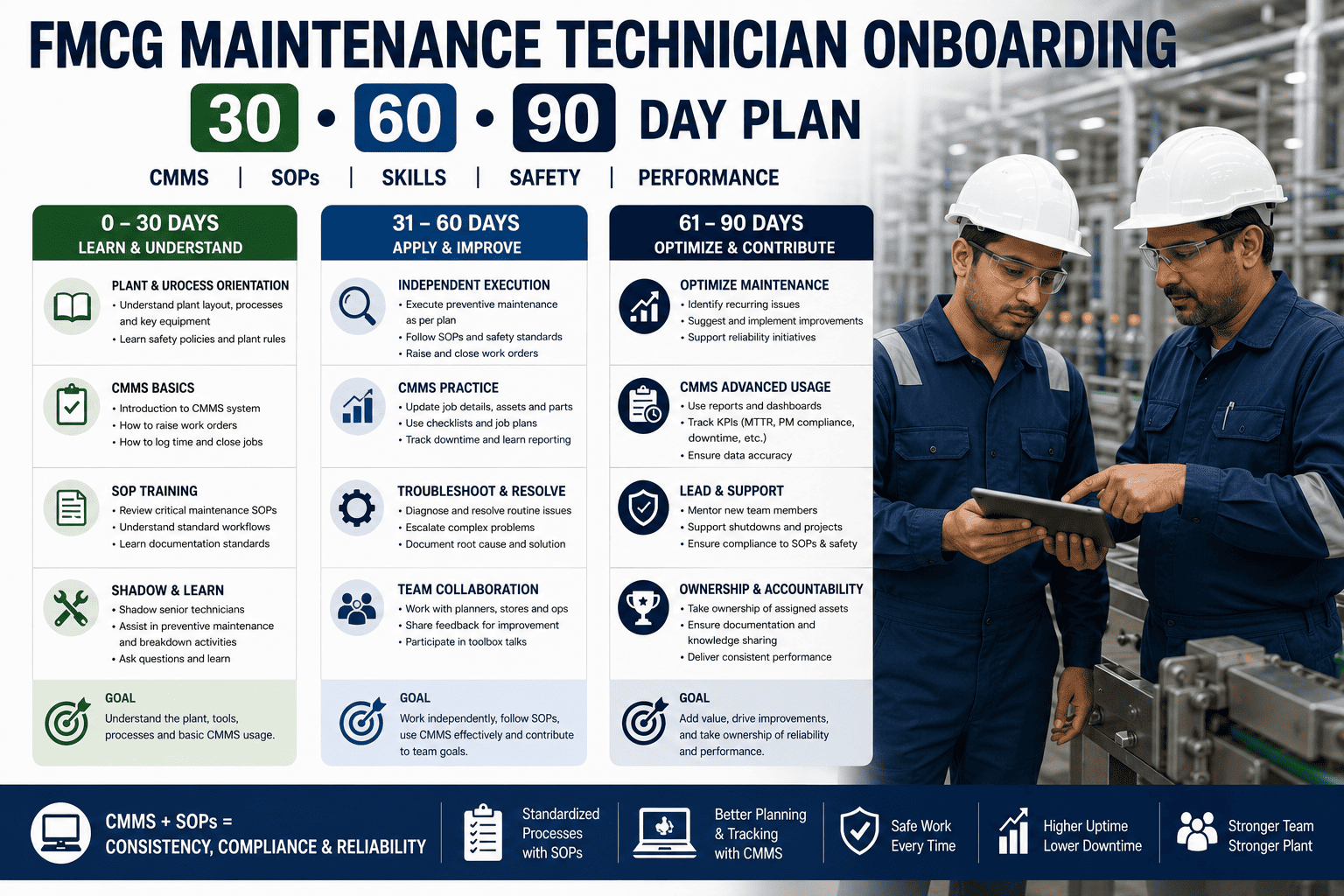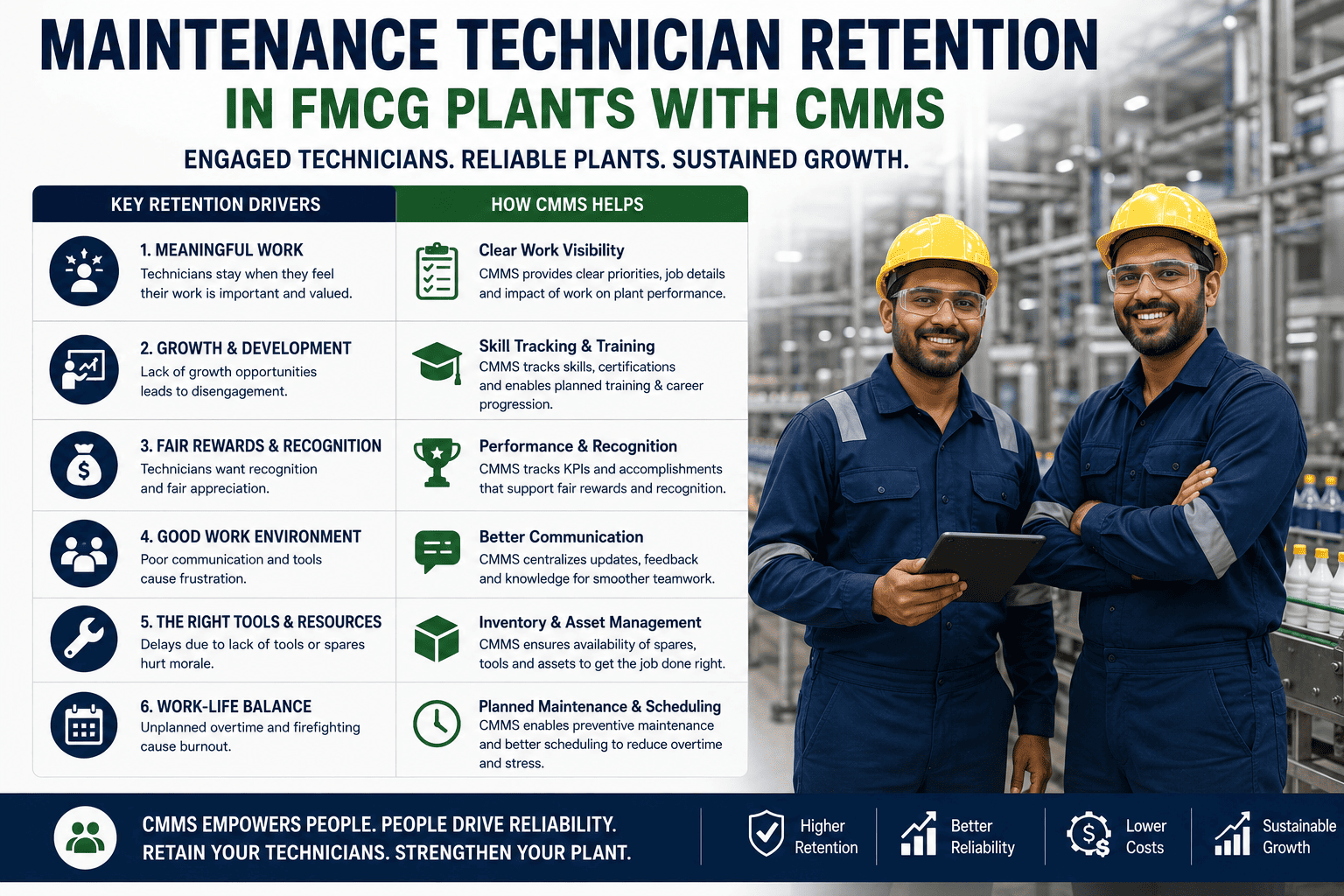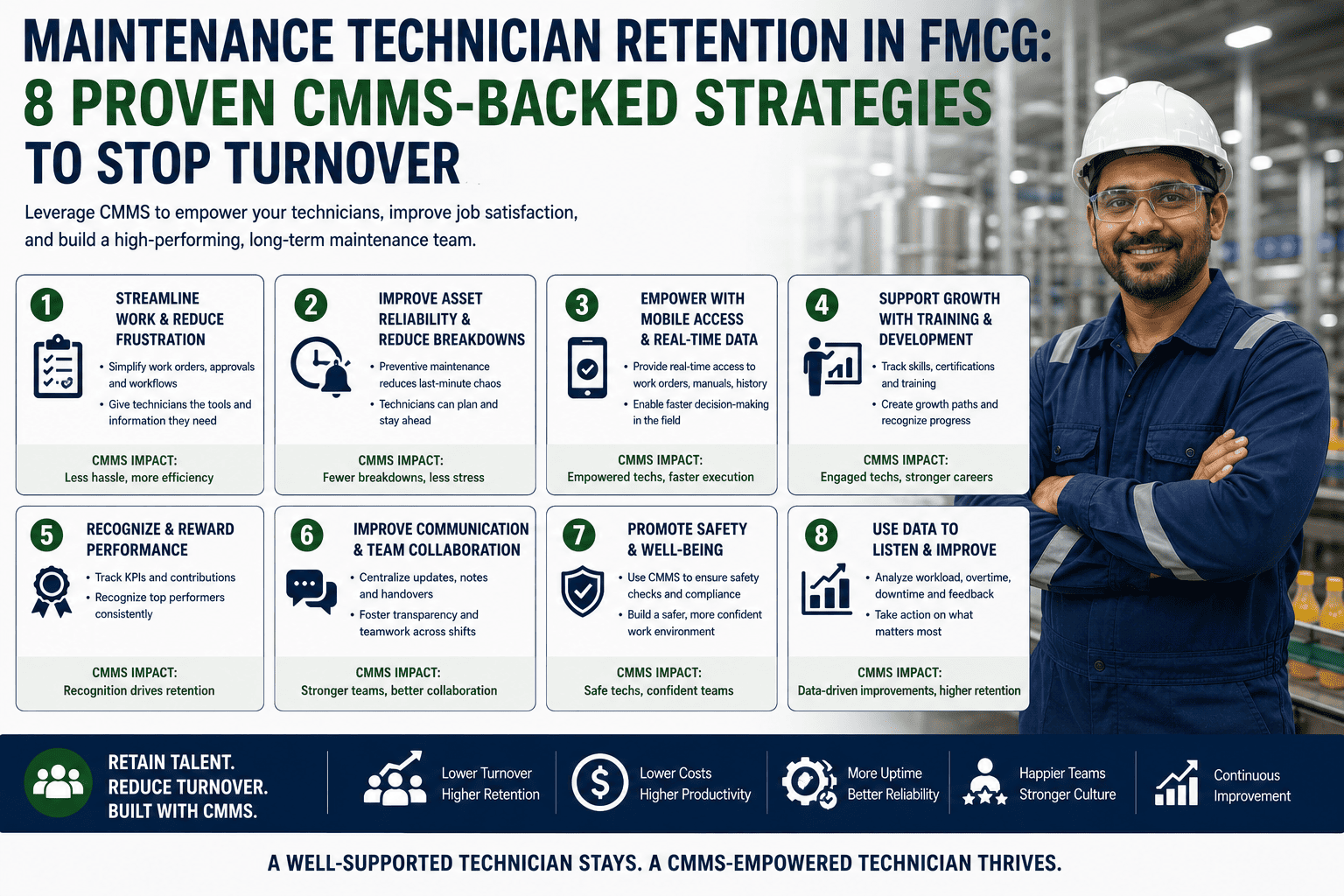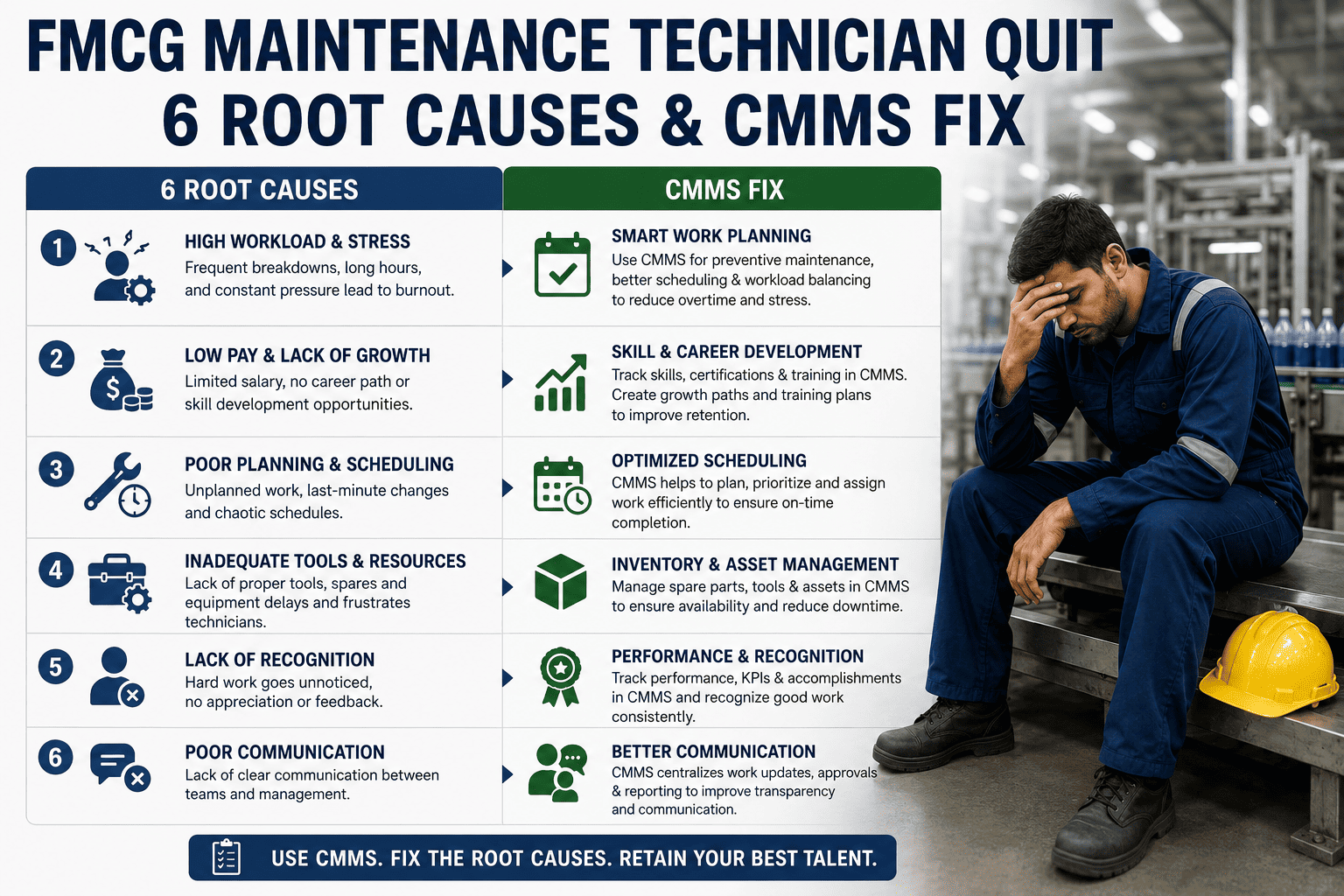
FMCG maintenance technicians quit — and they quit at a rate that should alarm every plant engineer and operations director carrying open positions. Industry data shows skilled maintenance technicians leave FMCG plants at twice the rate of other manufacturing roles, and replacement costs run between 50% and 200% of annual salary once recruitment, onboarding, and productivity ramp are factored in. The most damaging part: in most plants, the reasons technicians leave are identical, predictable, and directly addressable. Chaotic work order management, unclear priorities, outdated tools, lack of recognition, no career visibility, and the daily grind of fighting the same reactive fires — these are the six root causes that drive FMCG maintenance technician turnover. A CMMS addresses each one. This guide covers exactly how. Start a free trial on Oxmaint or book a demo to see how structured work management reduces technician frustration on day one.
Why FMCG Maintenance Technicians Quit: 6 Root Causes and How CMMS Fixes Each One
Skilled technicians don't leave for salary alone. They leave because of chaos, unclear priorities, and tools that make their job harder. Here's what drives FMCG maintenance technician quit rates — and how a CMMS eliminates each cause.
See how Oxmaint reduces technician frustration — and turnover — in 30 minutes.
1,000+ maintenance teams · Live in days, not months
Why FMCG Maintenance Technician Turnover Is a Different Problem
FMCG maintenance technicians don't quit their plants — they quit their working conditions. Unlike production operators, skilled technicians carry irreplaceable institutional knowledge: equipment quirks, failure histories, supplier contacts, and the diagnostic instincts built over years on the same lines. When they leave, that knowledge walks out the door, and the remaining team absorbs both the workload and the knowledge gap.
The six causes below are not unique to FMCG — but they hit harder here because of the 24/7 production pressure, SKU complexity, line changeover frequency, and the compliance burden that FMCG maintenance teams carry. The CMMS fix for each one is specific, practical, and implementable without reorganising the maintenance team or adding headcount.
If your plant is seeing technician attrition above 15% annually, book a demo and we'll map which of the six causes your current workflow is triggering — or start a free trial and give your team the tools to experience the difference themselves.
6 Root Causes FMCG Maintenance Technicians Quit
Technicians start each shift with no structured queue — they receive job requests by phone, WhatsApp, and verbal handover from supervisors. Everything is "urgent." The technician has no system to distinguish a filler line failure costing $4,000 per hour from a broken light in the warehouse. Decision fatigue sets in immediately, and no matter what they fix first, something else escalates. After years of this, the job feels impossible.
Oxmaint's AI-prioritised work order management assigns every job a priority based on asset criticality, production impact, and SLA. Technicians open their mobile app and see a clear, prioritised queue with the next three jobs, asset location, issue description, and required parts. No more ambiguity — no more starting a shift by arguing over what matters most.
Skilled technicians trained in mechanical, electrical, or instrumentation disciplines did not enter the profession to spend every shift chasing the same recurring breakdowns. When reactive repairs consume 60–70% of available maintenance hours, there is no time for PM — which means the same breakdowns recur every 3–6 weeks. Technically capable people burn out on repetitive firefighting faster than on genuinely complex diagnostic work.
Structured preventive maintenance scheduling and predictive failure alerts shift the maintenance programme from reactive to planned. Technicians spend their skills on systematic prevention work rather than emergency response. The recurring failures they've been patching for years get solved at root cause — making the job technically engaging again.
Technicians in their 30s and 40s manage their personal lives with apps that take seconds to use. Then they arrive at work and are handed paper PM checklists, asked to log jobs in a spreadsheet that nobody reads, and radio-called for updates instead of receiving task notifications. The friction is demoralising — it signals that the organisation does not take their time or their work seriously.
Oxmaint is built mobile-first. Technicians receive work orders on their phone, scan QR codes to pull up asset history and manuals, log completion with photos, and close jobs in under 60 seconds. The tool respects their time — and the friction reduction alone is measurable in technician satisfaction scores within the first month of deployment.
Technicians who complete 40 jobs a week have no way to see that number, no record of their PM compliance rate, and no documented proof of their contribution when appraisal season arrives. High performers are indistinguishable from low performers on paper — so recognition is random, pay reviews are arbitrary, and the best technicians — the ones with options — leave first.
Oxmaint tracks jobs completed, PM compliance rate, response time, and work quality per technician — and makes those metrics visible to the technician themselves, not just management. Technicians see their own performance trending. Managers have objective data for recognition, development conversations, and pay reviews. High performers get seen.
A technician dispatched to repair a failing conveyor bearing arrives at the store and finds the bearing not in stock. They spend two hours tracking down an emergency supplier, waiting for delivery, and explaining the delay to a production supervisor who is losing money every minute the line is down. This happens weekly in plants without managed parts inventory — and it is exhausting, embarrassing, and entirely avoidable.
Oxmaint's parts and inventory module auto-reorders critical parts based on PM schedules and minimum stock levels. Technicians check parts availability before leaving the workshop — and the part is waiting for them at the asset. The frustrating scramble for emergency procurement becomes rare rather than routine.
FMCG maintenance technicians carry a compliance burden that most industrial maintenance roles don't: GMP documentation, food safety records, LOTO procedures, PPE compliance, and audit trail requirements. When none of this is systematised, it becomes manual paperwork on top of the maintenance work itself — adding 30–60 minutes per shift of administrative burden that feels pointless and is deeply resented.
Oxmaint's safety and compliance module builds compliance documentation into the work order itself. LOTO steps, safety sign-offs, and GMP records are captured as part of the job — not added as separate paperwork afterwards. Technicians complete compliance without separate administrative effort, and the audit trail is automatic.
Each of these fixes is live on Oxmaint today — start a free trial and have your team using structured work orders within the hour, or book a demo to walk through the technician experience live.
Chaotic Maintenance vs CMMS-Structured Environment
| Technician Experience | Chaotic / No CMMS | CMMS-Structured (Oxmaint) |
|---|---|---|
| Start of shift | No structured queue — verbal handover, WhatsApp messages, everything urgent | Prioritised work order queue on mobile — next three jobs clear before first coffee |
| Job information | Asset location from memory or colleague; no manuals on site | QR scan pulls asset history, manuals, last repair, and required parts in seconds |
| Parts availability | Discover parts are out of stock at the asset; emergency procurement scramble | Parts checked in app before leaving workshop; auto-reorder prevents stock-outs |
| Compliance documentation | Manual paperwork after the job — 30–60 min of admin per shift | Compliance captured inside the work order; audit trail automatic, no separate admin |
| Performance visibility | No data; appraisal based on manager impression and recent memory | Technician sees their own metrics; manager has objective data for reviews |
| Career development | Invisible performance; no basis for promotion or specialist development | Documented competency record; skill tagging enables routing to specialist jobs |
What Changes When FMCG Maintenance Teams Use a CMMS
The Business Impact of FMCG Technician Retention
Calculate your retention ROI with the Oxmaint ROI Calculator — or book a demo to see the technician workflow live before committing.
Frequently Asked Questions
Why do FMCG maintenance technicians quit more than other manufacturing roles?
FMCG maintenance carries a uniquely high-pressure combination: 24/7 production lines where every breakdown has immediate financial impact, high compliance burden from food safety and GMP requirements, frequent line changeovers that multiply maintenance complexity, and — in most plants — no structured work management system to support technicians through it. The result is chronic reactive firefighting with no relief, no performance visibility, and no sense of professional progression. Skilled technicians with options leave for environments where their skills are supported, not wasted on avoidable chaos.
How does a CMMS reduce FMCG maintenance technician turnover?
A CMMS addresses the six root causes of technician attrition directly: it structures work priorities so every shift starts with a clear plan; it shifts the maintenance programme from reactive firefighting to planned work that uses technical skills properly; it provides mobile-first tools that reduce friction; it makes performance visible for recognition and development; it ensures parts are available before technicians are dispatched; and it embeds compliance documentation into the workflow so it doesn't add to the administrative burden. Together, these changes make the job better — and better jobs retain people.
What is the real cost of replacing an experienced FMCG maintenance technician?
Industry estimates place the true replacement cost between 50% and 200% of annual salary — the wide range reflects how much institutional knowledge the departing technician carries. Direct costs include recruitment fees, onboarding, and productivity ramp time for the new hire. Indirect costs include reduced team capacity during the vacancy, increased reactive maintenance failures while the new technician learns the equipment, and the accumulated equipment knowledge that cannot be documented or transferred. Plants with multiple simultaneous vacancies amplify each of these effects.
How quickly does a CMMS improve FMCG technician working conditions?
Most teams see measurable change within the first two weeks of CMMS deployment. Work order prioritisation takes effect immediately — technicians start their first post-deployment shift with a structured queue rather than verbal chaos. Parts availability improvements follow as the inventory module goes live, typically within the first month. The full shift from reactive to planned maintenance takes 60–90 days of PM schedule compliance, after which technicians report a significant reduction in emergency callouts and the stress that comes with them.
Oxmaint gives FMCG maintenance teams the structure, tools, and visibility that retain skilled technicians — structured work orders, mobile-first workflows, predictive alerts, and embedded compliance documentation that makes the job better from day one.
- ✓ Clear priorities and structured work queues — chaos eliminated from shift one
- ✓ Predictive maintenance that replaces firefighting with planned, skill-using work
- ✓ Performance visibility that makes high performers visible — and retainable
Trusted by 1,000+ maintenance teams across FMCG, food manufacturing, and plant operations · Live in days