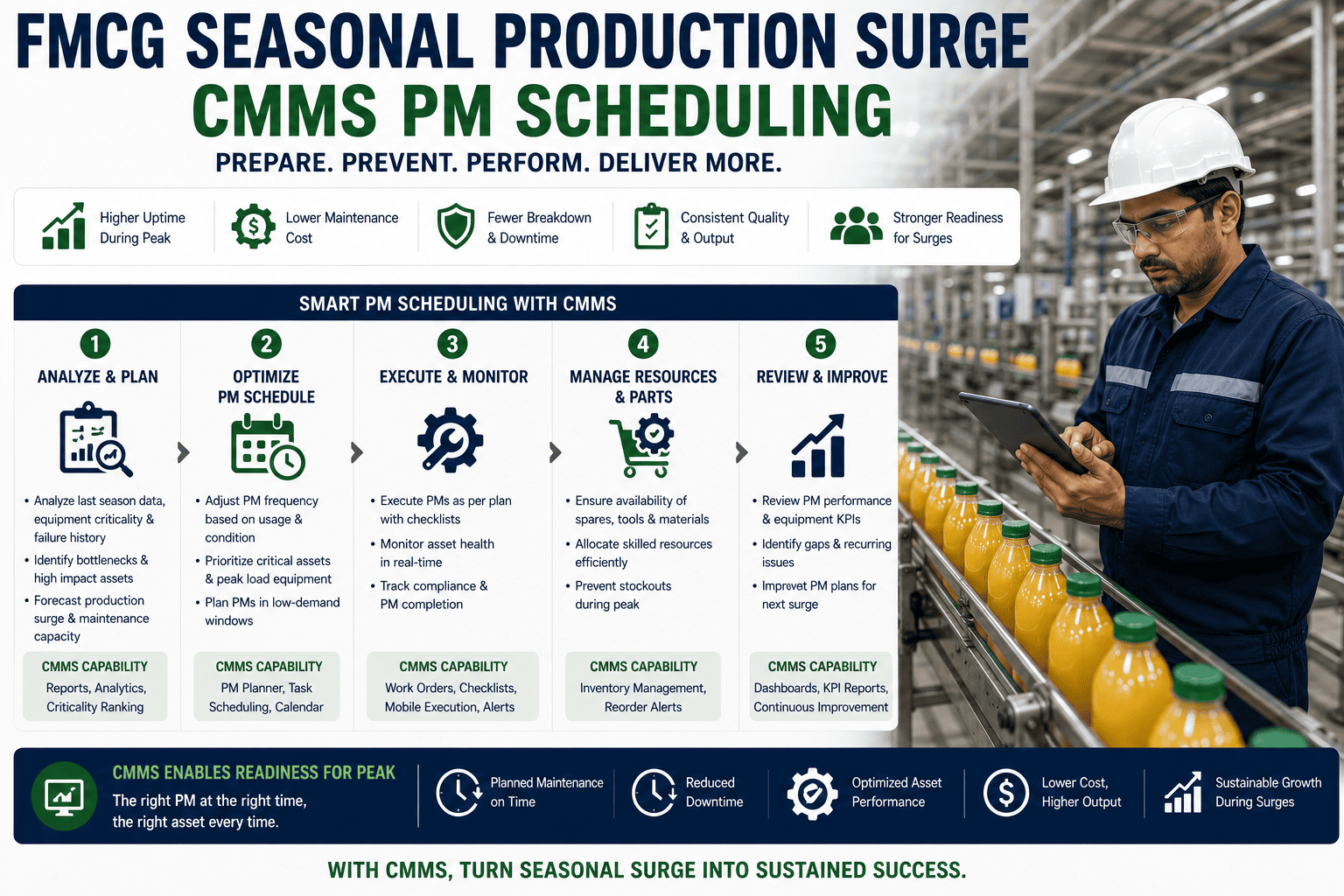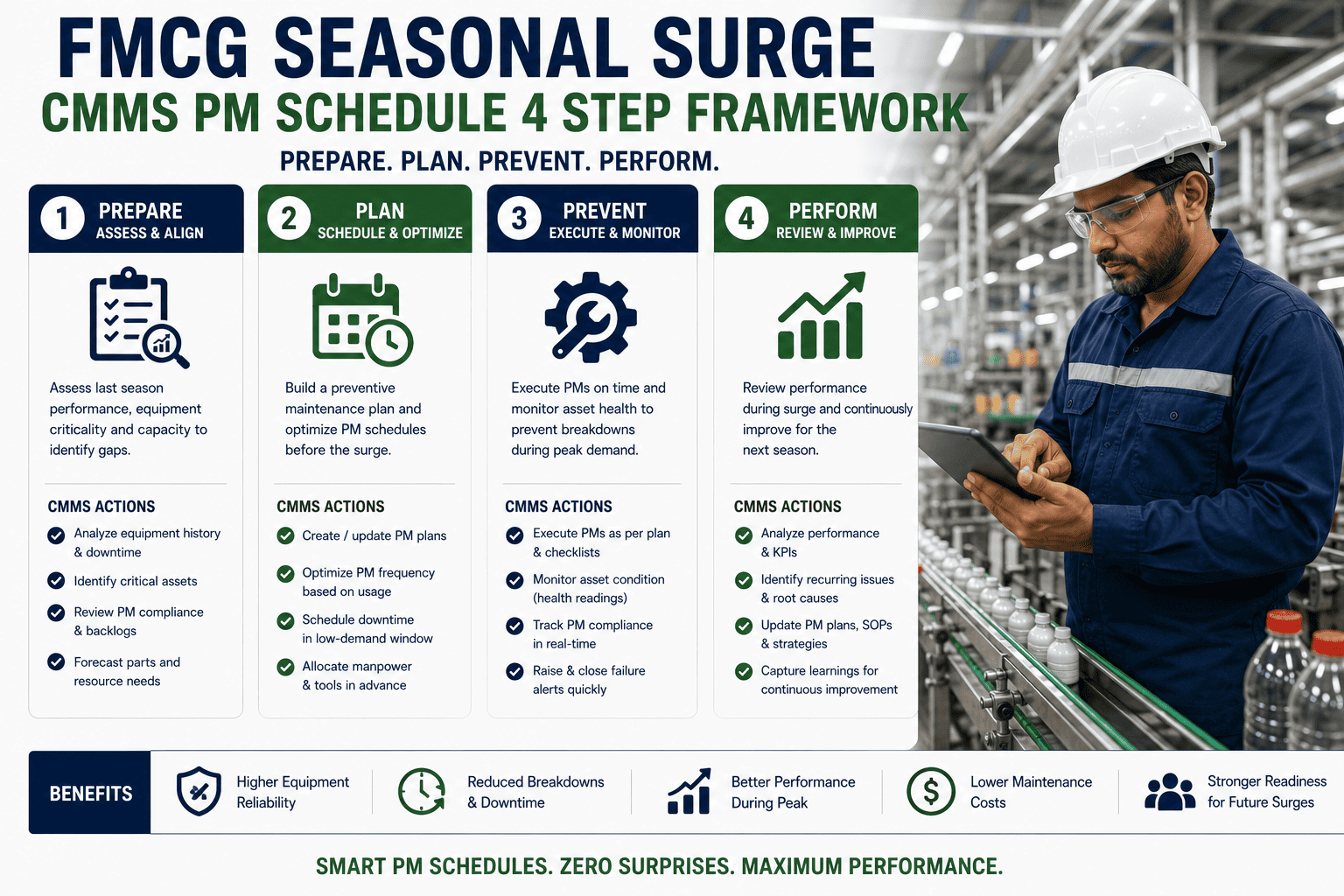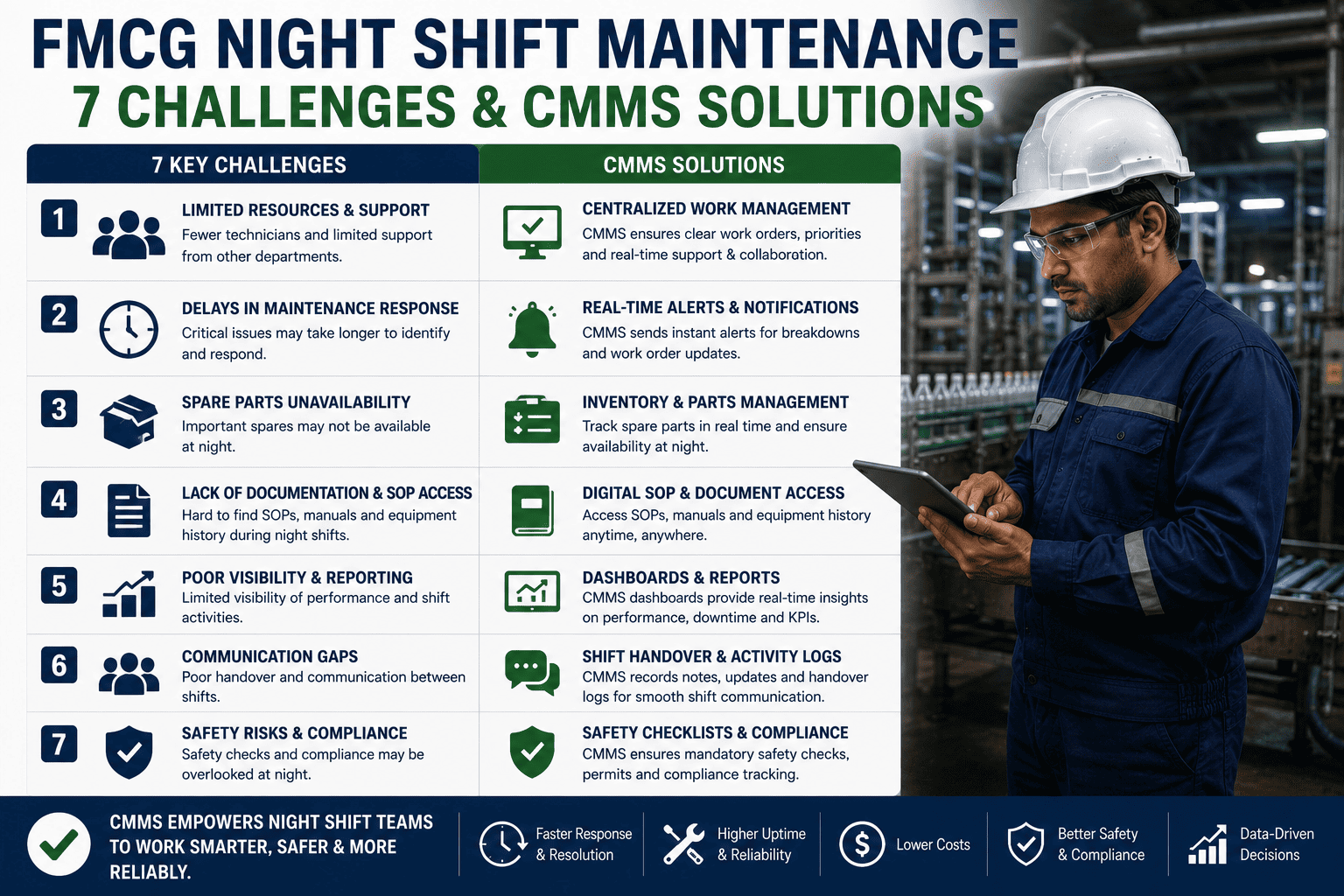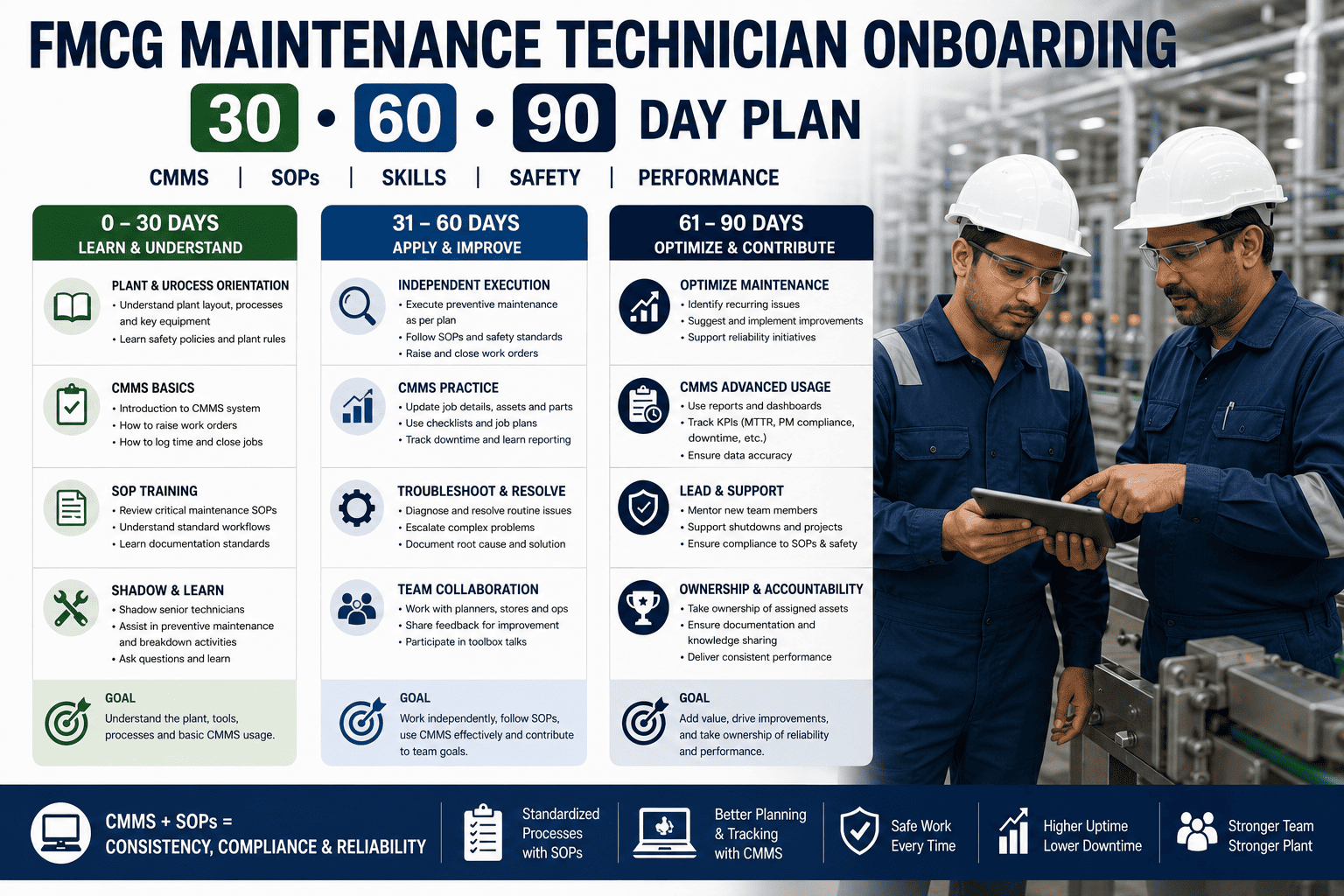
FMCG maintenance shift handover step-by-step using CMMS is one of the highest-leverage operational improvements available to plant maintenance managers — yet most FMCG plants still rely on verbal briefings, paper logbooks, or fragmented WhatsApp messages between shifts. The cost is measurable: research from plant maintenance studies consistently shows that up to 30% of maintenance rework in FMCG environments traces directly to incomplete or inaccurate shift handovers. When the night shift leaves without fully documenting an in-progress pump repair, the day shift diagnoses the same fault — spending 45–90 minutes on work already done. Multiply this across 26 shifts per week and the waste compounds into millions in lost productivity annually. Start a free trial to see how OxMaint's digital shift logbook eliminates this problem from day one.
FMCG Maintenance Shift Handover: Step-by-Step Guide to Digital Logbooks and CMMS Notes
Eliminate Rework · Ensure Context Continuity · Create Audit-Ready Shift Records
OxMaint's digital shift logbook automatically carries every open work order, parts request, and asset note forward to the incoming shift — no verbal briefings required, no context lost, no rework. Start a free trial and run your first digital shift handover this week, or book a demo and we'll walk through the handover workflow on your shift structure.
FMCG maintenance shift handover is the process by which one maintenance shift communicates the status of all in-progress work, pending parts, open failures, and asset anomalies to the incoming shift — so the incoming team can continue seamlessly without repeating context-gathering. In a 24/7 FMCG plant, this handover happens 2–3 times daily across multiple zones, asset classes, and technician teams. Done well, it's the connective tissue that makes multi-shift maintenance function as a single continuous operation. Done poorly, it's the source of 30% of all rework and a leading driver of technician frustration and turnover.
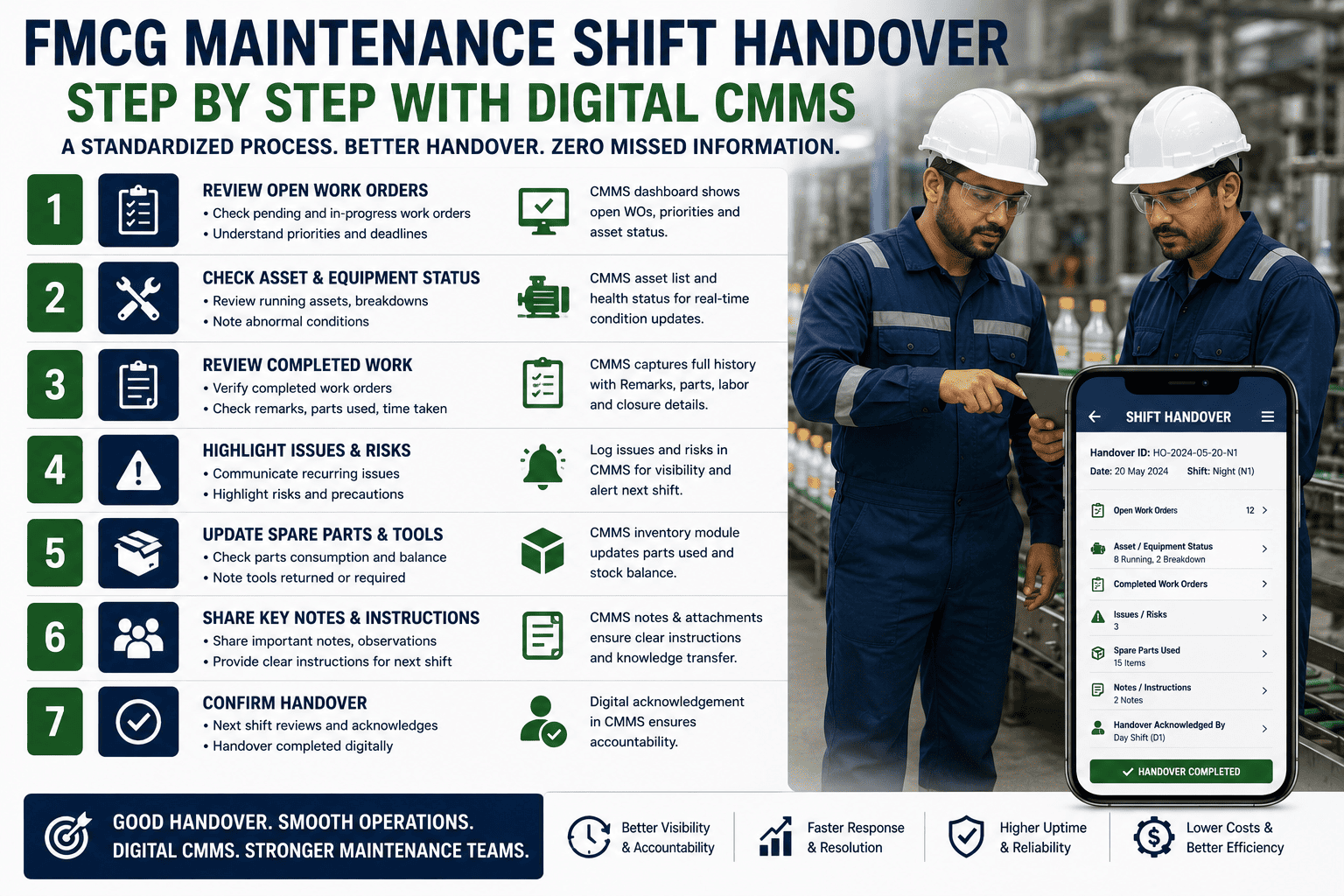
Digital CMMS shift handover replaces paper logbooks and verbal briefings with a system that carries context forward automatically. When a technician logs completion notes on a work order at 5:45 AM, that note is part of the incoming day shift's dashboard before the day shift lead walks in at 6:00 AM. Nothing is lost. Nothing has to be verbally communicated. The incoming shift sees exactly what was done, what's in progress, what parts are ordered, and what anomalies were observed — from a live digital system, not from a tired technician's memory at shift end. See how OxMaint work order management creates this continuity automatically.
A technician finishing an 8-hour night shift is asked to brief the incoming shift verbally. Fatigue means details get dropped — the partial fix on Line 4, the ordering status of the seal kit, the anomalous vibration observed at 3 AM that didn't become a formal work order.
Handwritten logbooks capture what a technician chooses to write, in whatever format they choose. Incoming shift leads spend 15–30 minutes interpreting handwriting, decoding abbreviations, and clarifying entries that were written in shorthand meaningful only to the person who wrote them.
Paper and verbal handovers capture completed work well — but struggle with nuance around in-progress work. A partially completed conveyor repair at shift end is easy to forget or under-document, causing the incoming shift to start the diagnosis from scratch.
In FMCG plants, food-contact equipment opened for maintenance requires documented clearance before resuming operation. When handover is verbal, the incoming shift may not know a food-contact asset was opened — creating a GMP compliance gap that only surfaces during an audit.
The previous shift requested a part but didn't document the PO number, supplier, or expected delivery. The incoming shift, not knowing the part is already ordered, requests it again — creating a double-order and delaying receipt while the asset sits offline waiting for a part that's coming twice.
When maintenance activity lives in paper logbooks and verbal briefings, plant managers cannot review shift performance, identify patterns, or hold shifts accountable for incomplete work. Management has visibility into completed shifts only after collating paper forms — typically too late to act on trends.
Every incoming shift lead in a paper-based FMCG plant spends 20–40 minutes reconstructing what the previous shift left: reviewing the paper logbook, checking open work orders in a separate system, calling the previous shift lead for clarifications. Across 3 shift changes daily, this is 60–120 minutes of supervisory time per day wasted before a single maintenance task begins.
A night shift technician opens a packaging line seal for an emergency fix at 4 AM. The work is completed, the equipment is reassembled, but the GMP clearance documentation is not captured in the handover. Day shift restarts the line without verifying hygiene clearance. In FMCG, this scenario is a food safety incident waiting to happen — and regulators treat it as such.
A specific failure on an asset recurs every 8–12 days. Without shift logbook continuity, each shift team approaches it as a new isolated event rather than a recurring pattern. The pattern is visible only if someone reviews paper logbooks from the past 30 days — which nobody has time to do. A CMMS would flag the recurrence automatically after the second occurrence and trigger an RCA.
A critical asset degrades during the final hour of a shift. The outgoing shift doesn't escalate — they're wrapping up and assume the incoming shift will handle it. The incoming shift doesn't know the asset was flagged. By the time either team acts, the failure has occurred. This overlap ambiguity is eliminated when CMMS escalation paths are tied to active work orders that carry forward at shift change.
Explore inspection management and safety and compliance workflows that protect FMCG plants during shift transitions involving food-contact equipment.
Every completed work order should be closed in CMMS with full completion notes — not just "done" but what was done, what parts were used, and what the asset condition is now. In OxMaint, closing a work order with notes automatically updates asset history, parts inventory, and the shift logbook simultaneously. This 5-minute step per work order creates the entire handover record for completed work.
For every work order that won't be completed before shift end, add a status note: what's been done so far, what step is next, whether parts are ordered or on hand, and what the incoming shift needs to know to continue without losing time. OxMaint marks these work orders as "In Progress — Pending Handover" so they appear prominently in the incoming shift's dashboard. See how OxMaint work order management handles in-progress handover status.
Not every maintenance observation during a shift becomes a formal work order — but some should. A bearing that ran warm at 4 AM without crossing the alert threshold, a belt showing early wear that can wait for the next scheduled PM, an unusual noise from a motor that hasn't failed yet. These observations go into the OxMaint shift logbook as asset notes, linked to the specific asset, so the incoming shift can monitor them during their rounds.
In FMCG plants, this step is non-negotiable. Log all food-contact equipment opened during the shift — what was accessed, what work was done, what GMP hygiene clearance was completed. Log all parts ordered during the shift — supplier, PO number, expected delivery, which work order the part belongs to. OxMaint's parts and inventory module tracks all part requests and orders within the work order record, so this step is a review, not a data entry task.
The incoming shift lead opens OxMaint before the verbal briefing and reviews the shift handover dashboard: open work orders with status notes, asset anomaly flags, parts pending arrival, predictive alerts active. The verbal briefing becomes a 5-minute Q&A on anything unclear, not a 30-minute information dump. When the outgoing shift lead leaves, every piece of context remains in the system — accessible to anyone, at any time.
OxMaint's AI prioritizes the work order queue based on asset criticality, SLA, and urgency flags. Incoming shift technicians are routed to their first tasks automatically — highest priority first, nearest certified tech. Supervisors see the full shift queue with assignments on the live dashboard. The first 30 minutes of every shift are productive, not administrative. Explore AI and automation in OxMaint for work order routing detail.
| Handover Element | Paper / Verbal Approach | OxMaint CMMS Digital Logbook |
|---|---|---|
| Completed work documentation | Handwritten summary — detail varies by technician, handwriting legibility a real issue | Closed work order with structured notes — searchable, timestamped, linked to asset history |
| In-progress work status | Verbal or brief note — incoming shift has to reconstruct context, often redoes diagnostics | Work order flagged "In Progress — Handover" with step-by-step notes visible on incoming shift dashboard |
| Food-contact compliance (FMCG) | Relies on outgoing shift mentioning it verbally — frequently omitted under shift-end pressure | GMP clearance checklist embedded in WO — cannot close without sign-off, auto-logged in audit trail |
| Parts ordering status | PO number on a paper note or verbal — incoming shift doesn't know what's ordered vs needed | Parts module shows all orders with supplier, PO, and ETA — linked to the relevant work order |
| Asset anomaly flags | Captured if technician remembers to write it — often omitted for sub-threshold observations | Asset note in CMMS linked to specific asset — incoming shift sees flagged anomalies in their rounds list |
| Management review of shift | Manual collation of paper logbooks — hours of work, always retrospective | Live dashboard accessible from any device — shift performance visible in real time or after-the-fact |
Maintenance rework eliminated when digital shift logbooks replace verbal and paper handovers in FMCG plants
Technician and supervisor time saved per day across a 3-shift FMCG operation by eliminating context-reconstruction
OxMaint client outcome — shift continuity directly reduces the reactive failures that cost FMCG plants the most
FMCG compliance documentation auto-generated from CMMS work orders — every shift, every asset, every hour
Calculate what better shift handover saves your plant — use the OxMaint ROI Calculator or explore analytics and reporting for shift performance tracking.
How long does it take technicians to complete a CMMS digital shift handover vs a paper logbook?
What should be included in an FMCG maintenance CMMS shift handover note?
How does OxMaint handle FMCG compliance documentation across shift changes?
Can supervisors see shift handover quality metrics across all shifts using OxMaint?
OxMaint's digital shift logbook carries every open work order, parts order, asset anomaly, and compliance record forward to the incoming shift automatically. Your incoming shift lead opens the dashboard and knows exactly what's open, what's pending, and what to prioritize — before the outgoing shift even finishes the verbal briefing. No rework. No compliance gaps. No wasted first hour.