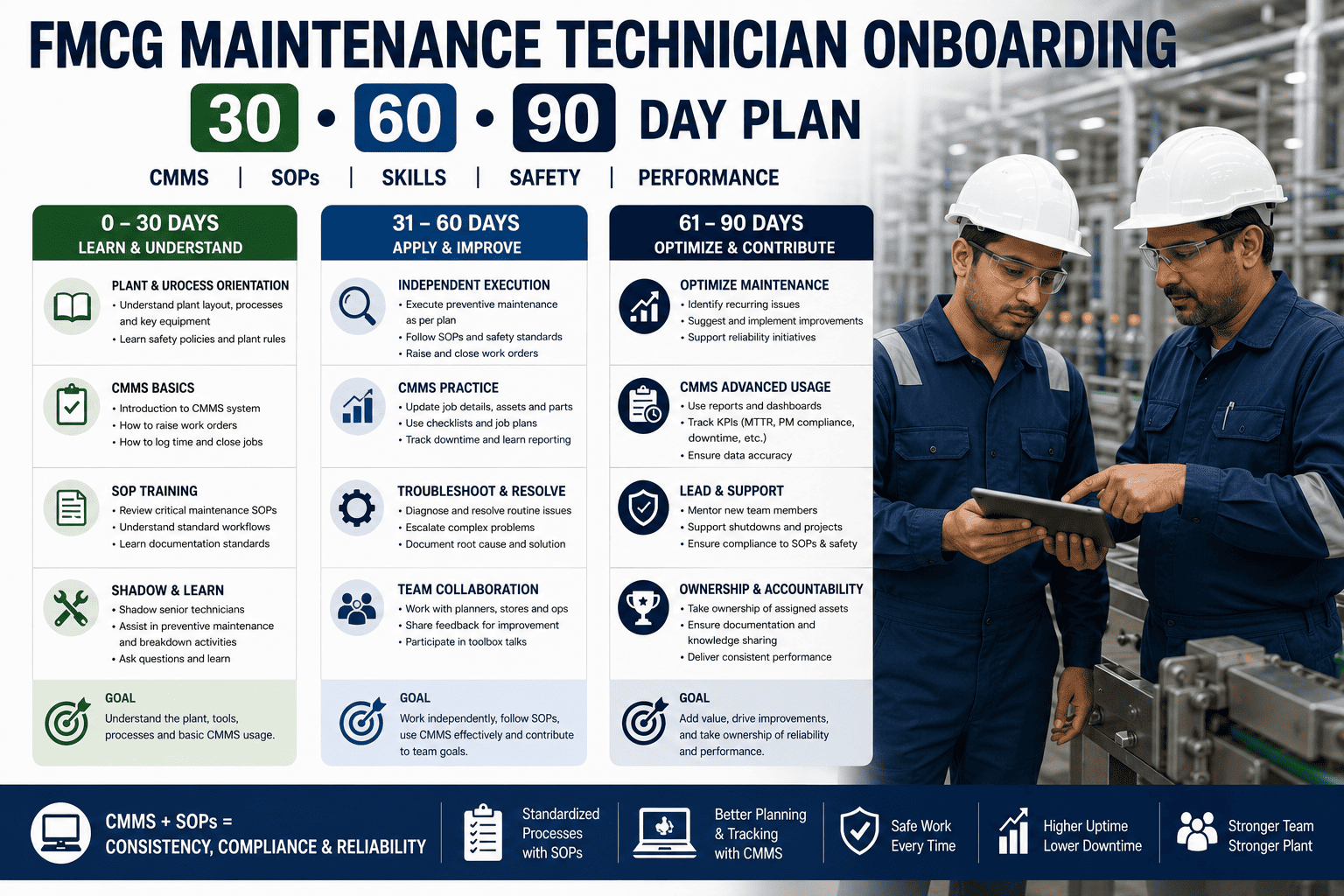
A structured FMCG technician onboarding plan using CMMS digital SOPs is the single fastest way to close the 4–6 week productivity gap that costs FMCG plants an estimated $8,000–$14,000 per new hire. Most plants hand new maintenance technicians a binder, pair them with a senior tech for two weeks, and hope institutional knowledge transfers before that senior tech gets called to a line failure. It rarely does. The 30-60-90 day onboarding framework using CMMS — with digital SOPs, QR-linked asset history, and structured PM task progression — turns ad hoc knowledge transfer into a repeatable, measurable system. Start a free trial to see how OxMaint makes this framework operational from day one.
How to Onboard FMCG Maintenance Technicians in 30-60-90 Days Using CMMS Digital SOPs
Accelerate Time-to-Productivity · Transfer Knowledge Digitally · Reduce Onboarding Cost
OxMaint stores every SOP, asset history, compliance checklist, and work order in a searchable digital system your new hires can access from day one — on a phone, tablet, or workstation. Start a free trial and put this onboarding framework into operation this week, or book a demo and we'll walk through it on your actual asset list.
FMCG technician onboarding using a 30-60-90 CMMS framework means structuring a new maintenance hire's first 90 days around progressive CMMS competency milestones — from basic navigation and digital SOP use in the first 30 days, through independent PM execution in the second phase, to full work order autonomy and predictive monitoring by day 90. This replaces the shadow-and-hope approach most plants rely on with a measurable, repeatable process.
The standard onboarding approach fails in FMCG for three structural reasons. First, senior technicians are constantly pulled to line failures — they cannot reliably mentor new hires while firefighting. Second, paper SOPs and binder-based training create knowledge silos: the procedure in the binder may not match what actually works on Line 4's aging conveyor. Third, without CMMS task checkpoints, there's no objective measure of a new hire's readiness, and supervisors either under-support or over-support based on perception rather than data. Explore how structured work order management creates the task progression framework for effective FMCG technician onboarding.
New hires scan any asset QR code and see the exact SOP for that specific machine — including FMCG-specific hygiene protocols, lockout/tagout steps, and maintenance sequences. SOPs live on the asset, not in a binder in the supervisor's office.
CMMS allows supervisors to assign work orders by complexity tier — routing simple PM tasks to new hires in weeks 1–4, increasing to independent corrective work by week 8. The system tracks completion rate and time-on-task for objective readiness assessment.
Every failure, repair, part used, and PM completed on an asset is accessible from QR scan. New hires see years of asset context in seconds — eliminating the institutional knowledge gap that makes every new hire feel lost for the first six weeks.
FMCG compliance documentation is complex and unforgiving. Digital inspection checklists guide new hires through GMP, HACCP, and OSHA requirements step by step — reducing compliance errors during onboarding and generating automatic audit trails.
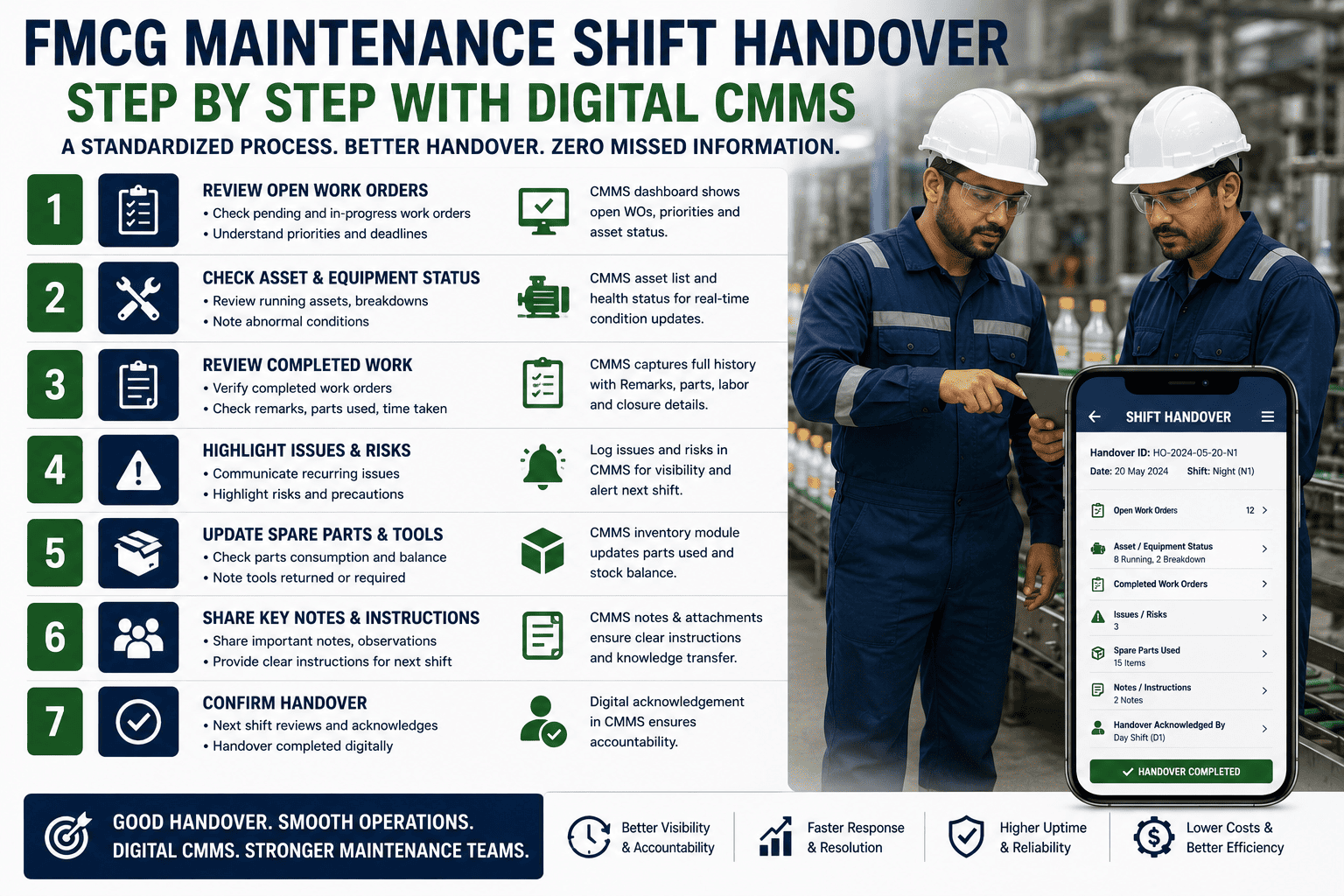
New hires learn how experienced technicians document shift handovers by reading digital logbooks from previous shifts. They see what context to capture, how to flag incomplete work, and how to write notes that the next shift can actually use — faster than any classroom training.
Supervisors see each new hire's closed work order count, PM completion rate, average resolution time, and inspection pass rate in real time. Milestone check-ins at day 30, 60, and 90 become data conversations instead of subjective impressions.
New hires need mentoring. Senior techs are your most critical maintenance resource. When your onboarding plan requires 4–6 hours of daily senior tech shadow time, you're spending your most expensive maintenance resource on knowledge transfer that a digital SOP system could handle in minutes. FMCG plants lose an estimated $1,800–$3,200 per week in senior tech opportunity cost during unstructured onboarding.
New hires who don't fully understand GMP, HACCP, or PPE requirements create real food safety and regulatory risk. In FMCG, a compliance failure during onboarding doesn't just result in a record — it can trigger a line shutdown, a product recall, or an OSHA citation. Paper-based onboarding with no digital verification is a regulatory liability.
When your most experienced FMCG maintenance technicians carry critical asset knowledge in their heads — not in a CMMS — every departure empties a knowledge library. New hires then learn from the next-most-experienced tech, who learned from memory, creating a degradation chain. Digitizing asset knowledge in a CMMS makes knowledge institutional, not personal.
Without CMMS-tracked task milestones, supervisors rely on gut feel to assess new hire readiness. This creates two failure modes: pushing a new hire to independence too fast (leading to errors and safety incidents) or over-supporting a ready technician (extending the productivity gap unnecessarily). Both cost money and damage team morale.
See how OxMaint inspection management and safety and compliance workflows protect FMCG plants during the high-risk onboarding window.
| Onboarding Element | Paper-Based / Ad Hoc Approach | OxMaint CMMS 30-60-90 Framework |
|---|---|---|
| SOP access | Paper binder — may be outdated, lost, or in supervisor's office during a breakdown | QR scan any asset — current SOP on phone immediately, always up to date |
| Knowledge transfer method | Senior tech shadow — interrupted constantly by line failures, inconsistent coverage | Digital asset history + structured work order progression — consistent, measurable |
| Readiness assessment | Supervisor gut feel — no objective data, risk of over- or under-support | CMMS performance dashboard — close rate, PM compliance, resolution time vs benchmark |
| FMCG compliance during onboarding | Memory-dependent — new hire must remember GMP/HACCP from classroom training | Digital checklists guide each task — compliance embedded in every work order |
| Time-to-productivity | 4–6 weeks to baseline — $8,000–$14,000 in productivity gap and mentor cost | 2.5–4 weeks to baseline — 40% faster with structured digital SOP progression |
| Milestone tracking | No formal checkpoints — graduation to independence based on calendar, not capability | Day 30/60/90 data reviews — objective milestone advancement or targeted support |
CMMS digital SOP access reduces new hire ramp time from 4–6 weeks to 2.5–4 weeks per technician
Productivity gap savings when new hire reaches baseline 2 weeks faster — per technician hired
OxMaint client outcome — driven by technicians with full asset context and structured PM programs
Including FMCG, food manufacturing, and consumer goods plants using OxMaint CMMS frameworks
Calculate what faster onboarding saves across your annual hiring volume — use the OxMaint ROI Calculator.
How long does it take to set up digital SOPs in OxMaint for FMCG asset onboarding?
Can OxMaint CMMS track individual new hire performance during the 30-60-90 onboarding period?
Does the 30-60-90 CMMS onboarding framework work for experienced technicians transferring from other FMCG plants?
What happens to onboarding continuity when the senior tech mentor is pulled to a line failure during a new hire's training?
OxMaint gives every new FMCG maintenance technician QR-linked digital SOPs on every asset, structured work order progression from day one, FMCG compliance checklists built into every task, and performance dashboards that turn the day 30/60/90 check-in into a real data conversation. No more senior tech bottlenecks. No more binder-based onboarding. No more guessing when a new hire is ready.