A single mislabeled allergen panel, a faulty seal, or a skewed barcode costs the average FMCG company $10 million per recall event — not counting brand damage that takes years to recover. Yet human inspectors operating at line speeds of 800–1,200 units per minute catch only 70–80% of defects on a good day, and fatigue drops that to 60% by mid-shift. AI-powered vision inspection systems are changing this equation entirely: detecting packaging defects at full line speed with 99.8% accuracy, reducing recall events by 75%, and paying for themselves within 6–9 months. This guide explains exactly how AI vision inspection works on FMCG packaging lines, what defects it catches that humans miss, and how to implement it without stopping production. Start your free trial to integrate AI vision inspection with your maintenance and quality workflows. Schedule a demo to see OxMaint's AI Vision module detecting live defects.
Why Human Inspection Fails at FMCG Line Speeds
The problem is not that human inspectors are careless — it is that the task is physically impossible at modern FMCG production rates. A packaging line running 1,200 units per minute gives an inspector 0.05 seconds per unit. No human eye can reliably detect a 2mm label shift, a hairline seal defect, or a wrong SKU variant in 50 milliseconds — especially 8 hours into a shift.
Research from the Food and Drug Administration shows that 42% of all FMCG recalls stem from labeling errors — the single most preventable defect category. These are not exotic failure modes requiring breakthrough technology. They are routine, repetitive errors that happen because human beings cannot maintain perfect attention at inhuman speeds for 8-hour shifts. AI vision systems solve this by never getting tired, never losing focus, and never missing a changeover mismatch.
What AI Vision Inspection Actually Detects
AI vision systems do not just replicate human inspection faster — they detect defect categories that are physically impossible for humans to see at production speed. Each defect type uses different imaging technology and AI models trained on millions of known-good and defective samples.
Prevents the #1 cause of FMCG recalls — mislabeling. AI reads every allergen declaration, nutrition panel, barcode, and expiry date against the master SKU database in real time. Catches wrong-SKU labels within 3 units of a changeover — before a single mislabeled case reaches the pallet. Detects label skew >1mm, wrinkles, bubbles, and misalignment that human inspectors miss at speed.
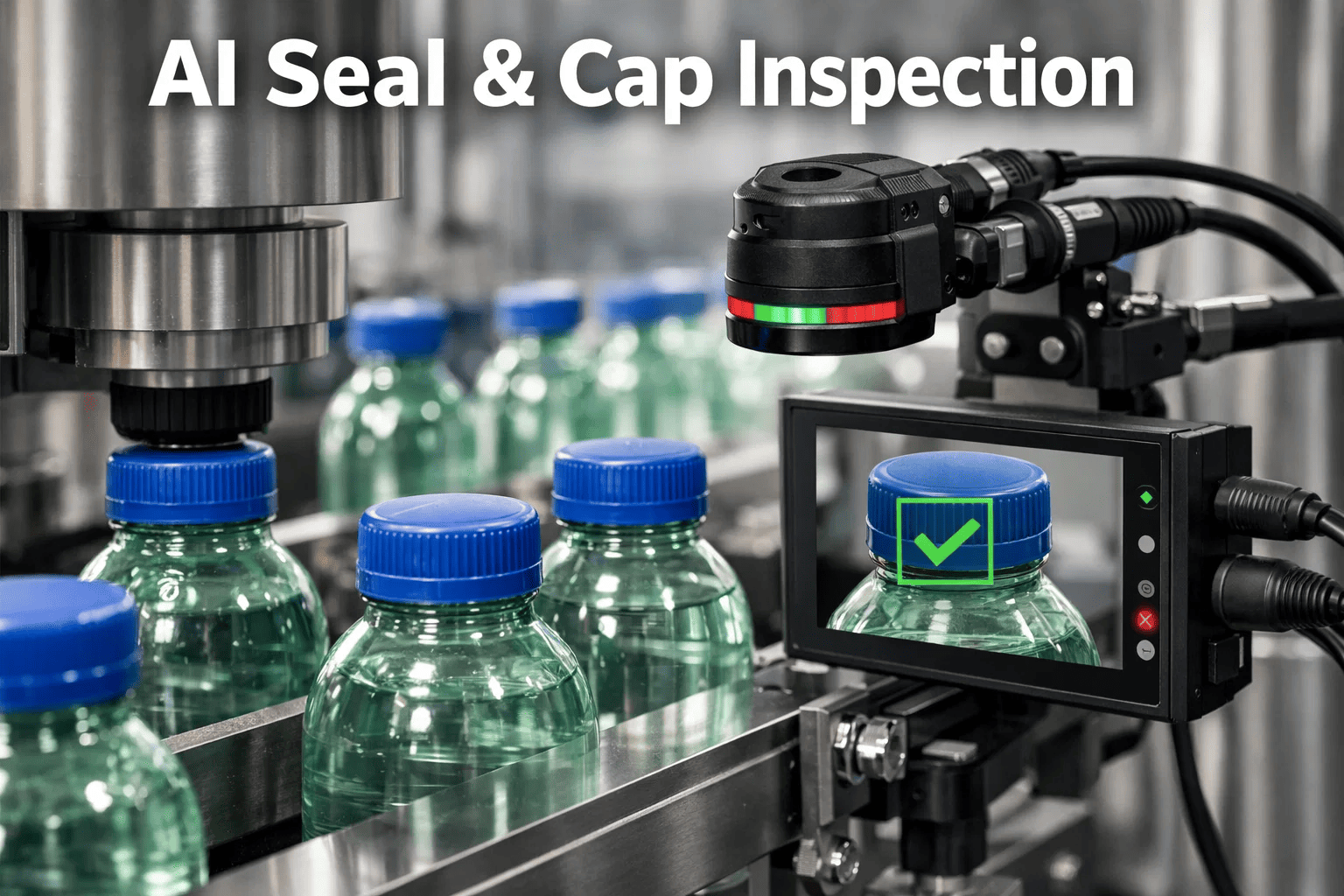
Prevents contamination, leakage, and shelf-life failures. Infrared imaging identifies micro-leaks in heat seals that are invisible to the naked eye — measuring seal width across the full package perimeter to ±0.3mm tolerance. Verifies cap torque consistency, tamper-evident band integrity, and detects product contamination trapped in pouch channel seals before it reaches consumers.
Prevents underfill complaints and regulatory violations. X-ray or gamma imaging measures actual product volume through opaque packaging — catching underfills that checkweighers miss when product density varies. Confirms inserts, scoops, desiccants, and promotional items are present. Identifies foreign objects including metal, glass, bone, plastic, and stone contaminants in-package.
Protects brand image and shelf presence. Spectrophotometric analysis ensures brand colors match within Delta-E <2.0 across every unit — a tolerance human eyes cannot consistently judge. Detects print registration errors exceeding 0.5mm between color layers, surface contamination from smudges or ink splashes, and package damage from dents, crushes, or tears.
AI Vision vs. Human Inspection: The Data
The performance gap between AI vision and human inspection is not marginal — it is categorical. Every metric that matters for FMCG quality moves dramatically when AI vision replaces or augments manual inspection.
How AI Vision Connects to Maintenance: The CMMS Integration
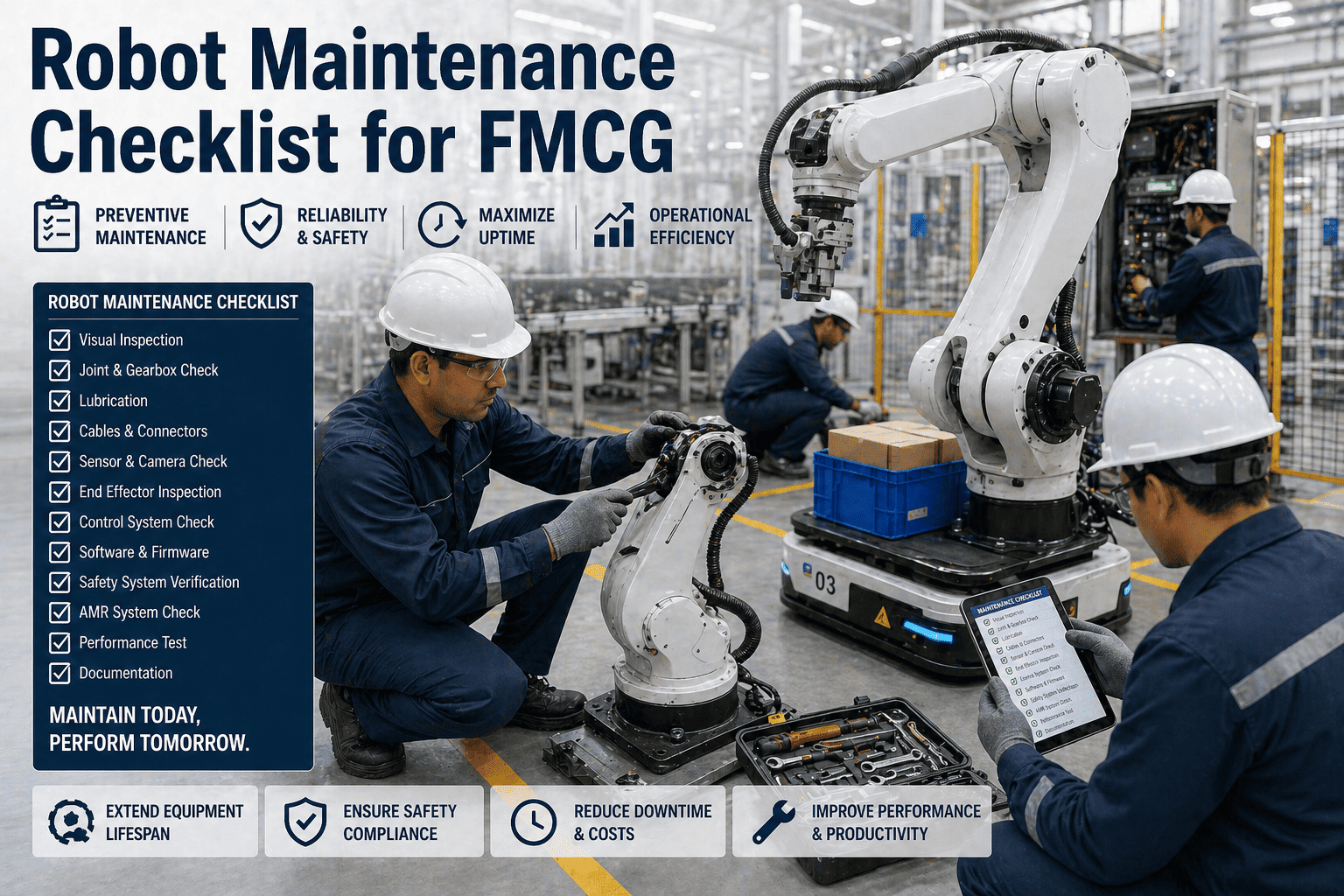
AI vision inspection is not just a quality tool — it is a predictive maintenance sensor. When defect rates spike, the root cause is almost always equipment degradation: worn seal jaws, drifting filler heads, misaligned labelers, or contaminated print heads. AI vision systems integrated with a CMMS create a closed loop that catches equipment problems before they produce defective product.
Here is how the closed loop works in practice. A camera detects seal width drifting from 8.0mm toward 7.2mm over 200 consecutive units — a trend that is invisible to human inspectors but unmistakable to an AI model tracking dimensional consistency. The CMMS receives this defect trend data and correlates it with the seal jaw's temperature profile and cycle count history. A predictive work order is auto-generated: "Replace seal jaw — projected failure in 4 hours at current drift rate." The assigned technician receives a mobile alert with the parts location, estimated repair time, and priority ranking. The intervention happens during the next scheduled changeover — zero unplanned downtime, zero defective product shipped. The root cause and resolution are documented in the CMMS, feeding the predictive model for the next occurrence.
This is the fundamental shift AI vision enables: quality data becomes maintenance intelligence. Every defect image, every trend anomaly, every reject spike tells the maintenance team something specific about equipment health — weeks or months before catastrophic failure would have produced a recall-worthy defect escape.
The Economics: What AI Vision Actually Costs and Saves
FMCG quality managers often assume AI vision is prohibitively expensive. In reality, a single prevented recall pays for the entire system multiple times over. Here is the real math for a typical 5-line FMCG packaging operation.
The Cost of Getting It Wrong: Real FMCG Recall Data
These are not hypothetical risks. FMCG recalls happen every week, and the costs are staggering. AI vision inspection would have caught every one of these defect types before a single unit left the plant.
Hardware: What the AI Vision System Looks Like on Your Line
AI vision inspection is not a black box — it is a modular system with specific hardware at defined positions along the packaging line. Each line typically has 3–5 inspection stations, each covering a different defect category. Understanding the components helps maintenance teams plan integration, cleaning schedules, and spare parts inventory.
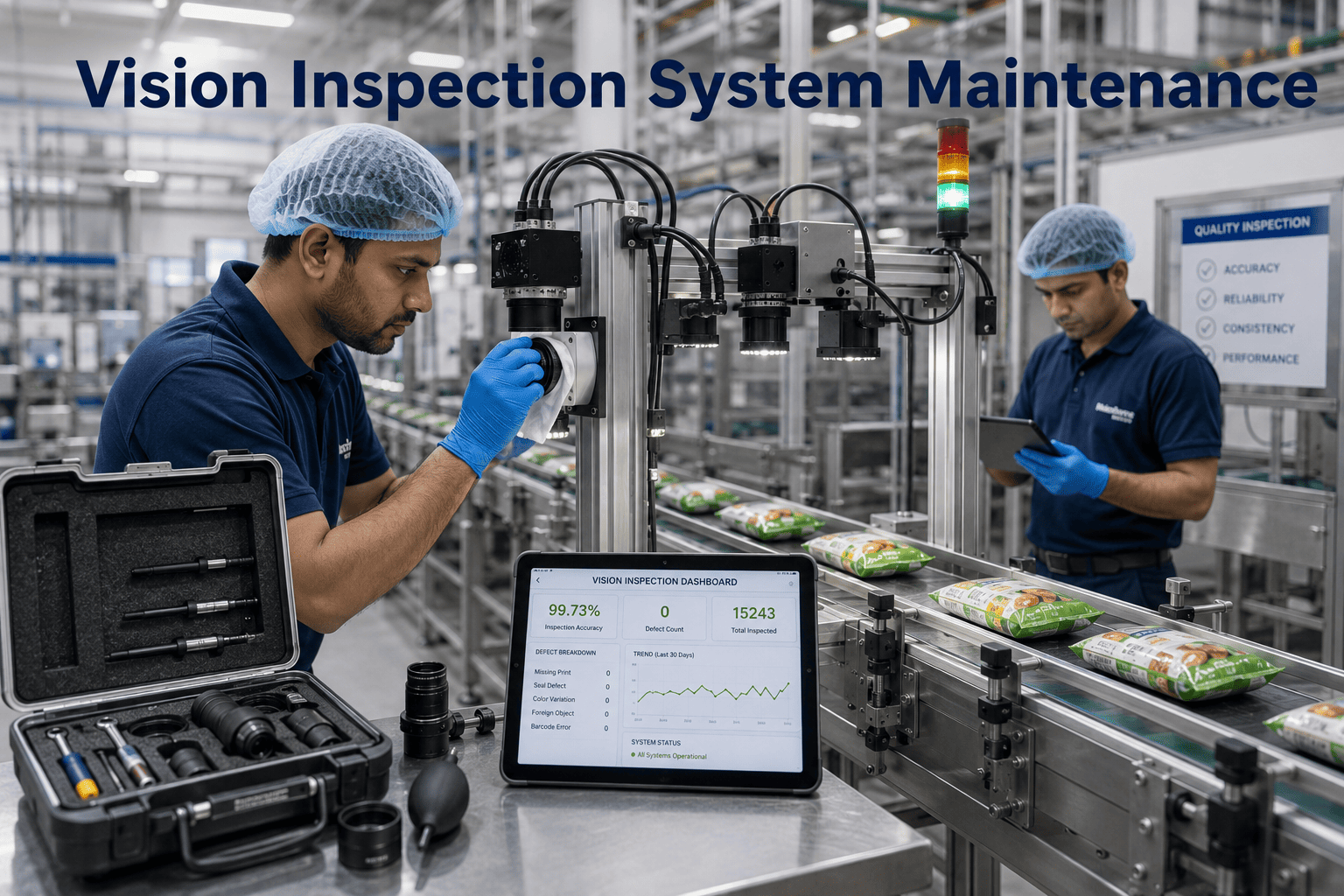
A typical station includes a high-speed area scan camera (5–20 megapixel, 120+ fps with GigE or CoaXPress interface), LED line lights or strobe arrays rated for 50,000+ hours in food-safe IP67/IP69K enclosures, an edge processing unit with GPU-accelerated inference running AI models at under 15ms per frame, and a pneumatic reject mechanism that activates in under 50ms. An HMI touchscreen gives operators live inspection feed with defect counts and pass/fail rates. The entire system connects to OxMaint via OPC-UA or REST API, feeding defect data into the CMMS in real time.
Maintenance requirements are remarkably low. Daily lens wipes take 2 minutes per station. Weekly calibration verification with certified test targets takes 15 minutes per line. Monthly enclosure cleaning and cable checks take 30 minutes. Quarterly LED output verification takes an hour. Annual full-system audit — camera alignment, processing performance, AI model review, firmware update — takes 4 hours. Total annual PM: approximately 52 hours per line, delivering 99.8% detection accuracy. Compare that to the 2,080 hours of human inspector time per line that delivers only 70–80% accuracy.
Implementation: From Pilot to Full-Line Deployment
AI vision deployment follows a structured path that proves value fast and scales with confidence. The critical insight: start with one line, one defect type, and expand as the system learns your product portfolio. Most FMCG plants go from first camera to full-line deployment in 8–10 weeks.