A vision inspection system on an FMCG line is only as reliable as its last calibration. The camera that is correctly detecting label placement defects and seal failures today can be missing 20–30% of defects by next week if a vibration event shifted its focal plane, if the lighting intensity degraded by 15% without a bulb replacement, or if the AI model was never updated after a packaging redesign changed the reference image. Most FMCG plants invest heavily in vision system procurement and initial deployment — and then manage the ongoing performance of these systems with ad hoc interventions that respond to defect escapes rather than preventing them. The result is a system that provides inconsistent protection, and a quality record that shows unexplained variation in detection rates that cannot be traced to any root cause because calibration history was never captured. Start a free trial of Oxmaint and manage your vision inspection systems as production-critical assets — or book a demo to see how FMCG plants maintain vision inspection accuracy in Oxmaint.
Vision System Maintenance & Calibration on FMCG Lines: A Complete 2026 Guide
How FMCG manufacturers maintain camera systems, calibrate vision inspection platforms, optimise lighting, and tune AI models to sustain defect detection accuracy at production line speed — with structured CMMS maintenance programmes.
How Vision Systems Lose Accuracy on FMCG Production Lines
Vision inspection systems degrade through five primary mechanisms — none of which are visible to operators until defects start escaping detection. Lens contamination from line mist, dust, and airborne particulates reduces image contrast progressively until defect edge detection accuracy drops below usable thresholds. Lighting intensity degrades as LED arrays age, changing the illumination conditions the AI model was trained on. Mechanical vibration shifts camera mounting positions and focal planes, causing consistent geometric misregistration between the image and the reference mask. AI model drift occurs when packaging design changes, substrate batch variations, or seasonal product colour changes move product appearance away from the reference dataset. Environmental changes — temperature swings, humidity, condensation — alter both optics and the structural rigidity of the camera mounting system. Every one of these mechanisms can be detected and corrected before detection accuracy is compromised — but only with a structured maintenance programme that includes regular calibration, cleaning, and model performance review. Start a free trial of Oxmaint to manage your vision systems as production-critical assets — or book a demo to see how vision system PM programmes are structured in Oxmaint.
The Four-Level Vision System Maintenance Programme
Run system self-test using certified reference test pieces (known-good and known-defect samples). Verify correct rejection of all defect test pieces. Confirm pass rate on all known-good references. Check lens surface condition. Document result with operator signature. Any failure halts production until investigated.
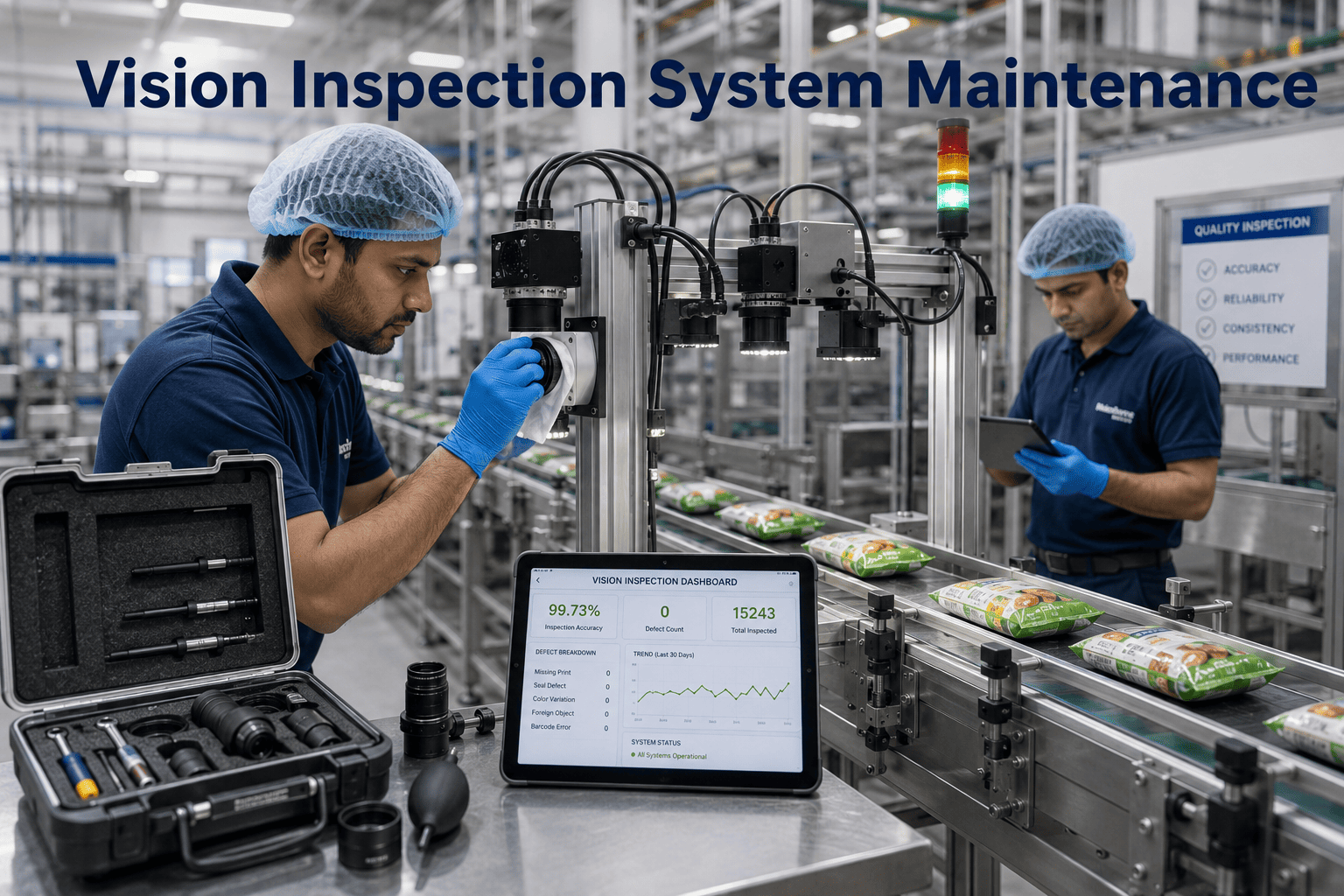
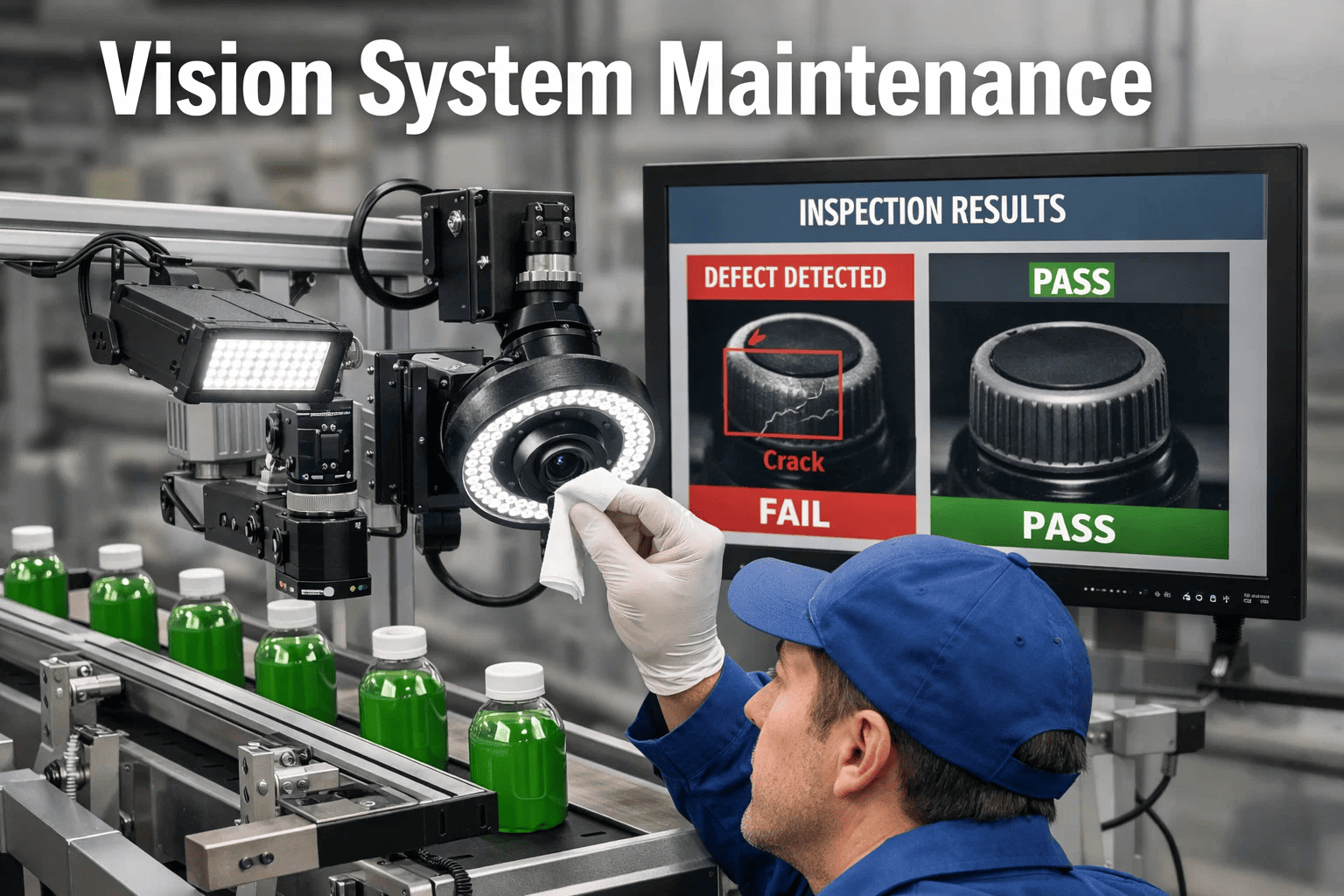
Lens cleaning with IPA solution and lint-free optical cloths. Lighting array surface cleaning. Physical check of camera mounting rigidity and cable management condition. Illumination intensity measurement against baseline using calibrated lux meter. Flag any intensity drop exceeding 10% from installation baseline.
Geometric calibration using certified calibration target board. Pixel-to-physical-dimension mapping verification. White balance and exposure setting review. Detection threshold confirmation using full range of reference test pieces (minimum 20 known-defect + 20 known-good). AI model performance metrics reviewed against baseline acceptance criteria.
Full optical system inspection including lens internal condition, sensor cleaning (CMOS/CCD), strobe timing calibration for line speed, and mounting structure mechanical integrity. AI model retraining review — evaluate false positive and false negative rates from previous quarter. Update model if rate has drifted beyond acceptance limits. OEM service if required.
Where Vision System Maintenance Programmes Break Down
Shift-start reference piece runs are skipped when production is ready to start. The vision system that correctly rejected defects yesterday has degraded overnight due to vibration or contamination — but production runs for a full shift before the drift is detected through defect escapes reaching the customer.
LED arrays lose 15% illumination intensity every 1,000 hours. Over 6 months of two-shift operation, a vision system can be operating at 60–70% of its installation lighting baseline. The AI model was trained at 100% intensity — the mismatch manifests as rising false negative rates on subtle defects that only show contrast at full illumination.
A packaging redesign changes label layout, substrate colour, or print registration — but the vision system AI model is never retrained. The model starts generating false positives on correctly-produced packs that don't match its training images, or false negatives on defects that now appear in positions the original model didn't cover.
A BRC or retailer audit asks for evidence that the vision system was operating within specification during the production of a recalled batch. The calibration records exist in scattered files — instrument software logs, email sign-offs, paper check sheets. Assembling them takes 3–5 days and is typically incomplete.
Manage Your Vision Systems Like the Production-Critical Assets They Are
Oxmaint registers every vision inspection system as an asset with structured PM schedules for all four maintenance levels — from daily shift-start verification work orders to quarterly deep maintenance and model retraining reviews. Every calibration record, lighting intensity measurement, and AI model performance log captured and traceable.
Ad Hoc Vision System Management vs CMMS-Managed Programme
Oxmaint for FMCG Vision System Maintenance Management
Register every camera, strobe, lens assembly, and controller unit with installation date, camera model, AI software version, training dataset reference, last calibration date, and condition score — linked to the specific production line position it covers.
Configure shift-start verification, weekly cleaning, monthly full calibration, and quarterly deep maintenance as separate PM work orders per system — each with the appropriate checklist, reference standard requirements, and technician assignment.
Log illumination intensity measurements at each weekly check. Baseline values stored at installation. PM trigger fires when any measurement falls below 85% of baseline — ensuring LED replacement before accuracy impact, not after defect escape.
Packaging design changes trigger a mandatory vision system model validation work order in Oxmaint. New pack production cannot proceed without recorded AI model revalidation sign-off — eliminating the gap where changed packs run on a model trained on the previous design.
Log false positive rate, false negative rate, and overall detection accuracy from each calibration run against the system's baseline acceptance criteria. Trend analysis flags gradual performance decline before it reaches the threshold where defect escapes become likely.
Complete maintenance and calibration history for any vision system, any date range, exportable in under 10 minutes. Provides the production-run-level evidence needed for BRC grade AA certification, retailer supplier audits, and recall investigation documentation.
Frequently Asked Questions
How often should FMCG vision inspection systems be fully calibrated?
Industry best practice is monthly full geometric and photometric calibration for inline production vision systems, plus a shift-start reference piece verification before every production run. Monthly calibration should include: geometric calibration with certified target board, illumination intensity measurement vs baseline, full detection threshold confirmation with reference test pieces covering all defect categories, and AI model performance review. Any packaging change should trigger an unscheduled calibration regardless of the regular cycle. Oxmaint automates all calibration scheduling and captures results digitally against each system's asset record. Start a free trial to build your calibration schedule.
How do I know if my vision system's AI model needs retraining?
Model retraining is indicated by: false positive rate rising above 0.5% (suggesting the model is over-rejecting good product), false negative rate rising above 0.1% (suggesting defects are escaping), or any packaging change including substrate batch variation, print registration changes, or label layout updates. Monthly calibration should include a formal review of both rates against baseline acceptance criteria from commissioning. A rising false negative rate is the most dangerous indicator — it means defects that were previously being caught are now escaping. Book a demo to see how Oxmaint tracks AI model performance over time.
What evidence does a BRC audit require for vision inspection systems?
BRC GSFS Issue 9 requires that detection systems (including vision systems) are routinely tested with challenge packs at defined intervals, and that records of these tests are maintained. Specifically: records of shift-start and end-of-run reference piece tests, calibration records with technician identification, records of any system adjustments and the reason for adjustment, and evidence that the system was validated for any changes to packaging or product format. Oxmaint provides all of these records automatically through its PM and calibration workflow — making BRC evidence assembly a 10-minute task rather than a multi-day manual effort. Start a free trial to see how Oxmaint structures BRC-ready vision system records.
Can Oxmaint manage vision systems alongside all other production line maintenance?
Yes. Oxmaint manages vision inspection systems, checkweighers, metal detectors, spectrophotometers, and all other quality-critical instruments as assets within the same platform that manages production equipment, utilities, and facility maintenance. This means a single PM schedule view covers vision system calibrations, metal detector validation, checkweigher calibration, and production equipment PMs — with one dashboard showing compliance status across all asset types. The vision system calibration due date and the conveyor belt PM due date are managed with the same discipline in the same system. Book a demo to see the unified production line maintenance view.
A Vision System That Is Not Maintained Is a False Assurance. Remove the Risk.
Oxmaint gives FMCG quality and maintenance teams a complete, structured vision inspection maintenance programme — from daily shift-start verification to quarterly deep maintenance — with every calibration record traceable, every model performance datapoint captured, and every BRC audit requirement covered. No paper. No gaps. No defect escapes from a system nobody was watching.