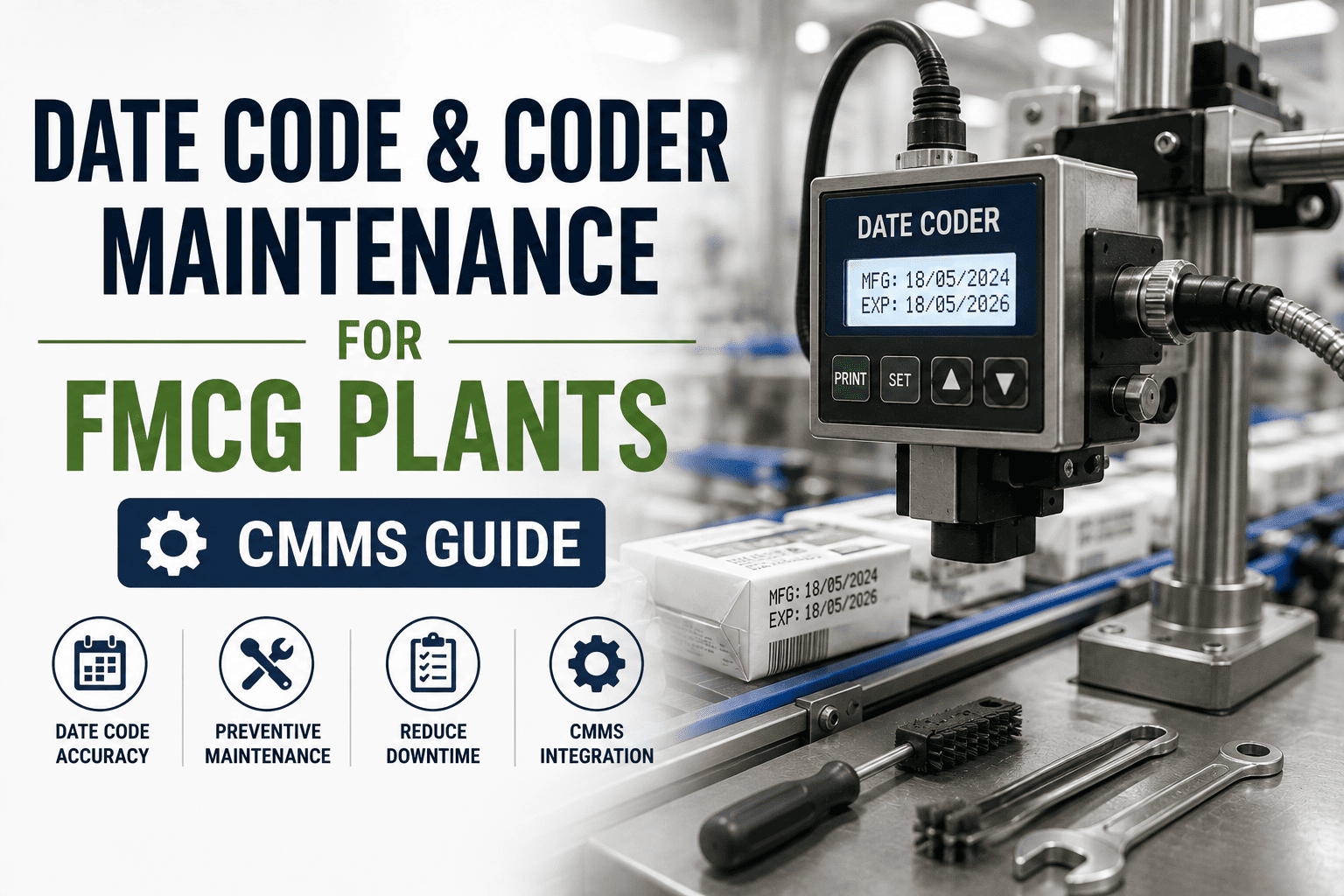
Date code accuracy sits at the intersection of regulatory compliance, traceability, and retailer conformance — a single illegible lot code can trigger a full product recall, retailer chargebacks exceeding $5,000 per SKU, and permanent shelf-space penalties. For FMCG plants running continuous inkjet, thermal transfer, and laser coders across multiple lines, the difference between 99.5% and 97% first-pass code readability is often the difference between a clean audit and a crisis. A CMMS-driven coder maintenance program standardizes printhead service intervals, automates calibration checks, and captures blank-code detection events into a defensible audit trail. Start your Start Free Trial to operationalize coder reliability across every line.
Can your plant prove every code was legible at line speed?
A 180-asset FMCG plant running 12 coders across four lines typically logs 8–14 blank or partial code incidents per month — each one a recall liability if it reaches a retailer. CMMS-driven coder maintenance closes the gap between printhead PM, calibration, and audit-ready documentation.
One smudged code can cost more than a year of coder PM
Retailer compliance programs (Walmart, Kroger, Target) treat unreadable date/lot codes as critical defects — the financial exposure compounds fast.
A regional snack producer running 9 CIJ coders across three lines was logging 11 blank-code events monthly — averaging $4,800 in chargebacks and 6 hours of rework labor. After implementing a CMMS-driven PM schedule (weekly printhead flush, biweekly viscosity check, monthly calibration verification), blank-code incidents dropped to under 2 per month and coder-related downtime fell 68% within one quarter. The CMMS subscription paid for itself in week seven.
Preventive maintenance tasks for CIJ, TTO, and laser coders
Each coder technology fails differently — PM frequency and task depth must match the print mechanism, ink chemistry, and line speed.
Continuous Inkjet (CIJ)
- Printhead flush and nozzle inspection — every 168 run-hours
- Ink viscosity check and make-up fluid top-off — weekly
- Charge electrode cleaning and gutter flush — biweekly
- Filter replacement (main + bypass) — every 2,000 hours
- Pump pressure calibration and phase-sensor test — monthly
- Ink expiry audit and expired-consumable purge — quarterly
Thermal Transfer (TTO)
- Printhead cleaning with isopropyl wipe — every shift change
- Ribbon path alignment and tension check — daily
- Platen roller inspection for residue buildup — weekly
- Printhead element resistance test — every 500 hours
- Ribbon spool drive belt inspection — monthly
- Darkness/temperature calibration against substrate — quarterly
Laser Coders
- Beam alignment verification with target test — weekly
- Protective lens cleaning and inspection — every 200 hours
- Fume extraction filter pressure drop check — biweekly
- Galvanometer calibration and mirror inspection — quarterly
- Laser tube power output test against baseline — semi-annual
- Safety interlock and enclosure seal audit — annual
| Coder Type | PM Interval | Critical Consumable | Replace Interval | Avg. Parts Cost / Yr |
|---|---|---|---|---|
| Continuous Inkjet (CIJ) | Weekly | Ink + make-up fluid kit | 2,000 hrs | $1,800 – $3,400 |
| Thermal Transfer (TTO) | Per shift | Ribbon + printhead | 500 hrs (head) | $2,100 – $4,600 |
| Laser (CO₂ / Fiber) | Weekly | Lens + extraction filter | 2,000 hrs (lens) | $900 – $2,200 |
| Drop-on-Demand (DOD) | Biweekly | Printhead + solvent | 1,500 hrs | $1,200 – $2,800 |
A CMMS-driven maintenance cadence across the year
Coder reliability is not a one-time project — it is a paced program of daily checks, scheduled PM, calibration events, and quarterly audits.
Baseline & Asset Registry
Register every coder in CMMS with make, model, firmware, line assignment, and substrate profile. Capture current first-pass readability rate and blank-code incident baseline (target: establish the audit-defensible starting point).
PM Schedule Activation
Deploy technology-specific PM templates (CIJ flush, TTO head clean, laser lens) as auto-generated work orders. Trigger spare-parts reorder points at 30% inventory threshold. Expect a 40–55% drop in unplanned coder downtime within 8 weeks.
Calibration & Verification Loop
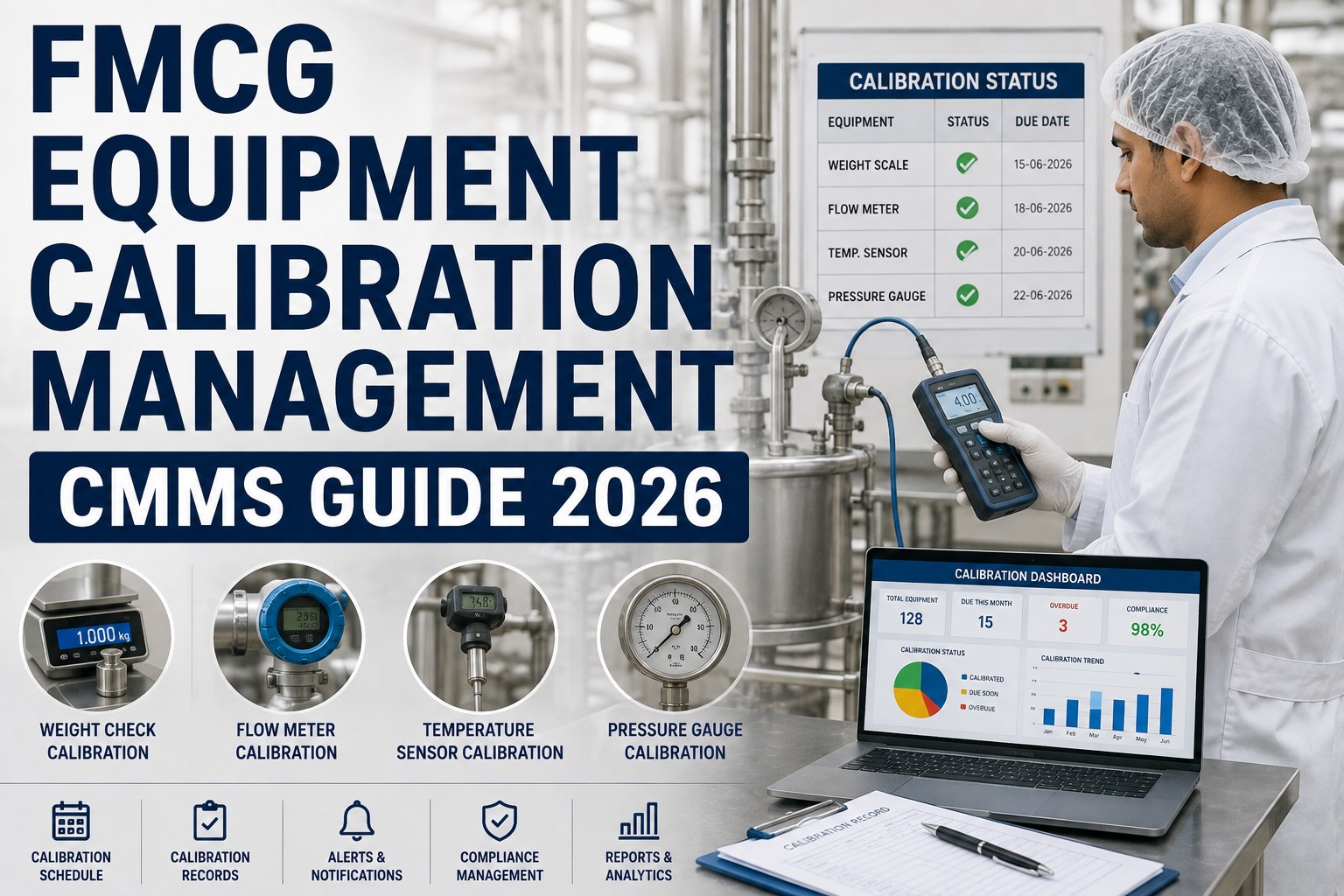
Monthly calibration verification against a certified test substrate. Vision-system integration feeds blank/partial code events back into CMMS as corrective work orders. Calibration drift beyond ±0.3mm triggers automatic recalibration task.
Reliability Analytics
MTBF and MTTR reporting per coder asset. Identify repeat-failure units for refurbishment or replacement. Coder OEE contribution calculated; typical lift from baseline is 6–11 percentage points on lines where coder was the bottleneck.
Audit Readiness & Optimization
Full PM history, calibration logs, and corrective-action records exportable as an audit packet. Quarterly compliance review against GS1 and retailer code standards. Coder reliability program certified audit-defensible for internal and external audits.
The payback math for a CMMS-driven coder program
For a mid-size FMCG plant running 10–15 coders, the financial case is rarely close — the program pays for itself in a single quarter.
Blank + partial code incidents per month × avg. chargeback cost
Unplanned coder downtime hours/yr × line downtime cost per hour
CMMS subscription + implementation and training for a 12-coder plant
| Cost / Savings Category | Before CMMS | After CMMS (Yr 1) | Annual Impact |
|---|---|---|---|
| Code-related chargebacks | $52,800 | $9,600 | −$43,200 |
| Unplanned coder downtime | $134,400 | $43,200 | −$91,200 |
| Rework labor (partial codes) | $18,600 | $4,100 | −$14,500 |
| Spare-parts inventory holding | $14,200 | $7,800 | −$6,400 |
| CMMS + implementation cost | $0 | $10,500 | +$10,500 |
| Net Annual Savings | — | — | $144,800 |
Turn coder maintenance from a recall risk into an audit asset
Deploy structured PM schedules, calibration tracking, and blank-code detection workflows across every coder — in days, not months.
Coder maintenance and CMMS — what plant teams ask
How often should CIJ printheads be serviced in a high-speed FMCG environment?
For lines running 16+ hours per day on water-based or MEK inks, a full printhead flush and nozzle inspection every 168 run-hours (roughly weekly) is the defensible standard. Plants pushing past 250 run-hours between cleanings typically see a 3–5× increase in partial-code incidents. A CMMS auto-generates the work order based on actual run-hour meter reads, not calendar guesses — you can configure this in minutes when you Start Free Trial.
What is the target first-pass code readability rate for retailer compliance?
Major retailer compliance programs (Walmart, Kroger, Target, Costco) effectively require 99.5% or higher first-pass readability on date and lot codes. Below 98%, chargebacks and corrective-action notices become routine. Vision-system verification tied to CMMS corrective work orders is the most reliable way to sustain 99.5%+ at line speed.
Can a CMMS integrate with vision systems for blank-code detection?
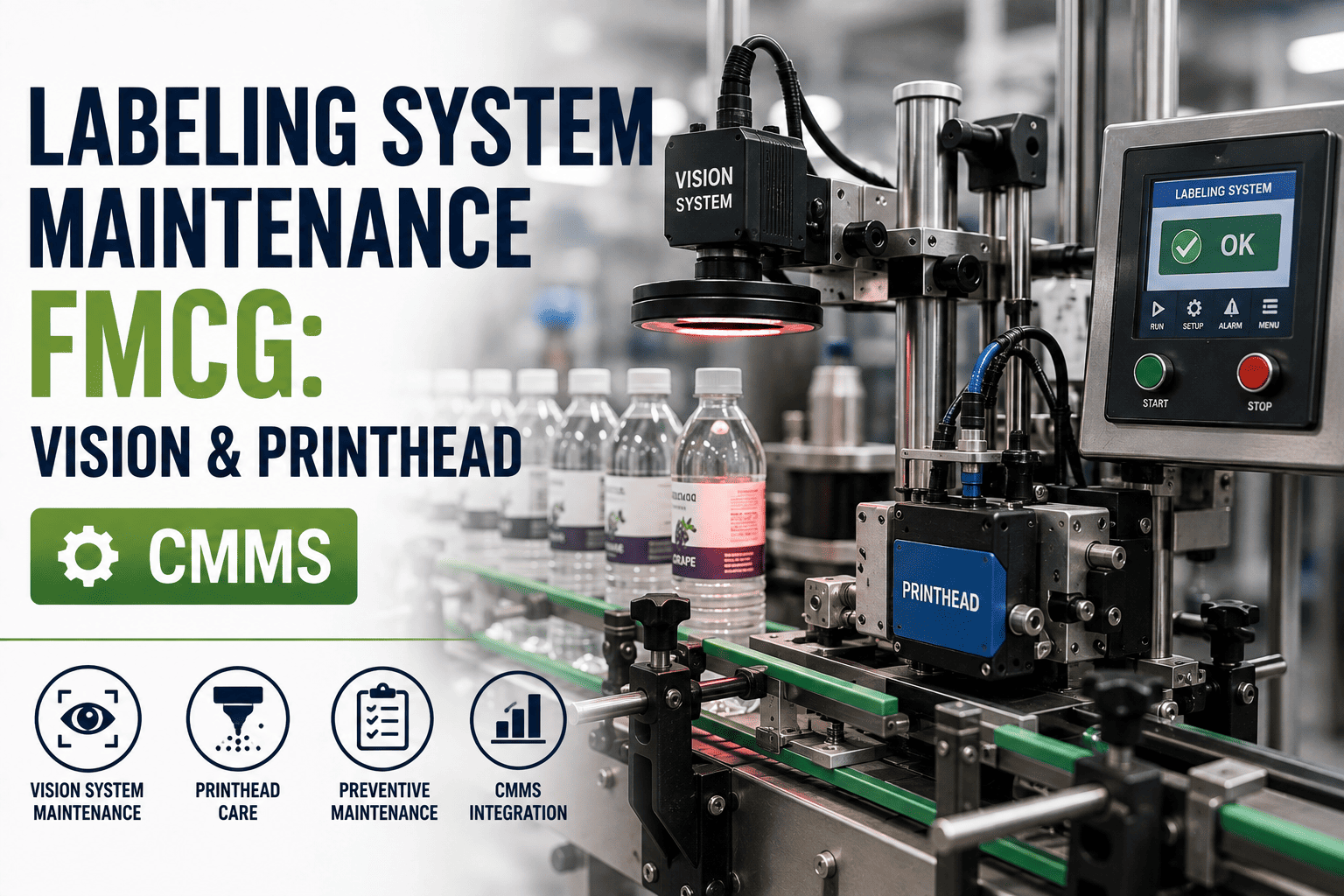
Yes — most modern vision systems (Cognex, Keyence, SICK) can push fail events via OPC-UA, MQTT, or REST API into a CMMS. Each blank or partial code event auto-generates a corrective work order tagged to the specific coder asset, line, and shift. This creates the audit trail that proves you detected and corrected the issue, which is critical during a recall investigation.
What calibration interval should laser coders follow?
Beam alignment verification weekly, galvanometer calibration quarterly, and full laser tube power output testing semi-annually is the baseline for CO₂ and fiber coders in FMCG. Substrate or line-speed changes should trigger an immediate recalibration. Calibration drift beyond ±0.3mm on character height is the threshold that should trigger corrective action.
How long does it take to implement a CMMS-driven coder maintenance program?
A plant with 10–15 coders can be fully live in 2–3 weeks: asset registration in week one, PM template deployment in week two, and calibration/vision integration in week three. Most plants see measurable downtime reduction within 6–8 weeks. To see the implementation plan mapped to your specific coder fleet, Book a Demo with our team.
Every illegible code is a recall waiting to happen — fix it this quarter
Deploy CMMS-driven coder maintenance, calibration tracking, and audit-ready documentation across your entire FMCG plant in under 30 days.
Free 14-day trial · No credit card