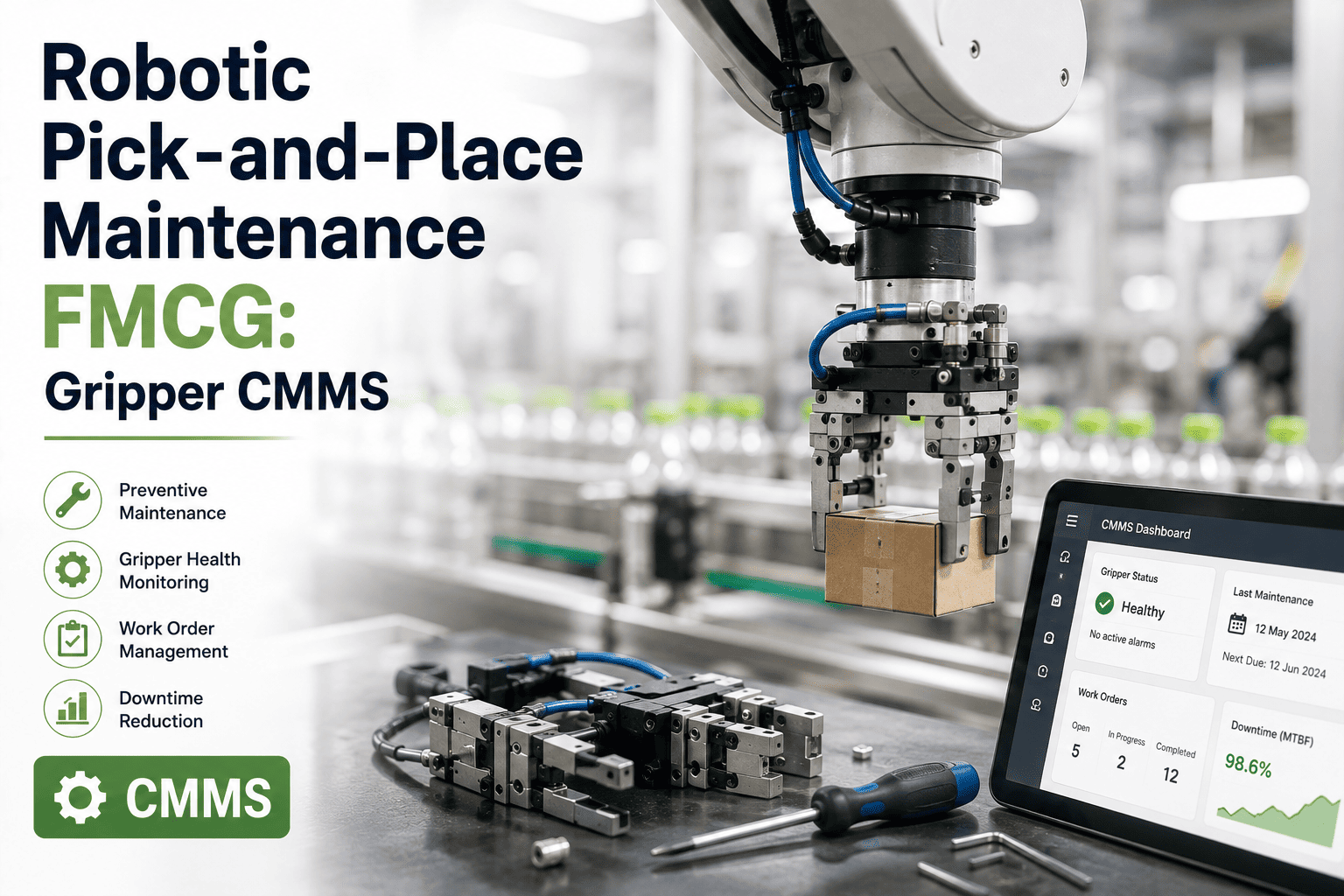
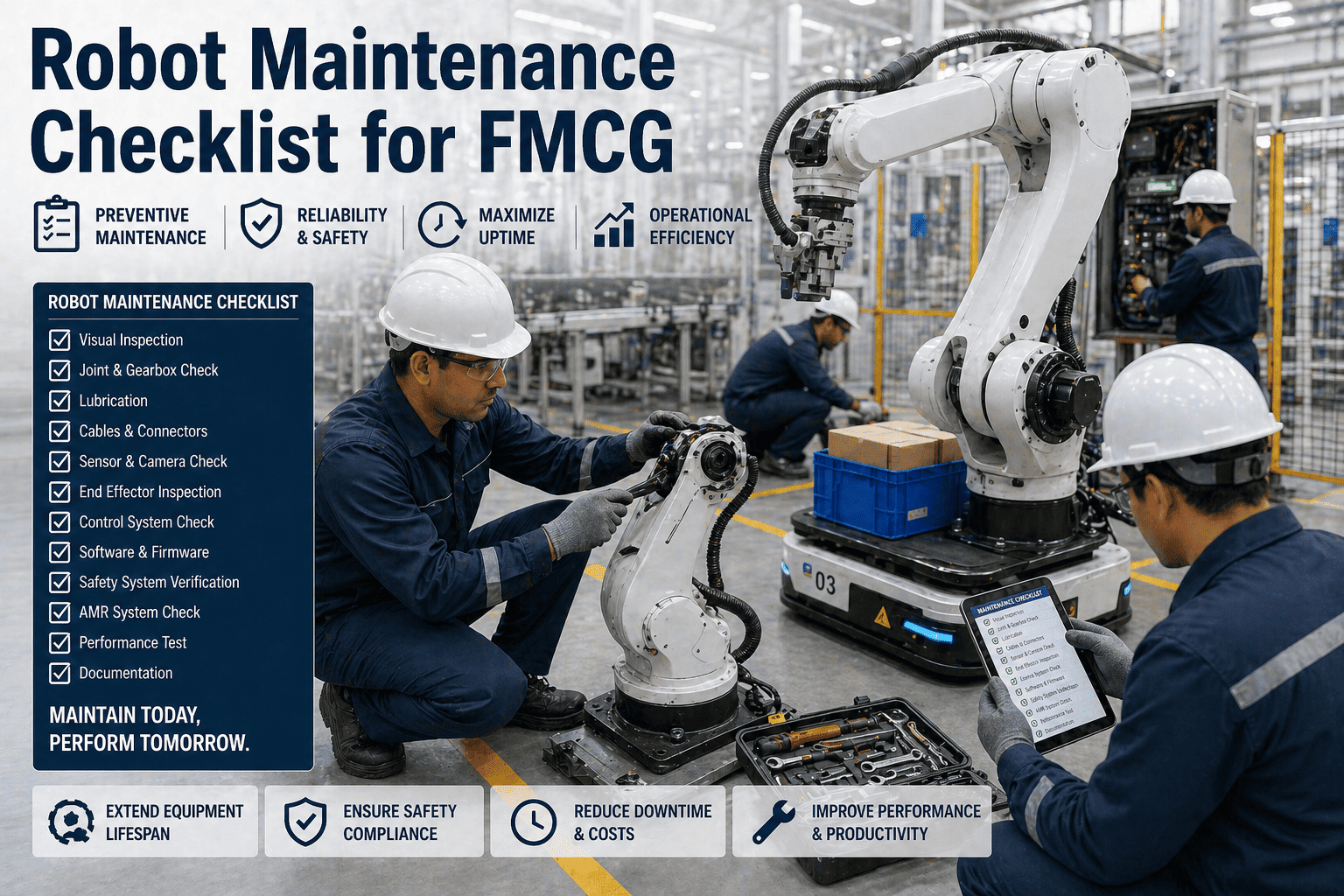
In Q3 of 2024, a leading North American snack manufacturer discovered that a vision-guided pick-and-place robot on their primary packaging line had drifted 0.4mm outside its calibration tolerance—undetected—for eleven days. The robot passed packages that were slightly under-filled, slightly misaligned, and slightly out of spec. "Slightly" became 2.1 million compromised units before a downstream customer audit caught it. The recall, customer concessions, and FDA-adjacent corrective actions exceeded $340,000. The root cause wasn't the robot. It was a missed calibration interval on a spreadsheet that nobody owned. In FMCG manufacturing, where margins are thin and throughput is everything, quality control robots are only as reliable as the calibration programs behind them. When calibration is managed through tribal knowledge, static schedules, or disconnected tools, it's not a question of if drift will cause a failure—it's when. A systematic, digitally-managed calibration framework transforms robotic QC from a latent liability into a measurable operational advantage. Oxmaint's calibration management platform provides the infrastructure for this discipline: automated scheduling, certificate-of-conformance tracking, As-Found/As-Left trending, and audit-ready reporting — so your QC robots deliver consistent, defensible precision rather than a compliance gap waiting to surface.
The Calibration Lifecycle: From Instrument Inventory to Continuous Optimization
Managing robotic QC calibration effectively requires a structured process that covers every stage of the instrument's lifecycle. Under ISO 9001:2015 Section 7.1.5 and 21 CFR Part 211 (for regulated consumables), manufacturers must demonstrate that monitoring and measuring resources are "fit for purpose" and traceable to national standards. An audit finding of "no documented calibration schedule" doesn't just close the line—it questions the validity of every batch produced since the last confirmed calibration. Oxmaint automates and tracks each phase:
Asset & Instrument Inventory
Procedure Digitization & Scheduling
Calibration Execution & Data Capture
Out-of-Tolerance Response & Corrective Action
Drift Analysis, Interval Optimization & Reporting
Calibration Risk Matrix: What to Track, When to Act
Every QC robot and precision instrument carries calibration risk. The key is quantifying it, monitoring it, and having clear thresholds for action. Oxmaint tracks these risk categories for every calibration-critical asset in your FMCG production environment:
One Missed Calibration Cost a Snack Manufacturer $340,000. What's Your Exposure?
Oxmaint automates robotic QC calibration scheduling, certificate tracking, drift analysis, and audit reporting — so your quality control robots deliver defensible precision rather than a compliance gap waiting to surface.
Calibration Performance Scorecard
Every calibration-critical asset in Oxmaint generates a continuous performance scorecard that determines maintenance priority, interval adjustments, and capital replacement timing. For a mid-sized FMCG operation running 3–5 packaging lines, this data consistently recovers 15% or more of the annual QC maintenance budget while simultaneously increasing OEE by 2–4 percentage points:
Instrument Calibration Health Scorecard
Auto-generated from calibration work order dataCommon Calibration Mistakes That Cost FMCG Manufacturers
These are the patterns Oxmaint helps you eliminate — each one is a real-world failure mode that generates losses far exceeding the cost of proper calibration management:
Treating Calibration as Maintenance
Calibration is metrology, not mechanics. A robot can be mechanically healthy but metrologically inaccurate — a pick-and-place arm may operate smoothly (PM is current) but its Tool Center Point may have shifted 0.5mm due to thermal cycling. Calibration and preventive maintenance are separate disciplines requiring separate schedules, separate procedures, and separate tracking. Merging them guarantees one gets neglected.
Fixed Intervals for All Instruments
Calibrating every instrument on the same 90-day cycle regardless of drift history wastes 30% of your calibration labor on instruments that hold tolerance for 180+ days, while leaving 15% of drift-prone instruments under-calibrated. Data-driven interval optimization — extending intervals on stable instruments, shortening them on drifters — recaptures that wasted labor and closes the coverage gaps simultaneously.
No As-Found / As-Left Documentation
Recording only "calibrated — pass" tells you nothing about drift behavior. Without As-Found readings, you can't trend accuracy over time, identify instruments approaching tolerance limits, or justify interval adjustments to auditors. Without As-Left readings, you can't confirm the instrument was actually returned to specification. Both readings are ISO 9001 requirements and the foundation of every defensible calibration program.
Third-Party Certificates in Email Inboxes
Outsourcing calibration to an accredited lab doesn't outsource the compliance obligation. When a third-party certificate lives in someone's email or a desk drawer instead of the asset record, it's invisible to the system, invisible to auditors, and useless for trending. Every certificate — internal or external — must be uploaded to the instrument's digital asset record within 24 hours of calibration completion.
No Batch Impact Analysis for Out-of-Tolerance Events
When an instrument is found out of tolerance, the immediate question is: what product did it inspect/measure since the last confirmed PASS calibration? Without a system that links calibration records to production batches, answering this question requires days of manual cross-referencing — time you don't have when a customer or auditor is waiting. Oxmaint auto-flags affected batches the moment an out-of-tolerance As-Found reading is recorded.
The Calibration Decision Tree: How Proactive Management Prevents a $340k Failure
This economic impact framework maps the decision points in every calibration event and the financial consequences at each branch. Use it to communicate the value of digital calibration management to leadership, or provide it to your design team as the specification for an internal visual:
2. Flag batches since last PASS calibration
3. Notify Quality Manager for disposition
2. Customer complaint / shipment rejection
3. Voluntary recall + concession credits
4. ISO 9001 Major Nonconformance
Expert Perspective: Precision as a Competitive Advantage
"In FMCG, we used to treat calibration as a necessary evil—something you did because ISO said so. The shift happened when we started analyzing our As-Found data and realized that 30% of our instruments were being calibrated too frequently while 15% weren't being calibrated often enough. Digital tracking didn't just make us compliant; it made us smarter. We reduced our total calibration labor by 20% while simultaneously eliminating every out-of-tolerance escape. The data changed the conversation from 'are we compliant?' to 'are we optimized?'"
— Director of Quality Assurance, National Beverage Manufacturer
Data-Driven Intervals
Historical As-Found/As-Left records reveal which instruments drift and which hold. Extending intervals on stable equipment frees technician hours for assets that genuinely need attention — recapturing 15% or more of your annual calibration budget without increasing risk.
Institutional Resilience
When your senior metrologist retires or your third-party calibration provider changes, the program doesn't skip a beat. Every procedure, every certificate, and every tolerance spec lives in the system — tied to the asset, not the person who last touched it.
OEE Protection
Every unplanned line stop for emergency recalibration costs 2–4% of daily OEE. Scheduled calibrations during planned downtime windows convert a crisis into a routine task — protecting throughput while maintaining measurement integrity.
Manufacturers who master robotic QC calibration don't just avoid recalls — they operate with higher OEE, lower scrap rates, and the confidence to push throughput knowing that their quality gates are rock-solid. If your calibration program still relies on spreadsheets and good intentions, our team can help you build a framework that scales with your production demands. Request a personalized calibration audit for your facility.
Your Calibration Program Deserves Better Than a Spreadsheet
Join leading FMCG manufacturers using Oxmaint to schedule robotic QC calibrations, store certificates of conformance, track drift trends, and maintain continuous ISO 9001 audit readiness — all from one unified platform. Request a 15-minute operational walkthrough tailored to your production environment.
Frequently Asked Questions
What is the difference between calibration and preventive maintenance for QC robots?
Preventive maintenance addresses the mechanical and electrical health of a robot — lubrication, belt tension, motor inspection, and wear part replacement. Calibration is a metrological process: it verifies and adjusts the accuracy of the robot's measurement or inspection capability against a known reference standard. A robot can be mechanically healthy but metrologically inaccurate. For example, a pick-and-place arm may operate smoothly (PM is current) but its Tool Center Point may have shifted 0.5mm due to a minor collision (calibration is overdue). A CMMS manages both as separate but linked workflows — PM work orders and calibration work orders run on independent schedules, but both are attached to the same asset record for full lifecycle visibility.
How does CMMS software help with ISO 9001 Section 7.1.5 compliance?
ISO 9001:2015 Section 7.1.5 requires that monitoring and measuring equipment be calibrated at specified intervals, traceable to international standards, and protected from adjustments that would invalidate calibration status. A CMMS directly addresses all three requirements. It schedules calibrations at the intervals you define (calendar, cycle, or condition-based), stores certificates of conformance with traceability to NIST or equivalent national standards, and maintains a tamper-evident digital audit trail showing who performed the calibration, what the As-Found and As-Left readings were, and when the next calibration is due. During an ISO audit, this data is retrievable in seconds rather than hours.
Can we track third-party calibration vendor activities in the same system?
Yes, and doing so is a best practice under both ISO 9001 and SQF. Many FMCG facilities outsource calibration of precision instruments — certified test weights, reference thermometers, laser measurement devices — to accredited third-party labs. Oxmaint allows you to assign calibration work orders to external vendors, require them to upload certificates of conformance directly into the system, and automatically flag any instruments returned as "out of tolerance" for corrective action. This creates a single source of truth where internal and external calibrations share the same audit trail, same escalation logic, and same reporting framework — eliminating the gaps that occur when vendor certificates sit in email inboxes.
What is As-Found / As-Left data and why does it matter for FMCG quality?
As-Found data is the reading taken from an instrument before any calibration adjustment — it shows the current state of accuracy. As-Left data is the reading after calibration — confirming the instrument is now within specification. The difference between As-Found and the acceptable tolerance tells you how much the instrument drifted since its last calibration. Over multiple cycles, this drift data creates a trend line that is invaluable: if a vision system's As-Found readings consistently fall within tolerance after 90 days, you can safely extend the interval to 120 days — reducing downtime and labor. Conversely, if a checkweigher drifts out before its 30-day interval, you need to shorten the cycle or investigate root cause. Oxmaint automates this trending and alerts you to instruments approaching tolerance limits.
How does robotic calibration tracking improve OEE in consumer goods manufacturing?
OEE (Overall Equipment Effectiveness) is the product of Availability, Performance, and Quality. Calibration drift impacts all three. When a QC robot goes out of tolerance unexpectedly, the line stops for emergency recalibration — reducing Availability. When a vision system runs at reduced sensitivity to compensate for suspected drift, throughput is throttled — reducing Performance. When out-of-spec product passes inspection due to uncalibrated equipment, scrap and rework increase — reducing Quality. Proactive calibration management eliminates the "surprise" factor by scheduling calibrations during planned downtime and using drift trending to predict when an instrument will need service. FMCG facilities that implement systematic calibration tracking consistently report 2–4 percentage points of OEE improvement within the first year.