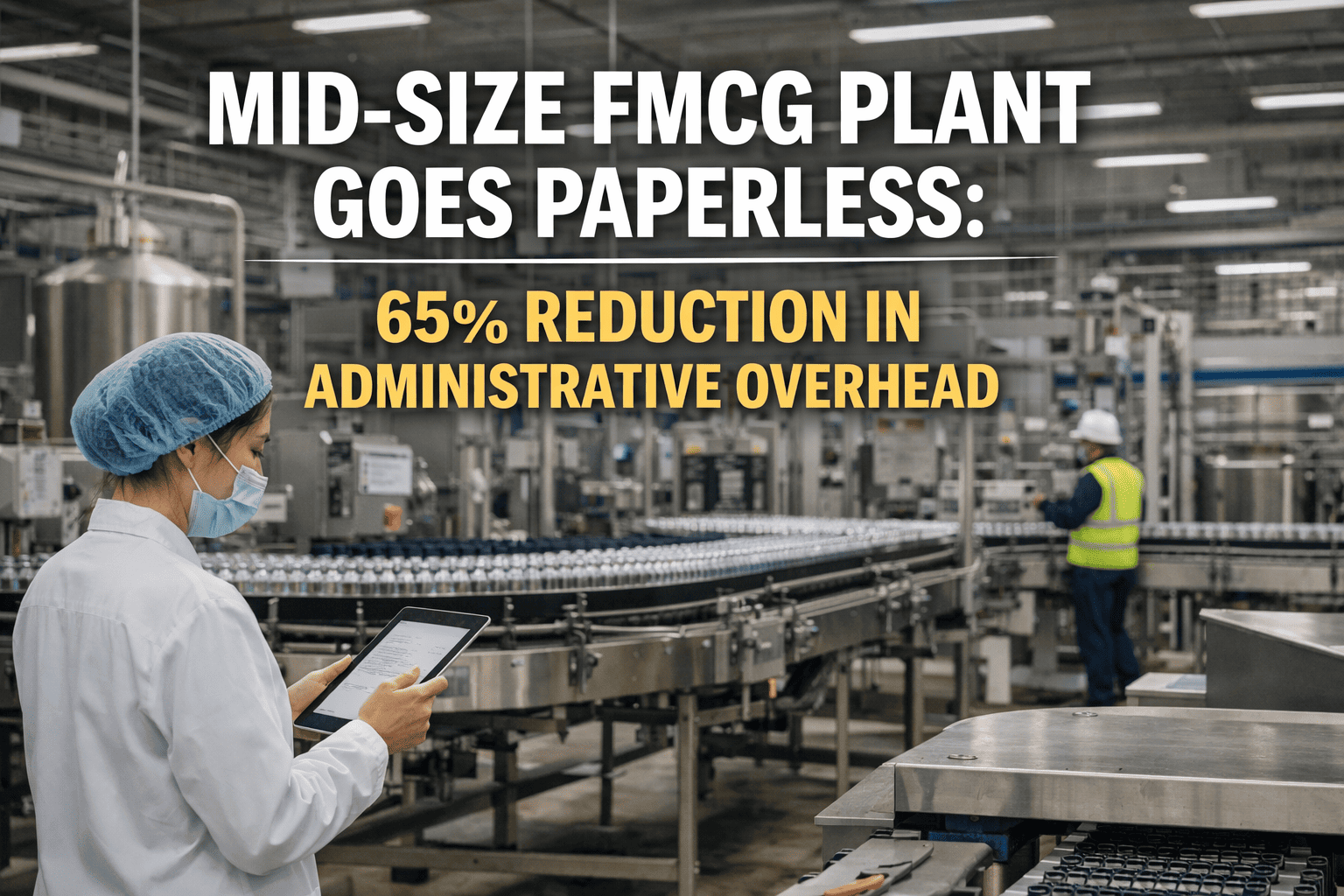
Somewhere in your plant right now, a technician is writing a work order on a clipboard that will be transcribed into a spreadsheet tomorrow, reviewed by a supervisor next week, and filed in a binder that no one will open again until an auditor asks for it. That single work order touches 4 people, 3 systems, and takes 22 minutes of total handling time — compared to 90 seconds on a mobile CMMS. Multiply that by 40–80 work orders per day across a 5-line FMCG plant, and paper-based maintenance consumes 12,000–18,000 hours of non-productive labor annually — the equivalent of 6–9 full-time employees doing nothing but shuffling paper. Digital transformation in FMCG is not about buying expensive technology. It is about eliminating the 60–70% of maintenance administration time that paper creates, redirecting that time to actual equipment care, and building the data foundation that makes AI-powered optimization possible. Plants that complete this journey recover $400K–$1.5M annually while cutting audit prep time by 90% and improving PM compliance from 70% to 95%+. Start your free trial to go paperless this week. Book a demo to see OxMaint's Mobile CMMS replacing paper in FMCG plants.
Mobile CMMS & Paperless Operations
Replace Every Clipboard, Binder, and Whiteboard — This Week
OxMaint replaces paper work orders, PM logs, downtime sheets, and parts requisitions with a mobile app that technicians learn in under 5 minutes — creating automatic audit trails, real-time KPIs, and the data foundation for AI.
22 min
paper work order handling time — vs 90 seconds on mobile CMMS
6–9 FTEs
worth of labor consumed annually by paper maintenance administration
$400K–$1.5M
annual savings from completing the paper-to-AI transformation
The Paper Tax: What Manual Processes Actually Cost
Most FMCG maintenance leaders underestimate the true cost of paper because they see each individual task as trivial — filling out a form takes 3 minutes, filing it takes 1 minute, finding it later takes 5 minutes. But when you multiply these micro-costs across every work order, every PM task, every parts requisition, every downtime event, and every audit request, the annual total is staggering.
Writing & transcribing work orders
4,800 hrs/yr
Filing, searching, retrieving records
2,900 hrs/yr
PM scheduling & tracking on spreadsheets
2,200 hrs/yr
Audit preparation & record compilation
1,400 hrs/yr
Parts requisitions & manual inventory counts
1,200 hrs/yr
KPI calculation & reporting
700 hrs/yr
Total Paper Tax
13,200 hrs/yr
= 6.3 FTE doing nothing but paper administration
These 13,200 hours are not performed by dedicated administrative staff — they are stolen from technicians, supervisors, and planners whose primary job is keeping equipment running. Every minute a technician spends writing on a clipboard is a minute they are not inspecting, repairing, or improving equipment. The paper tax does not appear on any budget line — it hides inside labor cost as "normal" overhead that has never been questioned because it has always been there.
The Five Stages of FMCG Digital Transformation
The journey from paper to AI is not a single project — it is a maturity progression where each stage delivers standalone ROI while building the foundation for the next. Plants that try to skip stages (jumping from paper directly to AI) fail because the data infrastructure does not exist yet.
Clipboards, binders, whiteboards, tribal knowledge. No data capture. Reactive maintenance. Audit prep takes weeks.
Where 45% of FMCG plants are today
Mobile CMMS replaces paper. Work orders, PM schedules, and parts data captured digitally. Basic reporting available. Audit trail automatic.
$200K–$400K/yr value — 3–6 month payback
KPI dashboards drive weekly decisions. Pareto analysis targets bad actors. PM programs optimized from failure data. Root cause analysis becomes systematic.
$400K–$800K/yr value — cumulative
IoT sensors on critical assets. AI failure predictions with 7–14 day warning. Automated work order generation. Quality-to-maintenance closed loop.
$800K–$1.5M/yr value — cumulative
AI adjusts maintenance schedules dynamically. Digital twins simulate scenarios. Supply chain integration. Continuous improvement is automated, not manual.
$1.5M–$3M/yr value — the destination
The critical insight: Stage 2 (Digitized) delivers 40–50% of the total journey value because eliminating paper simultaneously improves PM compliance, creates audit trails, enables KPI tracking, and builds the data foundation for everything that follows. Plants that execute Stage 2 well can reach Stage 3 within 3–4 months because the data they need already exists in the CMMS.
Paper vs. Digital: Side-by-Side on Every Workflow
The transformation is not abstract — it changes the daily experience of every person who touches maintenance. Here is what each core workflow looks like before and after digitization.
Create a work order
Write on clipboard, hand to supervisor, transcribe to spreadsheet
Tap on mobile, auto-routes to planner
18 min
Complete a PM task
Check paper schedule, do task, fill out form, file in binder
Receive mobile alert, follow checklist, tap complete
12 min
Request a spare part
Write requisition, walk to storeroom, wait for approval, manual log
Scan barcode, auto-deduct from inventory, reorder triggered
15 min
Log downtime event
Note on shift report (end of shift), cause code vague or missing
Real-time mobile entry, dropdown cause codes, photo
8 min
Find maintenance history
Search binders, cross-reference dates, hope records exist
Search asset ID, full history in 5 seconds
25 min
Prepare for audit
40+ hours pulling binders, reconstructing records, chasing signatures
Export reports, 2–4 hours total
36+ hrs
The workflow comparison reveals why technicians adopt digital faster than managers expect. Paper is not just slower — it is frustrating. Technicians know their paperwork disappears into binders no one reads. They know the PM schedule on the whiteboard is 2 weeks out of date. They know the parts requisition form takes 3 days to process. When mobile CMMS replaces these workflows, adoption is driven by technician relief, not management mandate.
5-Minute Adoption
Your Technicians Will Thank You — Not Resist You
OxMaint's mobile interface is designed for technicians who have never used a CMMS. Tap-based checklists, barcode scanning, photo capture, and voice-to-text notes. Average time to full adoption: 5 days.
The ROI at Each Stage
Each stage of digital transformation delivers measurable returns. You do not need to reach Stage 5 to justify the investment — Stage 2 alone pays for itself within 3–6 months.
Stage 2: Digitized
Paper elimination$120K
PM compliance improvement$95K
Audit prep reduction$45K
$260K/yr
+
Stage 3: Data-Driven
Targeted downtime reduction$280K
Optimized PM programs$145K
Parts inventory optimization$85K
$510K/yr
+
Stage 4: Predictive
Predictive failure prevention$340K
Energy optimization$62K
Equipment life extension$180K
$582K/yr
Cumulative Value by Stage 4: $1.35M/yr on a 5-Line FMCG Plant
Common Objections — and the Data That Defeats Them
Every digital transformation encounters resistance. Here are the five objections FMCG maintenance leaders hear most frequently — and the proven counter-arguments from plants that have completed the journey.
X
"Our technicians are too old to use technology"
OK
Average technician age at plants using OxMaint: 47. Adoption time: 3–5 days. The mobile interface is simpler than the smartphone they already carry. Older technicians often adopt faster because they hate paperwork more.
X
"We tried a CMMS before and it failed"
OK
90% of failed CMMS implementations fail from overcomplication, not technology. Start with work orders and PM only — nothing else. Add modules as the team gains confidence. Simplicity drives adoption.
X
"The cost is hard to justify for our plant size"
OK
A single prevented emergency failure ($18K+) pays for a full year of CMMS software. Most plants see positive ROI within 60 days from PM compliance improvement alone — before any predictive capabilities are deployed.
X
"We do not have time to implement a system"
OK
Cloud CMMS deployment takes 1–2 weeks, not months. Import your asset list (spreadsheet upload), create 5–10 PM templates, train the team (2 hours), go live. You spend more time preparing for one audit than implementing the system that eliminates audit prep.
The 30-Day Digital Launch Plan
Day 1–3
Import Assets & Users
Upload your asset list (equipment name, location, criticality) from a spreadsheet. Add technicians, supervisors, and planners as users. Configure basic work order categories and cause codes. Total setup: 4–6 hours.
Day 4–7
Build Your Top 10 PM Templates
Digitize the 10 most critical PM tasks — the ones you do weekly or monthly on your highest-value assets. Include step-by-step checklists, required parts, and expected duration. These 10 templates cover 60–70% of PM activity.
Day 8–14
Train & Go Live
2-hour hands-on training session per shift. Focus on: creating work orders, completing PM checklists, logging downtime, and requesting parts. Run parallel with paper for 3 days to build confidence. Go fully digital by day 14.
Day 15–30
First KPI Dashboard & Quick Wins
Pull your first real KPI report: PM compliance %, work order backlog, and downtime by asset. Share with plant leadership. Identify the #1 downtime-producing asset and assign focused RCA. First measurable improvement within 30 days.
Frequently Asked Questions
Mobile CMMS & Paperless Operations
Day 1: Import Assets. Day 14: Go Live. Day 30: First KPI Report.
90 sec
work order time (was 22 min)
$400K+
annual savings from Stage 2 alone
30 Days
to fully paperless
Trusted by FMCG maintenance teams going paperless worldwide. No credit card required.