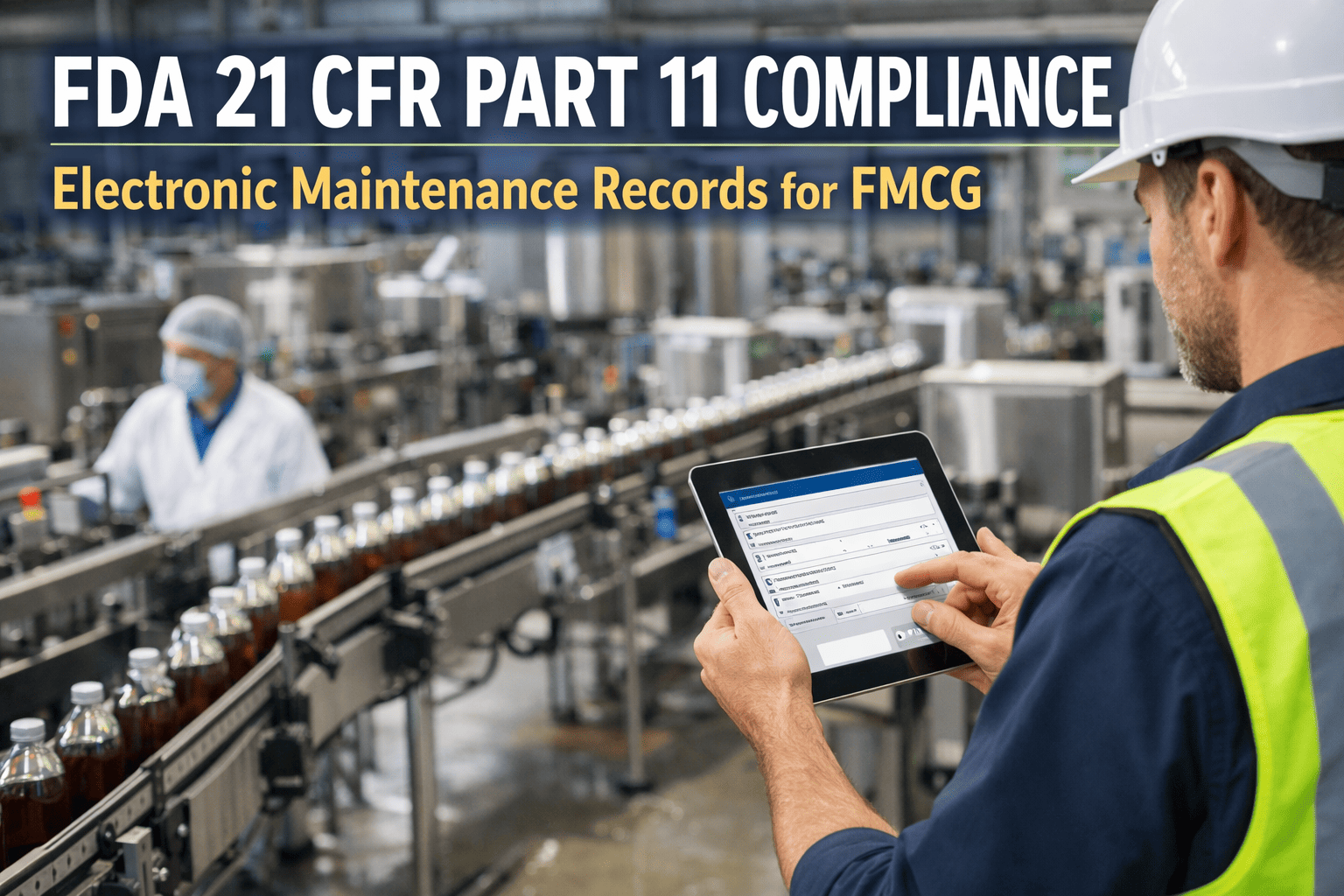
FDA 21 CFR Part 11 establishes the criteria under which electronic records and electronic signatures are considered trustworthy, reliable, and equivalent to paper records — and for FMCG manufacturers subject to FDA regulation, every electronic maintenance record, digital work order signature, calibration log, and CAPA document must meet these requirements or face regulatory enforcement action. The regulation is not optional for facilities that use electronic systems to satisfy FDA record-keeping requirements: if your CMMS generates the maintenance records that demonstrate GMP compliance, those records must comply with Part 11. Yet industry assessments consistently find that 40–60% of food and pharmaceutical manufacturers have significant gaps in Part 11 compliance — primarily in audit trail completeness, electronic signature implementation, and system validation documentation. The consequences of non-compliance range from FDA Warning Letters and Form 483 observations to product hold orders and consent decrees that can shut down production entirely. Start a free trial to see how Oxmaint delivers Part 11 compliant electronic maintenance records, or book a demo to review audit trail and e-signature capabilities in detail.
Your Electronic Maintenance Records Must Meet Part 11 — Oxmaint Makes Them Compliant by Design
Oxmaint provides audit trails, electronic signatures, access controls, and system validation documentation that satisfy 21 CFR Part 11 requirements — built into every work order, calibration record, and CAPA document your CMMS generates.
The Four Pillars of 21 CFR Part 11 Compliance
Part 11 compliance rests on four interconnected requirements that every electronic record system must satisfy. Most CMMS platforms claim "Part 11 compliance" but fail on one or more pillars when FDA inspectors examine the actual implementation. Understanding what each pillar specifically requires — and how your CMMS must implement it — is essential for avoiding the Form 483 observations that are increasingly common during FDA facility inspections. Book a demo to see how Oxmaint implements all four pillars.
Audit Trails
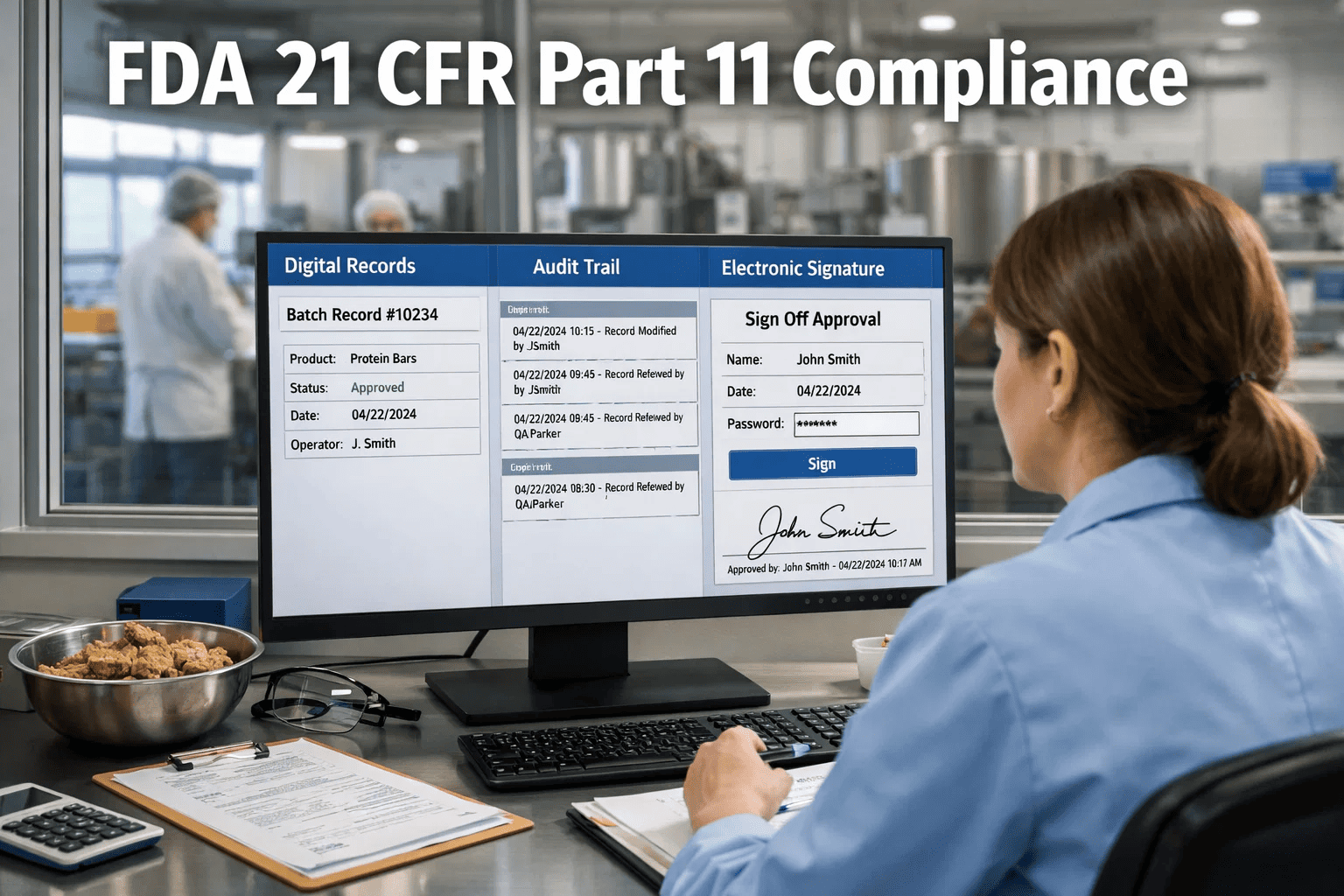
Every create, modify, and delete action on electronic records must generate a secure, computer-generated, time-stamped audit trail entry that cannot be manually altered. The audit trail must record who made the change, when they made it, and what the previous value was. Oxmaint generates immutable audit trails for every field change, work order update, and record modification — with the original data preserved alongside every revision.
Electronic Signatures
Electronic signatures must be unique to an individual, legally binding, and permanently linked to the signed record. Each signature must include the signer's printed name, date/time of execution, and the meaning of the signature (approval, review, verification). Oxmaint implements authenticated e-signatures with biometric or dual-factor verification tied to individual user credentials that cannot be shared or reassigned.
Access Controls
System access must be restricted to authorized individuals with unique user IDs, role-based permissions, and secure authentication. Password policies must include periodic expiration, complexity requirements, and account lockout after failed attempts. Oxmaint enforces role-based access (admin, maintenance manager, technician, auditor) with configurable permission levels and automatic session timeout for inactive users.
System Validation
Systems must be validated to ensure accuracy, reliability, and consistent intended performance. Validation documentation must demonstrate that the system performs correctly under real-world operating conditions. Oxmaint provides IQ/OQ/PQ validation protocols, validation summary reports, and ongoing change control documentation that satisfy FDA validation expectations for CMMS platforms.
Which FMCG Maintenance Records Require Part 11 Compliance?
Not every record in your CMMS requires Part 11 compliance — only records that are used to satisfy FDA regulatory requirements. However, in FMCG manufacturing, this scope is broader than most facilities realize. The following maintenance record types are subject to Part 11 when maintained electronically and used to demonstrate FDA compliance. Start a free trial to see how Oxmaint tags Part 11 records automatically.
Equipment PM and Calibration Records
Preventive maintenance completion records, calibration certificates, and instrument verification logs for food-contact equipment — used to demonstrate GMP compliance under 21 CFR 110/117. These must have complete audit trails showing who performed and verified each activity.
CCP Monitoring and Corrective Action Records
Temperature logs, pressure records, and corrective action documentation at Critical Control Points — used to demonstrate HACCP plan implementation. Electronic CCP records require immutable timestamps and operator signatures per Part 11.
CAPA and Non-Conformance Reports
Corrective and Preventive Action documentation including root cause analysis, corrective measures, and effectiveness verification — used to demonstrate quality management system compliance. CAPA lifecycle records require full audit trails of every status change and approval.
CIP Validation and Cleaning Records
CIP cycle parameter records, cleaning validation documentation, and sanitation verification results — used to demonstrate sanitation program compliance under FSMA. Electronic cleaning records must include e-signatures from both the operator who performed and the supervisor who verified.
Part 11 Compliance: Paper vs Digital CMMS
Frequently Asked Questions
Does 21 CFR Part 11 apply to food manufacturers or only pharmaceutical companies?
Part 11 applies to any organization that uses electronic records to satisfy FDA regulatory requirements — including food manufacturers subject to 21 CFR 110 (cGMP for food), 21 CFR 117 (FSMA Preventive Controls), and 21 CFR 120 (Juice HACCP). If your facility uses a CMMS or electronic system to maintain the records that demonstrate compliance with these regulations, those records must meet Part 11 requirements. FDA has increasingly applied Part 11 enforcement to food facilities, with Form 483 observations for data integrity and electronic record deficiencies rising 35% over the past three years. Start a free trial to evaluate Oxmaint's Part 11 capabilities for your food manufacturing operation.
What is the ALCOA+ framework and how does it relate to Part 11?
ALCOA+ is the data integrity framework FDA applies when evaluating electronic records. Every record must be: Attributable (linked to the person who created it), Legible (readable and permanent), Contemporaneous (recorded at the time of the activity), Original (the first capture of the data), and Accurate (correct and complete). The "+" adds Complete, Consistent, Enduring, and Available. Oxmaint enforces ALCOA+ principles by requiring user authentication for every record entry, generating immutable timestamps, preserving original data through audit trails, and providing instant retrieval for FDA inspection.
How does Oxmaint handle system validation for Part 11?
Oxmaint provides a complete validation package including Installation Qualification (IQ), Operational Qualification (OQ), and Performance Qualification (PQ) protocols with pre-written test scripts, expected results, and acceptance criteria. The validation package is designed to be executed by your quality team with minimal external support. Ongoing validation is maintained through Oxmaint's change control process — every system update includes release notes, regression test results, and validation impact assessment documentation. Book a demo to review the validation documentation package.
What happens during an FDA inspection if our electronic records are not Part 11 compliant?
FDA inspectors increasingly examine electronic record systems during facility inspections. If they find Part 11 deficiencies — missing audit trails, shared user accounts, unsigned electronic records, or inability to demonstrate system validation — they issue Form 483 observations. Multiple or serious 483 findings can escalate to Warning Letters, which are published publicly and can trigger retail customer audits, insurance premium increases, and contract re-negotiations. In severe cases, FDA can issue import alerts, consent decrees, or product seizure orders. The cost of non-compliance typically exceeds the cost of implementing a Part 11 compliant CMMS by 10–50x.
Part 11 Compliance Built Into Every Record Oxmaint Creates
FMCG and pharmaceutical manufacturers use Oxmaint to generate 21 CFR Part 11 compliant maintenance records — with immutable audit trails, authenticated e-signatures, role-based access controls, and IQ/OQ/PQ validation documentation that satisfies FDA inspection requirements from day one.