Robotics-Enabled Flexible Packaging Lines for Rapid SKU Changes
By Oxmaint on February 21, 2026
A snack manufacturer running 47 active SKUs across three packaging lines loses 22% of available production time to changeovers — format changes, tooling swaps, label reloads, and recipe parameter adjustments that consume 35-90 minutes per switch on conventional equipment. Multiply that across 8-12 changeovers per line per day, and the math is brutal: over 1,100 hours of lost production annually per line, translating to millions in unrealized throughput. Robotics-enabled flexible packaging lines cut changeover time by 50-80% through servo-driven format adjustment, tool-less quick-change systems, and recipe-driven automation that eliminates manual parameter entry. When those recipe changes and changeover workflows route through a CMMS, every format switch becomes a tracked, optimized, and continuously improving maintenance event. See how Oxmaint manages recipe changes and changeover workflows — Book a Demo.
The Hidden Cost of SKU Proliferation in FMCG Packaging
FMCG brands are adding SKUs faster than their packaging lines can adapt. Limited editions, regional variants, multi-pack configurations, and e-commerce-specific formats have pushed the average FMCG portfolio from 200 SKUs a decade ago to 500+ today. Legacy packaging equipment designed for long production runs cannot absorb this complexity without hemorrhaging uptime to changeovers. Here is what the numbers reveal about the current state of FMCG packaging flexibility.
22%
Of available production time lost to changeovers in FMCG facilities running 40+ active SKUs per line
35-90 min
Average changeover duration on conventional packaging equipment — the single largest source of non-productive time
500+
Average active SKU count for mid-size FMCG manufacturers — up from 200 a decade ago, with no sign of slowing
Flexible robotic packaging eliminates the trade-off between SKU variety and line efficiency. Servo-driven format changes execute in seconds instead of minutes, recipe management systems store and recall every parameter automatically, and CMMS integration ensures every changeover is documented, timed, and continuously improved. Track changeover times and recipe accuracy in Oxmaint — Sign Up Free.
Losing production hours to changeovers? Oxmaint tracks every format switch, times every step, and identifies which changeover sequences need engineering attention.
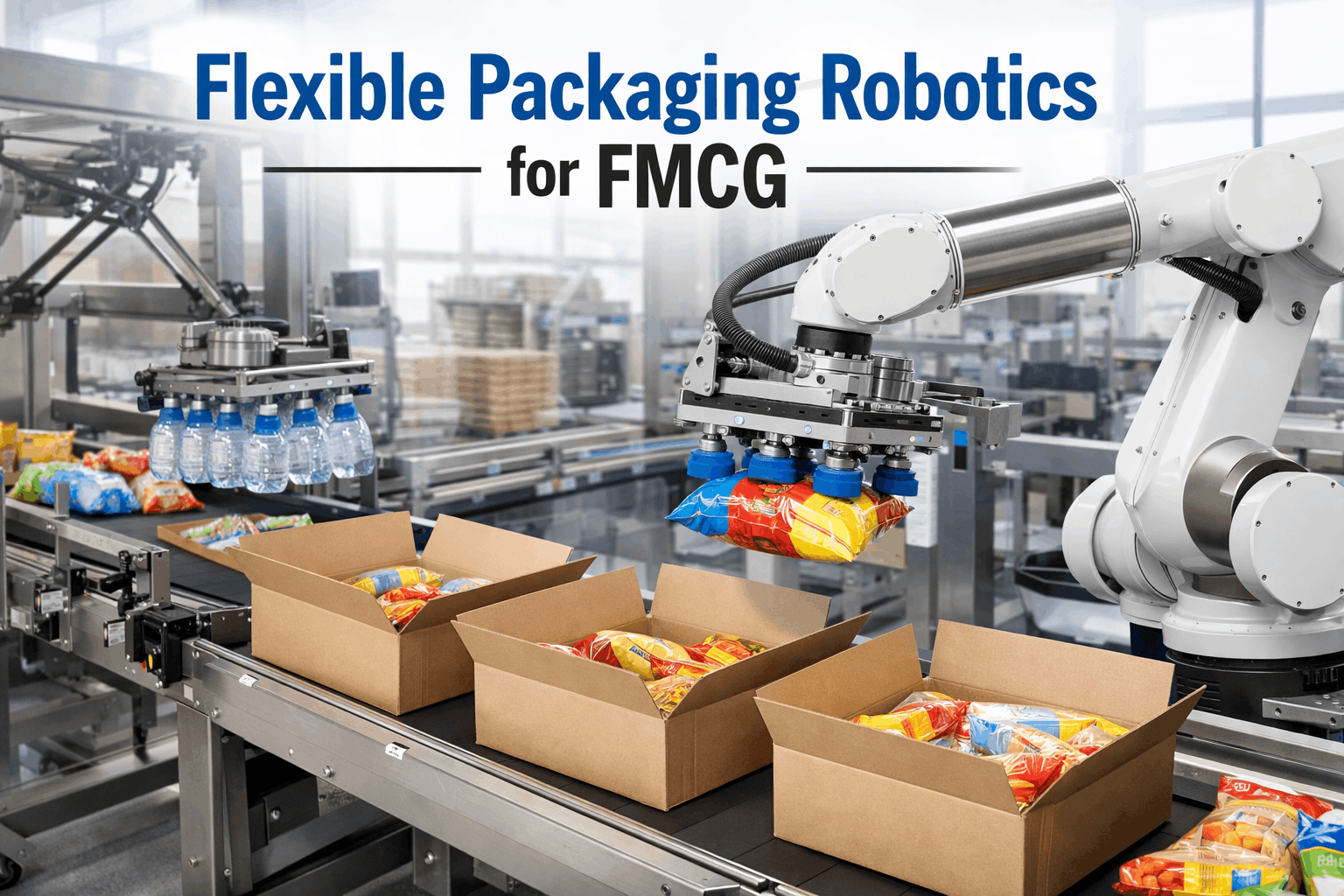
A truly flexible packaging line is not a single robot bolted onto a conventional machine. It is an integrated system where every station — from product infeed to case packing — adjusts format parameters automatically based on recipe selection. Each component below contributes to the elimination of manual changeover steps that consume time and introduce error.
Servo motors replace hand-crank adjustments on every mechanical format point. Recipe selection triggers simultaneous repositioning of guide rails, lane widths, and transfer heights — 40+ adjustment points moving to new positions in under 60 seconds with ±0.1mm repeatability.
B
Quick-Change Robotic Tooling
EOAT swapVacuum cupsGripper jawsTool racks
Robot end-of-arm tools (EOAT) exchange automatically via tool changer mechanisms. A pick-and-place robot handling pouches swaps to carton grippers in 8-15 seconds without operator intervention. Tool racks positioned within the robot's work envelope eliminate manual handling.
AI vision cameras identify incoming products by shape, label, and barcode — automatically confirming the correct SKU is running before packaging begins. Eliminates the most common changeover error: running the wrong product into the wrong packaging format.
D
Recipe-Driven Control Architecture
PLC recipesParameter setsBatch IDCMMS link
Every SKU has a stored recipe containing all machine parameters — speeds, temperatures, seal pressures, fill volumes, label positions, and case patterns. Selecting a recipe pushes hundreds of parameters to every station simultaneously. Oxmaint logs recipe execution and tracks parameter drift over time.
E
Robotic Case Packing & Palletizing
Multi-patternLayer configMixed palletsAuto-adjust
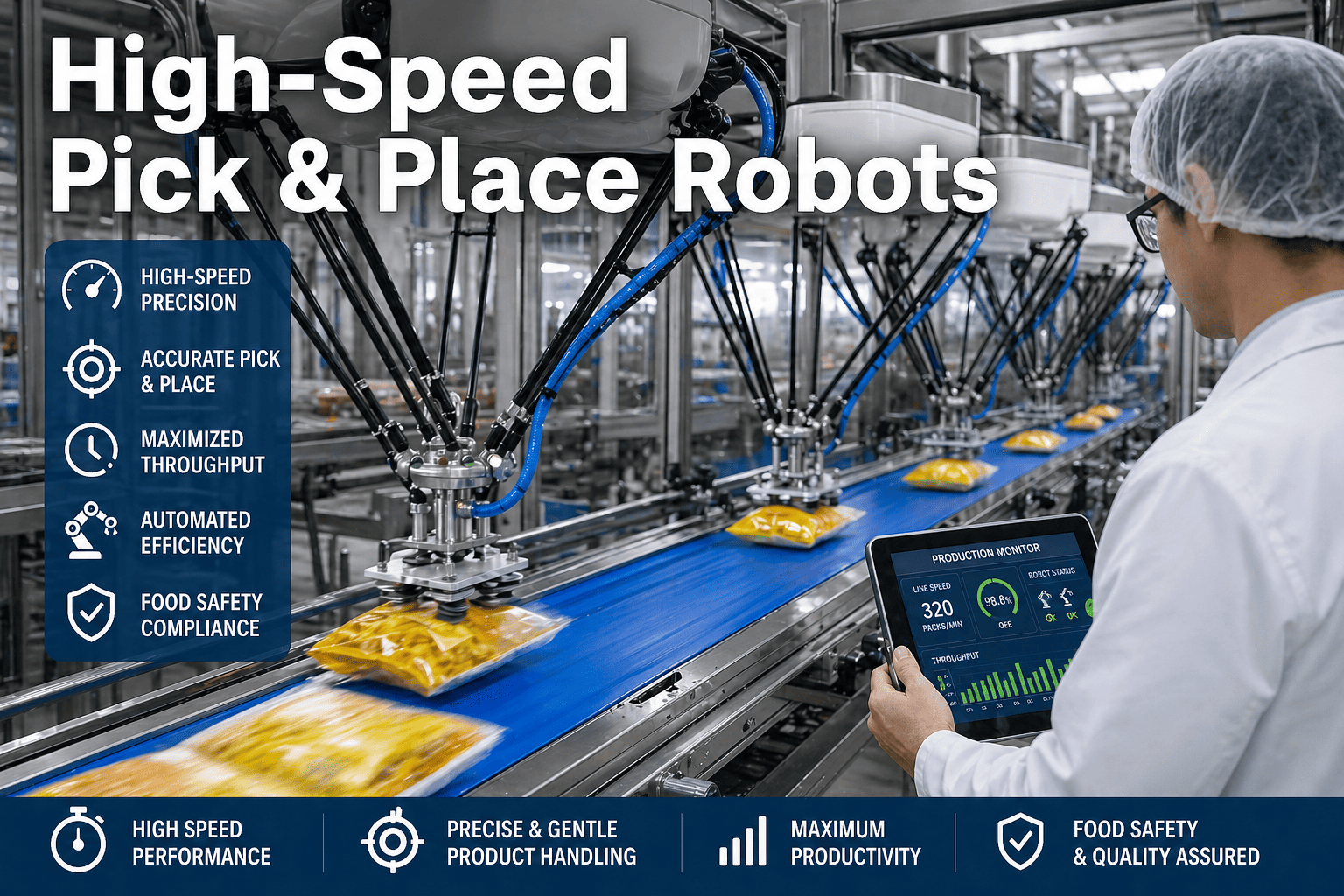
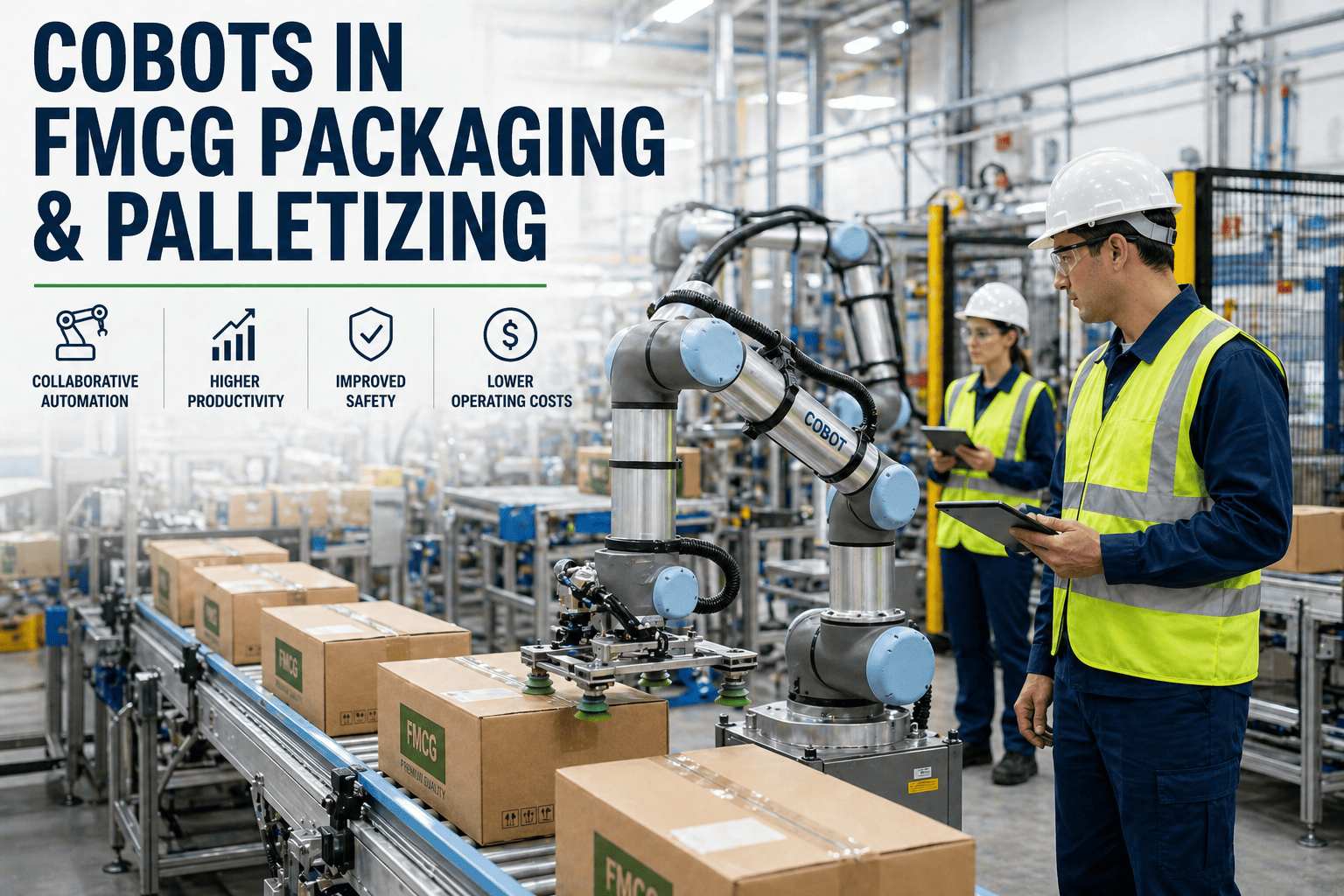
Delta and articulated robots switch between case packing patterns and pallet layer configurations via recipe selection. A single palletizing cell handles 20+ SKU patterns without physical tooling changes — pattern geometry stored digitally and recalled per production order.
What Makes Changeovers Slow — and How Robotics Fixes Each Step
A changeover is not a single event. It is a sequence of discrete tasks — some mechanical, some digital, some verification — each consuming time and introducing error potential. Understanding which steps consume the most time reveals where robotic flexibility creates the largest gains. Oxmaint times every changeover step for continuous improvement — Book a Demo.
Changeover Step Breakdown: Conventional vs. Robotic Flexible Line
Changeover Step
Conventional Time
Robotic Flexible Time
How It Works
Format Adjustment
15-25 min (hand cranks)
30-60 sec (servo-driven)
Recipe triggers simultaneous repositioning of all guide rails, lane dividers, and transfer points
Tooling Swap
10-20 min (manual bolt-on)
8-15 sec (auto tool change)
Robot automatically docks at tool rack, releases current EOAT, picks new tool, and verifies connection
Recipe Parameter Entry
5-10 min (manual HMI input)
Instant (recipe recall)
Operator selects SKU from library; all parameters push to all stations simultaneously via PLC network
Label/Film Changeover
8-15 min (threading/alignment)
2-4 min (pre-staged cassettes)
Pre-loaded label and film cassettes snap into position; registration auto-calibrates via vision feedback
First Article Verification
5-10 min (manual QC check)
30 sec (inline vision)
Vision system verifies label, date code, seal integrity, fill level, and case pattern on first units automatically
Total conventional changeover: 48-88 minutes. Total robotic flexible changeover: 3-6 minutes. Every changeover logged in Oxmaint with step-level timing for SMED analysis.
See step-level changeover timing in action. Walk through how Oxmaint captures every format switch and identifies bottleneck steps for SMED improvement.
Recipe Management: The Digital Backbone of Flexible Packaging
Recipe management is the single most critical capability separating a truly flexible packaging line from one that merely has fast mechanics. A recipe is not just a set of machine speeds — it is the complete digital definition of how every station on the line behaves for a specific SKU: fill volumes, seal temperatures, label positions, case patterns, checkweigher limits, and quality thresholds. Without rigorous recipe management, fast changeovers produce fast mistakes. Oxmaint stores and version-controls every recipe change — Sign Up Free.
1
Recipe Creation & Validation
Engineering creates the recipe for a new SKU by defining every parameter across every station — fill weight, seal time/temperature, label position, case count, pallet pattern, and quality limits. The recipe is validated through trial runs with parameter confirmation at each checkpoint before production release.
2
Version Control & Change Authorization
Every recipe modification is version-tracked in Oxmaint with the change author, reason, approval status, and before/after parameter values. Unauthorized recipe edits are blocked at the HMI level. Recipe change requests route through maintenance and quality for sign-off before deployment.
3
Recipe Deployment to Line
Operator selects the production order in the HMI; the corresponding recipe pushes to every station simultaneously via the PLC network. Servo positions, robot programs, vision parameters, and quality thresholds all update in a single transaction — eliminating station-by-station manual entry.
4
Runtime Monitoring & Drift Detection
During production, actual parameters are continuously compared against recipe targets. Seal temperature drifting 3°C above setpoint, fill weights trending toward control limits, or vision rejection rates exceeding baseline all trigger alarms routed through Oxmaint to the responsible technician.
5
Post-Run Analysis & Recipe Optimization
After every production run, Oxmaint compiles recipe performance data: actual vs. target parameters, waste rates, changeover duration, and alarm frequency. Repeated deviations on specific SKUs trigger recipe review work orders — the recipe itself becomes a maintained asset in the CMMS.
Six Principles of High-Performance Changeover Design
Fast changeovers do not happen by accident. They are engineered through deliberate design decisions applied to equipment, tooling, recipes, and workflows. These six principles, drawn from SMED methodology adapted for robotic packaging environments, form the foundation of sub-five-minute changeovers.
01
Externalize Every Possible Task
Pre-stage label cassettes, pre-load film rolls, pre-position tool racks, and pre-verify recipes while the line is still running the current SKU. The only tasks performed during the actual changeover window are those requiring the line to be stopped — everything else happens in parallel.
02
Eliminate Fasteners and Hand Tools
Replace bolted tooling connections with quarter-turn cams, bayonet mounts, and magnetic locks. Every manual bolt removed from the changeover sequence saves 30-60 seconds and eliminates a torque-related quality risk. Robotic tool changers achieve zero-fastener swaps automatically.
03
Standardize Reference Points Across SKUs
Design tooling and format parts with common mounting interfaces and datum surfaces. When every SKU's tooling registers to the same reference points, servo-driven adjustments need only move to new coordinates — no realignment, no shimming, no trial-and-error positioning.
04
Automate First Article Verification
Replace manual QC checks with inline vision verification of the first units off the line after changeover. Vision confirms label accuracy, date codes, seal integrity, fill levels, and case patterns in seconds — releasing the line to full speed without waiting for a QC hold.
05
Track and Time Every Step in the CMMS
Log changeover start, each step completion, and full-speed resumption in Oxmaint. Step-level timing data reveals which tasks consume the most time and which degrade over shifts. Without measurement, there is no improvement — SMED without data is just wishful thinking.
06
Maintain Changeover Tooling as Critical Assets
Quick-change tooling that wears, misaligns, or corrodes produces slow changeovers. Schedule preventive maintenance on tool changers, gripper surfaces, cassette mechanisms, and servo calibration through Oxmaint — treating changeover components with the same rigor as production assets.
Turn Every Changeover into an Improvement Opportunity
Oxmaint tracks changeover duration by step, by SKU, by shift, and by operator — giving your continuous improvement team the data to eliminate waste from every format switch. Recipe version control, alarm routing, and tooling PM schedules all live in one platform.
The difference between conventional and robotic changeovers is not a marginal improvement — it is a structural transformation that changes what is economically viable. Short production runs that were previously unprofitable become standard operations when changeover time drops below five minutes.
Conventional Lines vs. Robotic Flexible Lines
Dimension
Conventional
Robotic Flexible
Changeover Time
35-90 minutes per SKU switch
3-6 minutes per SKU switch
Format Adjustment
Manual hand cranks, trial-and-error alignment
Servo-driven to ±0.1mm via recipe coordinates
First Article QC
Manual inspection, 5-10 minute hold
Inline vision verification, 30 second release
Minimum Viable Run Length
4,000-10,000 units to justify changeover cost
200-500 units economically viable
Changeover Documentation
Paper logs completed after the fact, if at all
Auto-logged in CMMS with step-level timestamps
22%
of production time lost to changeovers
3-5%
of production time to changeovers
Alarm Routing: Catching Problems Before They Become Stoppages
Flexible packaging lines generate more alarm events than conventional lines because they change state more frequently. Each changeover introduces a brief window where parameters are settling, temperatures are stabilizing, and vision systems are recalibrating. Without intelligent alarm routing, operators drown in nuisance alerts while genuine problems escalate unnoticed. Oxmaint routes alarms by severity, asset, and shift — Book a Demo.
Alarm Routing Architecture for Flexible Lines
!
Critical: Production Stop Required
Wrong SKU detectedSeal failureSafety interlock
Immediate line stop with push notification to supervisor and operator. Wrong-product-in-wrong-package events trigger automatic rejection and hold until investigation clears. Work order auto-generated in Oxmaint with alarm data, production context, and required corrective action.
▲
Warning: Parameter Drift Detected
Seal temp driftFill weight trendVision reject rate
Production continues but the responsible technician receives a mobile alert with trend data. If drift continues beyond a second threshold, the alarm escalates to critical. Oxmaint logs the drift event and correlates it with recipe parameters and equipment condition history.
i
Informational: Changeover-Phase Settling
Temp rampServo homingVision calibration
Expected parameter fluctuations during the first 30-60 seconds after a recipe change are suppressed from operator alerts but still logged in Oxmaint. If settling exceeds the expected window, the alarm auto-escalates to warning level — catching changeover-related issues before they affect production quality.
Measured Impact of Robotic Flexible Packaging
The performance improvements from flexible robotic packaging lines are not incremental refinements — they are structural shifts in line economics that change which production strategies are viable. The following figures reflect documented outcomes from FMCG facilities that have completed at least six months of operation on flexible robotic packaging lines.
Performance After 6+ Months on Robotic Flexible Lines
80%Reduction in changeover time — from 45+ minutes to under 5 minutes per SKU switch
15-20%OEE improvement from recovered changeover time and reduced first-article waste
3xMore SKU changes per shift — enabling short runs previously considered uneconomical
60%Fewer changeover-related quality defects from automated recipe deployment and vision verification
The real breakthrough was not the speed of the changeover itself — it was what fast changeovers made possible. Once format switches dropped below five minutes, we could schedule 200-unit promotional runs that used to require a minimum of 5,000 units to justify the downtime. Our marketing team suddenly had packaging flexibility they had never experienced. The line pays for itself in new business that was previously impossible to service.
— VP Operations, Mid-Size North American Snack Manufacturer
Build the Digital Backbone for Flexible Packaging
Oxmaint manages the complete flexible packaging workflow: recipe version control, changeover step timing, tooling preventive maintenance, alarm routing, and parameter drift analysis. One platform connecting your robotic packaging line to continuous improvement outcomes.
Can existing packaging lines be retrofitted for robotic flexibility, or is a greenfield installation required?
Many existing lines can be upgraded incrementally. Servo-driven format adjustment kits replace manual hand cranks on most major OEM equipment. Robotic pick-and-place stations with automatic tool changers can be inserted into existing line layouts. Recipe management systems overlay onto existing PLCs via communication gateways. A phased retrofit typically delivers 50-70% of the changeover reduction achievable with a purpose-built flexible line, at 30-40% of the capital cost. Full greenfield installations achieve the highest performance but require longer lead times and larger investment.
How does recipe management integrate with our existing ERP and production scheduling systems?
Recipe management platforms connect to ERP systems via standard interfaces (OPC UA, REST API, or database connectors) to receive production orders with SKU and quantity specifications. The recipe system translates each production order into the corresponding machine parameter set and deploys it to the line. Oxmaint sits alongside this flow, logging recipe execution data, tracking parameter deviations, and managing the preventive maintenance schedules for all changeover-related tooling and servo systems.
What is the minimum production run length that becomes viable with robotic flexible changeovers?
When changeover time drops below five minutes, production runs as short as 200-500 units become economically viable for most FMCG packaging formats. This enables promotional packaging, regional variants, seasonal SKUs, and e-commerce-specific configurations that require minimum order quantities too small for conventional lines. The exact threshold depends on product margins, packaging material costs, and line speed — but the general principle holds: sub-five-minute changeovers make short runs profitable.
How do you prevent changeover-related quality defects when switching SKUs so frequently?
Three interlocking systems prevent changeover quality failures. First, recipe-driven parameter deployment eliminates manual entry errors — every machine setting comes from the validated recipe, not operator memory. Second, inline vision verification confirms the first units off the line match the correct SKU specification before full-speed production begins. Third, wrong-product-detection cameras identify any product-package mismatch and trigger immediate rejection. Together, these systems achieve changeover-related defect rates below 0.1% even at 10+ changeovers per shift.
What ROI timeline should we expect from flexible packaging line investment?
Most FMCG facilities report 12-24 month payback on flexible packaging investments, driven by three concurrent value streams: recovered production time from faster changeovers (typically 15-20% OEE improvement), new revenue from short-run SKUs that were previously uneconomical, and reduced changeover waste from automated recipe deployment and first-article verification. Retrofit projects with lower capital requirements often achieve faster payback than greenfield installations, making phased upgrades an attractive entry point for facilities testing the flexible packaging approach.