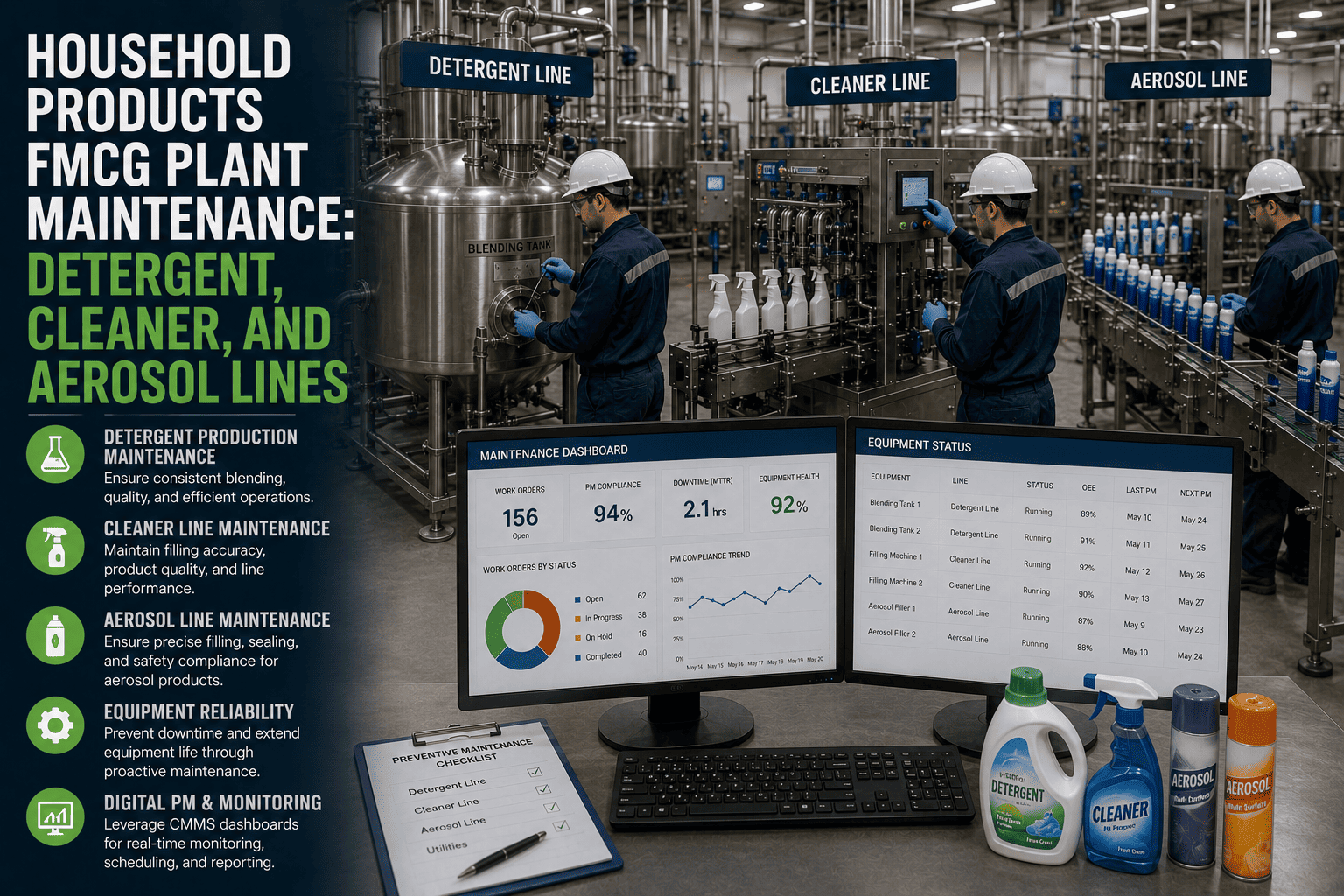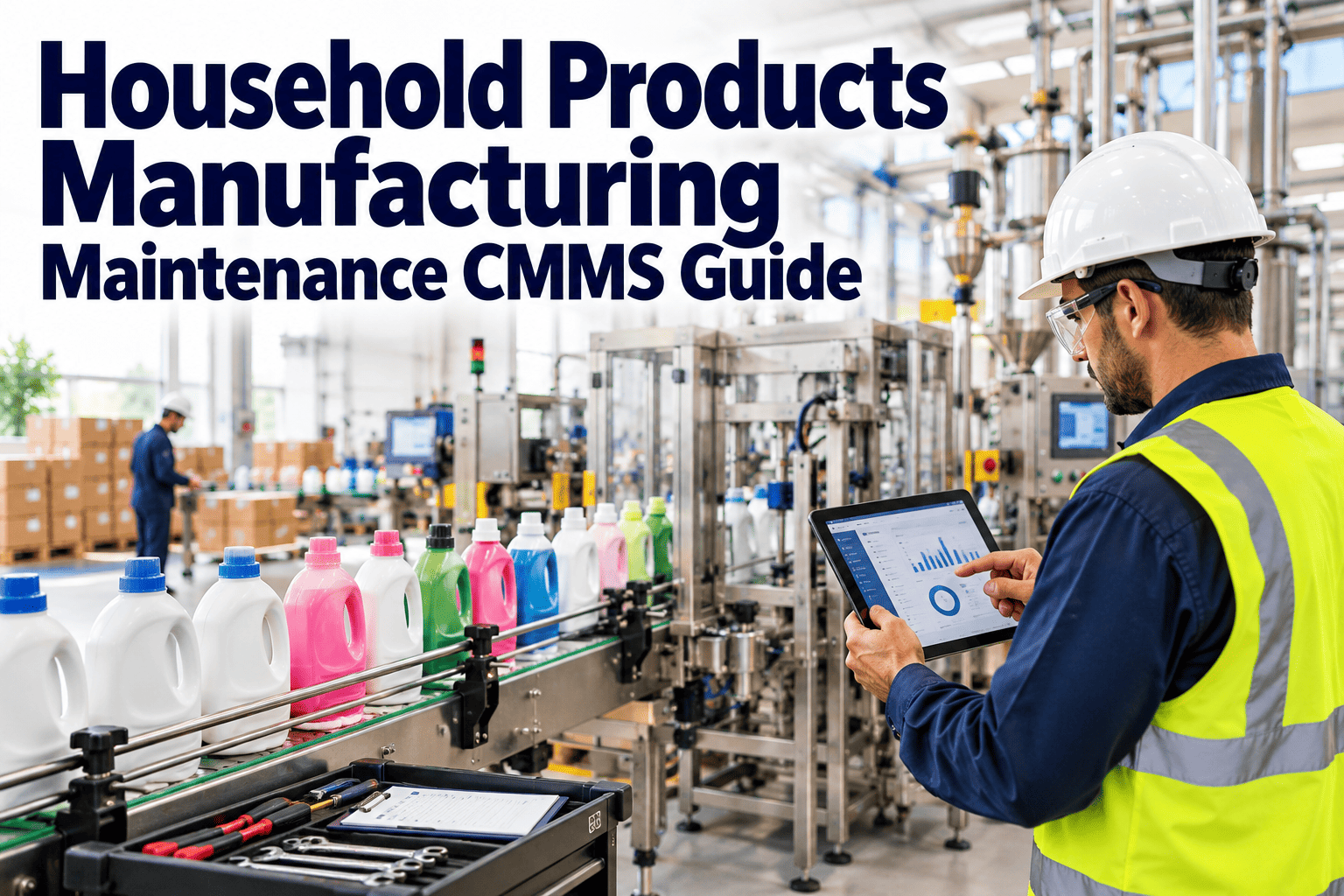
Household products plants blend detergents, cleaners, disinfectants, and fabric care liquids, then fill them into bottles fitted with caps, triggers, and pumps. The chemistry is harsh on pumps, seals, and hoses, the products foam and creep into places they should not reach, and the closures are small precision assemblies that fail in the hands of the customer. Maintenance teams are expected to keep a corrosive, high-volume process safe and running with limited downtime. This guide explains where the wear and the hazards sit, and how a CMMS can organize inspections, preventive tasks, and repair history for the whole plant.
Household Products Manufacturing Maintenance: Detergent Mixing, Filling and Spray Cap Assembly
Corrosive chemistry, foaming product, and tight-tolerance closures put unusual stress on equipment. A structured maintenance program keeps the line safe, leak-free, and ready for the next changeover.
What Makes Household Chemical Plants Hard on Equipment
The products are made of surfactants, solvents, acids, alkalis, and sometimes oxidizers, and these attack materials differently. A seal that lasts in one product may fail quickly in another, which is why asset history by product matters.
Chemical Compatibility Is a Maintenance Decision
Gaskets, seals, hoses, and diaphragms must match the product they touch. Record the material and the product on the asset, and check compatibility whenever a formula or supplier changes.
| Component | Typical problem in household chemicals | What to record | Preventive approach |
|---|---|---|---|
| Pump seals and diaphragms | Swelling, hardening, or leaks with solvents, bleach, or strong alkalis | Seal material, product, hours in service | Match material to product, inspect on hours and replace on condition |
| Transfer hoses | Softening, cracking, or delamination from product or cleaning chemicals | Hose type, product, pressure rating, install date | Inspect before each campaign and replace on a set life |
| Valve seats and o-rings | Leaks and sticking from residue or attack | Valve ID, seat material, cycles | Cycle-based inspection and a stock of matched spares |
| Tank fittings and gaskets | Weeping at flanges and manways | Gasket type, torque, last change date | Check torque and surface condition at each tank inspection |
| Sensors and level probes | Fouling or attack on the wetted part | Sensor type, material, calibration date | Clean and verify on a schedule, and keep spares for critical probes |
Detergent Mixing and Blending Maintenance
Bottle Filling and Foam Control
Common filler problems
- Foam rising in the container neck and giving false low fill.
- Drips and cutoff stringing from worn nozzles.
- Product on the bottle exterior that disrupts labeling and capping.
- Fill variation caused by air in the line or unstable pressure.
Maintenance responses
- Check nozzle condition, diving or bottom-fill settings, and filler speed together.
- Inspect valve seats and seals on a cycle basis.
- Verify pumps, air supply, and flow meters for stable pressure and accuracy.
- Schedule exterior cleaning and conveyor inspection in the same PM routine.
Spray Cap and Trigger Assembly: Small Parts, Big Complaints
A trigger sprayer is a small assembly of body, spring, piston, nozzle, and dip tube. Assembly machines must place and fasten these parts accurately thousands of times an hour, and a small error becomes a leaking or non-spraying bottle at home.
A practical routine for assembly and leak testing
Safety, Hazard Control, and Compliance
Household chemical plants handle materials that can burn, irritate, or ignite. Maintenance has to be planned with those hazards in view, using the procedures and regulations that apply in your location, such as hazard communication and lockout and tagout requirements.
Before and After: Paper Records Versus a Connected Plant History
Without a maintenance system
- Seal and hose changes are written on whiteboards or in personal notes.
- Repeated leaks are blamed on the product when material choice may be at fault.
- Safety permits and PM records live in different binders.
- Spray cap failures are discovered after shipment.
With a CMMS
- Each tank, pump, filler, and assembly station carries its own history.
- Seal materials and products are recorded, so recurring failures can be connected.
- Permits and isolation notes can be attached to the work order.
- Station-level failures are visible early, so tooling can be corrected before shipping.
The Operational Impact of Chemical Wear and Leaks
Troubleshooting by Symptom: What to Check First
| Symptom | First place to look | Records that help | Typical corrective action |
|---|---|---|---|
| Bottle leaks after capping | Capper torque and closure fit | Torque test results, tooling changes | Reset torque, replace worn chucks, check closure and neck finish |
| Spray does not work or feels weak | Spray cap assembly station and test results | Reject counts by station, tooling and feeder history | Correct press depth or insertion, replace worn parts, recalibrate test |
| Fill varies with foam | Filler settings and pump stability | Foam events, fill logs, seal history | Adjust fill method, stabilize supply, replace worn seals |
| Viscosity or concentration out of range | Dosing pump or flow meter accuracy | Calibration records, pump inspection history | Recalibrate, repair or replace the dosing equipment |
| Repeated hose or gasket failures | Material compatibility with the current product | Material, product, and install date for each failure | Change material, adjust inspection interval, update stock |
| Frequent jams on the assembly line | Part feeders and orientation tooling | Stoppage log by station, feeder wear findings | Repair or replace tooling, clean feeders, review part quality |
Cleaning and Changeover as Maintenance Opportunities
Every cleaning cycle gives access to parts that are otherwise covered by product. Used properly, changeover is the cheapest time to inspect.
Inspection points available during changeover
- Gaskets and seals exposed during tank and line flushes.
- Spray balls and drains that must be clear for the next product.
- Nozzles and valve seats after they have been cleaned and dried.
- Cap chutes, feeders, and tooling that are accessible while the line is stopped.
How to make it work
- Build a short inspection task into the changeover checklist for each line.
- Record findings against the asset, even when no repair is needed.
- Create a corrective work order when a defect cannot wait for the next planned stop.
- Review findings monthly to adjust the planned maintenance tasks.
Spare Parts Planning for Household Chemical Lines
Training and Handover Across Shifts
Household chemical lines often run around the clock, and a repair started on one shift is frequently finished on another. Work orders that carry the findings, the parts used, and the next step stop the second shift from starting over, and keep safety steps such as isolation visible to everyone who picks the job up.
Managing Contractors and Permits in a Chemical Plant
What to control
- Contractor induction on site hazards and chemical exposure.
- Permits for hot work, confined space, and electrical work.
- Isolation and verification before any line is opened.
- Handover and return-to-service checks after outside work.
How to keep it traceable
- Attach permits and isolation records to the work order.
- Log the contractor, task, parts, and findings against the asset.
- Require sign-off before the equipment returns to production.
- Review contractor repairs in asset reports, alongside internal work.
KPIs for a Household Products Maintenance Program
Maintenance Maturity for Household Chemical Plants
Pre-Campaign Readiness Checklist
- Tank gaskets, vents, and fittings checked for leaks.
- Dosing pumps and flow meters verified for the current product.
- Hoses inspected and rated for the chemistry in use.
- Spill containment, drains, and ventilation confirmed in working order.
- Filler nozzles, seats, and seals inspected.
- Capper and spray assembly torque and press settings checked.
- Leak and function test station verified with known good and bad samples.
- Spare seals, hoses, and tooling stocked and linked to the asset.
Start with the leak events of the last quarter, group them by seal or hose material and product, and use the pattern to choose the first tasks and spares to formalize in the system.