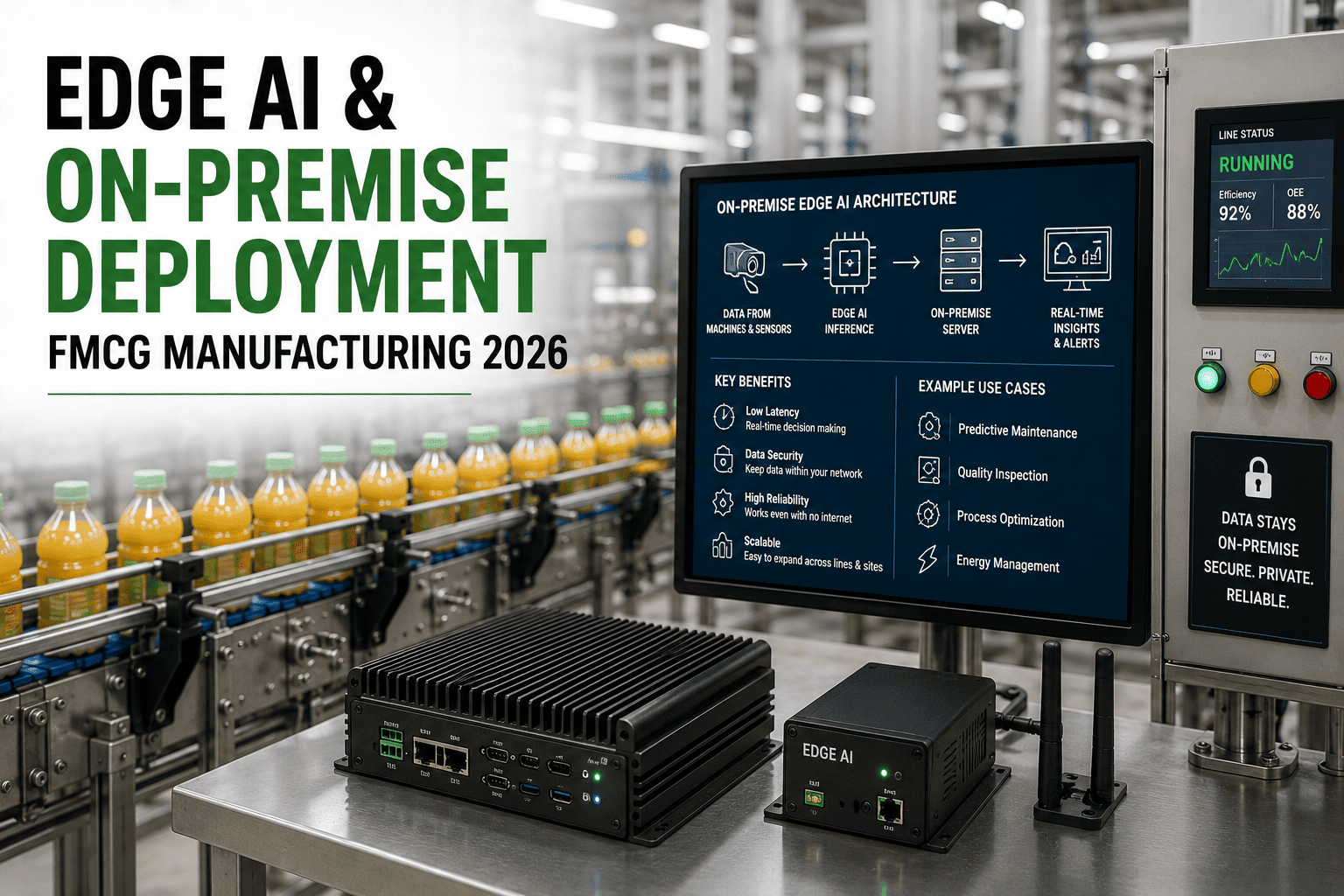
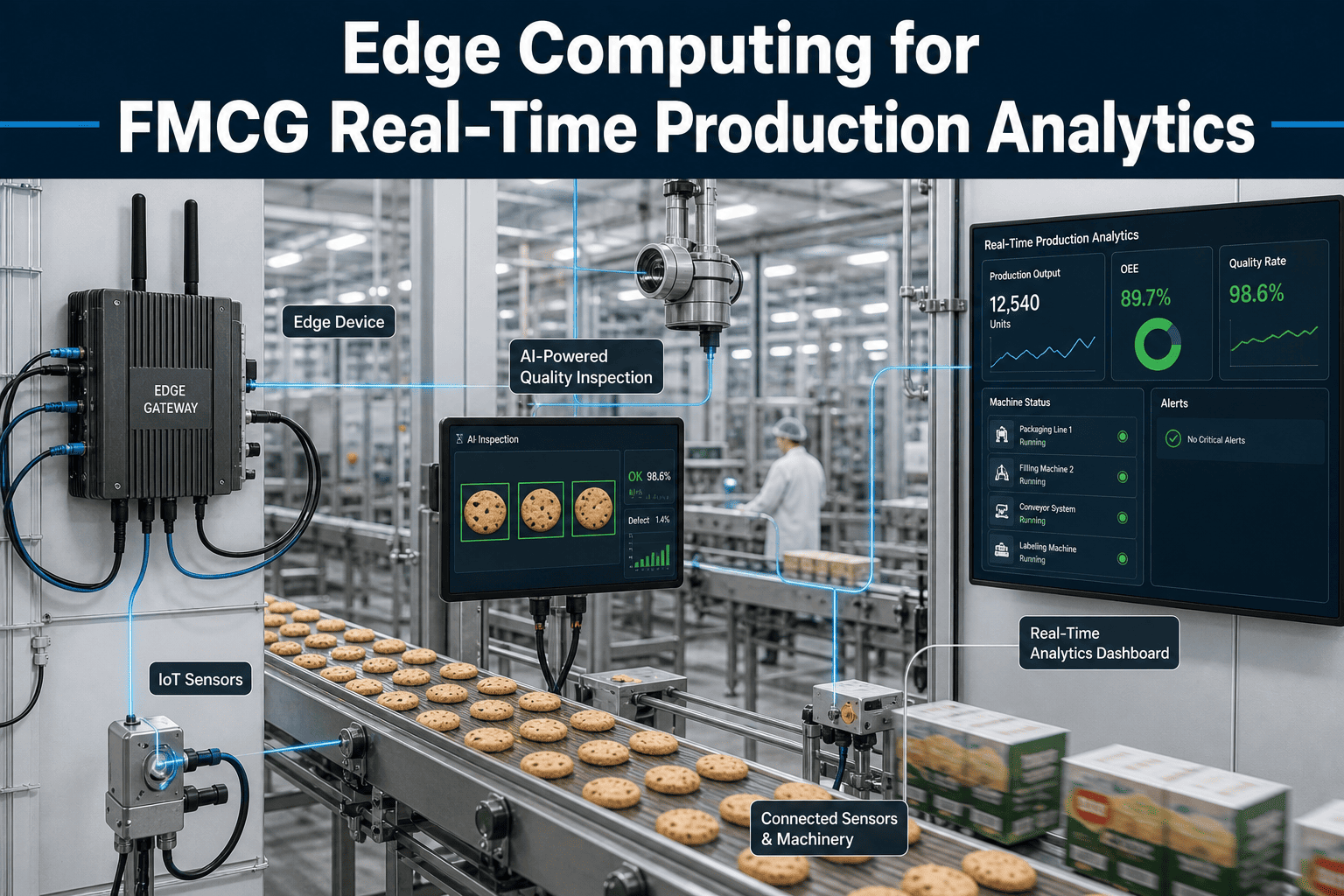
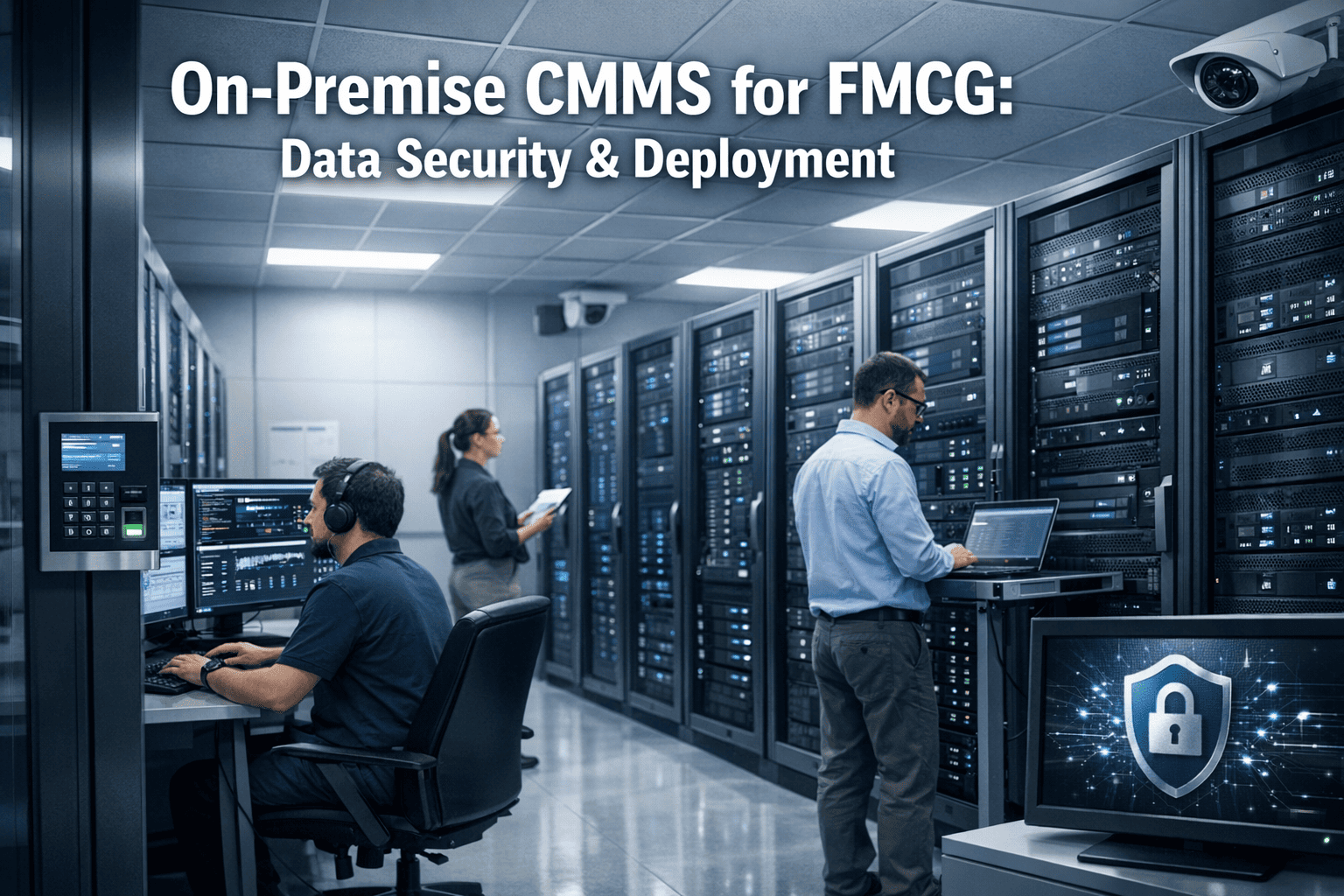
A global snack manufacturer's predictive maintenance system detected a critical bearing failure pattern on its highest-value filling line — and automatically uploaded the vibration signature, production volume, and SKU mix data to a cloud AI platform for analysis. Two weeks later, the company discovered that the cloud provider's terms of service granted the AI vendor a licence to use uploaded data for model training — meaning the manufacturer's proprietary production parameters, throughput data, and equipment failure patterns were now training a model that would serve their competitors. This is not hypothetical. It is the data security reality that drives leading FMCG manufacturers toward on-premise AI deployment: keeping proprietary production intelligence inside the factory fence, achieving sub-10ms inference latency that cloud round-trips cannot match, and maintaining air-gapped security for recipe formulations, supplier relationships, and competitive production data that has no business traversing the public internet. Start your free trial to explore OxMaint's on-premise AI capabilities. Book a demo to see how the On-Premise AI Deployment module works inside your network perimeter.
On-Premise AI Deployment
Your Production Data Stays Inside Your Factory. Period.
OxMaint's on-premise AI runs predictive maintenance, quality analytics, and energy optimization entirely within your network — no cloud dependency, no data exfiltration risk, no latency penalty.
<10 ms
inference latency on-premise vs 150–500ms cloud round-trip
100%
of production data stays inside the factory perimeter — zero cloud exposure
99.97%
AI uptime — no dependency on internet connectivity or cloud availability
The Three Forces Pushing FMCG Toward On-Premise AI
Cloud AI is the default assumption for most software vendors — and for good reason in many industries. But FMCG manufacturing has three characteristics that make cloud deployment increasingly untenable for production-critical AI workloads. These are not theoretical concerns — they are the operational realities that have driven the largest FMCG manufacturers to deploy AI locally.
What is at risk
Proprietary recipe formulations and process parameters
Equipment failure signatures that reveal production capacity
SKU mix, throughput, and yield data that competitors would pay millions for
Supplier relationships and raw material specifications
Cloud AI vendors' terms of service rarely guarantee data isolation at the level FMCG IP requires
What speed demands
Vision inspection at 1,200 upm needs sub-15ms per-unit inference
Real-time SPC requires continuous analysis with zero queuing
Cobot control loops need deterministic response times
Edge decisions on reject/accept cannot tolerate network variability
Cloud round-trip latency of 150–500ms makes real-time production AI physically impossible
What uptime requires
Production lines run 24/7 — AI must run 24/7 regardless of connectivity
Internet outages at remote plant locations are common (2–8 per year)
Cloud provider outages have caused multi-hour AI blackouts at critical times
Maintenance decisions cannot wait for connectivity restoration
On-premise AI operates independently — zero dependency on external infrastructure
The security argument alone is decisive for most FMCG manufacturers. A vibration signature from a filling machine contains information about fill speed, product viscosity, equipment wear rate, and production volume — data that, aggregated across an AI model, reveals competitive intelligence worth millions. When a cloud AI vendor's terms of service include phrases like "data may be used to improve our services," the manufacturer has effectively granted a licence to extract competitive intelligence from their production floor. On-premise AI eliminates this risk entirely: the data never leaves the building.
Cloud vs. On-Premise vs. Hybrid: The Full Comparison
The deployment decision is not binary. Each architecture has specific strengths, and the right choice depends on workload characteristics, security requirements, and connectivity reliability at each plant location.
Data leaves factory
Yes — all data
No — never
Aggregated only
Inference latency
150–500ms
<10ms
<10ms (edge)
Internet dependency
100% dependent
Zero dependency
Partial
Upfront cost
Low (subscription)
$15K–$60K hardware
$10K–$40K
3-year TCO (5 lines)
$120K–$250K
$45K–$90K
$60K–$120K
Model training
Cloud GPUs — fast
Local — slower
Cloud train, edge deploy
Regulatory compliance
Complex — data residency
Simple — data stays local
Depends on scope
Best for FMCG
Analytics, reporting
Real-time production AI
Multi-site fleet learning
The 3-year TCO comparison surprises most FMCG decision-makers. Cloud AI appears cheaper at year one because hardware costs are replaced by subscription fees. But cloud subscriptions compound annually while on-premise hardware is a one-time purchase that serves 5–7 years. By year three, on-premise AI costs 40–60% less than equivalent cloud deployments — and delivers better latency, better security, and zero connectivity risk. The hybrid model captures the best of both: real-time inference runs on-premise with sub-10ms latency, while anonymized, aggregated model improvements are trained in the cloud and pushed to edge devices periodically.
Flexible Deployment
On-Premise, Cloud, or Hybrid — Your Data, Your Rules
OxMaint supports all three deployment models. Start with cloud for rapid deployment, migrate to on-premise for production-critical AI, or run hybrid for multi-site fleet intelligence. Same platform, same features, your choice of architecture.
What On-Premise AI Actually Looks Like in an FMCG Plant
On-premise AI is not a server room full of racks. Modern edge AI hardware is compact, ruggedized, and purpose-built for factory environments. A complete on-premise AI deployment for a 5-line FMCG plant fits in a single standard 19-inch rack unit and draws less power than a commercial refrigerator.
Layer 1 — Sensors & Data Collection
Vibration
Tri-axial sensors on motors, pumps, gearboxes — streaming via LoRaWAN or wired Modbus
Vision
GigE cameras at inspection points — direct Ethernet to edge GPU, no cloud hop
Current / Power
CT clamps on motor feeds — current draw profiles streamed locally at 1-second intervals
Temperature
Wireless sensors on bearings and electrical panels — battery-powered, 30-second intervals
Layer 2 — Edge AI Processing (On-Premise)
Edge GPU Server
NVIDIA Jetson Orin or equivalent — 275 TOPS AI performance in 1U rack mount
AI Models
Failure prediction, anomaly detection, vision inspection, SPC — all running locally
Local Database
Time-series DB storing 12+ months of sensor data — queryable in milliseconds on-site
CMMS Integration
OxMaint on-premise instance — work orders, alerts, dashboards, all within your network
Layer 3 — Action & Output
Auto Work Orders
Predictive alerts generate CMMS work orders with parts, priority, and timing — no human lag
Real-Time Reject
Vision AI reject signals sent to PLC in under 10ms — no cloud latency in the decision path
Dashboards
Equipment health, prediction alerts, and KPIs on local network — accessible plant-wide
Optional Cloud Sync
Anonymized model updates only — raw data never leaves the facility perimeter
The entire data path — from sensor to AI inference to maintenance action — stays within the plant's local network. At no point does raw production data traverse the internet. The optional cloud sync in Layer 3 transmits only anonymized model improvement parameters (mathematical weights, not production data), and even this is one-way: cloud pushes updated models to the edge, the edge never pushes raw data to the cloud.
The Security Architecture: Five Layers of Data Protection
On-premise AI does not just keep data local — it provides defence-in-depth security that cloud deployments structurally cannot match. These five security layers protect production data from external threats, insider risks, and vendor access.
1
Physical Air Gap
Edge AI server sits on the OT network, physically separated from IT and internet-facing systems. No direct path from production sensors to the public internet exists in the architecture. Data exfiltration requires physical access to the server hardware.
2
Encrypted Local Storage
All sensor data, AI models, and maintenance records encrypted at rest using AES-256. Encryption keys stored in hardware security module (HSM) on the edge device — not in software, not in cloud key management.
3
Role-Based Access Control
Unique credentials per user with role-based permissions. Maintenance technicians see work orders and alerts. Data scientists access model parameters. No single role has access to both raw production data and external network connectivity.
4
Vendor-Blind Architecture
AI inference runs on your hardware, not a vendor's server. Software updates are delivered as signed packages installed by your IT team — the vendor never has remote access to your edge server, your data, or your models.
5
Tamper-Evident Audit Trail
Every data access, model query, and configuration change is logged in an immutable local audit trail — satisfying FDA 21 CFR Part 11 and ISO 27001 requirements for electronic record integrity.
The Economics: On-Premise AI Costs Less Than You Think
The cost comparison between cloud and on-premise AI for FMCG manufacturing reverses between year one and year three — and the gap widens every year after.
Cloud AI (subscription)
On-Premise AI (hardware + maintenance)
The year-one cost advantage of cloud disappears by month 14 and never returns. Cloud subscriptions include per-device fees, data ingestion charges, inference compute charges, and storage costs that scale linearly with the number of sensors and production volume. On-premise hardware is a fixed cost: the same edge GPU server that handles 50 sensors handles 200 sensors with no incremental cost. For FMCG plants planning to expand their sensor fleet (most add 30–50% more sensors within 18 months), the on-premise cost advantage compounds dramatically.
Implementation: 60-Day On-Premise AI Deployment
Week 1–2
Network Assessment & Hardware Sizing
Audit OT network topology, sensor count, and data throughput requirements. Size edge GPU hardware based on workload: vision inspection + predictive maintenance + SPC. Typical 5-line plant: single 1U edge server, $15K–$25K hardware cost.
Week 3–4
Hardware Install & Network Configuration
Mount edge server in plant IT rack. Configure OT network segmentation — sensors and edge AI on isolated VLAN with no internet routing. Establish one-way data diode for optional cloud sync if hybrid model selected.
Week 5–6
AI Model Deployment & CMMS Integration
Deploy pre-trained models for vibration analysis, vision inspection, and SPC. Connect to OxMaint on-premise instance for automated work order generation. Begin baseline learning period — models calibrate to your specific equipment behavior.
Week 7–8
Validation & Go-Live
Validate AI predictions against known equipment conditions. Confirm latency meets sub-10ms target for vision workloads. Security audit: verify no data path exists from edge server to public internet. Full production deployment with team trained on dashboard and alert workflows.
Frequently Asked Questions
On-Premise AI Deployment
Production Intelligence That Never Leaves Your Factory
47%
lower 3-year TCO vs cloud
60 Days
to full deployment
Trusted by FMCG manufacturers protecting proprietary production data. No credit card required.