In FMCG manufacturing, every minute a production line sits idle between SKU changeovers is a minute of pure margin erosion. Across a high-variety food or beverage plant running 12 to 18 changeovers per day, traditional setup times of 45 to 90 minutes per switch translate into 9 to 27 hours of lost production time daily — on a single line. SMED (Single-Minute Exchange of Die) is the industrial methodology that breaks this pattern, converting hours of changeover into structured, repeatable processes completed in under 10 minutes. Plants that have implemented SMED with digital tracking consistently report 40 to 60 percent reductions in changeover time within the first 90 days. Start a free trial with Oxmaint's changeover management module today, or book a demo to see SMED tracking in action on your line type.
45–90 min
Typical FMCG Changeover
before SMED implementation on packaging lines
40–60%
Time Reduction Achievable
within 90 days of structured SMED implementation
18+
Changeovers Per Day
on high-SKU FMCG lines — every minute saved multiplies fast
8–12pts
OEE Points Gained
from changeover time reduction on high-frequency lines
Your changeover time is your most controllable OEE loss
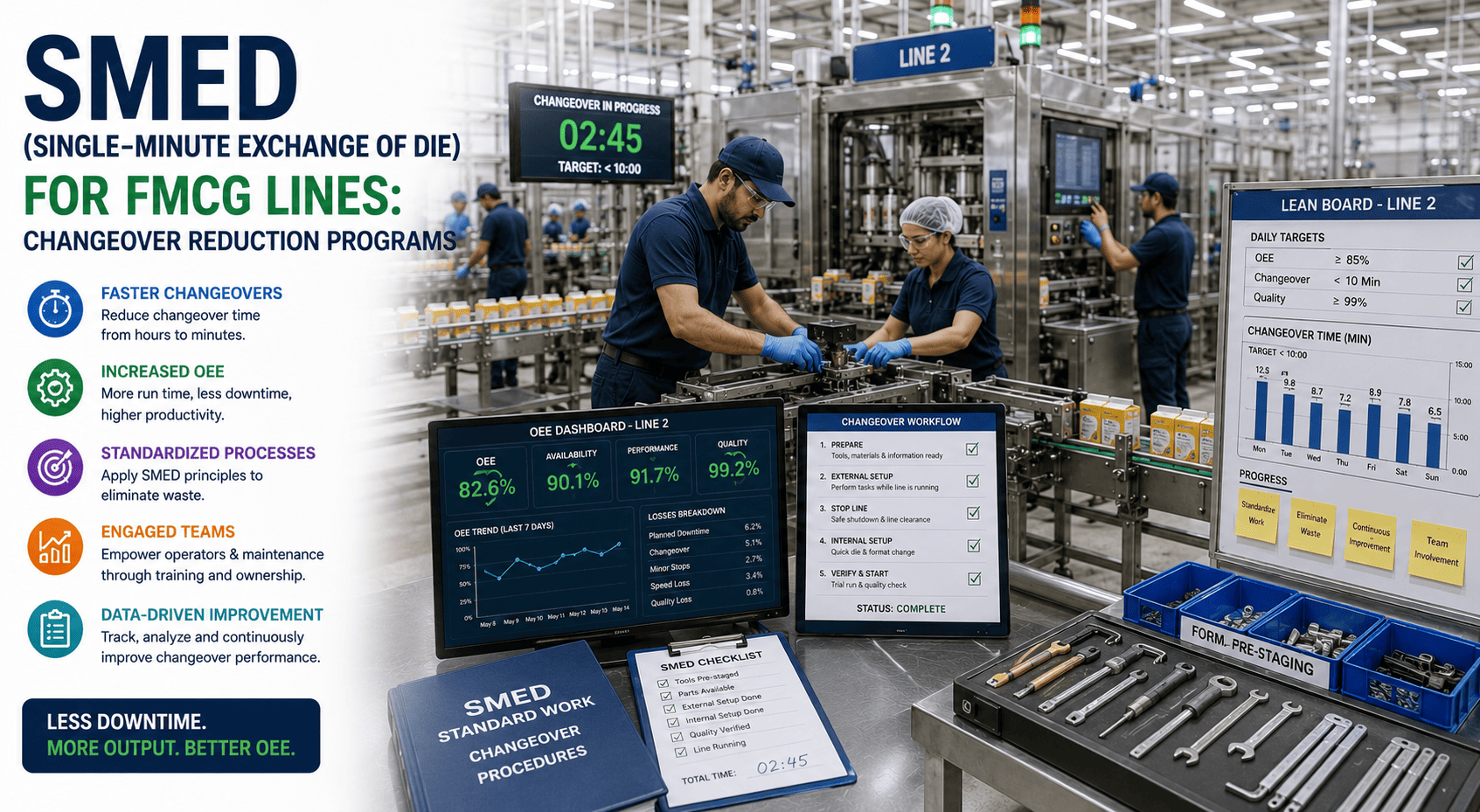
Oxmaint's changeover management and SMED tracking module gives plant managers digital checklists, time-stamped step tracking, and live comparison against SMED targets — all connected to your asset registry and maintenance system.
What Is SMED and Why Does It Transform FMCG Production?
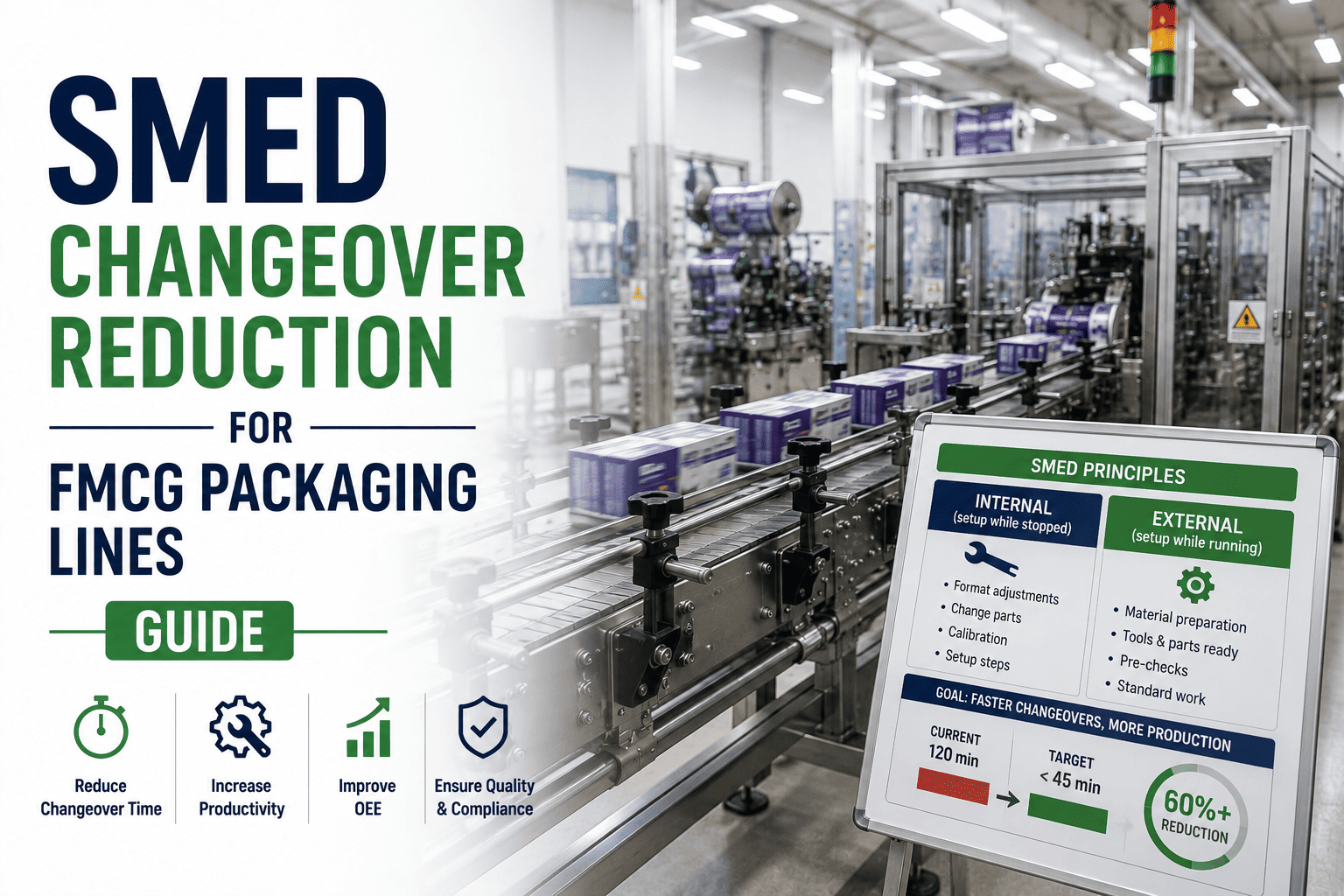
SMED — Single-Minute Exchange of Die — is a lean manufacturing methodology developed by Shigeo Shingo that aims to reduce equipment setup and changeover time to under 10 minutes (single digits). In FMCG production, SMED is applied to product format changes, SKU switchovers, line cleaning transitions, and seasoning or recipe changes. The core insight of SMED is that most changeover activities that teams believe must be done with the machine stopped can actually be done while the previous run is still finishing — converting "internal" time into "external" preparation time and slashing stop duration.
Internal Activities
Machine Must Be Stopped
Physical format part swap
Product flush and purge
Line cleaning (CIP cycle)
Calibration and verification
SMED Goal: Minimize and standardize these steps
SMED Converts
External Activities
Done Before Machine Stops
Staging and pre-kitting parts
Gathering tools and documents
Pre-warming or pre-heating
Operator briefing and prep
SMED Goal: Move as many steps here as possible
Where Changeover Time Is Lost in FMCG Lines
Before implementing SMED, plants need an accurate picture of where changeover time is actually going. Time studies consistently reveal that a large share of changeover duration is not the physical work itself — it is searching for tools, waiting for approvals, locating documentation, and the dead time between steps caused by poor coordination. Understanding which activities consume the most time per line type is the first step toward structured reduction.
High-Speed Filling Lines
Parts search and retrieval
Verification and sign-off
Startup waste stabilization
Packaging / Flow Wrap
Film roll change and threading
Test run and reject clearing
The 4-Stage SMED Implementation Framework
SMED is not a one-time project — it is a structured improvement cycle that compounds with each iteration. The proven four-stage framework applies across all FMCG packaging and processing line types. Start a free trial and implement digital SMED checklists from day one, or book a demo to see the full changeover management workflow.
Stage 1
Observe and Document
Video record or digitally time-study a full changeover from stop to start. Capture every activity, its duration, and whether it requires the machine to be stopped. Most teams discover up to 40% of their total changeover time is spent on activities that could be done externally — before the run ends.
Typical discovery: 35–45% of steps are externalizable
Stage 2
Separate Internal from External
Classify every documented activity as internal (requires stopped machine) or external (can be done during the previous run). Build a pre-changeover preparation checklist covering all external activities — parts kitting, tool staging, documentation retrieval — completed before the line stops.
Typical result: 20–30% immediate time reduction
Stage 3
Streamline Internal Activities
Analyze the remaining internal activities and eliminate waste within each step. Standardize torque settings, use quick-release clamps instead of bolts, implement centerline reference marks for guide rails, and pre-set temperature profiles electronically. Each improvement removes minutes from the stopped-machine portion of the changeover.
Typical result: 15–25% additional reduction
Stage 4
Standardize and Track
Document the optimized changeover procedure as a digital standard work checklist with step-by-step time targets. Track every actual changeover against the standard — capturing deviations, late steps, and recurring problem points for the next improvement cycle. SMED is never "done" — each cycle finds a further 10–15% improvement opportunity.
Typical result: Sustained improvement across all shifts
Before SMED vs. After SMED: The Operational Difference
How Oxmaint Powers SMED Implementation in FMCG Plants
Oxmaint's changeover management module gives FMCG plant managers the digital infrastructure to implement, track, and continuously improve SMED across every production line — without paper checklists, spreadsheet timers, or manual shift reports.
Standardization
Digital Changeover Checklists
Step-by-step digital changeover procedures tied to each line and product combination. Operators follow on mobile — every step time-stamped automatically. SMED standard captured once, deployed consistently across all shifts and operators.
Tracking
Step-Level Time Tracking vs. Target
Each changeover step tracked against its SMED target time in real time. Deviations flagged automatically — surfacing the specific steps causing overruns for targeted improvement, not guesswork.
Analytics
Changeover Pareto and Trend Reports
Automated analysis of changeover performance by line, product, shift, and operator — identifying the top time overrun causes and tracking improvement trend across the SMED cycle. Available to plant managers in real time, not next week's meeting.
Integration
Linked to OEE and Maintenance Data
Changeover duration automatically feeds into the line-level OEE availability calculation. Asset condition scores flag when component wear is extending changeover times — linking the maintenance team's work directly to production efficiency outcomes.
SMED Results: What FMCG Plants Achieve
40–60%
Changeover Time Cut
Typical reduction achieved within 90 days of structured SMED implementation with digital step tracking
8–12pts
OEE Points Recovered
From changeover availability improvement alone on high-frequency SKU switching lines
3.5% to 1.2%
Startup Waste Reduction
Product waste reduction from standardized centerline and startup procedures implemented as part of SMED
2–3 hr/day
Additional Production Capacity
Net production time recovered per line per day on a plant running 12+ changeovers — without any capital investment
Frequently Asked Questions
What does SMED stand for and what does it mean for FMCG production?
SMED stands for Single-Minute Exchange of Die — a lean manufacturing methodology aiming to reduce changeover times to under 10 minutes (single-digit minutes). In FMCG production, it is applied to SKU changeovers, format changes, and line cleaning transitions. The methodology separates activities that can be done while the line is still running (external) from those requiring the machine to be stopped (internal), dramatically reducing total changeover duration.
How much OEE improvement can SMED deliver in a food plant?
On high-frequency SKU switching lines running 12 or more changeovers per day, SMED implementation typically delivers 8 to 12 OEE availability points. A plant cutting average changeover time from 60 minutes to 24 minutes across 15 daily changeovers recovers 9 hours of production time per line per day — translating directly into increased throughput without capital investment in additional capacity.
How long does it take to implement SMED in an FMCG plant?
The initial SMED implementation cycle — time study, internal/external classification, procedure standardization, and digital checklist deployment — typically takes 4 to 8 weeks per line type. Most plants prioritize their highest-frequency changeover line first and see measurable time reductions within 30 days of implementing the standardized digital procedure. Continuous improvement cycles then deliver further 10 to 15% reductions quarterly.
How does digital tracking improve SMED outcomes versus paper checklists?
Paper changeover checklists capture completion but not timing — making it impossible to identify which specific steps are causing overruns, which shifts perform better, or whether improvements are holding across months. Digital tracking with step-level timestamps enables Pareto analysis of overrun causes, cross-shift consistency comparison, and trend monitoring of whether the SMED target is being sustained or drifting — turning changeover improvement from a one-time project into a continuous, data-driven program.
Cut your changeover time by 40% in 90 days — with data, not guesswork
Oxmaint's SMED tracking and changeover management module gives FMCG plants digital checklists, step-level timing, automated deviation flagging, and real-time comparison against targets — all connected to your OEE dashboard and maintenance system. No implementation project. No integration headaches.

.png)