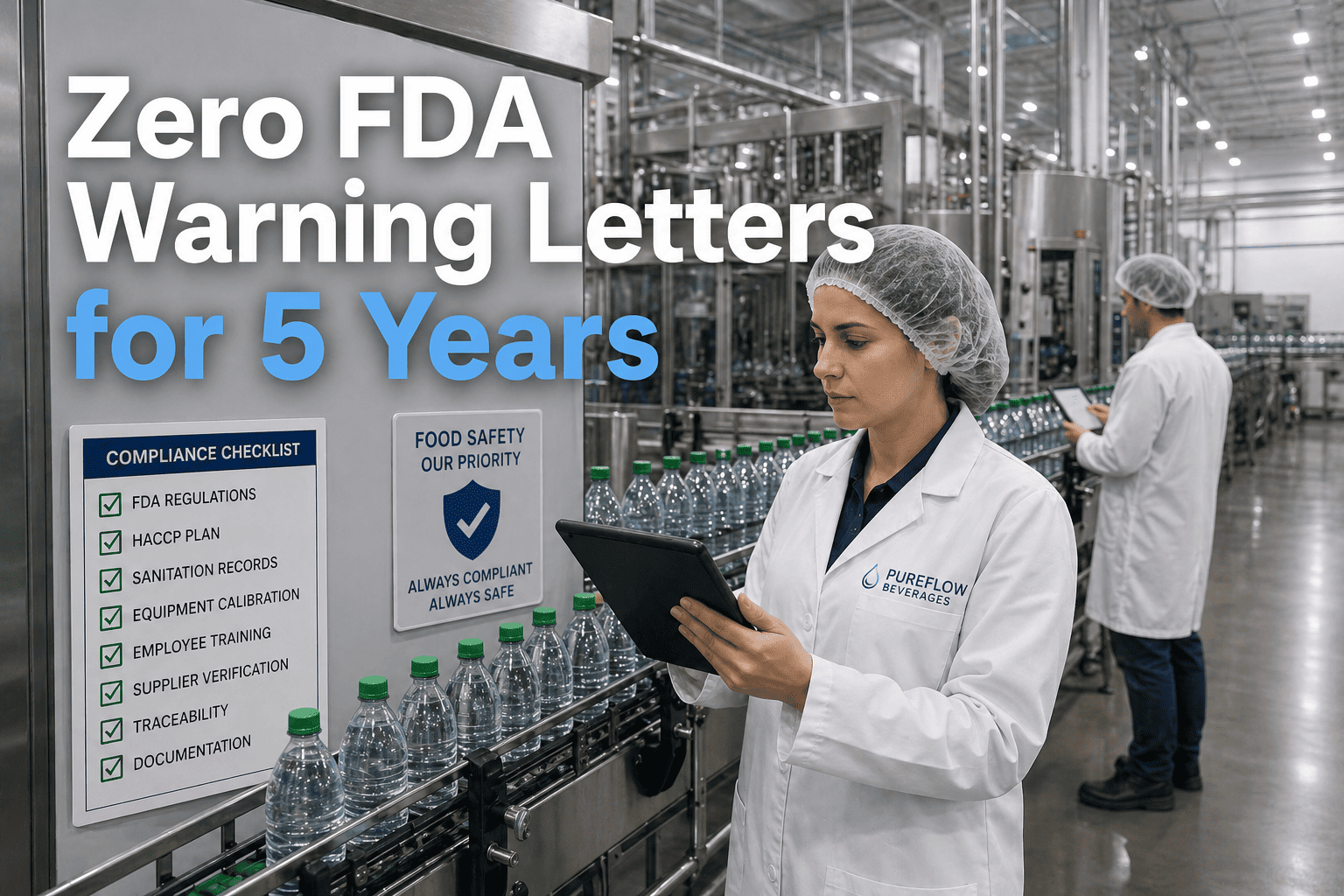
The bottling plant runs three high-speed lines in upstate New York, filling roughly 142 million units of carbonated soft drinks, flavoured waters, and ready-to-drink teas annually. Five years ago, the plant received a Form 483 with seven observations following an FDA inspection — including CIP validation gaps, undocumented sanitiser concentration verification, and incomplete preventive maintenance records on filling and pasteurising equipment. The corrective action plan that followed became the foundation for a structured compliance programme built inside OxMaint. Today, after sixty consecutive months of FDA and customer audits, the plant has zero warning letters on file and zero open FDA observations. Not zero observations during inspections — observations still happen, every facility gets them — but zero that escalated to written warnings or required formal corrective action plans. The shift was not a single project. It was the slow build of a compliance culture where every CIP cycle, every sanitiser titration, every PM completion, and every deviation lived in one system with the timestamps and signatures auditors expect to see. To explore the same compliance backbone on your bottling line, start a free trial — or to see how the audit packet is generated on demand, book a demo.
Beverage Plant Achieves Zero FDA Warning Letters in 5 Consecutive Years
Compliance tracking, CIP validation, and audit-ready documentation built into daily operations — turning FDA inspections from a survival event into a routine confirmation of how the plant already runs.
The Plant at a Glance
What FDA Actually Cites in Beverage Plants
The FDA issued 327 warning letters between July and December 2025 alone — a 73% increase over the same period the previous year. Beverage facilities are not the most-cited category, but they appear consistently. The citations cluster around five preventable categories: CIP and sanitation gaps, equipment maintenance documentation, preventive control verification, allergen control, and water system integrity. The plant in this study turned each category into a structured workflow inside OxMaint.
Missing CIP cycle records, sanitiser concentration not verified, and inadequate documentation of cleaning verification on filler heads, mixing tanks, and product lines.
Equipment PM records incomplete, missing technician signatures, undocumented corrective actions, and gaps between observed wear and recorded inspection findings.
FSMA preventive controls without documented verification activities, no validation of pasteurisation parameters, missing review of monitoring records.
Inadequate cleaning between flavour changeovers, missing allergen verification testing, and undocumented changeover validation when shared lines run multiple SKUs.
Process water system maintenance gaps, RO membrane replacement records missing, and chlorine residual monitoring not documented at the frequency required.
Pasteuriser thermometers, flow meters, and pH probes without calibration records or with calibration intervals exceeded between recorded events.
The Five Compliance Pillars That Held the Streak
The plant did not solve compliance through any single new process. They built five interlocking systems — each with its own KPIs, work order types, and audit-trail discipline — and ran them inside OxMaint as parallel programmes that all feed the same documentation backbone.
Every CIP cycle on every filler, mixing tank, and pasteuriser logs cleaning agent concentration, contact time, temperature, and conductivity rinse verification. The CIP work order does not close until all five parameters are within validated range.
Every PM, CIP cycle, calibration, deviation, and corrective action stored with technician digital signature and timestamp. Audit packet generation runs as a saved query — pulled within 48 hours of an inspector's notice.
Pasteuriser thermometers, flow meters, pH probes, conductivity sensors, and pressure transmitters all registered with calibration intervals. PM work orders generate 14 days before due date with traceable certificate upload required for closure.
SKU-to-SKU changeover SOPs with mandatory allergen verification swab testing on shared equipment. Production cannot restart until the verification step is signed off in OxMaint by Quality.
Process water assets — softeners, RO units, UV systems, storage tanks — registered with daily, weekly, and monthly PMs. Chlorine residual, conductivity, and microbial sampling captured at the frequency required by FSMA.
Every parameter excursion — CIP, pasteurisation, fill weight, seal integrity — generates a deviation record routed to QA with required root cause, corrective action, and verification evidence before closure.
FDA Audits Don't Have to Be a Survival Event
OxMaint runs CIP validation tracking, calibration scheduling, deviation workflows, and audit packet generation as one connected system — so the documentation an inspector asks for is already complete the day before they arrive. To explore on your own assets, start a free trial.
CIP Validation — What Every Cycle Records
CIP validation gaps are the single most-cited FDA category in beverage plants. The fix is not more inspections — it is structured capture of every CIP parameter, every cycle, every line. The plant in this study runs roughly 24 CIP cycles per day across three lines; the OxMaint CIP work order template captures the same five parameters every time, with no skip option.
Initial flush removes loose product residues. Captured: start time, duration, drain conductivity reading at end. Cycle does not advance until duration threshold met.
Strength verified by titration at start and mid-cycle. Captured: concentration, temperature, contact time, return conductivity. Out-of-spec parameter generates deviation record.
Mineral deposit removal and partial passivation. Captured: concentration, temperature, contact time. Acid concentration logged from automatic titration system, not manual estimate.
Verifies cleaning chemistry has been displaced. Captured: rinse duration, exit conductivity, pH neutrality. The work order does not close if conductivity does not drop within range.
Final disinfection step. Captured: sanitiser concentration, contact time, drain method. Test strip result photographed and attached to work order before closure.
Quality reviewer confirms all five parameters within range, attaches CIP curve printout, and electronically signs to release line for production. No production restart without sign-off.
Year-by-Year Audit Outcomes
| Audit Year | FDA Inspections | Form 483 Observations | Customer Audits | Customer Findings | Warning Letters |
|---|---|---|---|---|---|
| Year 1 (baseline) | 2 | 3 | 3 | 5 minor | 0 |
| Year 2 | 1 | 2 | 3 | 3 minor | 0 |
| Year 3 | 2 | 1 | 2 | 2 minor | 0 |
| Year 4 | 1 | 1 | 3 | 1 minor | 0 |
| Year 5 | 2 | 0 | 3 | 1 minor | 0 |
| 5-year total | 8 | 7 (all minor, no escalation) | 14 | 12 (all minor) | 0 |
What Five Years of Compliance Discipline Returned
Frequently Asked Questions
Audit-Ready Should Be the State of the Plant, Not a Project
OxMaint runs CIP validation, calibration scheduling, preventive control verification, and deviation workflows as one connected backbone — so audit documentation builds itself during normal operations and exports on demand. The same platform that supported five consecutive clean years can run on your bottling line starting today.