
A dairy processor in the Midwest ran 14 CIP cycles per day across 6 production lines — each cycle requiring validated temperature, chemical concentration, flow rate, and contact time parameters. Shift 3 operators noticed the caustic return temperature had been drifting 4 degrees below specification for a week. Nobody documented it. Nobody adjusted the cycle. The conductivity sensor on Line 4 had not been calibrated in 9 months. When the annual SQF audit arrived, the auditor pulled CIP validation records and found 47 cycles with incomplete documentation, 12 with no temperature verification, and zero evidence of sensor calibration since the previous audit. The facility received a major non-conformance. Two weeks later, an ATP swab on a filler valve returned a reading 8x above the acceptable limit. The root cause: a clogged spray ball that had been delivering partial coverage for an estimated 3 months. The resulting investigation, corrective action, product hold, and retesting cost $218,000 — not counting the production downtime or the brand damage from a customer complaint that surfaced during the hold period. CIP systems do not fail dramatically. They degrade silently — a sensor drifts, a spray ball clogs, a gasket weeps, a pump loses 15% of its flow rate — and the cleaning cycle that passed validation 18 months ago is now delivering 60% of its original effectiveness while the PLC screen still shows "Cycle Complete." Want to eliminate CIP blind spots across every production line? Book a demo to see how OxMaint tracks every CIP parameter, calibration record, and maintenance task in one audit-ready platform, or start a free trial and begin documenting CIP compliance today.
Stop Guessing If Your CIP System Actually Cleaned.
OxMaint automates CIP maintenance scheduling, tracks every calibration and inspection, and generates audit-ready documentation that satisfies FSMA, SQF, and BRC auditors without paper logs or manual data entry.
What Is CIP System Maintenance and Validation?
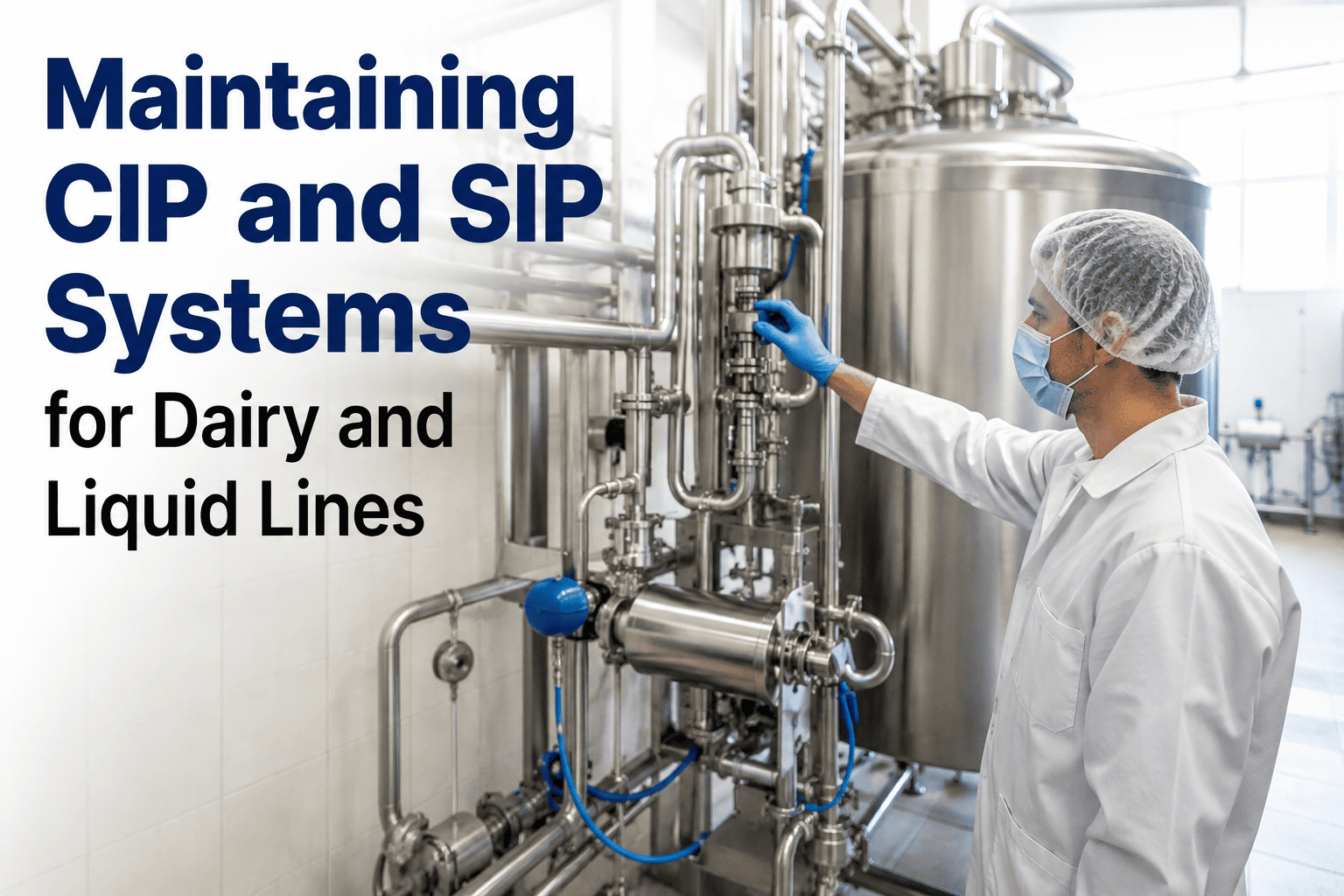
Clean-in-Place is the automated method of cleaning tanks, piping, and processing equipment without disassembly — using controlled combinations of water, heat, chemicals, and flow velocity. CIP maintenance is the structured preventive program that keeps every component of that system performing to its validated specification. CIP validation is the documented proof that each cleaning cycle achieves the required microbial and residue removal under worst-case soil loading conditions. Without maintenance, validated parameters drift. Without validation records, auditors cannot verify compliance. Without both, a CIP system is a machine that runs cycles — not a machine that cleans. The TACT framework — Time, Action (mechanical force from flow), Chemistry (cleaning agent concentration), and Temperature — defines the four interdependent variables that must remain within specification for effective cleaning. Weakness in any one variable compromises the entire cycle, and silent degradation in CIP components is the primary cause of TACT parameter drift. Looking to bring structure to your sanitation maintenance program? Start a free trial and see how OxMaint maps every CIP task to the right asset at the right interval.
Time
Each CIP phase requires minimum contact duration. Short cycles leave residue. Extended cycles waste resources. Validated cycle times must match actual run times within documented tolerances.
Action
Mechanical force from flow velocity — minimum 1.5 m/s (5 ft/s) in pipelines for turbulent scrubbing. Degraded pumps and clogged spray balls reduce action below cleaning thresholds without triggering alarms.
Chemistry
Caustic and acid concentrations must hit validated targets. Dosing pump wear and sensor drift cause concentration deviation that appears normal on the HMI while delivering inadequate cleaning power.
Temperature
Caustic cycles require 70-85 degrees C. Fouled heat exchangers deliver below-spec temperatures — the single most common root cause of incomplete cleaning in food processing plants.
Six CIP Components That Fail Silently
CIP systems do not announce their degradation. Each component below wears gradually, and the cleaning cycle continues running — appearing complete on the PLC screen — while delivering progressively less effective sanitation. Structured preventive maintenance is the only defense against silent CIP failure. Ready to track every component across every circuit? Book a demo and see OxMaint's CIP asset hierarchy in action.
Spray Balls and Rotating Jets
Mineral deposits and product residue clog spray holes, creating coverage gaps on tank surfaces. A spray ball delivering 70% coverage leaves 30% of the surface uncleaned — invisible until an ATP swab or microbial audit catches it.
CIP Supply Pumps
Centrifugal pump impeller wear reduces flow rate 10-20% over 12-18 months. Reduced flow means reduced mechanical action on surfaces — the cleaning cycle runs its full duration but delivers sub-threshold scrubbing force.
Conductivity and pH Sensors
Sensor drift from chemical exposure and thermal cycling causes false readings. A conductivity sensor reading 1.8% caustic when actual concentration is 1.2% approves cycles that are 33% below validated chemistry — with no alarm triggered.
CIP Heat Exchangers
Fouling from mineral scale and product residue reduces heat transfer efficiency. A heat exchanger delivering CIP solution at 65 degrees C instead of the validated 75 degrees C produces a critical process failure that cannot be corrected retroactively.
Pneumatic Valves and Seat Seals
Valves that fail to fully open restrict flow velocity below the cleaning threshold. Valves that fail to fully close allow CIP chemicals to cross-contaminate adjacent circuits or product zones — a direct food safety hazard.
Chemical Dosing Pumps
Diaphragm and peristaltic dosing pumps lose accuracy as internal components wear. A pump delivering 85% of target volume produces under-concentrated cleaning solution that the PLC records as a complete cycle — zero visibility into the actual chemistry reaching surfaces.
Unmanaged CIP vs. CMMS-Managed CIP
The difference between a CIP system that runs and a CIP system that cleans comes down to whether maintenance, calibration, and validation are tracked systematically or left to operator memory and paper logs.
How OxMaint Manages CIP Maintenance End-to-End
OxMaint maps every CIP component to a structured asset hierarchy — from the CIP skid down to individual spray balls, sensors, and valve seats — and generates preventive maintenance tasks at validated intervals with full documentation capture. No paper. No memory-dependent scheduling. No missing records during audits. Want to see how it works for your facility? Start a free trial today.
CIP Asset Registry
Every CIP circuit, tank, pump, valve, spray device, sensor, and heat exchanger is registered with manufacturer specs, installation dates, calibration schedules, and validated operating parameters. The asset hierarchy connects each component to its circuit and production line — so a spray ball replacement on Tank 4 is linked to the CIP circuit, the production line, and the validation record.
Automated PM Scheduling
Daily pre-shift checks, weekly component inspections, monthly calibrations, and quarterly validations are auto-generated as work orders with the correct frequency, assigned technician, and required documentation fields. Nothing depends on a supervisor remembering to schedule it. Each task triggers at the validated interval — no early, no late, no missed.
Digital Inspection and Calibration Capture
Technicians complete CIP inspections on mobile devices — recording flow rates, temperatures, conductivity readings, and visual observations with timestamped photos. Calibration records capture before/after readings, standards used, and next-due dates. Every data point attaches to the specific asset and work order automatically.
Audit-Ready Compliance Documentation
OxMaint generates the compliance evidence that FSMA, SQF, BRC, and FDA auditors require — sensor calibration histories, PM completion rates, validation records, corrective action documentation, and parts replacement histories. Every record is searchable, timestamped, and available in seconds during an audit, not buried in filing cabinets.
CIP Maintenance Impact: The Numbers That Matter
CIP Validation: What Auditors Actually Look For
CIP validation is not a one-time event. Initial validation establishes the baseline. Ongoing verification confirms each cycle meets that baseline. Re-validation is triggered by any system change — new products, modified circuits, different chemicals, altered parameters. Auditors from SQF, BRC, and FDA expect documented evidence of all three layers. Facilities without structured validation tracking face major non-conformances and, in severe cases, product holds and recalls. Need to get your validation records audit-ready? Book a demo and see how OxMaint structures CIP validation documentation.
Installation Qualification (IQ)
Documented verification that CIP equipment is installed according to manufacturer specifications. Piping diagrams, valve positions, spray device placement, and sensor locations are confirmed and recorded. OxMaint stores IQ documentation as the baseline record for each CIP circuit asset.
Operational Qualification (OQ)
Verification that CIP cycles operate within validated TACT parameters under normal conditions. Flow rates, temperatures, chemical concentrations, and contact times are measured and documented across multiple test cycles. OxMaint tracks OQ records linked to specific circuits and production configurations.
Performance Qualification (PQ)
Proof that CIP cycles achieve required microbial and residue removal under worst-case soil loading conditions. ATP swab results, microbiological surface testing, and rinse water analysis are documented. OxMaint links PQ results to the specific cycle parameters and maintenance state of each circuit at the time of testing.
Ongoing Verification and Re-Validation
Routine conductivity checks, temperature verification, and flow rate confirmation on every cycle. Formal re-validation triggered by equipment changes, new product introductions, chemical supplier changes, or circuit modifications. OxMaint flags re-validation requirements automatically when linked assets are modified.
Frequently Asked Questions
How often should CIP sensors be calibrated?
Conductivity and pH sensors should be calibrated monthly at minimum, with additional calibration after any maintenance event, chemical supplier change, or reading that deviates more than 5% from expected values. Temperature sensors should be verified weekly against a calibrated reference. OxMaint auto-schedules calibration work orders and captures before/after readings as permanent compliance records.
When does a CIP system require re-validation?
Re-validation is required after any change to vessel geometry, circuit length, product type, chemical supplier, or CIP program parameters. Under FSMA preventive controls, running a legacy validated protocol on a modified system without re-validation constitutes regulatory non-compliance. Annual review of validation data against current operational parameters is recommended as a minimum baseline. Book a demo to see how OxMaint tracks re-validation triggers.
What CIP maintenance records do SQF and BRC auditors expect?
Auditors expect documented evidence of sensor calibration histories with dates, standards used, and before/after readings. PM completion records for all CIP components with timestamps and technician identification. Validation and re-validation reports proving cleaning efficacy. Corrective action records for any CIP deviation. Digital records with automatic retention satisfy these requirements more reliably than paper-based systems.
Can OxMaint integrate with existing CIP PLC and SCADA systems?
Yes. OxMaint supports IoT and SCADA integration for real-time data capture from CIP controllers. Cycle parameters — time, temperature, flow rate, conductivity — can be automatically recorded and attached to the corresponding work order and asset record. Out-of-spec readings trigger automatic alerts and corrective action workflows. Start free and explore SCADA integration capabilities.
Your CIP System Ran. Did It Actually Clean?
OxMaint gives your sanitation and maintenance teams a single platform to schedule CIP preventive maintenance, capture calibration and inspection data digitally, generate audit-ready compliance documentation, and track every component from spray ball to heat exchanger across every production line and CIP circuit. Stop relying on PLC screens and paper logs. Start proving your CIP system performs to specification on every cycle.


-system-maintenance-best-practices-for-food-and-beverage.png)
