Spray dryers are among the highest-hazard pieces of equipment in any food plant. They concentrate finely divided, combustible powder inside a heated chamber with the ignition energy already on hand — the conditions a Dust Hazard Analysis (DHA) classifies as catastrophic on the first page. NFPA 652, NFPA 61, NFPA 68, and NFPA 69 collectively define the design, prevention, mitigation, and inspection discipline required to operate a dairy or nutritional powder spray dryer legally and safely in the United States. The standards mean little if the explosion vent panel inspection log lives on a clipboard, the rotary airlock isolation valve has not been tested since installation, or the atomiser nozzle wear record is a senior operator's memory. A single deflagration event inside a 200 m³ drying tower destroys the asset, takes the line offline for months, and routinely triggers OSHA general-duty-clause findings even when the protective devices were technically present. Start a free trial to digitise spray dryer PM, CIP, and NFPA-compliance evidence — or book a demo to see how Oxmaint produces inspector-ready records on the explosion-protection chain.
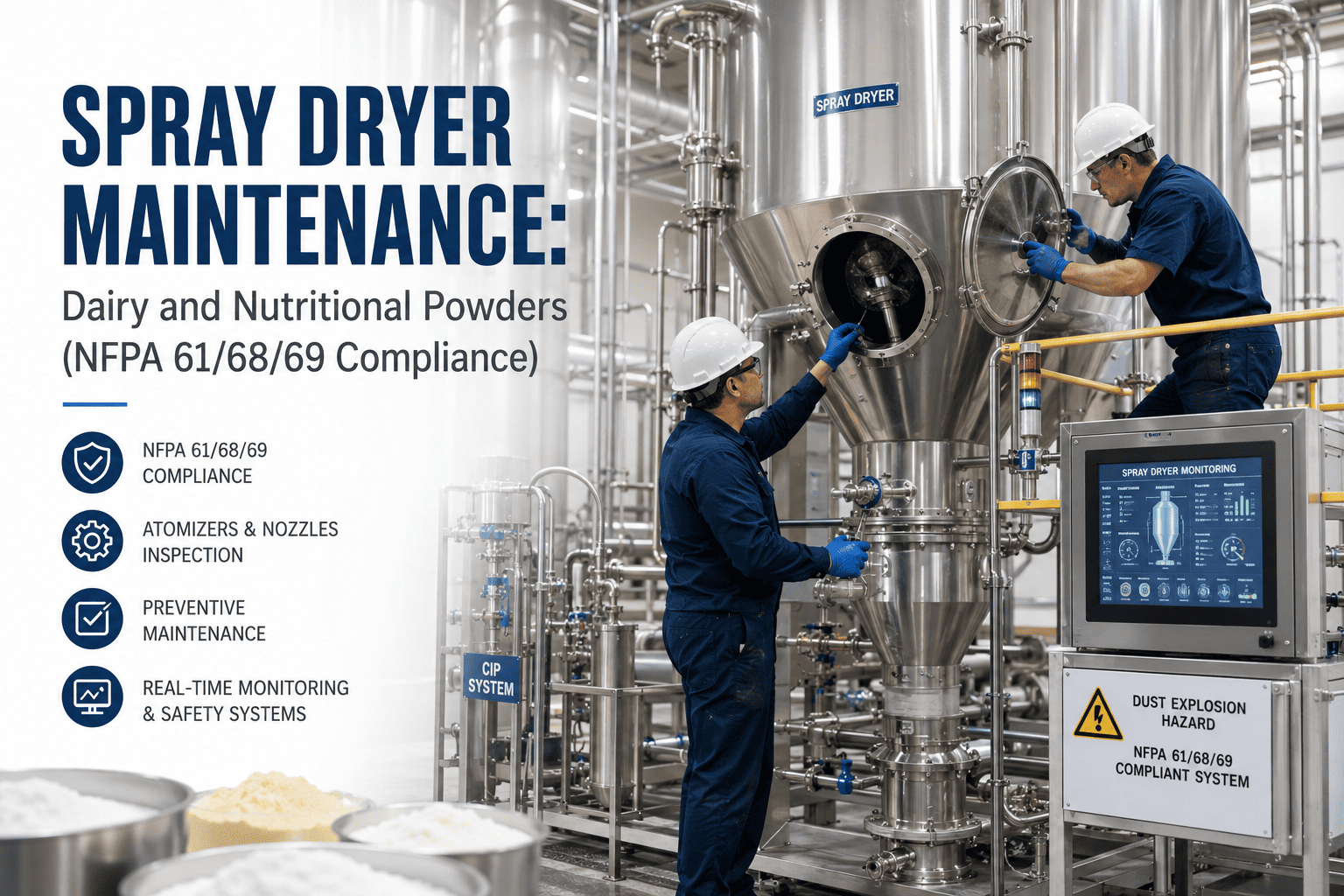
Spray Dryer Maintenance: Dairy and Nutritional Powders (NFPA 61/68/69 Compliance)
Nozzles, atomisers, CIP, and NFPA 61/68/69 dust-explosion compliance — every spray dryer asset on a documented PM and inspection record. See how dairy, infant formula, and nutritional powder operators prove DHA, vent, and suppression evidence on first request.
What Spray Dryer Maintenance Actually Covers
Spray dryer maintenance is the integrated PM, CIP, calibration, and explosion-protection inspection programme that keeps a dairy, infant formula, or nutritional powder dryer running safely and on spec. It spans the wet end (atomiser nozzles or rotary atomiser, feed pumps, filter housings), the drying chamber (air heater, distribution plenum, chamber walls and inspection ports), the powder-handling end (cyclone, baghouse, rotary airlocks, pneumatic conveying), and the entire explosion-protection chain (vent panels per NFPA 68, suppression bottles per NFPA 69, isolation valves, spark detection and divert systems).
The model matters because every regulatory framework — NFPA 61 for food and agricultural facilities, NFPA 68 for venting, NFPA 69 for prevention and suppression, NFPA 652 for the underlying dust hazard analysis — assumes the protective devices are inspected, tested, and documented on a schedule that survives the auditor's request. Operators that move from paper-and-spreadsheet records to a structured CMMS programme typically eliminate overdue protective-device inspections within 90 days and produce inspector-ready DHA and CIP evidence on demand — start a free trial to see how the workflow runs on your tower.
Six Pillars of an NFPA-Aligned Spray Dryer Programme
Six concepts separate spray dryer programmes that pass NFPA, OSHA, and FDA scrutiny from those that produce findings on first inspection. Each is a documented control the inspector will specifically look for.
Where Spray Dryer Programmes Break Down
Spray dryer compliance failures show up in the same six patterns across dairy, infant formula, and nutritional powder operators. Each one looks small in isolation and lethal in combination. Plants that close even two of these gaps typically pass their next NFPA and FDA inspection without scrambling — start a free trial to map your own profile.
How Oxmaint Runs Spray Dryer Maintenance and NFPA Evidence
Oxmaint structures spray dryer maintenance as one connected workflow that covers PM, CIP, calibration, and the full NFPA 61/68/69 inspection chain. Vent panel inspections, suppression bottle pressure tests, isolation valve function checks, and DHA review cycles each have their own template, frequency, and audit-ready record. Start a free trial to see the inspection chain on your tower.
Paper-Based NFPA Records vs Structured CMMS Programme — Side by Side
The gap between paper-based NFPA evidence and a structured CMMS programme is widest in the four moments inspectors and DHA reviewers specifically test — retrieval speed, completeness of inspection chain, vent panel chain-of-custody, and CIP traceability. The comparison below is built from dairy and nutritional powder operators that completed the transition.
| Compliance Dimension | Paper-Based NFPA Programme | Structured CMMS Programme |
|---|---|---|
| DHA review cycle | Manual, often lapsed | Auto-triggered on product / line change |
| Vent panel chain-of-custody | Installation cert only | Inspection, replacement, photo evidence |
| Suppression bottle tests | Annual paper certificate | Scheduled tests with signed records |
| Isolation valve verification | Assumed, rarely tested | Function-test workflow per cycle |
| CIP audit retrieval | Binder hunt | Filtered export in seconds |
| Hot-work / bonding log | Paper permits, often incomplete | Digital permit + bonding record |
| Inspector retrieval window | Days | Minutes |
ROI After Structured NFPA Programme Rollout
The numbers below come from dairy, infant formula, and nutritional powder operators that completed a 6–12 week move from paper-based NFPA evidence and reactive maintenance to a structured CMMS programme. The pattern is consistent — overdue inspections eliminated, audit findings dropped, and the cost of any single avoided deflagration event paying back the platform many times over.
Frequently Asked Questions
Does Oxmaint support both NFPA 68 vented and NFPA 69 suppressed dryer designs
How is the Dust Hazard Analysis kept current as products and processes change
Can Oxmaint capture CIP cycle data automatically from PLC or SCADA
How fast can a multi-tower dairy or nutritional powder operation deploy
Stop Carrying Avoidable Risk Inside a Heated Dust Cloud
Turn every NFPA 61, 68, 69, and 652 control into a documented, signed, audit-ready record — and let the inspection chain run on schedule, every cycle.