A snack food manufacturer in Ohio operated their maintenance program in isolation for years. Work orders lived in the CMMS. Parts costs appeared in the ERP system weeks later after manual reconciliation. Equipment sensor data scrolled across HMI screens but never connected to maintenance planning. When the CFO asked why maintenance costs had increased 23% while production volume stayed flat, no one could answer with confidence because the data existed in five different systems that never talked to each other. After implementing CMMS integrations connecting maintenance with ERP financials, IoT sensor feeds, and production scheduling, the picture became clear: emergency repairs on aging packaging equipment were consuming budget while PM resources were allocated to newer equipment that rarely failed. Within eight months of integration-driven reallocation, maintenance costs dropped 18% while equipment availability improved to 94%.
Integration transforms maintenance from an isolated function into a connected node in plant operations. When maintenance systems communicate with ERP, every work order carries accurate cost data. When IoT sensors feed the CMMS, condition-based maintenance becomes possible. When production scheduling shares calendars with maintenance planning, PM work happens during actual windows rather than theoretical ones. The value of a CMMS multiplies when it connects to the systems that provide context and consume its outputs.
Sign up to connect your maintenance systems or book a demo to see how enterprise integrations transform maintenance visibility and control.
Enterprise Integrations
Enterprise Integrations for Food Manufacturing (ERP, IoT, Identity)
Connect maintenance with ERP financials, IoT sensor data, production scheduling, and identity management for unified operational visibility.
Of Plants Operate Maintenance in Isolation from Other Systems
Average Cost Visibility Improvement with ERP Integration
Reduction in Manual Data Entry with Full Integration
2.8x
faster
Response to Equipment Anomalies with IoT Integration
Why Integration Matters for Food Manufacturing Maintenance
Food manufacturing maintenance operates within a complex ecosystem of interdependent systems. ERP systems manage financial transactions, inventory, and purchasing. Production systems control scheduling and equipment operation. Quality systems track compliance and food safety. IoT platforms collect real-time equipment data. Identity systems manage access and accountability. When maintenance operates in isolation from these systems, critical information flows through manual processes that introduce delays, errors, and blind spots.
The consequences of disconnected systems compound over time. Parts purchases in the CMMS do not automatically update ERP inventory. Equipment failures captured in production logs require manual re-entry into maintenance. Sensor data indicating developing problems sits in historian databases unseen by maintenance planners. Cost allocations require end-of-month reconciliation marathons. And auditors face the challenge of correlating maintenance records across multiple systems that use different identifiers for the same equipment.
72%
of food manufacturing plants operate maintenance systems without meaningful integration to ERP, production, or IoT platforms. These plants spend an average of 15 hours per week on manual data transfer, reconciliation, and report compilation that integration would eliminate.
Integration addresses these challenges by creating automated data flows between systems. Work order costs flow to ERP in real-time. Sensor anomalies trigger maintenance notifications automatically. Production schedules inform PM planning without manual calendar comparison. And a single source of truth emerges for equipment, costs, and maintenance history that supports both operational decisions and compliance documentation.
Sign up for Oxmaint to connect maintenance with your enterprise systems and eliminate manual data silos.
ERP Integration
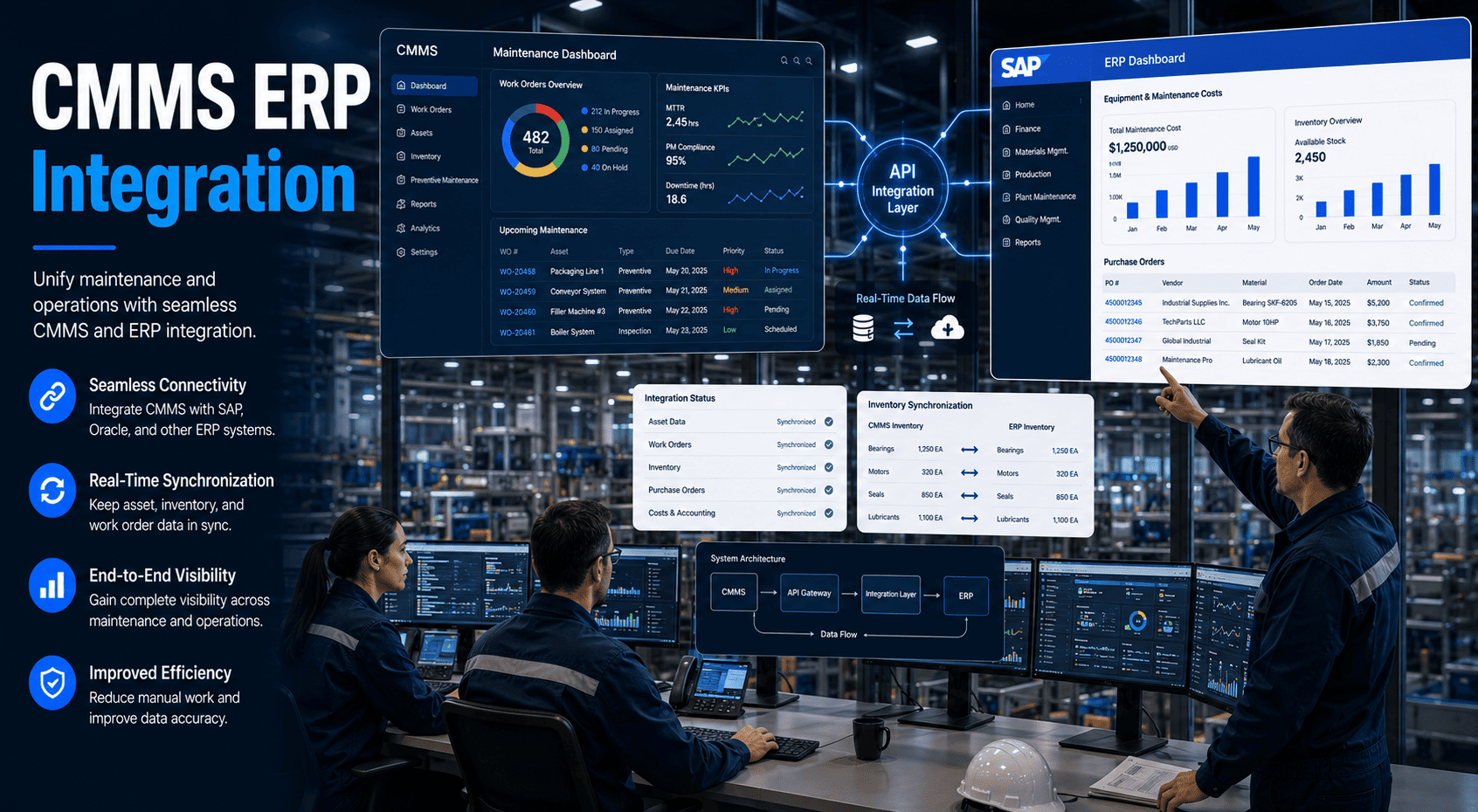
ERP integration connects maintenance operations with financial systems, inventory management, and procurement processes. This integration provides cost visibility, streamlines purchasing, and ensures accurate inventory tracking for maintenance parts and materials.
Data Flows: CMMS to ERP
Work order labor costs with cost center allocation
Parts consumption transactions updating inventory
Purchase requisitions for parts and services
Equipment downtime records for production costing
Asset acquisition and disposition records
Contractor and service invoice approvals
Data Flows: ERP to CMMS
Parts master data with pricing and suppliers
Inventory availability and stock locations
Purchase order status and delivery dates
Vendor information and approved supplier lists
Cost center and GL account structures
Employee master data for labor tracking
Integration Benefits
Real-Time Cost Visibility
Maintenance costs appear in financial reports as work completes, not weeks later after manual reconciliation.
Inventory Accuracy
Parts transactions update both systems simultaneously, eliminating discrepancies and improving reorder accuracy.
Streamlined Purchasing
Maintenance requisitions flow directly to procurement with proper approvals and coding.
Budget Management
Maintenance managers see real-time budget consumption against approved amounts.
IoT and Sensor Integration
IoT integration connects real-time equipment data with maintenance planning and execution. Sensor feeds enable condition-based maintenance, automated alerts, and predictive analytics that transform maintenance from calendar-based to condition-based.
Data Flows: IoT to CMMS
Equipment operating parameters (temperature, pressure, flow)
Vibration signatures and trend data
Runtime hours and cycle counts for meter-based PM
Alarm and fault conditions triggering work orders
Energy consumption patterns
Predictive analytics outputs and health scores
Data Flows: CMMS to IoT
Equipment master data for sensor contextualization
Maintenance status affecting alarm thresholds
Work order completion updating equipment status
Calibration data for sensor validation
Asset hierarchy for data organization
Integration Benefits
Condition-Based Maintenance
Replace calendar-based PM with condition-triggered maintenance that addresses actual equipment needs.
Automated Work Orders
Sensor anomalies automatically generate work orders with relevant diagnostic data attached.
Faster Response
Problems detected and notified immediately rather than waiting for operator reports or scheduled inspections.
Predictive Capability
Analytics predict failures before they occur, enabling proactive intervention during planned windows.
Connect Your Systems. Multiply Your Visibility.
Oxmaint provides pre-built connectors and flexible APIs that integrate with your existing enterprise systems. See how connected maintenance transforms operational decision-making.
Production System Integration
Production system integration aligns maintenance activities with manufacturing schedules, ensuring PM work happens during actual available windows and equipment status accurately reflects production needs.
Data Flows: Production to CMMS
Production schedule and equipment availability windows
Sanitation schedules creating maintenance opportunities
Equipment downtime events and duration
Production line status and changeover timing
Quality events requiring maintenance investigation
OEE data identifying equipment performance issues
Data Flows: CMMS to Production
Planned maintenance windows requiring production coordination
Equipment status after maintenance completion
Expected repair duration for scheduling adjustment
Maintenance-related equipment restrictions
Post-maintenance clearance for production restart
Integration Benefits
Schedule Alignment
PM scheduling automatically considers production windows, reducing conflicts and deferrals.
Window Utilization
Sanitation and changeover windows automatically flagged for maintenance opportunity.
Downtime Accuracy
Equipment downtime captured from production system rather than manual estimation.
Coordinated Communication
Maintenance status visible to production scheduling without phone calls or meetings.
Identity and Access Management Integration
Identity integration connects CMMS user management with enterprise identity systems, ensuring secure access, proper authorization, and accountability for maintenance activities that affect food safety and regulatory compliance.
Integration Capabilities
Single Sign-On (SSO) with enterprise credentials
Multi-factor authentication for sensitive functions
Role-based access control synchronized with HR systems
Automatic provisioning and deprovisioning of user accounts
Audit trail of access and authorization changes
Electronic signature compliance (21 CFR Part 11)
Security Benefits
Centralized access management reduces security gaps
Terminated employees automatically lose CMMS access
Role changes automatically update permissions
Consistent authentication across all enterprise systems
Compliance with data protection requirements
Complete audit trail for regulatory inspections
Integration Benefits
User Experience
Technicians use the same credentials for CMMS as all other systems, reducing password fatigue.
Security Compliance
Meet IT security policies and regulatory requirements for access control.
Administrative Efficiency
User management happens centrally rather than in each individual system.
Accountability
Every action traceable to verified identity for compliance documentation.
Quality and Food Safety System Integration
Integration with quality and food safety systems ensures maintenance activities support compliance requirements and that equipment status is visible to quality management processes.
Data Flows: QMS to CMMS
Quality events requiring maintenance investigation
CCP equipment performance requirements
Calibration requirements and schedules
Audit findings requiring corrective action
Change control requests affecting equipment
Food safety equipment validation requirements
Data Flows: CMMS to QMS
Maintenance completion records for CCP equipment
Calibration certificates and verification records
Equipment status affecting product disposition
Corrective action completion and verification
PM compliance metrics for management review
Equipment modification documentation
Integration Benefits
Compliance Visibility
Quality team sees maintenance compliance status without requesting reports.
Rapid Response
Quality events trigger maintenance investigation automatically.
Audit Readiness
Maintenance records accessible from QMS for audit response.
Coordinated CAPA
Corrective actions flow between systems without duplication.
Integration Designed for Food Manufacturing
Oxmaint provides flexible integration options including REST APIs, pre-built connectors, and webhook support. Connect your existing systems without replacing what works.
Measuring Integration Value
Quantifying integration benefits helps justify investment and prioritize additional integration efforts. These metrics demonstrate integration value in food manufacturing environments.
Manual Data Entry Reduction
Target: 80%+ reduction in duplicate data entry across systems
Report Generation Time
Target: From hours to minutes for cross-system reports
Reconciliation Effort
Target: Eliminate end-of-period reconciliation marathons
Data Consistency
Target: 99%+ match between systems for shared data
Data Latency
Target: Under 15 minutes for time-sensitive data
Error Rate
Target: Under 0.1% transaction failure rate
Cost Visibility
Target: Real-time maintenance cost tracking vs. month-end
Response Time
Target: Sensor-to-work-order under 5 minutes for IoT integration
PM Schedule Adherence
Target: Improved adherence through production calendar integration
Audit Response Time
Target: Cross-system data retrieval under 4 hours
Data Traceability
Target: Complete audit trail across integrated systems
Electronic Signature Compliance
Target: 21 CFR Part 11 compliance for integrated workflows
Frequently Asked Questions: CMMS Integrations
How long does integration implementation typically take?
Implementation timelines vary significantly based on complexity. Simple file-based integrations may take 2-4 weeks. API integrations with modern cloud systems typically require 4-8 weeks. Complex ERP integrations involving multiple data flows can take 3-6 months. The biggest variable is usually data mapping and business rule definition rather than technical implementation.
Do we need IT resources dedicated to integration maintenance?
Modern integrations with good monitoring require relatively little ongoing maintenance. Plan for 2-4 hours monthly for monitoring review and issue resolution. Major system upgrades (ERP updates, CMMS upgrades) require integration testing and potentially updates. Cloud-based integration platforms and well-designed APIs reduce maintenance burden compared to custom point-to-point integrations.
Can we integrate with older systems that do not have APIs?
Yes, though options are more limited. File-based integration works with virtually any system that can export or import data files. Database-level integration can read from legacy databases directly. Screen scraping and RPA tools can automate data extraction from systems without proper interfaces. The right approach depends on what the legacy system supports and data timeliness requirements.
Book a demo to discuss integration options for your specific system landscape.
What security considerations apply to CMMS integrations?
Integration security requires attention to authentication, data protection, and access control. Use encrypted connections (TLS/SSL) for all data transfers. Implement API keys or OAuth for authentication. Apply principle of least privilege to integration accounts. Maintain audit logs of integration transactions. For IoT integrations, ensure proper network segmentation between OT and IT systems. Review integration security with your IT security team before implementation.
Should we prioritize ERP or IoT integration first?
The answer depends on your biggest pain points. If cost visibility and inventory accuracy are primary concerns, start with ERP integration. If equipment reliability and condition-based maintenance are priorities, IoT integration may deliver more value. ERP integration is typically more straightforward because ERP systems have mature integration capabilities, while IoT integration often requires infrastructure preparation. Most plants ultimately benefit from both, but sequencing based on immediate value makes sense.
Connect Your Maintenance. Transform Your Operations.
Oxmaint integrates with your ERP, IoT platforms, production systems, and identity providers to create unified maintenance visibility. See how connected systems multiply the value of your CMMS investment.