Food Manufacturer Standardizes Maintenance Across 12 Plants
By Josh Turley on April 29, 2026
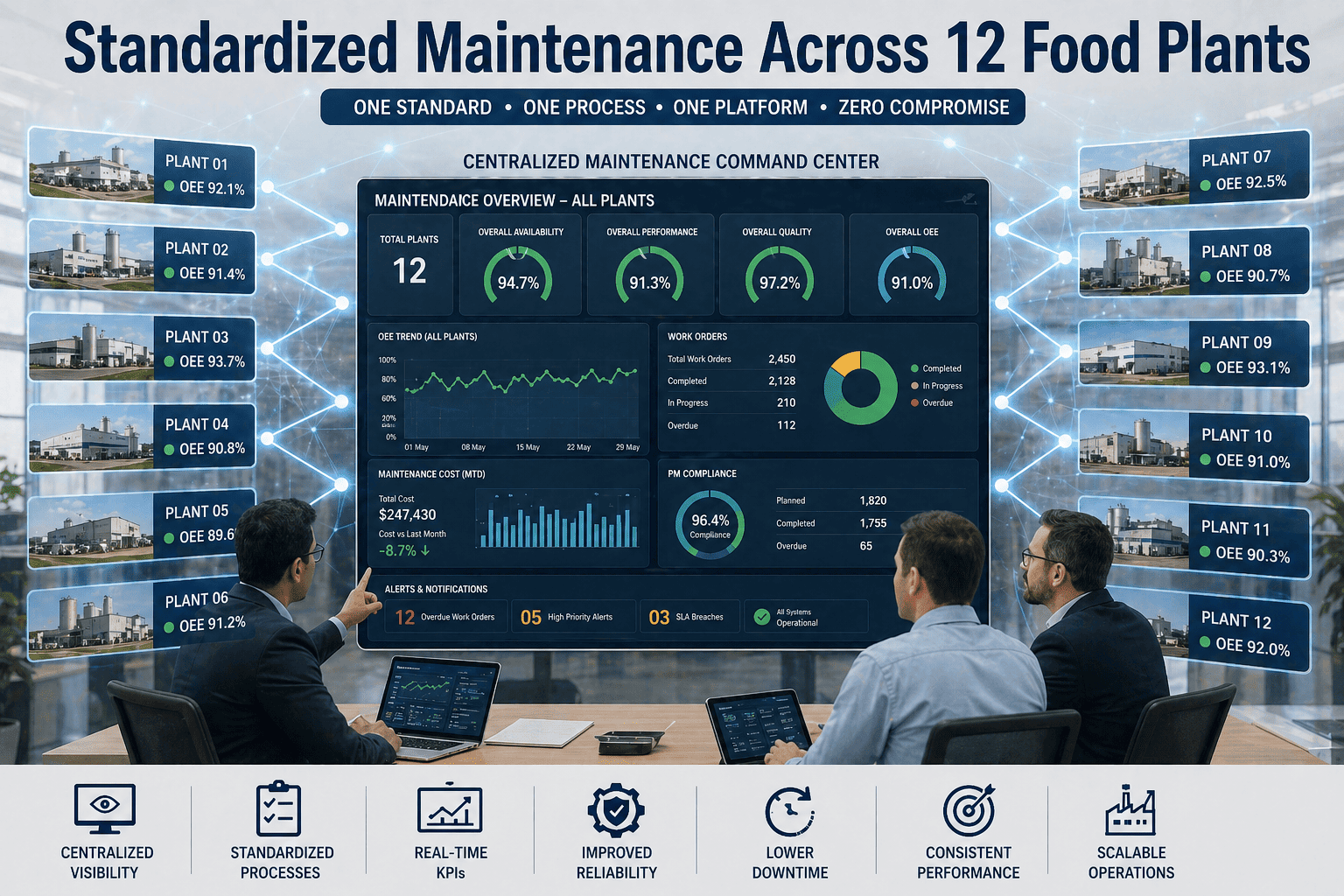
Running maintenance across 12 food manufacturing facilities without a shared system is like managing 12 separate businesses — each with its own spreadsheets, PM calendars, and spare parts logic. The result is predictable: compliance gaps, cost variance of 30–50% between plants, and audit exposure that keeps the VP of Operations awake before every FDA inspection cycle. This case study documents how a multi-site food manufacturer eliminated that fragmentation — standardizing maintenance across all 12 plants, reducing total maintenance costs by 30%, and achieving 96% PM compliance network-wide within 14 months. If you manage maintenance across multiple food facilities, start a free trial with Oxmaint or book a multi-site assessment call to see what standardization looks like at your scale.
Enterprise Food Manufacturing
How a Food Manufacturer Standardized Maintenance Across 12 Plants and Cut Costs by 30%
A multi-facility food manufacturer replaced 12 disconnected maintenance systems with one CMMS platform — achieving network-wide PM compliance, a 30% cost reduction, and full audit readiness across all sites within 14 months.
30%
Total maintenance cost reduction
96%
Network-wide PM compliance
12
Plants standardized on one platform
14mo
Time to full network deployment
Managing maintenance across multiple food plants? Oxmaint gives every site a shared system with local execution and centralized oversight — built for multi-facility food operations.
The Multi-Plant Maintenance Problem Nobody Talks About
At single-facility scale, disconnected maintenance systems are manageable. At 12 facilities, fragmentation becomes a strategic liability — with direct financial and compliance consequences that compound every quarter.
Cost Variance
30–50%
Cost-per-asset varies by 30–50% between plants running identical equipment with no shared standards — all pure waste.
Audit Exposure
12x Risk
Each site using a different PM record format multiplies audit preparation time and compliance risk — especially under FDA 21 CFR Part 117 and FSMA.
Inventory Duplication
18–25%
Facilities with no shared parts catalog carry 18–25% excess inventory. Plants 40 miles apart stockpile identical parts with no visibility into each other's stores.
No Benchmarking
Zero Visibility
Without a shared KPI layer, leadership cannot identify which plants are best-in-class — or which ones are dragging the network down with preventable costs.
Where the 12-Plant Network Stood Before Standardization
Before deploying Oxmaint, a full maintenance audit across all 12 sites revealed the scale of the fragmentation. The findings justified immediate action.
PM Systems in Use
7 different tools
Spreadsheets, legacy CMMS platforms, paper binders, and two plants with no formal system at all.
Average PM Compliance
54% network-wide
Top plant hit 79%; lowest plant ran at 31%. No shared standard, no accountability mechanism.
Cost per Asset (annual)
Variance: 44%
Identical assets maintained at vastly different costs across sites — no shared labor rates, contractor frameworks, or parts pricing.
Audit Prep Time per Site
3–6 weeks
Each facility spent 3 to 6 weeks assembling maintenance records for every FDA or SQF audit — manually pulling from disparate systems.
Spare Parts Inventory Excess
$2.1M excess stock
Network-wide audit identified $2.1 million in excess or duplicate spare parts inventory held across 12 stores with no shared visibility.
Cross-Plant Knowledge Transfer
None formal
Best practices from high-performing plants existed only in the heads of individual technicians — never documented or shared across sites.
The Standardization Roadmap: 5 Phases Over 14 Months
Oxmaint's multi-site deployment followed a phased approach — rolling out by plant cluster to minimize operational disruption while building momentum with early-adopter sites.
Phase 1
Months 1–2
Asset Registry & Master PM Library
All 12 plants' asset lists were consolidated into a single Oxmaint asset registry. A master PM template library was built for 14 equipment categories common across sites — fryers, conveyors, packaging lines, CIP systems, compressors — with interval, task, and compliance documentation standardized.
Phase 2
Months 3–5
Pilot Rollout: 3 Plants
The 3 highest-volume facilities went live first. Existing paper and spreadsheet PM records were migrated. Technicians received mobile app training. PM compliance at pilot plants rose from an average of 61% to 88% within 8 weeks of go-live.
Phase 3
Months 6–9
Network Rollout: Remaining 9 Plants
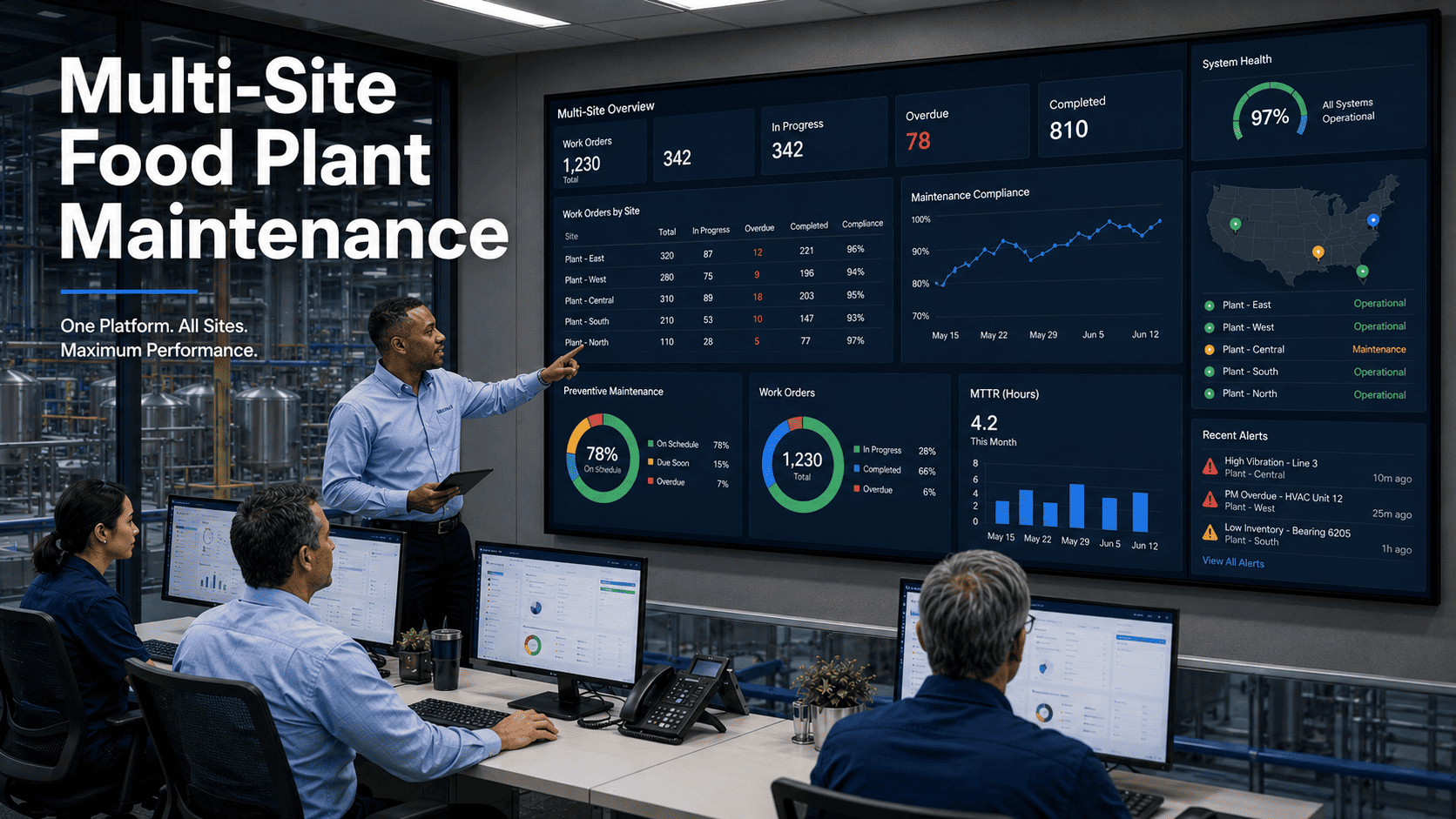
Remaining plants deployed using the validated pilot configuration. Shared spare parts catalog went live — each site could now view and request parts from any other facility's inventory. Emergency parts expediting costs began declining immediately.
Phase 4
Months 10–12
KPI Benchmarking Dashboard
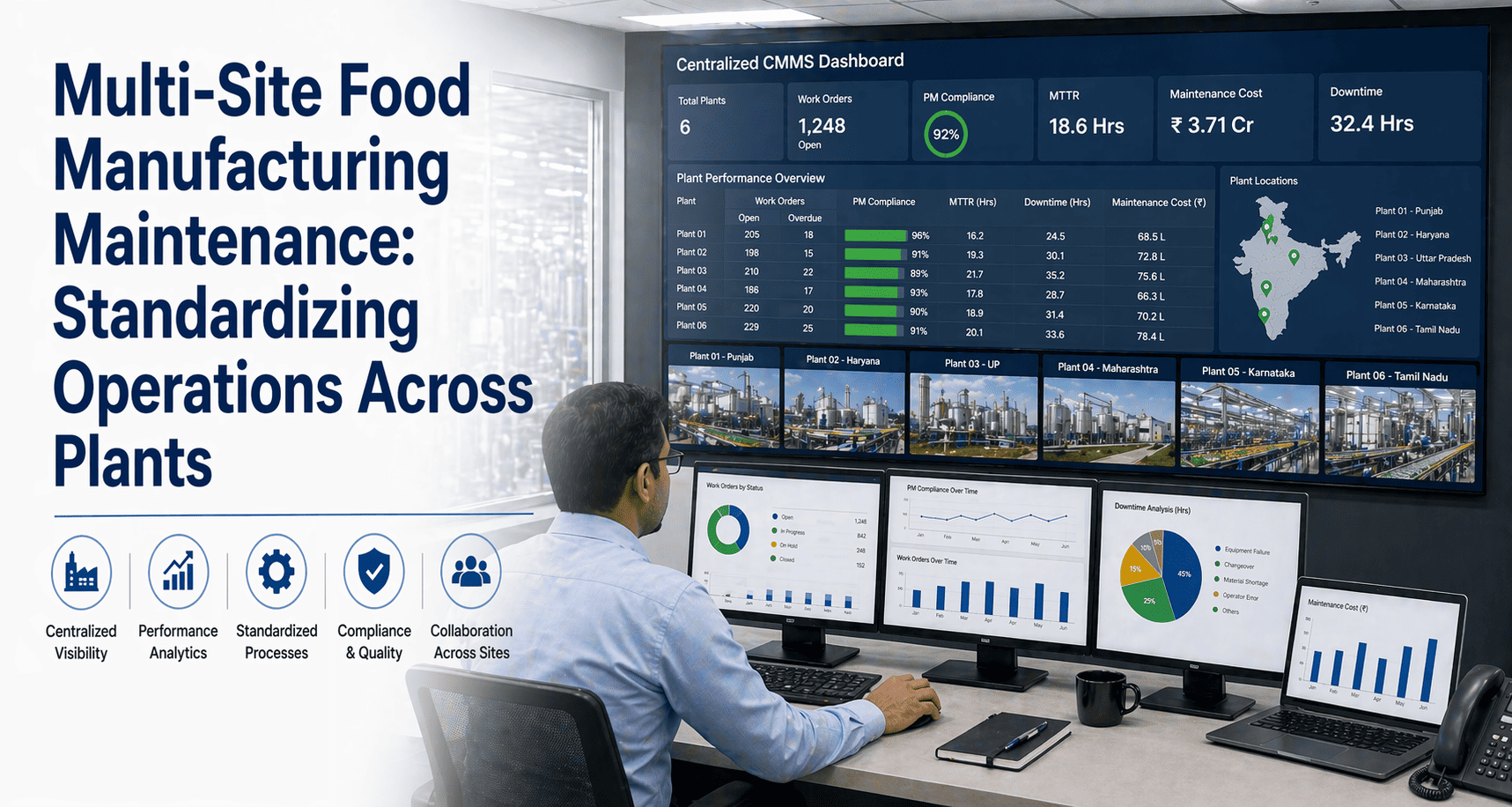
Corporate operations leadership gained a multi-plant dashboard showing PM compliance, cost-per-asset, MTTR, and downtime frequency by site. For the first time, the VP of Operations could rank all 12 plants against each other and target improvement resources to the lowest performers.
Phase 5
Months 13–14
Audit Readiness & Continuous Improvement
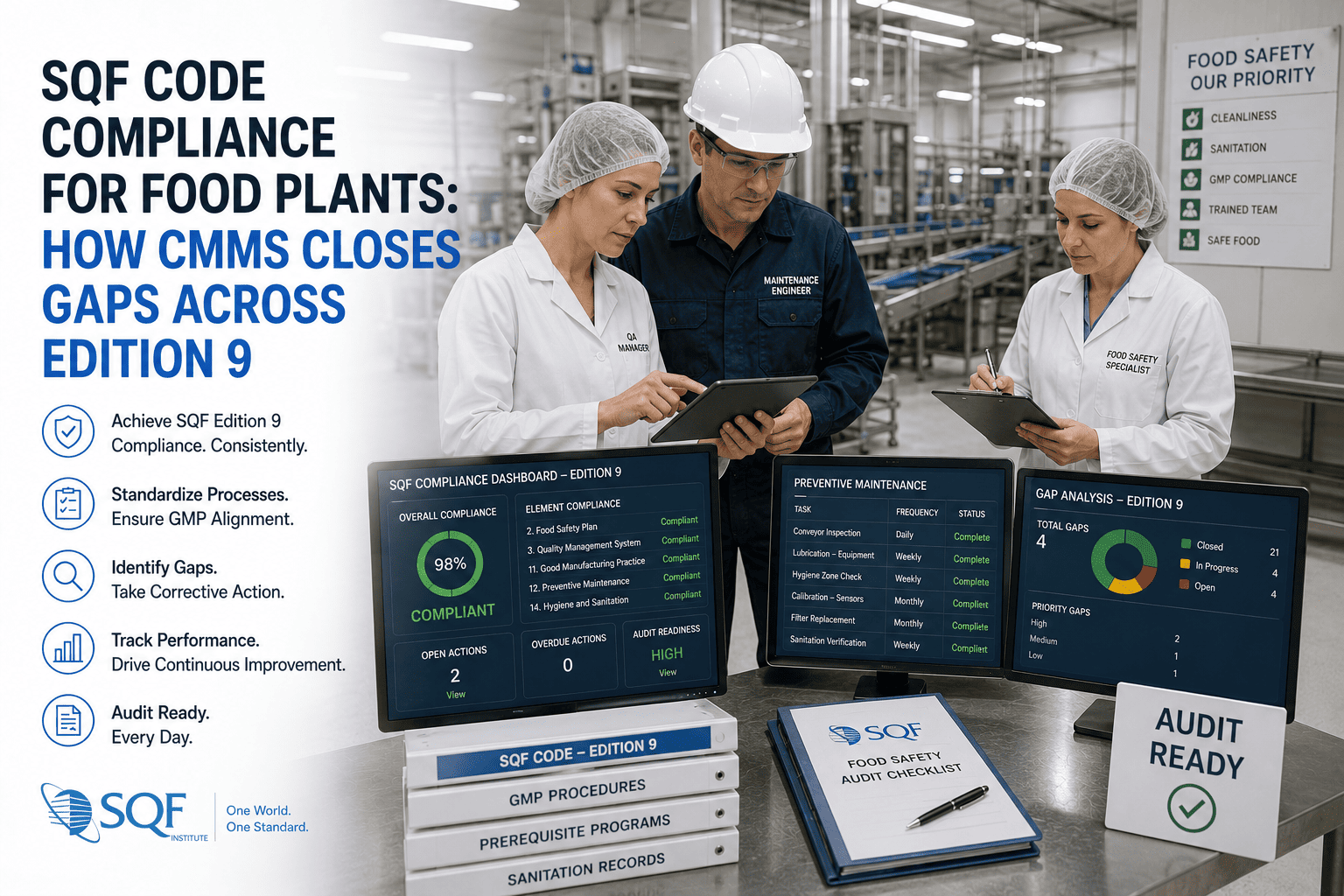
All 12 sites achieved one-click audit report generation. The first full network FDA audit cycle was completed with zero critical findings related to maintenance documentation — a first in the company's history. PM compliance reached 96% network-wide.
The CFO signed off on a multi-facility CMMS expansion 6 months into the rollout — before the full deployment was complete — based on early financial signals from the pilot plants.
$4.2M
Annual maintenance cost savings (30% reduction)
$1.5M
Freed from excess spare parts inventory reduction
$800K
Saved in unplanned downtime reduction across all sites
11x
Return on Oxmaint investment in year one
Every week of delay in standardizing a fragmented network is a week of compounding cost variance, compliance risk, and unrecoverable audit exposure. Start a free trial and have your first multi-site dashboard live within 30 days.
Frequently Asked Questions
How long does it take to deploy CMMS across multiple food manufacturing plants?
With a phased rollout approach, most multi-site food manufacturers complete full network deployment in 12–18 months. Pilot plants typically go live in 6–8 weeks. Oxmaint's pre-built food industry PM templates accelerate the asset library setup significantly. Book a call to review a deployment timeline for your network.
Can different plants use customized PM procedures while sharing a central system?
Yes. Oxmaint's multi-site architecture supports global PM templates that can be locally adapted for equipment variations, local regulations, or site-specific procedures — without fragmenting the central compliance and reporting layer. Corporate sees network-level KPIs; plant managers see their own site dashboards.
What is the typical maintenance cost reduction from standardizing across multiple food plants?
Based on industry benchmarks and Oxmaint customer data, multi-site standardization typically delivers 20–35% total maintenance cost reduction. The primary drivers are: elimination of cost variance between sites, consolidated spare parts inventory, and reduced emergency repair frequency from improved PM compliance. Sign up to benchmark your current network costs.
How does Oxmaint help with FDA and SQF audit readiness across multiple sites?
Oxmaint generates one-click audit reports for each site, including PM completion records, corrective action logs, equipment calibration history, and work order documentation — all formatted for FDA 21 CFR Part 117, FSMA, and SQF requirements. The company in this case study reduced per-site audit prep from 3–6 weeks to a single day.
One Platform. 12 Plants. Zero Compliance Gaps.
Every day your food manufacturing network runs on disconnected maintenance systems is a day of compounding cost variance, compliance risk, and unrecoverable audit exposure. Oxmaint gives every site a shared standard — with the local flexibility maintenance teams need and the network visibility leadership demands.