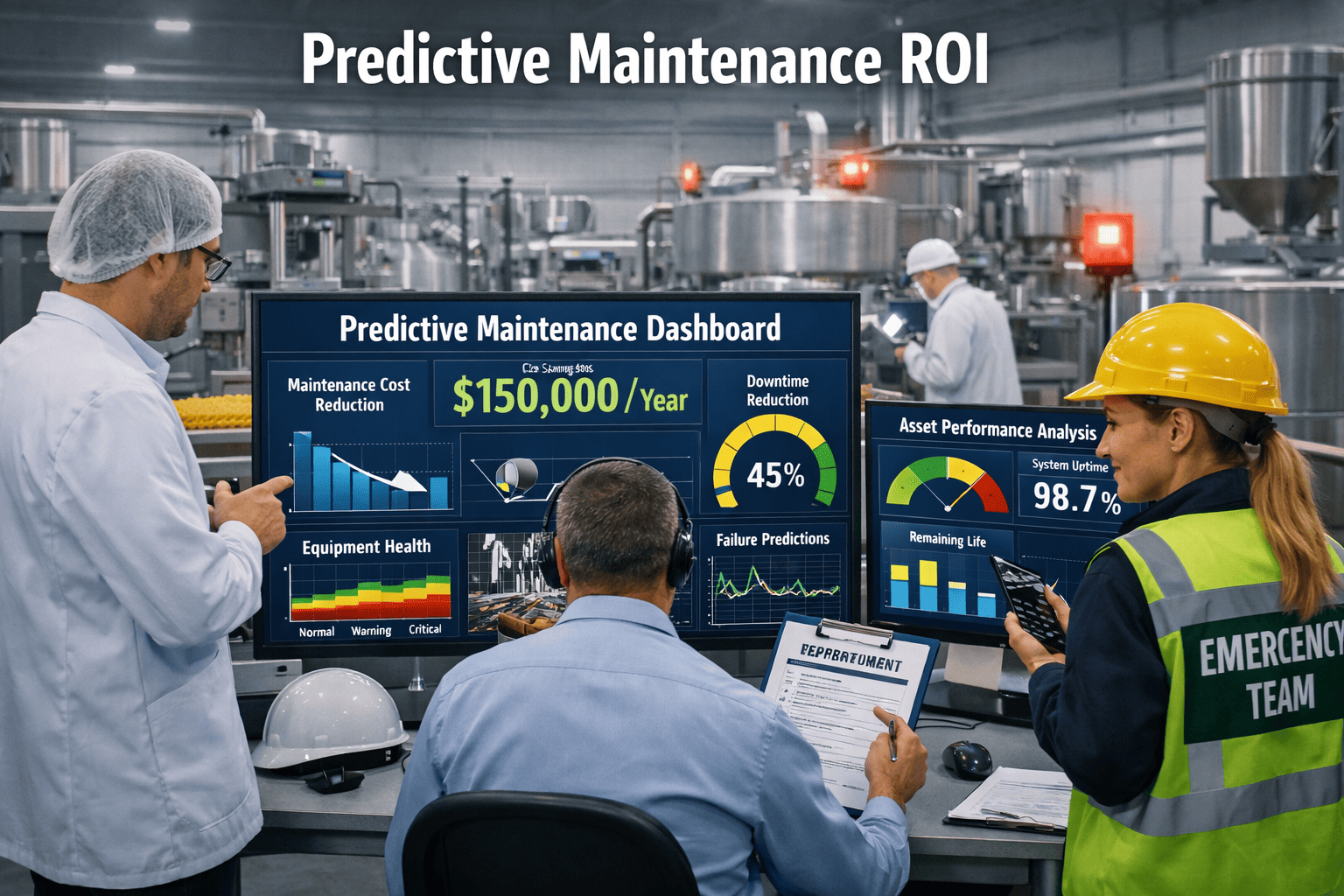
Most food plant managers believe their maintenance operation is "pretty solid." They have a PM schedule, a CMMS, and a team that responds to breakdowns. But when you apply a structured maturity framework, the same plant often scores at Level 2 out of 5 — and the gap between where they are and where they could be is costing them hundreds of thousands annually. With increasing downtime, rising repair costs, and inefficiencies in resource utilization, many managers realize too late that their reactive approach is hindering overall performance. A data-driven, proactive maintenance strategy can drive both cost savings and operational excellence. Assess your plant's maturity with Oxmaint →
Why It Matters
The Framework That Separates Reactive Plants from Reliable Ones
The Maintenance Maturity Model (MMM) gives food manufacturers a structured way to benchmark their current maintenance practices, identify exactly where they're losing money, and define a concrete roadmap to higher performance. Every food plant falls somewhere on this model — whether they know it or not.
Without the Model
You know maintenance is "a problem" but you can't articulate exactly what kind of problem, why it's happening, or what to prioritize first. Every improvement feels reactive and disconnected.
With the Model
You have a precise score, a clear picture of what's holding you back at each dimension, and a prioritized roadmap that tells you the highest-leverage next steps for your specific plant.
The Five Levels
The Maintenance Maturity Model: All Five Levels Explained
Each level represents a distinct stage in how a food plant manages its assets, handles failures, and uses data. Most plants are at Level 2. World-class facilities operate at Level 4–5.
Level 1
Reactive
Run-to-Failure
Maintenance happens when something breaks. No PM schedule exists in practice. Technicians spend their shifts responding to emergencies. Downtime is unpredictable and expensive. Data exists only in memory.
Signs you're here:
Equipment failures surprise your team weekly
No formal work order system — verbal task assignments
Maintenance budget is unpredictable and always over
Reactive maintenance costs 3–5x more per repair than planned maintenance (GitNux Research)
Level 2
Preventive
Calendar-Based
A formal PM program exists. Maintenance happens on a schedule — every 30, 90, or 180 days. Equipment is serviced whether it needs it or not. Work orders are tracked, but completion rate is the only KPI that matters. Performance data is sparse.
Signs you're here:
PM schedule exists but actual completion is 60–75%
OEE tracked monthly, often manually from supervisor notes
Still experiencing unplanned breakdowns despite having a PM program
Preventive maintenance eliminates ~80% of unplanned downtime — but over-maintenance adds unnecessary labor and parts costs
Level 3
Condition-Based
Data-Driven Triggers
Maintenance is triggered by actual equipment condition, not just a calendar. Basic sensors and inspection routines tell technicians when to act. Work orders are tracked digitally. OEE is measured in real time on critical lines. Beginning to benchmark asset performance.
Signs you're here:
IoT sensors on key assets — compressors, motors, refrigeration
OEE tracked per line per shift with digital tools
Work order backlog actively managed; CMMS used daily
Plants at Level 3 typically see 20–30% reduction in unplanned downtime versus Level 1–2 operations
Level 4
Predictive
AI-Driven Foresight
AI and machine learning analyze sensor data to predict failures before they happen — often 2–6 weeks in advance. Maintenance is scheduled proactively, parts are pre-ordered, and technicians execute planned repairs. Failure patterns are analyzed and eliminated. OEE averages 80–88%.
Signs you're here:
AI failure predictions received 2–6 weeks before actual failure
Maintenance cost per unit of output declining year-over-year
Compliance documentation auto-generated; audits take hours, not days
Predictive maintenance delivers up to 50% reduction in maintenance labor and MRO costs (Deloitte, 2025)
Level 5
Prescriptive
Self-Optimizing
The system doesn't just predict failures — it recommends the optimal maintenance action, identifies the best time window to minimize production impact, and automatically dispatches work orders. Maintenance, production, and procurement are fully integrated. The plant essentially manages itself.
Signs you're here:
Automated work order generation based on AI recommendations
Maintenance windows integrated with production scheduling
OEE consistently above 88%; unplanned downtime near zero
World-class performance: Fortune 500 plants estimate saving $233B annually at full condition monitoring adoption
Self-Assessment
Quick Scorecard: Where Does Your Plant Stand?
Rate your plant honestly across these six dimensions. Your lowest scores reveal your true maturity level — and where to focus first.
Work Order Management
Verbal, no system
Paper or basic software
Digital CMMS, tracked
Auto-generated, AI-prioritized
Failure Response
Always reactive
Mostly planned PM
Condition-triggered
Predicted weeks in advance
OEE Measurement
Not tracked
Monthly, manual
Real-time per line
Cross-plant, automated
Asset Data
Lives in technicians' heads
Spreadsheets & binders
CMMS asset registry
Live digital twin baseline
Compliance Records
Paper, incomplete
Paper or manual logs
Digital, organized
Auto-generated, audit-ready
Maintenance Culture
Fire-fighting mentality
Schedule compliance focus
Reliability awareness
Continuous improvement mindset
Most columns where you answered "Level 1" or "Level 2" = your actual maturity level, regardless of what your PM software says.
The Business Case
The Real Cost of Not Advancing Your Maturity Level
Every level you stay below your potential is a measurable financial gap. Here's what the data says about the cost difference between maturity stages.
Level 1 → 2 Gap
3–5x
higher cost per repair when reactive vs. preventive. Emergency labor, expedited parts, and secondary damage compound every unplanned failure.
Level 2 → 3 Gap
30%
of PM labor is spent on maintenance that wasn't actually needed. Condition-based triggering eliminates this waste while catching real degradation sooner.
Level 3 → 4 Gap
50%
reduction in maintenance costs possible moving from preventive to predictive, per Deloitte 2025. OEE lifts from 65–72% toward 80–88% range.
Level 4 → 5 Potential
$233B
estimated annual savings across Fortune 500 companies at full predictive and prescriptive maintenance adoption. The opportunity is real and measurable.
The Oxmaint Path
How Oxmaint Moves You from Your Current Level to the Next — Fast
Oxmaint is built to meet food manufacturers at their current maturity level and accelerate their journey upward — without requiring a full infrastructure overhaul or years of implementation time.
From Level 1–2
Digital Foundation in Days
Deploy digital work orders, a structured PM schedule, and a centralized asset registry. Replace paper logs and verbal task assignments with a mobile-first CMMS that your team actually uses. Oxmaint's onboarding is designed for plants that are starting from scratch — not for IT departments.
Typical result: 80% reduction in emergency repairs within 90 days
→
To Level 3–4
Condition Monitoring and AI Predictions
IoT sensors connect to Oxmaint's AI layer, which builds asset performance baselines and begins generating predictive failure alerts — typically 2–6 weeks before actual failure. OEE tracking goes live per line, per shift, automatically. Compliance records generate themselves.
Typical result: OEE lifts to 80–88%; unplanned stops drop by 70%
→
Toward Level 5
Prescriptive Intelligence & Enterprise Integration
Oxmaint's advanced workflow automation integrates maintenance windows with production scheduling. Best-practice workflows are pushed across facilities. AI recommendations translate directly into optimized maintenance actions — moving toward the self-optimizing plant that defines Level 5 maturity.
Typical result: Maintenance becomes a measurable profit driver, not just a cost center
Free Maturity Assessment
Find Out Your Plant's Exact Maturity Level in 10 Minutes
Oxmaint's free assessment scores your plant across all six maturity dimensions and gives you a personalized roadmap showing the highest-leverage improvements for your specific situation.
Questions About the Maturity Model and Your Plant
Real questions from plant managers and operations directors evaluating where their facility stands.
We have a CMMS — does that automatically mean we're at Level 3?
Not necessarily. Having a CMMS is a prerequisite for Level 3, but what matters is how it's used. If your CMMS is primarily used for work order logging after the fact, with minimal PM scheduling or asset performance data, your effective maturity is still Level 2. Level 3 requires that condition-based triggers are driving maintenance decisions — not just a calendar or a supervisor's instinct. The tool enables the level; the practice defines it.
How long does it typically take to advance from Level 2 to Level 4?
With a structured implementation, most food plants can move from Level 2 to Level 3 within 60–90 days — primarily by establishing digital work orders, an asset registry, and real-time OEE tracking. Moving to Level 4 (predictive) typically takes 3–6 months as AI models build on sensor data to generate accurate failure predictions. The compounding nature of AI learning means the value accelerates significantly after the first 90 days. Oxmaint's phased implementation is designed to surface ROI at every stage, not just at the end.
Does our plant need to replace existing equipment to adopt predictive maintenance?
No. Predictive maintenance works by adding sensors to existing equipment — not by replacing it. Retrofit IoT sensors can be mounted externally on most food manufacturing assets without modifications. The sensor data feeds into Oxmaint's AI platform, which then builds performance baselines and generates predictions. Your existing equipment becomes "smart" without capital investment in new machinery. This is precisely why predictive maintenance delivers such high ROI: the cost is in software and sensors, not in capital equipment.
How does this model apply specifically to food manufacturing versus other industries?
Food manufacturing adds layers of complexity that other industries don't face: FSMA and HACCP compliance requirements mean maintenance records are legal documents, not just operational logs. Sanitation cycles, temperature-controlled environments, and 24/7 production schedules mean equipment degrades differently and faster than in general manufacturing. The Maintenance Maturity Model in a food context includes compliance record generation, food safety-linked asset monitoring, and sanitation-compatible sensor specifications as part of what distinguishes each level — not just OEE and uptime metrics.
Our team is small. Is Level 4 maturity realistic for a facility without a large maintenance department?
Yes — and in some ways it's more achievable for smaller teams. A large reactive maintenance team is expensive and always overwhelmed. A small predictive maintenance team with the right tools is often more effective. Oxmaint is specifically designed to give small maintenance teams the leverage of AI-driven prioritization — so your team focuses only on what actually needs attention, rather than splitting time between PM tasks and emergency response. Plants with 3–5 person maintenance teams routinely achieve Level 4 maturity with the right platform in place.
What's the single most important step a Level 2 plant can take right now?
Establish an asset performance baseline. Before you can detect deterioration, you need to know what "normal" looks like for your critical equipment. This means documenting expected run time, temperature ranges, vibration signatures, pressure levels, and cycle durations for your highest-impact assets — mixers, compressors, refrigeration units, packaging lines. Once you have a baseline, every deviation becomes visible and actionable. This single step is the foundation of Level 3 and the prerequisite for Level 4. Oxmaint's asset registry and onboarding process is specifically designed to help plants complete this baseline quickly.
Maintenance Maturity Assessment for Food Plants
Your Plant's Maturity Level Determines Your Profitability
The gap between Level 2 and Level 4 isn't a technology gap — it's a visibility gap. Oxmaint gives food manufacturers the tools, data, and AI intelligence to move up the maturity curve faster than any other platform in the industry.
2 weeksto live digital work orders
90 daysto Level 3 maturity
6 monthsto predictive AI alerts
50%typical reduction in maintenance costs