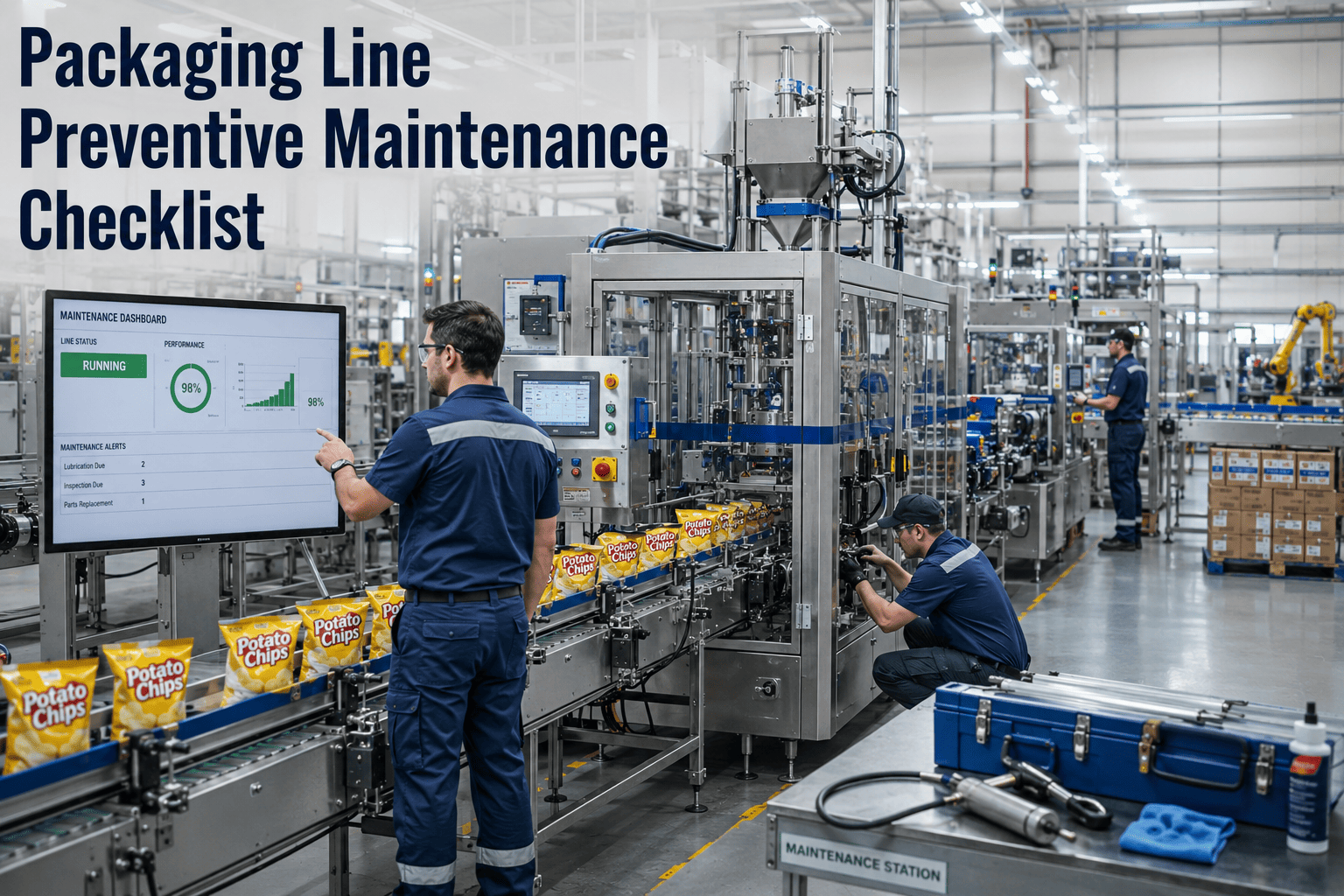
If you're running a frozen food packaging operation and your OEE hovers around 55-65%, you're not alone—but you're also leaving significant money on the table. Industry benchmarks show that top-quartile food manufacturers achieve 78% OEE, while "best of the best" performers reach 93%. The gap between average and excellent represents hundreds of thousands in annual savings. This guide breaks down exactly how reliability engineering principles apply to frozen food packaging lines, what makes these environments uniquely challenging, and the specific strategies that move facilities from reactive firefighting to predictive excellence.
What This Guide Covers
This isn't a sales pitch—it's a practical framework for improving packaging line reliability in frozen food environments. You'll learn the specific failure modes that plague VFFS baggers, case packers, and sealing systems in cold environments, the PM frequencies that actually work, and how to build a condition monitoring program that predicts failures before they shut you down.
Understanding OEE Benchmarks in Food Packaging
Before diving into tactics, let's establish what "good" actually looks like. According to industry benchmarking data from studies covering 700+ global manufacturing operations, here's where food and beverage facilities typically fall:
The gap between 60% and 85% OEE on a packaging line running 20 hours/day represents roughly 5 additional hours of productive time daily. For a line producing $2,000/hour in packaged product, that's $10,000/day or over $2.5 million annually in recovered capacity. This is why reliability engineering matters—it's not about maintenance for maintenance's sake, it's about capturing value that's currently being lost. Calculate your potential savings—try Oxmaint free.
Approximately 75% of food manufacturers actively measure OEE, compared to only 50% in other industries like pharmaceuticals. This higher adoption reflects the competitive pressure and thin margins in food production. If you're not measuring, you're already behind. Start tracking your OEE accurately today—it's the foundation for any reliability improvement program.
Why Frozen Food Packaging Is Uniquely Challenging
Generic maintenance approaches developed for ambient manufacturing environments consistently underperform in frozen food facilities. Understanding these specific challenges is essential for developing effective reliability strategies. See how Oxmaint handles food manufacturing compliance.
Temperature Differential Stress
Equipment operates across extreme ranges—from -18°C (-0.4°F) freezer zones to 177°C (350°F) hot melt adhesive systems. This 195°C differential creates constant thermal cycling that accelerates component wear by 35-50% compared to ambient manufacturing. Bearings, seals, electrical connections, and pneumatic components all experience accelerated degradation.
Impact: Component lifespan 30-50% shorter than OEM predictions based on ambient conditions. See how predictive alerts prevent these failures.
Moisture and Condensation
When cold product meets warmer air, condensation forms continuously. This moisture infiltrates electrical cabinets, corrodes bearings, degrades lubricants, and creates food safety risks. Standard IP54-rated equipment may not provide adequate protection—NEMA 4X ratings are often necessary for controls in washdown environments.
Impact: Electrical failures 2-3x more common than dry environments
Film Material Behavior
Packaging films behave differently at cold temperatures. The coefficient of friction (COF) changes—too high causes poor film feeding and jams, too low causes slippage and misalignment. The sealing window narrows, requiring tighter temperature control. Cold film is also more brittle and prone to tearing.
Impact: Seal failures and film waste 40-60% higher without proper adjustment
Sanitation Requirements
Frozen food facilities face rigorous cleaning protocols—high-pressure washdowns, chemical sanitizers, and strict FDA/SQF/BRC requirements. Equipment must withstand daily abuse while maintaining calibration and function. Maintenance documentation becomes audit evidence.
Impact: Equipment exposed to more aggressive cleaning than most industrial environments
VFFS Bagger Reliability: The Packaging Line Bottleneck
Vertical Form Fill Seal (VFFS) machines are often the constraint in frozen food packaging lines. When the bagmaker stops, everything upstream backs up. Understanding common failure modes and implementing targeted preventive maintenance is essential for maintaining throughput.
Common VFFS Failure Modes in Frozen Environments
Seal Quality Failures
Root Causes:
- Temperature deviation in seal bars (±5°F can cause failures)
- Contamination on sealing surfaces (product dust, moisture)
- Film tension inconsistency from cold-stiffened material
- Worn or damaged sealing jaws
PM Focus: Daily seal bar inspection, weekly jaw alignment check, continuous temperature monitoring
Film Tracking Issues
Root Causes:
- COF changes due to temperature (film becomes "grabby" when cold)
- Static buildup in dry cold environments
- Worn or contaminated forming collar
- Incorrect tension settings for current conditions
PM Focus: Weekly forming collar cleaning, tension adjustment protocols, static elimination maintenance
Product Jams
Root Causes:
- Product bridging in hopper (frozen clumps)
- Timing mismatch between weigher and bagger
- Damaged or misaligned product chute
- Speed exceeding product flow capability
PM Focus: Daily hopper inspection, weekly timing verification, monthly chute alignment
Drive System Failures
Root Causes:
- Belt wear accelerated by cold (rubber hardens)
- Bearing failures from moisture infiltration
- Motor overheating from increased load
- Encoder drift affecting positioning accuracy
PM Focus: Monthly belt inspection, quarterly bearing assessment, continuous motor temperature monitoring
VFFS Preventive Maintenance Schedule
The following PM frequencies are based on typical frozen food packaging operations running 16-20 hours/day. Adjust based on your specific equipment, product characteristics, and operating conditions. Try our PM scheduling tools free to build and track these schedules automatically.
Pro Tip: Temperature Monitoring
Install continuous temperature monitoring on seal bars with alerting capabilities. A drift of just 5°F can increase seal failures by 200-300%. Start monitoring your equipment conditions today—catch drift before it causes quality issues and automatically generate corrective work orders.
Strengthen Food & Beverage Manufacturing Service Quality Through Condition Monitoring
The shift from time-based to condition-based maintenance is where significant OEE gains are captured. Rather than replacing components on a fixed schedule (which often means replacing them too early or too late), condition monitoring allows you to intervene at the optimal moment—after degradation begins but before failure occurs.
Key Monitoring Points for Frozen Food Packaging Equipment
| Equipment | Parameter | Monitoring Method | Alert Threshold |
|---|---|---|---|
| VFFS Seal Bars | Temperature | Continuous thermocouple | ±5°F from setpoint |
| VFFS Main Drive | Vibration | Accelerometer sensor | >2x baseline amplitude |
| Case Packer Servos | Current draw | Amp clamp/monitoring | >15% above baseline |
| Hot Melt System | Tank temperature | Integrated sensor + CMMS | ±10°F from setpoint |
| Conveyor Motors | Temperature | IR thermometer/sensor | >20°F above baseline |
| Multihead Weigher | Load cell drift | Calibration check | >0.5% deviation |
| Compressors | Pressure differential | Gauge monitoring | >10% above normal |
Swipe to see more →
The key to effective condition monitoring is establishing accurate baselines when equipment is known to be in good condition, then tracking deviation over time. This requires software that can store historical data, display trends, and alert when thresholds are exceeded. See how Oxmaint tracks asset conditions in real-time.
Aligning Teams and Vendors — A Food & Beverage Manufacturing Architecture with AI
Technology alone doesn't improve reliability—it requires alignment across your entire operation. The most successful frozen food facilities create integrated systems where maintenance, production, quality, and vendors all work from shared data and common goals.
Maintenance Team Role
Shift from reactive responders to reliability engineers. Use data to prioritize work, predict failures, and continuously improve PM programs. Daily huddles should focus on leading indicators (condition alerts, PM compliance) not just lagging indicators (yesterday's breakdowns).
Production Operator Role
Operators are the first line of equipment monitoring. Enable them to report issues instantly via mobile app—try it free today. Their observations—unusual sounds, smells, behaviors—provide early warning that sensors may miss.
Quality Department Integration
Connect maintenance and quality data to reveal correlations. When seal failures spike, is it equipment or film? When weights drift, is it the weigher or the product? Book a demo to see integrated data analysis—eliminate finger-pointing and accelerate root cause analysis.
Vendor Collaboration
Give OEMs and service providers visibility into equipment condition before they arrive. They show up prepared with the right parts. Document all service for warranty tracking. Book a demo to see vendor management in action.
Ready to Implement These Strategies?
The framework above requires systematic execution—asset tracking, PM scheduling, condition monitoring, and data integration. A purpose-built CMMS makes this manageable even for small maintenance teams.
Hot Melt Adhesive System Reliability
Carton sealing failures—"pop-opens"—are a major source of quality rejects and retailer complaints in frozen food. Hot melt systems are particularly sensitive to temperature control and maintenance consistency. Track adhesive system maintenance automatically—start free.
Critical Failure Modes
Char Buildup
Adhesive that sits too long at high temperature carbonizes, creating char that clogs nozzles and causes inconsistent application. More common when lines run intermittently.
Prevention: Implement temperature setback during extended stops. Clean nozzles weekly. Monitor adhesive consumption rate vs. baseline.
Temperature Drift
Hot melt viscosity is highly temperature-dependent. Even 10°F drift changes flow characteristics, causing either insufficient coverage or excessive squeeze-out.
Prevention: Continuous tank temperature monitoring. Calibrate controllers monthly. Document optimal settings for each adhesive type.
Nozzle Wear
Applicator nozzles wear over time, changing spray patterns and causing inconsistent coverage. Often unnoticed until pop-opens spike.
Prevention: Track nozzle runtime. Replace on fixed schedule (typically 500-1000 hours). Inspect pattern during PM.
Case Packer and End-of-Line Reliability
Case packers, palletizers, and end-of-line equipment often receive less maintenance attention than primary packaging, but failures here can shut down entire lines just as effectively. See how to prioritize end-of-line PM—book a demo.
Case Packer PM Priorities
Vacuum System
Pick-and-place case packers rely on vacuum for product handling. Leaks, worn suction cups, or pump degradation reduce grip strength, causing drops and jams.
PM Schedule: Weekly vacuum pressure check. Monthly suction cup inspection. Quarterly pump service.
Servo Motors
Servo-driven movements require precise calibration. Cold environments stress motors and can cause encoder drift affecting positioning accuracy.
PM Schedule: Monthly position verification. Quarterly motor temperature trending. Annual encoder calibration.
Timing and Synchronization
Case packers must synchronize with upstream baggers. Timing drift causes jams, miscounts, and case damage. Often the root cause of "random" stoppages.
PM Schedule: Weekly timing verification. Monthly full cycle audit. Quarterly complete synchronization check.
Compliance Documentation: Maintenance as Audit Evidence
In food manufacturing, maintenance documentation serves dual purposes: operational improvement and regulatory compliance. SQF, BRC, and FDA auditors increasingly examine maintenance records as evidence of food safety commitment. Start building audit-ready documentation today.
Equipment Calibration Records
Temperature controllers, scales, metal detectors—all require documented calibration with traceability to standards. Paper systems make this tedious; try digital calibration tracking free and automate your compliance records.
PM Completion Evidence
Auditors want to see not just that PMs were scheduled, but that they were completed on time with proper procedures followed. Electronic timestamps and e-signatures provide irrefutable evidence.
Corrective Action Documentation
When equipment issues are identified, auditors expect documented corrective actions with root cause analysis. Your CMMS should link work orders to assets, track resolution, and store supporting photos.
OEM Manual Access
Auditors may ask technicians to demonstrate they have access to manufacturer procedures. Schedule a demo to see how we organize equipment documentation and keep manuals linked to every asset.
Facilities with mature digital maintenance systems typically reduce audit findings by 60-80% compared to paper-based operations. More importantly, they spend 75% less time preparing for audits—the documentation exists automatically from daily operations. Get audit-ready in 30 days—start free.
Building Your Reliability Improvement Roadmap
Improving packaging line reliability is a journey, not a single project. The following roadmap provides a realistic timeline for facilities transitioning from reactive to predictive maintenance.
Foundation
- Implement CMMS and establish asset registry
- Deploy mobile work orders and digital PM checklists
- Begin capturing failure data and downtime reasons
- Train technicians on new systems and procedures
Expected Outcome: 15-25% reduction in repeat failures, baseline data established. Start building your foundation today.
Preventive Excellence
- Develop equipment-specific PM schedules based on failure data
- Achieve 80%+ PM compliance through scheduling optimization
- Integrate production schedules to eliminate conflicts
- Begin tracking OEE components systematically
Expected Outcome: PM compliance 80%+, reactive work drops below 40%
Predictive Capabilities
- Install condition monitoring on critical assets
- Establish baselines and alert thresholds
- Integrate sensor data with work order generation
- Begin predictive analytics and trend analysis
Expected Outcome: OEE improvement of 10-20 points, emergency work below 20%
Continuous Optimization
- Refine predictive models based on accumulated data
- Extend reliability practices to secondary equipment
- Benchmark against industry and drive toward world-class
- Scale successful practices to additional facilities
Expected Outcome: Sustained 75%+ OEE and industry leadership position
Expert Perspective
Industry Insight
"The facilities hitting 85%+ OEE all have one thing in common: they invested in proper maintenance systems before they thought they needed them. The ones stuck below 65% are still 'too busy fighting fires' to implement the systems that would prevent those fires. It's a self-fulfilling prophecy."
"In frozen food specifically, the environmental challenges mean generic maintenance approaches fail. You need PM frequencies and procedures specifically designed for thermal cycling, moisture exposure, and the unique failure modes of cold-environment equipment."
Conclusion: Start With the Fundamentals
Packaging line reliability in frozen food environments isn't about exotic technology or massive capital investment. It's about executing the fundamentals consistently: accurate asset tracking, disciplined PM completion, systematic data capture, and continuous improvement based on evidence rather than intuition. The facilities achieving world-class performance do the same things as everyone else—they just do them every day, without exception, with systems that make excellence easier than mediocrity.
The first step is visibility: you can't improve what you can't measure. Start your free trial today to establish your baseline, then systematically address the gaps between your current state and where you need to be.
Put These Principles Into Practice
The strategies in this guide require systematic execution. Oxmaint CMMS provides the foundation—asset management, PM scheduling, mobile inspections, condition monitoring integration, and compliance documentation—all designed for food manufacturing environments.
No credit card required. See results in your first 30 days.
Want to discuss your specific situation? Schedule a consultation with a food manufacturing specialist.
Frequently Asked Questions
What OEE should we realistically target for frozen food packaging?
For facilities currently below 65%, targeting 75-80% within 12-18 months is realistic with disciplined reliability practices. World-class (85%+) typically requires 2-3 years of sustained improvement and investment in predictive capabilities. The key is consistent progress, not overnight transformation.
How often should VFFS machines be serviced in frozen food environments?
Shift-level inspections daily, thorough cleaning and jaw inspection at end of each production day, weekly lubrication and tension checks, monthly mechanical inspections per OEM guidelines, and quarterly bearing/belt assessments. Cold environments typically require 20-30% more frequent service than ambient operations.
What's the ROI timeline for implementing a CMMS?
Most food manufacturing facilities see positive ROI within 6-12 months through reduced emergency repairs, improved PM compliance, and better parts management. Quick wins in the first 30-60 days typically include reduced repeat failures (15-25% improvement) and faster work order completion.
Do IoT sensors work reliably in freezer environments?
Modern industrial IoT sensors are rated for -40°F to 185°F with IP67+ protection. Battery-powered wireless sensors typically achieve 3-5 year life even in continuous cold exposure. The key is selecting sensors specifically rated for harsh environments—consumer or light-industrial sensors will fail quickly.
How does maintenance documentation help with SQF/BRC audits?
Digital CMMS provides timestamped, e-signed records of all maintenance activities, calibration events, and corrective actions. Auditors can verify PM completion, access equipment history instantly, and confirm procedures match documentation. Facilities with mature digital systems typically see 60-80% fewer audit findings related to maintenance.